
Mu’awiyah ibn Abu Sufyan (Radiyallahu ‘anh) relates: I heard the Messenger of Allah (Subhanahu wa Ta’ala) say: “It is the day of ‘Ashura. Allah (Subhanahu wa Ta’ala) has not made fasting obligatory for you. But I am fasting. He who likes to observe fast among you should do so, and he who likes not to observe it (does not have to) observe it.” [Sahih Muslim]

Abu Qatada (Radiyallahu ‘anh) relates that the Holy Prophet (Sallallahu ‘alayhi wa Sallam) said that the fast on the 10th of Muharram atones for the sins of the preceding year. [Sahih Muslim]

Abu Huraira (Radiyallahu ‘anh) reports that the Holy Prophet (Sallallahu ‘alayhi wa Sallam) said that after Ramadan, the fasts of Muharram have the greatest excellence. [Sahih Muslim]

Alhamdulillah, Allah (Subhanahu wa Ta’ala) has blessed us to see another year. The first month of this year is Muharram. In this month is an excellent day—the day of ‘Ashura—which falls on the 10th of Muharram. The Holy Prophet (Sallallahu ‘alayhi wa Sallam) recommended that we fast on this day, by his Sunnah. He also indicated how we should observe the fast of ‘Ashura.

Hakam ibn Al-Arat (Radiyallahu ‘anh) relates: I went to Ibn Abbas (Radiyallahu ‘anh)… I said to him: Tell me about fasting on ‘Ashura. He said, “When you seen the new moon of Muharram count the (days) and (begin to) observe fast on the 9th.” I said to him: “Is it how the Holy Messenger of Allah (Sallallahu ‘alayhi wa Sallam) observed the fast?” He said, “Yes.” [Sahih Muslim]

Hazrat Ibn Abbas (Radiyallahu ‘anh) relates that when the Holy Prophet (Sallallahu ‘alayhi wa Sallam) said: “If I survive till next year, I will definitely observe fast on the 9th of Muharram (as well).” [Sahih Muslim]

(Note: What the Holy Prophet (Sallallahu ‘alayhi wa Sallam) meant was that he would also fast on the 9th as well as the 10th to which he was accustomed. We also should try fasting on the 9th and the 10th of Muharram.)


Hazrat Ibn Abbas (Radiyallahu ‘anh) reports that the Holy Prophet (Sallallahu ‘alayhi wa Sallam) arrived in Madinah and found the Jews observing fast on the day of ‘Ashura… They said: “It is the day of great (significance) when Allah delivered Hazrat Musa (‘Alaihis-Salaam) and his people and drowned Pharoah and his people, and Sayyidina Musa (‘Alaihis-Salaam) observed fast out of gratitude. And we also observe it.” The Holy Messenger of Allah (Sallallahu ‘alayhi wa Sallam) responded: “We have more right, and we have closer connection with Sayyidina Musa (‘Alaihis-Salaam) than you have”; so Allah’s Messenger (Sallallahu ‘alayhi wa Sallam) observed fast (on the day of ‘Ashura) and gave us orders to observe it. [Sahih Bukhari and Muslim]

‘Ashura is a day of great historical significance. On this day: Allah (Subhanahu wa Ta’ala) accepted the repentance of Sayyidina Adam (‘Alaihis-Salaam) after his exile from Paradise; Allah (Subhanahu wa Ta’ala) saved Sayyidina Nuh (‘Alaihis-Salaam) and his companions in the ark; Allah extinguished the fire in which Sayyidina Ibrahim (‘Alaihis-Salaam) was thrown by Nimrod; And Allah (Subhanahu wa Ta’ala) spoke directly to Sayyidina Musa (‘Alaihis-Salaam) and gave him the Commandments. On this same 10th of Muharram, Sayyidina Ayyub (‘Alaihis-Salaam) was restored to health (from leprosy); Sayyidina Yusuf (‘Alaihis-Salaam) was reunited with his father Ya’qub (‘Alaihis-Salaam); Sayyidina Yunus (‘Alaihis-Salaam) was taken out from the belly of the fish; and the sea was divided as the nation of israel was delivered from captivity and Pharoah’s army was destroyed. ‘Ashura is also the day when Sayyidina Dawud (‘Alaihis-Salaam) was forgiven; the kingdom of Sulaiman (‘Alaihis-Salaam) was restored; Sayyidina Isa (‘Alaihis-Salaam) was raised to Jannah and Sayyidina al-Husayn (Radiyallahu ‘anh) (the Holy Prophet’s, Sallallahu ‘alayhi wa Sallam, grandson) achieved the honor of Martyrdom.

Worship Allah (Subhanahu wa Ta’ala) as much as you can on ‘Ashura. Whoever fasts on this day is like one who fasts all his life. Whoever clothes a naked person Allah (Subhanahu wa Ta’ala) will release him from a painful punishment. He who visits a sick person, Allah (Subhanahu wa Ta’ala) will grant him a reward that will not be decreased. Whoever places his hand on an orphan’s head, or feeds a hungry person or gives water to a thirsty man, Allah will feed him a feast from Paradise and will quench his thirst with Salsabil (a wine that does not intoxicate). And who ever takes a Ghusl on this day will enjoy excellent health and freedom from sickness and indolence. Whoever provides generously for his family on this day, Allah (Subhanahu wa Ta’ala) will be generous to him throughout this year. And whoever applies Kuhl to his eyes will never suffer from eye-sore again, inSha’Allah al-Aziz.

O’ Allah! Bless us to perform good deeds and gain their reward on ‘Ashura. Make the new year one of unity, cooperation and success for Muslims in this city and around the world. Ameen.


1. These are mentioned as what scholars have determined as the specialties of that day in Ghunya li-Talibi Tariq al-Haqq, Sayyidina Abdul Qadir al-Jilani.

2. These specialties are  mentioned in Ghunya li-Talibi Tariq al-Haqq, Sayyidina Abdul Qadir al-Jilani.
اسلامی سال کا پہلا مہینہ محرم الحرام ہے ۔ محرم کو محرم اس لئے کہا جاتا ہے کہ اس ماہ میں جنگ و قتال حرام ہے۔ یہ اللہ تعالیٰ کا مہینہ ہے اور اس مہینہ میں عاشورہ کا دن بہت معظم ہے یعنی دسویں محرم کا دن ۔ (فضائل الایام والشہور صفحہ ٢٥١)
محرم کی پہلی رات کے نوافل
ماہِ محرم کی پہلی شب میں چھ رکعات تین سلام کے ساتھ ادا کرے ۔ اس کی ہر رکعت میں سورئہ فاتحہ کے بعد گیارہ مرتبہ سورۃ اخلاص اور تین بار سُبْحَانَ الْمَلِکُ الْقُدُّوْسٌ پڑھے۔ اس کا بہت زیادہ ثواب ہے۔ پھرمحرم کے مہینے کی ہر شب سوبار پڑھے
لَا اِلٰہَ اِلَّا اللّٰہُ وَحْدَہ، لَا شَرِیْکَ لَہ، ۔ لَہ، الْمُلْکُ وَلَہ، الْحَمْدُ یُحْیِیْ وَیُمِیْتُ وَہُوَ حَیٌّ الَّا یَمُوْتُ اَبْدًا ذُوالْجَلَالِ وَالْاِکْرَامِ اَللّٰہُمَ لَا مَانِعُ لِمَا اَعْطَیْتَ وَلَا مُعْطِیَ لِمَا مَنَعْتَ وَلَا یَنْفَعُ ذُالْجَدِّ مِنْکَ الْجَدُ
(ترجمہ) سوائے اللہ کے کوئی معبود نہیں ہے ۔ اس کا کوئی شریک نہیں ہے۔ ملک اُسی کا ہے، تعریف اُسی کے لیے ہے۔ زندہ کرتا ہے اور مارتا ہے۔ وہ زندہ ہے اور نہیں مرے گا۔ صاحبِ جلا ل اور اکرام ہے ۔ اے اللہ اس چیز کا جو تونے دی کوئی مانع نہیں ہے اور جس چیز کو تونے روک دیا اسے کوئی نہیں دے سکتا اور صاحب دولت کو تجھ سے بے نیاز ہونا کوئی نفع نہیں دیتا۔ (لطائف اشرفی، صفحہ ٣٣٢)
تمام سال کی حفاظت اور برکت
یکم محرم شریف کے دن دو رکعت نماز نفل پڑھے کہ ہر رکعت میں الحمد شریف کے بعد تین بار سورۃ الاخلاص پڑھے۔ سلام کے بعد ہاتھ اٹھا کر یہ دعا پڑھے
اَللّٰہُمَّ اَنْتَ اللّٰہُ الْاَبَدُ الْقَدِیْمُ ہٰذِہ سَنَہٌ جَدِیْدَۃٌ اَسْئَلُکَ فِیْہَا الْعِصْمَۃَ مِنَ الشَّیْطٰنِ الرَّجِیْمِ وَالْاَمَانَ مِنَ السُّلْطَانِ الْجَابِرِ وَمِنْ شَرِّ کُلِّ ذِیْ شَرٍّ وَّمِنَ الْبَلَاءِ وَ الْاٰفَاتِ وَاَسْئَلُکَ الْعَوْنَ وَالْعَدْلَ عَلٰی ہٰذِہِ النَّفْسِ الْاَمَّارَۃِ بِالسُّوْءِ وَالْاِشْتِغَالِ بِمَا یُقَرِّبُنِیْ اِلَیْکَ یَا بَرُّ یَا رَءُ وْفُ یَا رَحِیْمُ یَا ذَالْجَلَالِ وَالْاِکْرَامِ۔
جو شخص اس نماز کو پڑھے گا اللہ تعالیٰ اس کے اوپر دو فرشتے مقرر فرمادے گا تاکہ وہ اس کے کاروبار میں اس کی مدد کریں۔ اور شیطان لعین کہتا ہے کہ افسوس میں اس شخص سے تمام سال ناامید ہوا۔ (فضائل الایام والشہور ، صفحہ ٢٦٨، ٢٦٩)
دعائے محرم الحرام
پہلی محرم الحرام کو جو یہ دعا پڑھے تو شیطانِ لعین سے محفوظ رہے اور سارا سال دو فرشتے اس کی حفاظت پر مقرر ہوںگے ۔ دعا یہ ہے:
اَللّٰہُمَّ اَنْتَ الْاَبَدِیُّ الْقَدِیْمُ وَہٰذِہ سَنَۃٌ جَدِیْدَۃٌ اَسْئَلُکَ فِیْہَا الْعِصْمَۃَ مِنَ الشَّیْطٰنِ وَاَوْلِیَائِہ وَالْعَوْنَ عَلٰی ہٰذِہِ النَّفْسِ الْاَمَّارَۃِ بِالسُّوْءِ وَالْاِ شْتِغَالَ بِمَا یُقَرِّ بُنِیْ اِلَیْکَ یَا کَرِیْمُ (فضائل الایام الشہور صفحہ ٢٦٧، بحوالہ نزہۃ المجالس)
یومِ عاشورہ
عاشورہ کی وجہ تسمیہ میں علما ء کا اختلاف ہے اس کی وجہ مختلف طور پر بیان کی گئی ہے ، اکثر علماء کا قول ہے کہ چونکہ یہ محرم کا دسواں دن ہوتا ہے اس لئے اس کو عاشورہ کہا گیا، بعض کا قول ہے کہ اللہ تعالیٰ نے جو بزرگیاں دنوں کے اعتبار سے امت محمدیہ کو عطا فرمائی ہیں اس میں یہ دن دسویں بزرگی ہے اسی مناسبت سے اس کو عاشورہ کہتے ہیں ۔
یوم عاشورہ کی فضیلت
حضرت ابن عباس رضی اللہ تعالیٰ عنہما سے مروی ہے کہ جب حضور نبی کریم صلی اللہ علیہ وسلم مدینہ منورہ تشریف لائے تو یہودیوں کو عاشورا کے دن روزہ رکھتے ہوئے پایا۔ ان سے اس کی وجہ پوچھی تو انہوں نے کہا : اس دن میں اللہ تعالیٰ نے حضرت موسیٰ علیہ السلام اور بنی اسرائیل کو فرعون پر غلبہ عطا کیا۔ ہم اس کی تعظیم کرتے ہوئے اس کا روزہ رکھتے ہیں ۔ حضور نبی کریم صلی اللہ علیہ وسلم نے فرمایا : ہم موسیٰ علیہ السلام سے زیادہ قریب ہیں، چنانچہ آپ نے اس کا روزہ رکھنے کا حکم دیا۔ (مکاشفۃ القلوب، صفحہ ٦٩٨ از امام محمد غزالی علیہ الرحمہ )
یومِ عاشورہ کے فضائل میں بکثرت روایات آتی ہیں ۔ اس دن حضرت آدم علیہ السلام کی توبہ قبول ہوئی، اس دن ان کی پیدائش ہوئی، اسی دن جنت میں داخل کیے گئے۔ اسی دن عرش، کرسی ، آسمان وزمین، سورج ، چاند ستارے اور جنت پیدا ہوئے۔ اسی دن حضرت ابراہیم علیہ السلام پیداہوئے، اسی دن انہیں آگ سے نجات ملی، اسی دن حضرت موسیٰ علیہ السلام اور ان کے ساتھیوں کو نجات ملی اور فرعون اور اس کے ساتھی غرق ہوئے ۔ اسی دن حضرت عیسیٰ علیہ السلام پیدا ہوئے ، اور اسی دن وہ آسمان پر اٹھالیے گئے۔ اسی دن حضرت ادریس علیہ السلام کو بلند مقام (آسمان) پراٹھالیا گیا۔ اسی دن حضرت نوح علیہ السلام کی کشتی جودی پہاڑ پر لگی۔ اسی دن حضرت یونس علیہ السلام کو مچھلی کے پیٹ سے نجات ملی ۔ اسی دن حضرت سلیمان علیہ السلام کو عظیم سلطنت عطا ہوئی ۔اسی دن حضرت یعقوب علیہ السلام کی بینائی واپس ہوئی ۔ اسی دن حضرت ایوب علیہ السلام کی تکلیف دُور ہوئی۔ اسی دن زمین پر آسمان سے پہلی بارش ہوئی۔ (مکاشفۃ القلوب ، صفحہ ٦٩٩)
نوافل برائے شبِ عاشورہ
٭ جو شخص اس رات میں چار رکعات نماز پڑھے اور ہر رکعت میں الحمد شریف کے بعد پچاس ٥٠ مرتبہ سورہئ اخلاص پڑھے تو اللہ عزوجل اس کے پچاس برس گزشتہ اور پچاس سال آئندہ کے گناہ بخش دیتا ہے۔ اور اس کے لئے ملاءِ اعلیٰ میں ایک محل تیار کرتا ہے۔
٭ اس رات دو ٢ رکعات نفل قبر کی روشنی کے واسطے پڑھے جاتے ہیں جن کی ترکیب یہ ہے کہ ہر رکعت میں الحمد شریف کے بعد تین تین مرتبہ سورہ اخلاص پڑھے۔ جو آدمی اس رات میںیہ نماز پڑھے گا تو اللہ تبارک و تعالیٰ قیامت تک ا س کی قبر روشن رکھے گا۔
عاشورے کے روزے رکھنے کی فضیلت
حضور علیہ الصلوٰۃ والسلام نے فرمایا: اگر مومن اللہ کی راہ میں روئے زمین پر مال خرچ کرے تو اسے (اس قدر) بزرگی حاصل نہ ہوگی جس قدر کوئی عاشورے کے روز روزہ رکھے۔ اس کے لیے جنت کے آٹھ دروازے کھل جائیں ، وہ جس دروازے سے داخل ہونا پسند کرے گا داخل ہوگا۔ (لطائف اشرفی ، صفحہ ٣٣٦)
حضور علیہ الصلوٰۃ والسلام نے فرمایا: جو شخص عاشورے کے دن روزہ رکھے پس شب و روز کی ساعتوں میں ہر ساعت اللہ تعالیٰ اُن ساعتوں کی ہر ساعت کے بدلے اس پر سات لاکھ فرشتے نازل فرمائے گا جو قیامت تک دعا اور استغفار کریں گے اور بے شک اللہ تعالیٰ کی آٹھ جنتیں ہیں، اللہ تعالیٰ ہر بہشت میں ساٹھ لاکھ فرشتے مقرر کرے گا کہ (عاشورے کے روزے دار کےلئے ) روزہ رکھنے کے دن سے اس بندے اور بندی کی موت تک محلات اور شہر تعمیر کرے ، درخت اُگائیں، نہریں جاری کریں۔ (لطائف اشرفی ، صفحہ ٣٣٦)
حضور علیہ الصلوٰۃ والسلام نے فرمایا: جس شخص نے عاشورے کے دن کا روزہ رکھا اس کا اجر توریت، انجیل ، زبور اور قرآن میں جتنے حرف ہیں ان کی تعداد کے مطابق ہر حرف پر بیس نیکیاں ہونگی۔ جس شخص نے عاشورے کے دن کا روزہ رکھا اسے ایک ہزار شہیدوں کا ثواب ملے گا۔ (لطائف اشرفی ، صفحہ ٣٣٦)
حضور علیہ الصلوٰۃ والسلام نے فرمایا: جس شخص نے عاشورے کے دن کا روزہ رکھا خاموشی اور سکوت میں وہ روزہ اس کے اُس سال کے گناہوں اور خطاؤں کا کفارہ ہوگا، اور جو شخص کامل قیام، رکوع اور سجود کے ساتھ دو رکعت نماز خضوع سے پڑھے اللہ تعالیٰ فرمائے گا اس بندے کی جزا کیا ہونی چاہیے پس فرشتے عرض کریں گے کہ اللہ تعالیٰ تو ہی خوب جانتا ہے پھر اللہ تعالیٰ فرمائے گا اس کے حساب میں ہزار ہزار نیکیاں لکھی جائیں اور ہزار ہزار بدی مٹادی جائیں۔ اس کارتبہ ہزار ہزار درجے بلند کیا جائے۔ ہم نے اپنی بزرگی کے ہزار ہزار دروازے کھول دیے ہیں جو اس پر کبھی بند نہ کیے جائیں گے۔ (لطائف اشرفی ، صفحہ ٣٣٦)
ایصالِ ثواب برائے امام حسین رضی اللہ تعالیٰ عنہ
امیر المومنین امام حسین رضی اللہ تعالیٰ عنہ، کے ایصال ثواب کیلئے دورکعات نماز ادا کرے اور دونوں رکعتوں میں فاتحہ کے بعد دس بار سورہ اخلاص پڑھے ۔ سلام کے بعد نو ٩ نو ٩ بار آیت الکرسی اور درود شریف پڑھے۔ بیان کیا گیا ہے کہ حضرت امیر المومنین رضی اللہ تعالیٰ عنہ، اس روز دو رکعت نماز ادا فرماتے تھے۔ اس کی پہلی رکعت میں فاتحہ کے بعد اَلَمْ نَشْرَحْ اور دوسری میں اِذَاجَآءَ  پچیس پچیس بار پڑھے۔ (لطائف اشرفی ، صفحہ ٣٣٨)
ہر حاجت پوری ہوگی (ان شاء اللہ)
جو شخص عاشورے کے روز حاجت کے لیے یہ دعا مانگے اس کی حاجت پوری ہوگی
بِسْمِ اللّٰہِ الرَّحْمٰنِ الرَّحِیْم
اِلٰہِیْ بُحُرْمَتِ الْحُسَیْنِ وَ اَخِیْہِ وَ اُمِّّہِ وَ اَبِیْہِ وَجَدِّہِ وَ بَنِیْہِ فَرِّجْ عَمَّا اَنَا فِیْہِ وَصَلَّی اللّٰہُ عَلٰی خَیْرِ خَلْقِہ مُحَمَّدٍ وَّاٰلِہ اَجْمَعِیْنَ
(ترجمہ) اللہ کے نام سے شروع بڑا مہربان نہایت رحم والا۔ اے اللہ! حسین رضی اللہ تعالیٰ عنہ، اُن کے بھائی، اُن کی والدہ، اُن کے والد اور اُن کے نانا کی حرمت کے واسطے سے میں جس حاجت میں ہوں وہ مجھ پر کھول دے ۔ اللہ تعالیٰ اپنے بہترین خلائق محمدا پر اور آپ ا کی تمام آل پر رحمت فرما۔ (لطائف اشرفی ، صفحہ ٣٣٨)
یومِ عاشورہ کے ممنوعات
عاشورہ کے دن سیاہ کپڑے پہننا، سینہ کوبی کرنا، کپڑے پھاڑنا، بال نوچنا، نوحہ کرنا، پیٹنا، چھری چاقو سے بدن زخمی کرنا جیسا کہ رافضیوں کا طریقہ ہے حرام اور گناہ ہے اِیسے افعال شنیعہ سے اجتناب ِ کلی کرنا چاہیے۔ ایسے افعال پر سخت ترین وعیدیں آئی ہیں جن میں سے چند تحریر کی جاتی ہیں:
حدیث ١
عبداللہ بن مسعود رضی اللہ تعالیٰ عنہ، سے روایت ہے کہ فرمایا رسول خدا صلی اللہ علیہ وآلہ وسلم نے کہ ہمارے طریقے پر وہ نہیں ہے جو رخساروں کو مارے اور گریبان پھاڑے اور پکارے جاہلیت کا پکارنا۔ (فضائل الایام والشہور ، صفحہ ٢٦٤۔ بحوالہ مشکوۃ صفحہ ١٥٠)
حدیث ٢
سیدنا حضرت ابو ہریرہ رضی اللہ تعالیٰ عنہ، نے فرمایا کہ ابو موسیٰ رضی اللہ تعالیٰ عنہ، پر بے ہوشی طاری ہوگئی پس آئی اس کی عورت جس کی کنیت ام عبداللہ تھی اس حال میں رونے کے ساتھ آواز کرتی تھی۔ جب ان کو افاقہ ہوا تو کہا کیا تو نہیں جانتی اور تھے ابو موسیٰ رضی اللہ تعالیٰ عنہ، جو اس کو خبر دے رہے تھے کہ پیغمبر علیہ الصلوٰۃ والسلام نے فرمایا: میں بیزار ہوں اس شخص سے جو بال منڈائے اور بلند آواز سے روئے اور کپڑے پھاڑے۔
حدیث ٣
سیدنا حضرت ابو مالک اشعری رضی اللہ تعالیٰ عنہ، سے مروی ہے کہ رسولِ خدا صلی اللہ علیہ وآلہ وسلم نے فرمایا چار خصلتیں میری امت میں جاہلیت کے کام سے پائی جاتی ہیں فخر کرنا، اپنے حسب میں طعن کرنا، عیب نکالنا لوگوں کی نسب میں، بارش طلب کرنا ستاروں سے اور ماتم میں نوحہ کرنا ۔ اور فرمایا نوحہ کرنے والی مرنے سے قبل توبہ نہ کرے تو قیامت کے روز کھڑی کی جائے گی اس حال میں کہ گندھک کی قمیص اس پر ہوگی اور ایک قمیص خارش والی ہوگی۔
ایک سال تک زندگی کا بیمہ (دعائے عاشورہ)
یہ دعا بہت مجرب ہے حضرت امام زین العابدین رضی اللہ عنہ سے روایت ہے کہ جو شخص عاشورہ محرم کے طلوع آفتاب سے لے کر غروب آفتاب تک اس دعا کوپڑھ لے یا کسی سے پڑھوا کر سن لے تو ان شاء اللہ تعالیٰ یقینا سال بھر تک اس کی زندگی کا بیمہ ہو جائے گا۔ ہرگز موت نہ آئے گی اور اگر موت آنی ہی ہے تو عجیب اتفاق ہے کہ پڑھنے کی توفیق نہ ہوگی۔ وہ دعا یہ ہے :۔
یَا قَابِلَ تَوْبَۃِ اٰدَمَ یَوْمَ عَاشُوْرَآئَ۔
یَا فَارِجَ کَرْبِ ذِی النُّوْنَ یَوْمَ عَاشُوْرَآئَ۔
یَا جَامِعَ شَمْلِ یَعْقُوْبَ یَوْمَ عَاشُوْرَآئَ۔
یَا سَامِعَ دَعْوَۃِ مُوْسٰی وَ ھٰرُوْنَ یَوْمَ عَاشُوْرَآئَ۔
یَا مُغِیْثَ اِبْرَاہِیْمَ مِنَ النَّارِ یَوْمَ عَاشُوْرَآئَ۔
یَا رَافِعَ اِدْرِیْسَ اِلَی السَّمَآءِ یَوْمَ عَاشُوْرَآءَ ۔
یَا مُجِیْبَ دَعْوَۃِ صَالِحٍ فِی النَّاقَۃِ یَوْمَ عَاشُوْرَآئَ۔
یَا نَاصِرَ سَیِّدِنَا مُحَمَّدٍ صَلَّی اللّٰہُ عَلَیْہِ وَسَلَّمَ یَوْمَ عَاشُوْرَآءَ ۔
یَا رَحْمٰنَ الدُّنْیَا وَ الْاٰخِرَۃِ وَ رَحِیْمُھُمَا صَلِّ عَلٰی سَیِّدِنَا مُحَمَّدٍ وَّ عَلٰی اٰلِ سَیِّدِنَا مُحَمَّدٍ وَّ صَلِّ عَلٰی جَمِیْعِ الْاَنْبِیَآءِ وَ الْمُرْسَلِیْنَ وَاقْضِ حَاجَاتِنَا فِی الدُّنْیَا وَ الْاٰخِرَۃِ وَ اَطِلْ عُمُرَنَا فِیْ طَاعَتِکَ وَ مَحَبَّتِکَ وَ رِضَاکَ وَ اَحْیِنَاحَیٰوۃً طَیِّبَۃً وَّ تَوَفَّنَا عَلَی الْاِیْمَانِ وَ الْاِسْلَامِ بِرَحْمَتِکَ یَا اَرْحَمَ الرَّاحِمِیْنَ ط اَللّٰھُمَّ بِعِزِّ الْحَسَنِ وَ اَخِیْہِ وَ اُمِّہٖ وَ اَبِیْہ وَ جَدِّہ وَ بَنِیْہ فَرِّجْ عَمَّا مَا نَحْنُ فِیْہِ ط
پھر سات بار پڑھے
سُبْحَانَ اللّٰہِ مِلْءَ الْمِیْزَانِ وَ مُنْتَھَی الْعِلْمِ وَ مَبْلَغَ الرِّضٰی وَ زِنَۃِ الْعَرْشِ لَا مَلْجَاءَ وَ لَا مَنْجَاءَ مِنَ اللّٰہِ اِلَّا اِلَیْہِ ط سُبْحَانَ اللّٰہِ الْشَفْعِ وَ الْوِتْرِ وَ عَدَدَ کَلِمَاتِ یَا اَرْحَمَ الرَّاحِمِیْنَ ط وَ ھُوَ حَسْبُنَا وَ نِعْمَ الْوَکِیْلُ ط نِعْمَ الْمَوْلٰی وَ نِعْمَ النَّصِیْرُ ط وَ لَا حَوْلَ وَ لَا قُوَّۃَ اِلَّا بِاللّٰہِ الْعَلِیِّ الْعَظِیْمِ ط وَ صَلَّی اللّٰہُ تَعَالیٰ عَلٰی سَیِّدِنَا مُحَمَّدٍ وَّ عَلٰی اٰلِہ وَ صَحْبِہ وَ عَلَی الْمُؤْمِنِیْنَ وَ الْمُؤْمِنَاتِ وَ الْمُسْلِمِیْنَ وَ الْمُسْلِمَاتِ عَدَدَ ذَرَّاتِ الْوُجُوْدِ وَ عَدَدَ مَعْلُوْمَاتِ اللّٰہِ وَ الْحَمْدُ لِلّٰہِ رَبِّ الْعَالَمِیْنَ ط
محرم الحرام شریف میں رونما ہونے والے اہم واقعات

٭عاشورہ کا روزہ رکھنے کا آپ ا نے حکم فرمایا ٭سیدتنا امّ کلثوم بنتِ رسول اللہ صلی اللہ علیہ وسلم کا نکاح حضرت عثمان ذوالنورین سے۔۔۔۔۔۔٣ھ ٭غزوہئ خیبر۔۔۔۔۔۔٦ھ ٭عام الوفود (ساٹھ وفود آئے جنہیں سرکار علیہ الصلوٰۃ و السلام نے تعلیم دی اور تحائف بھی دیئے۔۔۔۔۔۔٩ھ ٭طاعون عمواس۔۔۔۔۔۔١٨ھ ٭وفات ابو عبیدہ رضی اللہ تعالی عنہ ٭امارت حضرت امیر معاویہ رضی اللہ تعالی عنہ ۔۔۔۔۔۔١٩ھ ٭مصر میں عمرو بن العاص رضی اللہ تعالی عنہ کا داخلہ۔۔۔۔۔۔٢١ھ ٭فتح نہاوند۔۔۔۔۔۔٢٢ھ ٭شہادت حضرت امیر المؤمنین سیدنا عمر فاروق رضی اللہ تعالی عنہ۔۔۔۔۔۔٢٤ھ٭خلافت حضرت عثمان رضی اللہ تعالی عنہ ۔۔۔۔۔۔٢٤ھ ٭فتح سابور ۔۔۔۔۔۔٢٦ھ ٭فتح قبرص۔۔۔۔۔۔٢٨ھ ٭واقعہ صفین۔۔۔۔۔۔٣٧ھ ٭وفات خوات رضی اللہ تعالی عنہ و عقبہ رضی اللہ تعالی عنہ ۔۔۔۔۔۔٤٠ھ ٭فتوحاتِ افریقہ۔۔۔۔۔۔٤٥ھ ٭وفات حضرت ابو ایوب انصاری رضی اللہ تعالی عنہ ۔۔۔۔۔۔٥١ھ ٭وفات عبدالرحمن بن ابی بکر رضی اللہ تعالی عنہ ۔۔۔۔۔۔٥٣ھ ٭وفات سعد بن ابی وقاص رضی اللہ تعالی عنہ ۔۔۔۔۔۔٥٥ھ ٭وفات ام المؤمنین حضرت جویریہ رضی اللہ تعالیٰ عنہا۔۔۔۔۔۔٥٦ھ ٭وفات سمرۃ بن جندب رضی اللہ تعالی عنہ ۔۔۔۔۔۔٦٠ھ ٭سانحہ کربلا(سیدنا امام عالی مقام امام حسین رضی اللہ عنہ اور ان کے ١٤٦ اصحاب کی شہادت عمل میں آئی)۔۔۔۔۔۔٦١ھ ٭وفات مسلم بن عقبہ (فاتح افریقہ)۔۔۔۔۔۔٦٤ ھ ٭خلافت مروان۔۔۔۔۔۔٦٥ھ ٭وفات عبداللہ بن عمر رضی اللہ تعالی عنہ ۔۔۔۔۔۔٧٤ھ ٭فتح فرغانہ ۔۔۔۔۔۔٨٨ھ ٭فتح میورقہ و منورقہ۔۔۔۔۔۔٨٩ھ ٭وفات کریب موٹی بن عباس۔۔۔۔۔۔٩٨ھ ٭فتح غور۔۔۔۔۔۔١٠٨ھ ٭زید بن علی کی شہادت۔۔۔۔۔۔١٢٢ھ ٭مراکش و الجیریا میں جنگ۔۔۔۔۔۔١٢٣ھ ٭میسرہ کی مغرب میں بغاوت۔۔۔۔۔۔١٢٤ھ ٭ضحاک خارجی کا خروج اور قتل۔۔۔۔۔۔١٢٨ھ ٭ابو مسلم کا خراسان پر قبضہ۔۔۔۔۔۔١٣١ھ ٭بنو امیہ کا قتل عام ۔۔۔۔۔۔١٣٣ھ٭کوفہ سے انبار کو دار الخلافہ منتقل کیا گیا۔۔۔۔۔۔١٣٤ھ ٭وفات عطاء بن السائب الکونی۔۔۔۔۔۔١٣٦ھ ٭خلافت منصور العباسی۔۔۔۔۔۔١٣٧ھ ٭قیصر روم کی شکست۔۔۔۔۔۔١٣٨ھ ٭عطیہ کی دوبارہ آبادی۔۔۔۔۔۔١٣٩ھ ٭قلعہ مصیصہ کی تعمیر جدید۔۔۔۔۔۔١٤٠ھ ٭فرقہ راوندیہ کی ابتداء۔۔۔۔۔۔١٤١ھ ٭بغاوتِ ویلم ۔۔۔۔۔۔١٤٣ھ ٭محمد بن السفاح کی بغاوت۔۔۔۔۔۔١٤٤ھ ٭قبرص پر مکمل قبضہ۔۔۔۔۔۔١٤٦ھ ٭کفار آرمینا کی بغاوت۔۔۔۔۔۔١٤٧ھ ٭استاذ سیلس کا دعوائے نبوت۔۔۔۔۔۔١٥٠ھ ٭وفات محمد بن اسحق اخباری۔۔۔۔۔۔١٥١ھ ٭افریقہ میں اباضیہ کا زور۔۔۔۔۔۔١٥٣ھ ٭وفات سعید بن ابی عروبہ ۔۔۔۔۔۔١٥٦ھ ٭خالد برمکی پر جرمانہ۔۔۔۔۔۔١٥٨ھ ٭مسجد نبوی میں توسیع۔۔۔۔۔۔١٦١ھ ٭جنگ روم۔۔۔۔۔۔١٦٢ھ ٭وفاتِ خلیفہ المہدی العباسی۔۔۔۔۔۔١٦٩ھ ٭وفات عبدالواحد بن زید البصری۔۔۔۔۔۔١٧٧ھ ٭جعفر برمکی کا قتل ۔۔۔۔۔۔١٨٧ھ ٭ہارون کے فتوحاتِ روم۔۔۔۔۔۔١٩٠ھ ٭آزر بائیجان میں خرامیہ کا ظہور۔۔۔۔۔۔١٩٢ھ ٭امین اور مامون کے درمیان جنگ۔۔۔۔۔۔١٩٥ھ ٭وفات ابو نواس شاعر۔۔۔۔۔۔١٩٦ھ ٭خلیفہ امین الرشید کا قتل و غارت۔۔۔۔۔۔١٩٨ھ ٭عباسیوں کی مردم شماری۔۔۔۔۔۔٢٠٠ھ ٭دولت اغلبیہ کی ابتدائ۔۔۔۔۔۔٢٠١ھ ٭وفات یحییٰ بن مبارک نحوی۔۔۔۔۔۔٢٠٢ھ ٭وفات طاہر ذوالیمینن۔۔۔۔۔۔٢٠٧ھ ٭تفضیلِ علی کا سرکاری حکم۔۔۔۔۔۔٢١١ھ ٭وفات اسد بن انصرات المغربی۔۔۔۔۔۔٢١٣ھ ٭شہر طوانہ کی تعمیر ۔۔۔۔۔۔٢١٨ھ ٭بابک الخرمی کا قتل۔۔۔۔۔۔١٢٣ھ ٭فرغانہ میں شدید زلزلہ۔۔۔۔۔۔١٢٤ھ ٭مکہ میں سخت گرانی۔۔۔۔۔۔٢٢٨ھ ٭شہادت احمد الخزاعی۔۔۔۔۔۔٢٣١ھ ٭عراق میں آندھی۔۔۔۔۔۔٢٣٤ھ ٭وفات اسحق موصلی الندیم۔۔۔۔۔۔٢٣٥ھ ٭متوکل نے کربلا کے تمام نشانات مٹادئیے۔۔۔۔۔۔٢٣٦ھ ٭وفات حافظ احمد الاشقر۔۔۔۔۔۔٢٤٣ھ ٭وفات وعبل الشاعر ۔۔۔۔۔۔ ٢٤٦ھ ٭قتل المستعین و خلافت المعتز۔۔۔۔۔۔٢٥٢ھ ٭وفات حافظ احمد بن سعید الدارمی۔۔۔۔۔۔٢٥٣ھ ٭دولت صفاریہ کی ابتداء۔۔۔۔۔۔٢٥٤ھ ٭بصرہ میں زنگیوں کی شورش۔۔۔۔۔۔٢٥٧ھ ٭واسط میں زنگیوں کا فساد۔۔۔۔۔۔٢٦٤ھ ٭وفات ابو معشر المنجم۔۔۔۔۔۔٢٧١ھ ٭مصر میں زلزلہ ۔۔۔۔۔۔٢٧٢ھ ٭جنگ مابین خمارویہ و ابن الساج۔۔۔۔۔۔٢٧٦ھ ٭وفات ابو حاتم الرزی۔۔۔۔۔۔٢٧٧ھ ٭قرامطہ کا ظہور۔۔۔۔۔۔٢٧٨ھ ٭منجموں کی بندش۔۔۔۔۔۔٢٧٩ھ ٭سرکاری جشنِ نوروز کی ممانعت۔۔۔۔۔۔٢٨٣ھ ٭قرمطیوں سے جنگ۔۔۔۔۔۔٢٨٧ھ ٭وفات ثابن بن قرۃ الحکیم۔۔۔۔۔۔٢٨٨ھ ٭وفات محدث ابوبکر البزاز صاحب المسند۔۔۔۔۔۔٢٩٢ھ ٭وفات ابو العباس، الشاعر المتکلم۔۔۔۔۔۔٢٩٣ھ ٭شام میں قرامطہ کے مظالم۔۔۔۔۔۔٢٩٤ھ ٭وفات ابو العباس ابن مسروق ۔۔۔۔۔۔٢٩٨ھ ٭وزیر ابن الفرات کی گرفتاری۔۔۔۔۔۔٢٩٩ھ ٭وفات زندیق الراوندی۔۔۔۔۔۔ ٣٠١ھ ٭رومیوں کے خلاف جہاد۔۔۔۔۔۔٣٠٤ھ ٭رومیوں کا سفیر بغداد آیا۔۔۔۔۔۔٣٠٥ھ ٭وفات محدث ابو یعلی الموصلی صاحب المسند۔۔۔۔۔۔٣٠٧ھ ٭مصر پر عباسیوں کا قبضہ۔۔۔۔۔۔ ٣٠٩ھ ٭بصرہ میں قرامطہ کے مظالم۔۔۔۔۔۔٣١١ھ ٭فتح فرغانہ ۔۔۔۔۔۔٣١٢ھ ٭ابوعلی بن مقلہ وزیر ہوا ۔۔۔۔۔۔٣١٦ھ ٭ابو منصور القاھر العباسی کی صرف دو یوم کی خلافت۔۔۔۔۔۔٣١٨ھ ٭وفات شیخ المعتزلہ الکعبی۔۔۔۔۔۔٣١٩ھ ٭ویلمیوں کا فارس پر قبضہ۔۔۔۔۔۔٣٢٠ھ ٭اصفہان میں قحط۔۔۔۔۔۔ ٣٢٤ھ ٭خلیفہ ئ عباسی کے قبضہ میں صرف بغداد رہ گیا۔۔۔۔۔۔٣٢٥ھ ٭البیریدی وزیر ہوا ۔۔۔۔۔۔٣٢٦ھ ٭بغداد میں قحط اور وباء ۔۔۔۔۔۔٣٣٠ھ ٭وفت حافظ ابن عقدہ۔۔۔۔۔۔٣٣٢ھ ٭بغداد میں سیلاب۔۔۔۔۔۔٣٣٧ھ ٭شعیہ سنی فسادات۔۔۔۔۔۔٣٣٨ھ ٭قرامطہ کا استیصال ۔۔۔۔۔۔ ٣٤٠ھ ٭وفات ابو علی اصفار النحوی۔۔۔۔۔۔٣٤١ھ ٭سیف الدولہ کی رومیوں پر فتح۔۔۔۔۔۔٣٤٢ھ ٭وفات شیخ الکوفہ ابو الحسن۔۔۔۔۔۔٣٤٣ھ ٭عراق میں روزبہاں کی بغاوت۔۔۔۔۔۔٣٤٥ھ ٭عراق و شام پر رومیوں کا حملہ ۔۔۔۔۔۔٣٤٧ھ ٭شعیہ سنی فسادات۔۔۔۔۔۔٣٤٨ھ ٭دو٢ لاکھ تُرک اسلام پر ایمان لائے۔۔۔۔۔۔٣٤٩ھ ٭وفات فاتک مجنون رومی۔۔۔۔۔۔٣٥٠ھ ٭شام پر رومیوں کے حملے اور مظالم ۔۔۔۔۔۔٣٥١ ٭نوحہ، ماتم اور مراسم محرم کی ابتداء ۔۔۔۔۔۔٣٥٢ھ ٭وفات ابو علی السکن۔۔۔۔۔۔٣٥٣ھ ٭وفات ابو بکر الحداد مصری ۔۔۔۔۔۔ ٣٥٤ھ ٭وفات قاضی منذر البلوطی۔۔۔۔۔۔٣٥٥ھ ٭سرکاری طور پر جبراً ماتم۔۔۔۔۔۔٣٥٦ھ ٭وفا احمد السندی۔۔۔۔۔۔٣٥٩ھ ٭دمشق پر فاطمیوں کا قبضہ۔۔۔۔۔۔٣٦٠ھ ٭وفات معرمول خلیفہ المطیع العباسی۔۔۔۔۔۔٣٦٤ھ ٭وفات ابو بکر احمد ختلی۔۔۔۔۔۔٤٦٥ھ ٭نوبت بجنے کی ابتداء۔۔۔۔۔۔٣٦٨ھ ٭وفات حافظ ابو الشیخ۔۔۔۔۔۔٣٦٩ھ ٭وفات ابن خالویہ نحوی۔۔۔۔۔۔٣٧٠ھ ٭بغداد میں شدید قحط۔۔۔۔۔۔٣٧٢ھ ٭شمس الدولہ ابن البویہ کی ولادت۔۔۔۔۔۔٣٧٣ھ ٭دنیا کی سب سے بڑی رصد گاہ بغداد میں تعمیر کی گئی۔۔۔۔۔۔٣٧٨ھ ٭وفات ابو جعفر المتکلم الجوہری۔۔۔۔۔۔٣٧٩ھ ٭وفات الوزیر الیہودی بن کلبی۔۔۔۔۔۔٣٨٩ھ ٭جے پال سے دوسری جنگ۔۔۔۔۔۔٣٨١ھ ٭بغداد میں فوجی فسادات۔۔۔۔۔۔٣٨٢ھ ٭وفات فقیہ ابن بطۃ العکبری۔۔۔۔۔۔٣٨٧ھ ٭شدتِ سرما(بغداد)۔۔۔۔۔۔٣٨٨ھ ٭وفات ابو عمر و الباجی۔۔۔۔۔۔٣٩٦ھ ٭ظہور ابورکوہ مدعی امامت۔۔۔۔۔۔٣٩٧ھ ٭بغداد میں فسادات۔۔۔۔۔۔٣٩٨ھ ٭وفات ابن میمون الطلیطلی ۔۔۔۔۔۔ ٤٠٠ھ ٭موصل میں فاطمی خطبہ۔۔۔۔۔۔٤٠١ھ ٭تحقیق نسب نامہئ عبیدین۔۔۔۔۔۔٤٠٢ھ ٭وفات حافظ سلیمان البیکندی ۔۔۔۔۔۔ ٤٠٤ھ ٭اندلس میں علی الناصر بن جمود حاکم ہوا۔۔۔۔۔۔٤٠٧ھ ٭بغداد میں فسادات۔۔۔۔۔۔٤٠٨ھ ٭وفات قاضی منصور ہراتی۔۔۔۔۔۔٤١٠ھ ٭ایک مصری باطنی نے حجر اسود کو ہتھوڑا مار کر توڑ دیا۔۔۔۔۔۔٤١٣ھ ٭وفات ابو عبداللہ الغفاری ۔۔۔۔۔۔٤١٤ھ ٭وفات ابو اسحق الاسفرائینی۔۔۔۔۔۔٤١٨ھ ٭عراق میں شدید ژالہ باری۔۔۔۔۔۔٤٢٠ھ ٭مسعود غزنوی نے اصفہان کو تاراج کیا۔۔۔۔۔۔٤٣٢ھ ٭وفات امام المفسرین ابو اسحق۔۔۔۔۔۔٤٢٧ھ ٭وفات ابو بکر الاصبہانی صاحب۔۔۔۔۔۔٤٢٨ھ ٭وفات ابو یعقوب القراب۔۔۔۔۔۔٤٢٩ھ ٭وفات ابو نعیم الاصبہانی۔۔۔۔۔۔٤٣٠ھ ٭فاطمیوں نے ابو بکر نام رکھنے کی ممانعت کردی۔۔۔۔۔۔٤٣١ھ ٭وفات امیر قرطبہ جمہور بن محمد ۔۔۔۔۔۔٤٣٥ھ ٭بغداد میں اذان کے ساتھ نوبت۔۔۔۔۔۔٤٣٦ھ ٭وفات ابو علی المالکی صاحب الرومنہ۔۔۔۔۔۔٤٣٨ھ ٭مراکش میں الجیریا میں دوبارہ عباسی خطبہ۔۔۔۔۔۔٤٤٩ھ ٭بغداد میں فرقہ وارانہ فسادات۔۔۔۔۔۔٤٤٣ھ ٭وفات ابو القاسم التنوخی۔۔۔۔۔۔٤٤٧ھ ٭مصر میں قحط اور وبائ۔۔۔۔۔۔٤٤٨ھ ٭عراق میں شدید قحط اور وباء۔۔۔۔۔۔٤٤٩ھ ٭وفات ابو القاسم الغفاف۔۔۔۔۔۔٤٥٠ھ ٭وفات ابو الفضل بن عمروس۔۔۔۔۔۔٤٥٢ھ ٭وفات محمد بن حمدون السلمی۔۔۔۔۔۔٤٥٥ھ ٭وفات خدیجہ بغدادیہ٤٦٠ھ ٭وفات ابو القاسم محمود الفورانی۔۔۔۔۔۔٤٦١ھ ٭شام میں زلزلہ۔۔۔۔۔۔٤٦٢ھ ٭قتل ابو شجاع۔۔۔۔۔۔٤٦٥ھ ٭عراق مین زبردست سیلاب۔۔۔۔۔۔٤٦٦ھ ٭طلیطلہ پر عیسائیوں کا قبضہ ۔۔۔۔۔۔٤٧٨ھ ٭حرمین میں عباسیوں کے نام کا خطبہ۔۔۔۔۔۔٤٧٩ھ ٭شہادت عبدالملک الیصری ۔۔۔۔۔۔٤٨٤ھ ٭شہادت نظام الملک الوزیر۔۔۔۔۔۔٤٨٥ھ ٭وفات شیخ الاسلام الہکاری۔۔۔۔۔۔٤٨٦ھ ٭وفات المقتدی العباسی و خلافت المستظہر۔۔۔۔۔۔٤٨٧ھ ٭وفات ابو الفضل ابن خیرون۔۔۔۔۔۔٤٨٨ھ ٭وفات ابو طاہر الباقلانی۔۔۔۔۔۔٤٨٩ھ ٭وفات العقبہ نصر النابلسی۔۔۔۔۔۔٤٩٠ھ ٭عیسائیوں نے شام میں مسلمانوں کا قتل عام کیا۔۔۔۔۔۔٤٢٩ھ ٭حسن بن صباح کا خوف چھاگیا۔۔۔۔۔۔٤٩٤ھ ٭فرنگیوں کا عکہ پر قبضہ۔۔۔۔۔۔٤٩٧ھ ٭نہاوند مجیں ایک مدعی نبوت کا قتل۔۔۔۔۔۔٤٩٩ھ ٭وفات یوسف بن تاشفین بانی مراکش۔۔۔۔۔۔٥٠٠ھ ٭فخر الاسلام قاضی الرویانی کو باطنیوں نے جامع آملہ میں قتل کردیا۔۔۔۔۔۔٥٠٢ھ ٭وفات ابو الحسن لکیاہراسی۔۔۔۔۔۔٥٠٤ھ ٭وفات ابو الحسن العلاف۔۔۔۔۔۔٥٠٥ھ ٭وفات ابو الحسن الدامغانی ۔۔۔۔۔۔٥١٣ھ ٭ایوان حکومت میں آگ لگ گئی (بغداد)۔۔۔۔۔۔٥١٥ھ ٭خلیفہ المسترشد نے دبیس کوشکست دی۔۔۔۔۔۔٥١٧ھ ٭شہر صور پر فرنگیوں کا قبضہ۔۔۔۔۔۔٥١٨ھ ٭دمشق میں قتل عام ۔۔۔۔۔۔٥٢٣ھ ٭بغداد میں اڑنے والے بچھو پیدا ہوگئے۔۔۔۔۔۔٥٢٤ھ ٭قتل ابو الحسن بن ابی یعلی ۔۔۔۔۔۔٥٢٦ھ ٭وفات ابو علی الفارقی۔۔۔۔۔۔٥٢٨ھ ٭وفات علی بن عطیہ الشاعر۔۔۔۔۔۔٥٢٩ھ ٭سلطان سنجر اور کفار تاتار میں جنگ عظیم۔۔۔۔۔۔٥٣٦ھ ٭وفات عبدالوہاب الانماطی۔۔۔۔۔۔٥٣٨ھ ٭وفات ابو منصور الجوالیقی۔۔۔۔۔۔٥٤٠ھ ٭طرابلس میں فرنگیوں کا قبضہ ۔۔۔۔۔۔٥٤١ھ ٭نورالدین محمود زنگی نے فرنگیوں سے تین قلعے واپس لئے۔۔۔۔۔۔٥٤٢ھ٭وفات محمد بن غلام الفرس الدانی۔۔۔۔۔۔٥٤٧ھ ٭بغداد میں کئی بار آگ لگی۔۔۔۔۔۔٥٥١ھ ٭شام کے تیرہ شہر زلزلہ سے تباہ ہوگئے۔۔۔۔۔۔٥٥٢ھ ٭نور الدین کے سامنے سے فرنگیوں کی فراری۔۔۔۔۔۔٥٥٨ھ ٭بغداد میں رافضیوں کی بے اعتدالیاں۔۔۔۔۔۔٥٦١ھ ٭وفات ہبۃ اللہ الدقاقی۔۔۔۔۔۔٥٦٢ھ ٭شام میں زلزلہ (٨٠ہزار ہلاک)۔۔۔۔۔۔٥٦٥ھ ٭نور الدین کی فتوحات ۔۔۔۔۔۔٥٦٦ھ ٭آخری فاطمی امام العاضد کی معزولی اور عباسی خطبہ کا اجرائ٭٥٦٧ھ ٭مسلمانوں نے یمن اور طرابلس الغرب فتح کیا۔۔۔۔۔۔٥٦٨ھ ٭وفات و عبل بن کارہ الفقیہ الحریمی۔۔۔۔۔۔٥٦٩ھ ٭فصیل قاہرہ کی بنیاد۔۔۔۔۔۔٥٧٢ھ ٭واقعہ الرملہ(فرنگیوں نے لاکھوں مسلمانوں کو شہید کیا) ۔۔۔۔۔۔٥٧٣ھ ٭بغداد میں ابن فرایا کا قتل۔۔۔۔۔۔٥٧٤ھ ٭پرنس ارناٹ کی مدینہ منورہ کی طرف فوج کشی اور عزیزالدین فرخشاہ کی مدافعت ازناٹ کی شکست۔۔۔۔۔۔٥٧٧ھ ٭وفات اسد بن المطران الطیب۔۔۔۔۔۔٥٨٧ھ ٭علاؤالدین خوارزم شاہ کا بخارا پر قبضہ۔۔۔۔۔۔٥٩٤ھ ٭وفات عماؤالدین الملک العزیز۔۔۔۔۔۔٥٩٥ھ ٭مصر میں قحط۔۔۔۔۔۔٥٩٧ھ ٭وفات القاضی ابو بکر الاموری۔۔۔۔۔۔٥٩٩ھ ٭وفات روز یہاں صوفی مفسر۔۔۔۔۔۔٦٠٦ھ ٭وفات اثیر الدین الاخسکیتی۔۔۔۔۔۔٦٠٨ھ ٭حکومت ناصر الدین محمود(دہلی) ۔۔۔۔۔۔٦٤٤ھ ٭وفات سیف الدین امیر لاچین پدر امیر خسرو۔۔۔۔۔۔٦٥١ھ ٭ہلاکو خان نے بغداد کو تاراج کردیا۔۔۔۔۔۔٦٥٦ھ ٭خلافت الحاکم الاول عباسی۔۔۔۔۔۔٦٦١ھ ٭وفات حضرت بابا فرید گنج شکر(پاک پٹن شریف) ۔۔۔۔۔۔٦٦٤ھ ٭وفات یحییٰ حلی فقیہ شعیہ۔۔۔۔۔۔٦٧٩ھ ٭شام پر تاتاریوں کا حملہ اور شکست۔۔۔۔۔۔٦٨١ھ ٭تخت نشینی عثمان بانی دولت عثمانیہ۔۔۔۔۔۔٦٩٩ھ ٭قتل زید یق فتح الدین ۔۔۔۔۔۔٧٠١ھ ٭حکومت قطب الدین مبارک خلجی۔۔۔۔۔۔٧١٦ھ ٭وفات ملا کمال کاشی۔۔۔۔۔۔ ٧٢٠ھ ٭حکومت فیروز تغلق۔۔۔۔۔۔٧٥٢ھ ٭وفات خلیل بن کیکلدی۔۔۔۔۔۔٧٦١ھ ٭تخت نشینی بایزید یلدرم عثمانی و محمد تغلق۔۔۔۔۔۔٧٩٢ھ ٭وفات سعد الدین تفتازانی۔۔۔۔۔۔٧٩٢ھ ٭وفات جمالدین البہنسی۔۔۔۔۔۔٨٠٥ھ ٭وفات شمس الدین محمد الشویکی۔۔۔۔۔۔٨١٣ھ ٭شہادت علامہ ابن الخاس مصنف مصارح العشاق۔۔۔۔۔۔٨١٤ھ ٭وفات شہاب الدین بن حجی۔۔۔۔۔۔٨١٦ھ ٭مصر میں طاعون اور قحط۔۔۔۔۔۔٨١٨ھ ٭قتل نسیم الدین شیخ الحروفیہ۔۔۔۔۔۔٨٢٠ھ ٭وفات برہان الدین ابن عذار۔۔۔۔۔۔٨٢٥ھ ٭مدینہ منورہ میں سنیوں کا قتل۔۔۔۔۔۔٨٢٩ھ ٭وفات شمس الدین عجلوکی۔۔۔۔۔۔٨٣١ھ ٭وفات زین الدین ابن الخراط الشاعر۔۔۔۔۔۔٨٤٠ھ ٭وفات قاسم انوار۔۔۔۔۔۔٨٤٥ھ ٭وفات شمس الدین القایاتی۔۔۔۔۔۔٨٥٠ھ ٭خلافت حمزہ القاسم و تخت نشینی محمد الفاتح عثمانی۔۔۔۔۔۔٨٥٥ھ ٭وفات جلال الدین المحل۔۔۔۔۔۔٨٦٤ھ ٭خلافت المتوکل ثانی ۔۔۔۔۔۔٨٨٤ھ ٭وفات قاضی ابن الشحنہ حنفی۔۔۔۔۔۔٨٩٠ھ ٭مصر میں قحط۔۔۔۔۔۔٨٩٢ھ ٭مصر میں قحط۔۔۔۔۔۔٨٩٤ھ ٭وفات حضرت مولانا عبد الرحمن جامی (عاشق رسول ا)۔۔۔۔۔۔٨٩٨ھ ٭فتح الباری شرح بخاری مکہ سے یمن (زبیدہ) لائی گئی ۔۔۔۔۔۔٩٠١ھ ٭وفات عبدالرحمن الہجرانی۔۔۔۔۔۔٩٠٣ھ ٭وفات جلال الدین دوانی۔۔۔۔۔۔٩٠٨ھ ٭یمن میں شدید طوفان بادوباراں۔۔۔۔۔۔٩١١ھ ٭وفات کبیر داس ۔۔۔۔۔۔٩١٥ھ ٭وفات امام قسطلانی شارح بخاری۔۔۔۔۔۔٩٢٣ھ ٭وفات نور الدین الاشمونی ۔۔۔۔۔۔ ٩٢٩ھ ٭وفات خوند میر (قانون ہمایوں)۔۔۔۔۔۔٩٤٢ھ ٭حکومت شیر شاہ سوری۔۔۔۔۔۔٩٤٧ھ ٭قتل ہیمول بقال۔۔۔۔۔۔٩٦٤ھ ٭کشمیر میں حکومت غازی خاں چوک۔۔۔۔۔۔٩٦٧ھ ٭وفات محمد غوث گوالیاری۔۔۔۔۔۔٩٧٠ھ ٭مکہ مکرمہ میں سیلاب۔۔۔۔۔۔٩٧١ھ ٭وفات عبداللہ الغاکہی ۔۔۔۔۔۔٩٧٢ھ ٭وفات سراج الدین عمر العید روس (عدن)۔۔۔۔۔۔١٠٠٠ھ ٭وفات فیضی علامہ ۔۔۔۔۔۔ ١٠٠٤ھ ٭قتل نور اللہ شوستری۔۔۔۔۔۔١٠١٩ھ ٭وفات صائب تبریزی۔۔۔۔۔۔١٠٨٠ھ ٭خلافت سلیمان ثانی۔۔۔۔۔۔١٠٩٩ھ ٭وفات باقر مجلسی۔۔۔۔۔۔١١١٠ھ ٭وفات نعمت خان عالی ۔۔۔۔۔۔١١٢٠ھ ٭وفات مرزا عبدالقادر بیدل۔۔۔۔۔۔١١٣٣ھ ٭وفات کلیم اللہ جہاں آبادی ۔۔۔۔۔۔١١٤٠ھ ٭محمد بن سعود اور محمد بن عبدالوہاب نجدی نے تلوار کے زور سے وہابیت پھیلانا شروع کی۔۔۔۔۔۔١١٥٩ھ ٭کریم خان زند نے صفوی حکومت ختم کردی (حسین ثانی) ۔۔۔۔۔۔١١٦٦ھ ٭ولادت ٹیپو سلطان شہید ۔۔۔۔۔۔١١٦٦ھ ٭وفات امیر تقی خیالؔ۔۔۔۔۔۔١١٧٠ھ ٭وفات میر قاسم صوبہ دار بنگالہ ۔۔۔۔۔۔١١٩١ھ ٭وفات مرزا مظہر جان جانان۔۔۔۔۔۔١١٩٥ھ ٭وفات کمالؔ گیاوی (کمال الحکمۃ)۔۔۔۔۔۔ ١٢١٥ھ ٭سعود بن عبد العزیز فاتحانہ مکہ میں آیا ۔۔۔۔۔۔١٢١٨ھ٭وفات میر تقی میرؔ ۔۔۔۔۔۔١٢٢٥ھ ٭وفات حافظ دراز پشاوری (شارح پشاوری) ۔۔۔۔۔۔١٢٦٣ھ ٭قتل علی محمد باب قرۃ العین۔۔۔۔۔۔١٢٦٦ھ ٭وفات مرزا دبیر لکھنوی۔۔۔۔۔۔١٢٩٢ھ ٭وفات سوامی دیانند سرسوتی(بانی آریہ دھرم) ۔۔۔۔۔۔١٣٠٢ھ ٭وفات واجد علی شاہ (کلکتہ)۔۔۔۔۔۔١٣٠٥ھ ٭وفات حاجی وارث علی۔۔۔۔۔۔١٣٢٣ھ ٭وفات محمد حسین آزاد۔۔۔۔۔۔١٣٢٨ھ ٭وفات شمس الحق عظیم آبادی (شارح ابو داؤد)۔۔۔۔۔۔١٣٢٩ھ ٭وفات مفتی لطف اللہ علیگڑھ۔۔۔۔۔۔١٣٣٥ھ ٭قیام جامعہ ملیہ اسلامیہ۔۔۔۔۔۔١٣٣٩ھ ٭وفات اکبر ؔالہ آبادی۔۔۔۔۔۔١٣٤٠ھ ٭وفات انور شاہ کشمیری (دیوبندی)۔۔۔۔۔۔١٣٥١ھ ٭آزادی مصر ۔۔۔۔۔۔ ١٣٥٥ھ ٭قتل لیاقت علی خاں وزیر اعظم پاکستان۔۔۔۔۔۔١٣٧١ھ٭آزادی صومالیہ ۔۔۔۔۔۔ ١٣٨٠ھ ٭یمن میں جمہوریت۔۔۔۔۔۔١٣٨٣ھ ٭وفات سید عبدالاحد فائق۔۔۔۔۔۔١٣٨٤ھ ٭ وصال مفتی اعظم شہزادئہ اعلیٰ حضرت علامہ محمد مصطفی رضا خان صاحب علیہ الرحمہ ١٤٠٢ھ
محرم الحرام میں وفات پانے والے صحابہ کرام اور اولیائے کرام
رضوان اللہ تعالی علیہم اجمعین

یکم محرم الحرام
٭خلیفہ دوم امیر المؤمنین سیدنا عمر فاروق اعظم رضی اللہ عنہ،٭حضرت ابو بکر محمد بن ابراہیم سوسی ٣٨٦ھ ٭حضرت شیخ الشیوخ ابو حفص شہاب الدین عمر سہروردی ٦٣٢ھ ٭حضرت شاہزادہ محمد داراشکوہ قادری ١٠٧٠ھ ٭حضرت جیو مجددی پشاوری
٢ محرم الحرام
٭حضرت شیخ اسد الدین معروف کرخی محکم الافلاک ٢٠٠ھ ٭حضرت ابو عبدالرحمن حاتم اصم ٢٣٧ھ ٭حضرت احمد بن عبدالواسع ٦٠٩ھ ٭حضرت سید عقیق اسواد ابدال ١٠٠٠ھ ٭حضرت خواجہ معین الدین نقشبندی کشمیری ١٠٨٥ھ
٣محرم الحرام
٭حضرت شیخ سعید قیروانی ٢١١ھ ٭حضرت شیخ تقی الدین احمر صوفی ٥٩٥ھ ٭حضرت مخدوم سالار نوشہ صفات فیض آبادی ٩٨٩ھ ٭حضرت شاہ محی الدین دہلوی ١٢٨٩ھ ٭حضرت حافظ عبدالستا خالصپوری ١٢٩٨ھ ٭حضرت ابو الحسن تہکاری
٤ محرم الحرام
٭امام الاولیا حضرت سیدنا خواجہ حسن بصری ٭حضرت سید حمید لاہوری ١٠٩٠ھ ٭حضرت اخون درویزد نگرہاری ٨٩٧ھ ٭حضرت میر محمد بن احمد کشمیری ١٠١١ھ ٭حضرت میر فضل علی لاہوری ١١٦٠ھ ٭
٥ محرم الحرام
حضرت رفیع الدین مجذوب قلندری٭حضرت شیخ حجاج سرقندی ٣٤٢ھ حضرت ابو الفرح یوسف طرطوسی ٤٦١ھ ٭حضرت عوض علی شاہ ٭حضرت فردالاولیا شیخ العالم خواجہ فرید الدین مسعود گنج شکر ٦٦٤ھ ٭حضرت ابو اسحق لاہوری٩٨٥ھ ٭حضرت خواجہ احمد مہروی چشتی ١٣٣٠ھ
٦ محرم الحرام
٭حضرت سیدی عبداللہ بن مسلمہ قعبنی ٢٢١ھ ٭حضرت ابو القاسم ابراہیم نصرآبادی ٣٦٧ھ
٧ محرم الحرام
٭حضرت سید امام مہدی بن امام حسین رضی اللہ عنہ،٭حضرت امام احمد غزالی ٥١٧ھ ٭حضرت سید شہاب الدین احمد قسطلانی ٩٢٣ھ ٭حضرت حاجی محمد ہاشم گیلانی لاہوری ١٠٨٧ھ ٭حضرت شیخ محمد عاشق معشوف صفات ١١٩٩ھ ٭حضرت شاہ محمد آفاق ١٢٥١ھ ٭حضرت فضیل بن عیاض
٨ محرم الحرام
٭حضرت سیدی ابی نعیم احمد اصفہانی (صاحب مستخرج صحیح مسلم) ٤٠٣ھ ٭حضرت شیخ ابو الفتح بغدادی ٩٥٩ھ ٭حضرت شیخ محمد طاہر لاہوری ١٠٤٠ھ ٭حضرت شاہ محمد آفاق نقشبندی مجددی ١٢٥١ھ ٭مناظر اہلسنّت مولانا حشمت علی خاں ١٣٨٠ھ ٭شیخ عبدالغفور اخوند
٩ محرم الحرام
٭حضرت شیخ جعفر کوفی ٢٢٢ھ ٭حضرت شیخ ابو القاسم میردانی٢٧٨ھ ٭حضرت شمس الدین مرزا مظہر جان جانان الملقب بہ حبیب اللہ ٥٩٠ھ ٭حضرت سید بہاؤالدین عرف محمود کرخی ٦٠٢ھ ٭حضرت ابو الفتح حفظی کنتوری لکھنوی١٢٠٤ھ ٭حضرت خواجہ گل محمد احمد پوری ١٢٤٣ھ ٭حضرت سیدنا علی ہجویری داتا گنج بخش
١٠ محرم الحرام
٭ام المؤمنین حضرت خدیجۃ الکبری رضی اللہ تعالیٰ عنہا٭ حضرت امام حسین بن علی رضی اللہ تعالیٰ عہنما ٦٠ھ ٭حضرت خواجہ ابو الفر بُشر حافی بغدادی ٢٢٧ھ٭حضرت شیخ فارس ٣٤٢ھ ٭حضرت ابو الحسن علی فرقانی ٤٤٥ھ ٭حضرت شیخ شہاب الدین یحییٰ مقبول سہروردی ٥٧٧ھ ٭حضرت اوحد الدین عبداللہ بلیانی ٦٨٦ھ ٭حضرت شاہ لطف اللہ ٨٧١ھ ٭مولوی برکت اللہ مارہروی ١١٤٢ھ٭حضرت اخوند حافظ عبدالعزیز دہلوی١٢٩٦ھ ٭حضرت سید شاہ برکت اللہ مارہروی ١١٤٣ھ
١١ محرم الحرام
٭حضرت ابو بکر محمد رازی ٣١٠ھ ٭حضرت شیخ بنان جمال مصری ٣١٦ھ ٭حضرت احمد بن محمد معروف بہ شیخ جعفر الخداد بصری ٣٤١ھ ٭حضرت عبداللہ شامی ٣٥٧ھ ٭حضرت ابو الفضائل عین القضاہ عبداللہ ہمدانی ٥٣٣ھ ٭حضرت ابو عمر و عثمان قرشی ٥٦٤ھ ٭حضرت سلمان ملتانی ٧٣٧ھ ٭حضرت خواجہ محمد یحییٰ بن خواجہ احرار ٩٠٦ھ ٭حضرت شیخ حسین خوارزمی ٩٥٦ھ ٭حضرت سید نورالدین بغدادی ٩٩٩ھ ٭حضرت حافظ برخوردار گنگوہی ١١٦٢ھ ٭حضرت خواجہ عبدالباقی حیات الجسد ١٢٠١ھ ٭حضرت مولانا غریب شاکر آزاد ١٢٦٧ھ
١٢ محرم الحرام
٭حضرت ابو محمد سہیل بن عبداللہ تستری ٢٨٣ھ ٭حضرت ابو بکر علی طرطوسی ٣٧٤ھ ٭حضرت شیخ محمد قادری بغدادی ٦٢٧ھ ٭حضرت محی الدین عربی مکی ٦١٣ھ ٭حضرت شیخ فخر الدین محبوبی ٧٢٧ھ ٭حضرت شیخ محمد سعدی وجوب حیرت ٨١٩ھ ٭حضرت ابو الفضل محمد بغدادی ٨٤٦ھ ٭حضرت سید غیاث اللہ کانپوری ١١٣٧ھ ٭حضرت حاجی عبداللہ آبریز مکی ١٢٠٠ھ ٭شیخ صفی الموسوی٭حضرت خواجہ محمد ضیاء الدین سیالوی
١٣ محرم الحرام
٭حضرت شیخ غلان واسطی ٢٨٦ھ٭حضرت ابو بکر محمد واسطی مروزی ٣٠٨ھ ٭حضرت سید کریم مشغول سمنانی ٤٧٥ھ ٭حضرت عماد الدین عمار یا سر سہروردی ٥٩٩ھ ٭حضرت شیخ نجیب الدین فردوسی دہلوی ٧٣٣ھ ٭حضرت محمد معزالدین اجودہنی ٧٤٩ھ ٭حضرت شیخ محمد قادری بغدادی ٧٨٢ھ٭حضرت شاہ محمد بلخی ٨٩٩ھ ٭حضرت عبدالرحمن یمنی ٩٠٨ھ ٭حضرت عبدالقادر قدرت حق بغدادی ٩٦٩ھ ٭حضرت مولوی خیر الدین ١١٤٧ھ ٭حضرت علامہ غلام حید راجکوٹی ١٣٧٩ھ
١٤ محرم الحرام
٭حضرت ابو الحسن مالکی ٢٧٧ھ٭حضرت خواجہ کریم الدین علو ممشاد دینوی ٢٩٩ھ ٭حضرت خواجہ ابو محمد ٣٢١ھ ٭حضرت ابو بکر محمد مصری ٣٤٥ھ ٭حضرت خواجہ اختیار الدین عمر ٨٩٠ھ ٭حضرت شیخ سلیمان مندوی ٩٤٤ھ ٭حضرت شیخ محمد حیات ٩٩٤ھ ٭حضرت شیخ عبدالکریم انصاری ١٠٢٤ھ ٭حضرت اخون الہ دل ١١٥٧ھ ٭حضرت سید شاہ حمزہ مارہروی ١١٩٨ھ ٭حضرت سید محمد عبداللہ بغدادی ١٢٠٧ھ ٭حضرت مفتی اعظم مولانا مصطفٰی رضا نوری بریلوی ٭حضرت سید عبدالقدیر میاں ٭حضرت شاہ عبداللہ بغدادی
١٥ محرم الحرام
٭حضرت شیخ ابو محمد بن ابی نصر٦٠٦ھ ٭حضرت شیخ عیسی مغربی ١٠٩٧ھ ٭مولوی مظہر حسین کاندھلوی ١٢٨٢ھ٭حضرت میاں علی محمد چشتی
١٦ محرم الحرام
٭حضرت سیدی عبداللہ صاحب مسند داری سمرقندی ٢٥٥ھ ٭حضرت ابو الفرح فراغی بصری٤٩٧ھ ٭حضرت درویش محمد بن قاسم اودہے ٨٩٩ھ ٭حضرت شاہ قطب الدین ١٠٢١ھ ٭حضرت بابا نصیب الدین غازی کشمیری ١٠٤٧ھ ٭حضرت سید نتھے خان جی مفاد الاکرام ١١٩٥ھ ٭پیر چراغ علی شاہ ١٣٨٩ھ
١٧ محرم الحرام
٭حضرت ابو محمد کشادن روح ٧٩٣ھ ٭حضرت شاہ فضیل مرتبہ الوہیت ٩٩٩ھ ٭حضرت گلزار شاہ کشوی ١٢٦٨ھ ٭مولوی غلام محمد ترنم امرتسری ١٣٧٩ھ ٭حضرت پیر سید جماعت علی شاہ٭حضرت شاہ ابو الرضا محمد
١٨ محرم الحرام
٭حضرت امام المسلمین سیدنا علی زین العابدین رضی اللہ تعالی عنہ ٩٤ھ ٭حضرت شیخ شہاب الدین احمد الزاہد ٢٢٩ھ ٭حضرت شیخ ابو القاسم بن غیاث الدین ٥١١ھ ٭حضرت نور الدین عبدالرحمن جامی ٨٩٨ھ ٭حضرت مخدوم شاہ صفی عرف عبدالصمد ٩٤٥ھ ٭حضرت دیوان محمد ابراہیم اجودہنی ١٠٣١ھ ٭حضرت قطب الدین بن مولانا فخر ١٢٣٣ھ ٭
١٩ محرم الحرام
٭حضرت سیدنا احمد جیلانی٭حضرت احمد قدیر ٥٣٧ھ ٭حضرت میر سید احمد جیلانی ٨٥٣ھ ٭حضرت مولانا درویش محمد اسفراری ٩٧٠ھ ٭حضرت مولانا محمد درویش ہراتی ٩٨٥ھ ٭حضرتر شیخ محمد صادق گنگوہی ١٠٥٣ھ ٭حضرت محی الدین بن یوسف یحییٰ چشتی مدنی ١١١٣ھ ٭حضرت شاہ غلام نبی لاہوری ١٢٤٧ھ ٭
٢٠ محرم الحرام
٭حضرت کرکم ضحاک بصری ٦٠٦ھ
٢١ محرم الحرام
٭حضرت او العباس عبداللہ بُستی ٣٠٤ھ ٭حضرت ابوالعباس احمد حریثی ٣١١ھ ٭حضرت ابو بکر قطبی ٣٦٨ھ ٭حضرت شیخ عبدالجلیل تلمسانی ٣٩٧ھ ٭حضرت شیخ الحرمین ابوالمعالی عبدالملک مکی ٥٤٦ھ ٭حضرت شیخ عدی بن مسافر شامی ہنکاری ٥٥٧ھ ٭حضرت شیخ یونس سیستانی ٦١٩ھ ٭حضرت ظہیر الدین عبدالرحمن بن علی برغش ٧١٦ھ ٭حضرت شاہ سید احمد بخاری ٧٩٩ھ ٭حضرت کرم عدیم بن قاسم انوار ٨٢٣ھ ٭حضرت عبدالنعیم سالک نیشاپوری ٨٤٢ھ ٭حضرت شیخ محمد شریف شوک بابا کشمیری ١٠٢٧ھ ٭حضرت اکسیر عشق ابو المجد پیر محمد سلونی ١٠٩٩ھ ٭خواجہ عبدالرسول قصوری ١٢٩٤ھ ٭حضرت شاہ ابو الفیاض (پٹنہ)
٢٢ محرم الحرام
٭ حضرت شیخ ابو الفتح حمصی٣٠٧ھ ٭حضرت شیخ عبدالجلیل نیشاپوری ٥١٣ھ ٭حضرت محمد شاہ نیک اختر نوشاہی ١٣٣٧ھ ٭حضرت سید اصغر حسین ١٣٦٤ھ ٭حضرت سیدنا امام حسن عسکری رضی اللہ عنہ،
٢٣ محرم الحرام
٭حضرت مجد الدین بغدادی ٦١٩ھ ٭حضرت شیخ امام الدین قادری پلوسی
٢٤ محرم الحرام
٭حضرت سید حمزہ اصغر بغدادی ٭شاہ ابو الحسن پھلواری ١٣٦٥ھ
٢٥ محرم الحرام
٭حضرت ابو الحسن علی ہنکاری ٤٨٢ھ ٭حضرت ابو الحسن علی بن محمد٤٨٦ھ ٭حضرت حافظ عبدالوہاب خالصپوری ١٣١٢ھ ٭حافظ محمد خلیل الرحمن قادری نقشبندی ١٣١٩ھ ٭مولوی مفتی غلام جان ہزاروی ١٣٧٩ھ ٭حضرت شاہ ولی اللہ محدثِ دہلوی
٢٦ محرم الحرام
٭حضرت قاضی عبدالمقتدر دہلوی ٧٩١ھ ٭حضرت بابا تاج الدین ناگ پوری
٢٧ محرم الحرام
٭حضرت ابو بکر محمدابن داؤد ٣٥٤ھ٭حضرت ابو العباس احمد اسود دینوری ٣٦٧ھ ٭حضرت شیخ ابو داؤد سنجانی طوسی ٤٦٧ھ ٭حضرت ابو سعید شیخ بخاری٥٠١ھ ٭حضرت مخدوم اشرف جہانگیر سمنانی ٨٠٨ھ ٭حضرت شیخ اسلم کشمیری ١٢١٢ھ
٢٨ محرم الحرام
٭حضرت ابی الحسن علی دمشقی ٢٨٦ھ ٭حضرت انس بن مالک صخادم ِ نبی کریم صلی اللہ علیہ وسلم ٥٤ھ٭حضرت شیخ ابو حدین شعیب مغربی ٥٩٠ھ ٭مولوی چراغ علی شاہ قادری محبت پوری ١٣٦٢ھ ٭حضرت شاہ مظفر حسین (پٹنہ)
٢٩ محرم الحرام
٭حضرت خواجہ محمد صالح بلخی ١٠٤٨ھ ٭حضرت حجۃ اللہ شرف الدین محمد نقشبندی ثانی ١١١٤ھ ٭حضرت حجۃ اللہ شرف الدین محمد نقشبندی ثانی ١١١٤ھ٭حضرت مولوی شاہ عبدالغنی دہلوی ١٢٩٦ھ ٭حضرت خواجہ فقیر محمد چورہ شریف ١٣١٥ھ٭حضرت سید علی میراں داتا ٭حضرت محمد نقشبند٭حضرت عبید اللہ احرار
٣٠ محرم الحرام
٭حضرت روز بہان بقلی شیرازی ٦٠٦ھ ٭حضرت شیخ زاہد بن علی مرغابی ٧٩١ھ ٭حضرت سید زین الدین رکنابادی ٧٩٣ھ ٭
رضی اللہ تعالیٰ عہنم اجمعین و رحمہما اللہ

The Islamic Year ends with the month of Zil-Hijjah with the sacrifice of Eid al-AdHa, and the new year begins with Muharram with memories of the historical martyrdom of Sayyiduna Imam Hussain (Radi Allahu Anhu). The martyrdom of Hadrat Imam Hussain (Radi Allahu Anhu) had breathed new life into the spirit of Islam regarding the values of Imaan. This philosophy of sacrifice in Islam teaches us the great lesson which forms the basis of spirituality in Islam, and this is the sacrifice of the nafs or physical desires, and the acquisition of sabar or patience.


Beginning of Islamic Calendar

It was during the Caliphate of Sayyiduna Umar ibn Al Khattab (Radi Allahu Anhu) that the senior surviving Sahaba (Radi Allahu Anhum Ajma’een) were approached for their advice on deciding the beginning of the Islamic Calendar. Numerous proposals were put forward by the Sahaba with their relevant motivation. But it was due to the sacrifices made by the Muslims at the time of Hijrah, and the successful results produced by their sacrifices that weighed heavily in the favour of Hijrah being chosen by Sayyiduna Umar (Radi Allahu Anhu) as the beginning of the Islamic Calendar.

It is a co-incidence that the first date of Islamic year (first Muharram) is attached with his remembrance, the date of his martyrdom. His era after our Beloved Holy Prophet (Sallallaho Alaihi wa Aalihi wa Sallam) was the golden period of Islamic history. He was the conqueror of forty four countries only within the span of ten years. In his period, once on the day of Hajj millions of people were performing Hajj, and Hadrat ‘Umar was looking at them which made his eyes wet, someone asked him, that at this time of happiness why are you crying, he replied, I was so strong in my youth, my father had some camels and my duty was to control them. Every evening when I used to tie one of them the other would untie… at that time I was only ‘Umar bin Khattaab… and I was a strong young man and could not handle a few camels… and today the same ‘Umar bin Khattaab is controlling millions smoothly and peacefully and this strength and unity came from becoming a true and humble servant of the Holy Prophet (Sallallaho Alaihi wa Aalihi wa Sallam).

On an other occasion his eyes became wet when after one holy war (of Madain) lot of valuable stuff came to Madinah, according to todays value, that stuff was worth billions. People asked why there are tears in your eyes, he replied that, these are tears of thankfulness to Allah Kareem, Why? Look at them, the people who brought the stuff which is worth billions, their clothes are tattered. And they did not even touch a single piece of anything. I am only crying to pay thanks to Allah Kareem that, with me there are such pious and God-fearing people… all this is due to the attachment with the Beloved Holy Prophet (Sallallaho Alaihi wa Aalihi wa Sallam).

Today, where have this unity and purity of the Muslims gone?

We all claim that we have the love of the Holy Prophet (Sallallaho Alaihi wa Aalihi wa Sallam), then why we are not tying to unite and become pure?


Hijrah is a Turning Point of Islamic History

This new Islamic Year 1431 A.H. demands more attachment to Islam and Shari’ah. The wisdom behind relating the Islamic Calendar to the Hijrah is that the Muslim Ummah should remember the history of the Hijrah which contains the sacrifices and deep love for Islam and the Holy Prophet Muhammad (Sallallaho Alaihi wa Aalihi wa Sallam).

The Islamic Year begins with the auspicious month of Muharram, which is the month in which the Holy Prophet of Islam (Sallallaho Alaihi wa Aalihi wa Sallam) migrated from Makkah to Madinah, an event better known as the “Hijrah”. The Hijrah was a turning point in Islamic History from whence Islam progressively strengthened its power and support base.

Prior to the Hijrah, the Muslims were few in number, were weak and were therefore placed under physical, social and economics sanctions.

After arriving in Madinatul Munawwarah, Islam and the Muslims acquired economic and political strength within a short space of time, and eventually gathered the military might to conquer their oppressors of Makkah.

According to history, when Rasool-e-Paak (Sallallaho Alaihi wa Aalihi wa Sallam) arrived in Madina, Abdullah bin Salaam, the famous Jewish scholar was busy breaking dates in his garden. When news of Rasoolullah’s (Sallallaho Alaihi wa Aalihi wa Sallam) arrival reached him, he immediately set out to observe Rasoolullah’s (Sallallaho Alaihi wa Aalihi wa Sallam) activities. Before long he found himself in the midst of the Muslims of Madina where Nabi-e-Paak (Sallallaho Alaihi wa Aalihi wa Sallam) was addressing the Muslims thus, “O people! Get into the habit of greeting one another at all times, and feed one another, and treat your relatives and friends with love and kindness. And when everyone is asleep at night, remember to pray to Almighty Allah at that time. If you keep up in practice with these things then you shall enter Jannah in peace.”

This Prophetic advice bears glad tidings for Muslims throughout the ages. Alas! Had the Muslims of today only given heed to, and practised upon this advice, it would have produced the solutions to nearly all their problems. Hidden embodied in this advice is the secrets of the success of this world and the Hereafter.

This advice had produced a deeply profound effect on Abdullah bin Salaam, so much so that he went to the house of Sayyiduna Abu Ayub Ansari (Radi Allahu Anhu) and addressed the Prophet (Sallallaho Alaihi wa Aalihi wa Sallam) in the following manner, “I accept your claim of Prophethood and I sincerely believe that your religion (Islam) is a true religion.” Having made this announcement, he accepted Islam.

The oft-forgotten importance, of the genuine sacrifice of the early Muslims cannot be detached from this historical event. In a fragile and delicate moment in the history of Islam, these oppressed but brave Muslims, charged with the love of the great Prophet of Islam (Sallallaho Alaihi wa Aalihi wa Sallam) were put to the ultimate test. They had to choose between their settled lifestyle in Mecca and migrating with the Prophet of Islam (Sallallaho Alaihi wa Aalihi wa Sallam) to Madinah. Many had left with only the clothes they wore and left behind their houses, wealth, family and property. These were the Muhajireen, who were assisted in Madina by the Ansaar.


Remembrance of the Ahle-Bait

Muslims the world over, in their remembrance of the Ahle-Bait and Hadrat Imam Hussain (Radi Allahu Anhum Ajma’een), engage themselves in feeding the poor in their memory as a mark of respect. On this occasion, it is imperative to reflect as to what aspect of the great Imam’s life we Muslims are emulating to improve ourselves spiritually. Should we lack the enthusiasm to put into practice the teachings of the Sunnah which Sayyiduna Imam Hussain (Radi Allahu Anhu) followed so truthfully that he paid the ultimate price for it, we should sit back and question our sincerity in the love for Almighty Allah, His Rasool (Sallallaho Alaihi wa Aalihi wa Sallam), the Ahle-Bait, and the beloved Sahaba like Sayyiduna Abu Bakr, Sayyiduna Umar, Sayyiduna Uthman and Sayyiduna Ali (Ridwanullahi Ta’ala Ajma’een).

It is the love of the Ahle-Bait and the Sahaba-e-Kiraam (ridwanullahi ta’ala ajma’in) that should produce the driving force in emulating closely in our lives the Sunnah of Rasoolullah (Sallallaho Alaihi wa Aalihi wa Sallam). This alone in these times would not only provide the guiding light spiritually, but also be a source of great Barakah and reward in this world and the Hereafter.

The prominence of Imam Hasan ibn Ali and
Imam Hussain ibn Ali – Allah’s pleasure be upon them all

1. It is reported that once, Imam Hasan approached the Holy Prophet – blessings and peace be upon him – and climbed on his shoulders. A person, (who was present) remarked, “O blessed son! What a nice steed you have”. In reply, the Holy Prophet declared, “And how nice a rider (too).” [Sunan al-Tirmidhi, Kitab al-Manaqib, Manaqib Abi Muhammad al-Hasan – Hadith no. 3809, Vol 5, Page 432].

2. Once, when the Holy Prophet – blessings and peace be upon him – was in ritual prostration Imam Hasan wrapped himself on the blessed back of the Holy Prophet – blessings and peace be upon him. Due to this, the Holy Prophet – blessings and peace be upon him – lengthened the ritual prostration so that he (Hasan) would not fall when the Prophet raised his head. [Musnad Abu Ya’la, Musnad Anas bin Malik, Hadith no. 3415, Vol 3, Page 21].

3. The Prophet – blessings and peace be upon him – declared: “these two sons of mine are the leaders of the youth in Paradise.” [Sunan al-Tirmidhi, Kitab al-Manaqib, Manaqib Abi Muhammad al-Hasan, Hadith no. 3793, Vol. 5, Page 426].

4. The Holy Prophet – blessings and peace be upon him – has also stated that, “Their friends are my friends, their enemies are my enemies.” [Sunan ibn Maja, kitab al-Sunna, Fadl al Hasan wa al Husain, Hadith no. 143, Vol. 1, Page 96].

5. He has also stated that, “these two are the swords of the heavens.” He has also stated that, “Hussain is from me and I am from Hussain. May Allah keep him as a friend who keeps Hussain as his friend. Hussain is a grandchild from among grandchildren.” [Sunan al-Tirmidhi, Hadith no. 3800, Vol. 5, Page 429].

6. It is stated that once, the Holy Prophet – blessings and peace be upon him – placed Imam Hussain on his right thigh and and his own son, Sayyiduna Ibrahim on his left thigh. Jibra’il appeared to him and said, “Allah will not keep them both with the Prophet, choose one of them.” The Holy Prophet – blessings and peace be upon him – could not bear being separated from Imam Hussain and three days later, Sayyiduna Ibrahim passed on to the Divine Lord. After this incident, whenever Imam Hussain came in front of him , he used to kiss him and say, ‘Welcome to the one for whom I have sacrificed my own son’” [Tarikh al-Baghdad, Vol. 2, Page 200].

7. He has also declared that, “They are my sons and the sons of my daughter. O Allah! I have kept them in my friendship; You also keep them in Your friendship and keep him as Your friend who keeps them as his friends.” [Sunan al-Tirmidhi, Kitab al-Manaqib, Hadith no. 3794, Vol. 5, Page 427].

8. He advised his blessed daughter, “Bring me both my sons.” He used to then smell them and then hug them to his chest. [Sunan al-Tirmidhi, Kitab al-Manaqib, Hadith no. 3797, Vol. 5, Page 428].

Gems of Wisdom by Hasnain al-Kareemain
Radi Allahu Anhum Ajma’een

Sayyiduna Imam al-Hasan Radi Allahu Ta’ala Anho:

  • Good manners and disposition are ten:
1.    Truth in Speech
2.    Strongly opposing falsehood
3.    Charity
4.    To repay favours
5.    Kindness of kith and kin
6.    Protect your neighbour
7.    Right enjoined upon you on all creation
8.    Entertaining guests
9.    Etiquette and
10.    The most important is Shame and modesty.
  • The best characteristic regarded amongst the wise is wisdom of Taqwah (fear of Allah SubHanuhu wa Ta’ala) and the worst characteristic is bad behaviour and bad manners.
  • Those who extend a hand of friendship towards you then become friends with them you will be regarded as just.
  • Your age continues to increase while your life span decreases therefore assist somebody while you can with anything you have.
  • Momin is he who provides for himself in the hereafter while a Kafir (rejecter of Faith) is he who is busy in providing for himself the comforts of the World.


Sayyiduna Imam al-Hussain Radi Allahu Ta’ala Anho:

  • Dishonoured is he, who is a Miser.
  • If you wish to become a leader then make action and movement, toil and labour your business.
  • You are seeing the different types of business dealings shows that the World is changing its colours (becoming more fickle), turning its face away, emptying itself of good, but we still have a little time, a contemptible life is left, danger and fearfulness has enclosed, Alas with regret, can’t you see that justice and truth have been placed behind, falsehood is being practised openly, whosoever hand you grab to rescue he does not want to be rescued towards the everlasting and Almighty creator, nor does he wish to fulfil his duties to his Eternal Lord. I prefer martyrdom, instead of living a life under these oppressors for such a life is also a crime.
  • The World has changed colours and it has been deprived of good, Is there nobody that would stop the oppressor from oppression, The time has come for the Mo’min to come forth and to sacrifice everything for the sake of Allah SubHanuhu wa Ta’ala.
  • Do not fear that which you do not understand, not cannot attain.
  • Do not keep high hopes for any remuneration for work which is more than necessary.
  • If you know the results of a job will be difficult, then do not take its responsibilities upon your shoulders.
  • The highest status amongst the forgiving is of that person who has all the power to avenge himself yet he adopts to forgive.
  • All the people whom I loved have departed from this World and I am left amongst those whom I don’t like.
  • The best use of wealth is to modestly and honourably resolve it.
Amazing Incidents after the Martyrdom of
Sayydiuna Imam Hussayn Radi Allahu Ta’ala Anhu

It is recorded that when this blessed head arrived before the unclean Yazeed, he began to touch it with his cane. At that moment, a Christian ambassador from Rome was also present. When he saw this, he remarked surprisingly,

“In a church on one of our islands, there a hoof which is said to belong to Nabi Esa’s donkey. Every year, people come from far and wide to see this hoof and also take oaths through it. We also respect it as you people respect the Kaba. However, what have you done with the son of your Prophet Peace and Blessings of Allah Be Upon Him? I bear witness that you people are indeed misguided.”

Another Jew remarked that,

“There were seventy generations which separated me from Nabi Daud (as family) and yet, the Jews still respected me. And yet, you people have yourselves killed the son of the Holy Prophet Peace and Blessings of Allah Be Upon Him.”

In the evening, this caravan travelled onwards towards Madina Sharif. On arrival in Madina Sharif, it brought with it a scene from Qiyamat. Every house was filled with grief and sadness.


It is said that immediately after the martyrdom of Imam Hussain Radi Allahu Ta’ala Anho, blood actually rained down from the sky. A person called Nasra Azdayah admits that,

“When we awoke in the morning, every container in the house was filled with blood. The sky was so dark during the day that even the stars could be seen. Whatever stone was turned in Syria, below it was blood.”

In one narration it is stated that

“This darkness in the sky lasted for nearly seven days and the walls seemed like it was covered by red colour similar to a flame. It seemed like there was a continuous storm among the stars and they were also smashing against each other.”

Abu Sa’eed says that

“Whatever stone was overturned in the world, below it was fresh blood. The sky rained blood. In the lands of Khurasan, Kufa and Syria, the houses and walls were dripping with blood.”

The Ulama declare that this redness which is seen during the dawn was never present before the actual Shahaadat. This redness remained in the corner of the sky, then become apparent everywhere.

The frightful end of those who took part in the
Martyrdom of Imam Hussain Radi Allahu Ta’ala Anhu

Abu Shaykh narrates that whoever took part or assisted in the martyrdom of Imam Hussain Radi Allahu Ta’ala Anho, each and everyone became victims of some tragedy.

Once, an old man proudly boasted that nothing had ever happened to him. When he was trying to set a light, suddenly fire engulfed him. He began to scream, “Fire, fire” and jumped into the Tigris. However, he could not manage to put off the fire until finally he went to his final destination which was the fire of hell.

Mansoor bin Ammar narrates that

The killers of Imam Hussain Radi Allahu Ta’ala Anho Radi Allahu Ta’ala Anho became victims of such immense thirst that no matter how much they drank, they could not quench their thirst.

Sadmi narrates that

“A person once invited him to Karbala and people were speaking among themselves that whoever was responsible for the martyrdom of Imam Hussain Radi Allahu Ta’ala Anho had died a disgraceful death. The person who had invited me declared that he had also been involved in this and that nothing had ever happened to him. The following night, while he was preparing a fire, suddenly the fire engulfed him and he was burnt beyond recognition”. The narrator admits that when he saw the body, it was burnt to ashes.

Imam Zuhri admits that,

“Some were killed, some became blind and the faces of some became black.”

Imam Waaqidi narrates that,

“There was once an old man who was present during this incident but was not involved. Suddenly he became blind. When he was asked the reason for this, he replied that he had seen the Holy Prophet Peace and Blessings of Allah Be Upon Him in his dream. The sleeve of the Holy Prophet Peace and Blessings of Allah Be Upon Him was folded and in his blessed hand was a sword. In front of the Holy Prophet Peace and Blessings of Allah Be Upon Him, ten of the killers of Imam Hussain Radi Allahu Ta’ala Anho lay dead. He then turned to the old man and said angrily, “By been present, you had increased their numbers. He then placed a drop of the blood of Imam Hussain Radi Allahu Ta’ala Anho on my eye and when I awoke, I found that I was blind.”

Sabat ibn al-Joza narrates that

“The person who had hung the blessed head of Imam Hussain Radi Allahu Ta’ala Anho on his horse, after a few days, his face became blacker than coal. When people asked him the reason for this and also mentioned to him that his face used to always look bright and fresh, he replied that, ‘Every night, two people approach me and grabbing me by my shoulders, they throw me into a flaming fire with my head over the fire. The flames continue to lick away at my face.’ It is said that he had a very bad death.”

An old man admits that

Once he saw the Holy Prophet Peace and Blessings of Allah Be Upon Him in a dream in front of which there was a tray of blood. People were then presented to the Holy Prophet Peace and Blessings of Allah Be Upon Him and each person is stained with this blood. When this old man approached the Holy Prophet Peace and Blessings of Allah Be Upon Him, he admitted that, “I was not present.” However, the Holy Prophet Peace and Blessings of Allah Be Upon Him replied, “But this is what you wished in your heart.” The Holy Prophet Peace and Blessings of Allah Be Upon Him then pointed at him with his right index finger and in the morning, he found that he was blind.

Imam Haakim narrates that once the Holy Prophet Peace and Blessings of Allah Be Upon Him declared to Jibreel-e-Ameen,

“Almighty Allah has declared that in retaliation for the death of Nabi Yahya bin Zakariyah, I have killed seventy thousand and in revenge for Hussain Radi Allahu Ta’ala Anho, I have killed seventy thousand and another seventy thousand.” [Al Mustadrak, Vol. 3, Page 485, Hadith no. 4408]

All praise is due to Almighty Allah in that He has taken his retribution from ibn Ziyad for the sake of Imam Hussain Radi Allahu Ta’ala Anho. It is stated that when he was killed with his companions, all their heads were placed and people came to see. The narrator declares that,

“I saw a snake suddenly appear. After going through all the heads, it finally came to the unclean head of ibn Ziyad.  It went through one nostril opening and appeared through the other nostril. This continued for a few times.”

Mansoor narrates that,

“I saw a person in Syria once whose face resembled that of a pig. When I asked him the reason, he replied, that, ‘I used to curse Hadrat Ali and his pure family. One night, I saw the Holy Prophet Peace and Blessings of Allah Be Upon Him in my dream and Imam Hasan Radi Allahu Ta’ala Anho complained about him. The Holy Prophet Peace and Blessings of Allah Be Upon Him cursed him and spat on his face. Suddenly his face took the shape of a pig.”


wa al-‘Ayadhu Billahi Ta’ala!!


— — —
Extracted from
Aaina-e-Qiyamat (The mirror unto the day of Reckoning)
by Ustaz-e-Zaman Mawlana Hasan Rida al-Qadiri Alaihir raHmah

A man came to visit Sayyiduna Junaid Baghdadi, whose life reflected no change, even after having performed Hajj.

Sayyiduna Junaid asked him: “Where are you coming from?”

“Sir, I have returned after performing Hajj of the House of Allah”, was the reply.

“So, have you actually performed Hajj?”

“Yes, Sir, I have performed Hajj “, said the man.

“Did you pledge that you would give up sins when you left your home for Hajj?” asked Sayyiduna Junaid.

“No, Sir, I never thought of that”, said the man.

“Then, in fact, you did not even step out for Hajj. While you were on the sacred journey and making halts at places during the nights, did you ever think of attaining nearness to Allah?”

“Sir, I had no such idea.”

“Then you did not at all travel to the Ka’bah, nor did ever visit it. When you put on the Ihram garments, and discarded your ordinary dress, did you make up your mind to abandon your evil ways and attitudes in life as well ?”

“No, Sir, I had no idea of that.”

“Then, you did not even don the Ihram garments!” said Sayyiduna Junaid ruefully. Then he asked; “When you stood in the Plain of Arafat and were imploring Allah Almighty, did you have the feeling that you were standing in Divine Presence and having a vision of Him?”

“No, Sir, I had no such experience.

Sayyiduna Junaid then became a liltle upset and asked: “Well, when you came to Muzdalifah, did you promise that you would give up vain desires of the flesh?”

“Sir, I paid no heed to this.”

“You did not then come to Muzdalifah at all.” Then he asked: 0″Tell me, did you happen to catch glimpses of Divine Beauty when youmoved round the House of Allah?”

“No, Sir, I caught no such glimpses.”

“Then, you did not move around the Ka’bah at all.” Then he said: “When you made Sa’i (running) between the Safa and the Marwa, did you realize the wisdom, significance and objective of your effort?”

“Sir, I was not at all conscious of this.”

“Then you did not make any Sa’i!” Then he asked: “When you slaughtered an animal at the place of sacrifice, did you sacrifice your selfish desires as well in the way of Allah?”

“Sir, I failed to give any attention to that!”

“Then, in fact you offered no sacrifice whatever.”

“Then when you cast stones at the Jamarahs, did you make a resolve to get rid of your evil companions and friends and desires?”

“No, Sir, I didn’t do that.”

“Then, you did not cast stones at all”, remarked Sayyiduna Junaid regretfully, and said:

“Go back and perform Hajj once again, giving due thought and attention to all the requirements, so that your Hajj may bear some resemblance with Prophet Ibrahim’s Hajj, whose faith and sincerity has been confirmed by the Qur’an: Ibrahim who carried out most faithfully the Commands (of his Lord).” (53:37)

Hadrat ‘Abdullah ibn ‘Abbas Radi Allahu Ta’ala Anhuma reported that the Messenger of Allah SallAllaho Alaihi wa Aalihi wa Sallam has stated,

يا أيها الناس كتب عليكم الحج فقام الأقرع بن حابس فقال : أفي كل عام يا رسول الله؟ فقال : لو قلتها لوجبت ، ولو وجبت لم تعملوا بها ولم تستطيعوا أن تعملوا بها ، الحج مرة فمن زاد فهو تطوع

“‘O People! Allah has made Hajj incumbent upon you.’ Hadrat Aqra’ ibn Habis stood up and inquired, ‘O Messenger of Allah! Is it incumbent each year?’ The Messenger of Allah said, ‘If I say ‘yes’ then it would be made obligatory and incumbent upon you each year, and if it was to be made incumbent each year you would not be able to fulfill this religious duty. Thus, Hajj is only once in the lifetime and those who exceed this (do more than once) then the (extra) is nafl (optional).’” [Mishkat, Kitab al-Manasik, Page 221]

From this we understand that the Holy Prophet has full power, control and authority on Shari’ah and Sacred Islamic Laws. If the Messenger of Allah desired, he could have made Hajj obligatory and incumbent each year. For a detailed treatise on this topic please read: Muniyyat al-Labib Anna al-Tashri’a biyad al-Habib (1311AH ) by Imam Ahmed Rida Khan.

Hadrat ‘Abdullah ibn ‘Abbas Radi Allahu Ta’ala Anhuma reported that the Messenger of Allah SallAllaho Alaihi wa Aalihi wa Sallam said,

من أراد الحج فليعجل

“He who intends to perform hajj should hasten to do so.” [Sunan Darimi, Vol. 2, Page 27]

Hadrat ‘Abdullah ibn Mas’ud Radi Allahu Ta’ala Anhu reported that the Messenger of Allah SallAllaho Alaihi wa Aalihi wa Sallam said,

تابعوا بين الحج والعمرة فإنهما ينفيان الفقر والذنوب كما ينفي ‏ ‏الكير ‏ ‏خبث الحديد ‏ ‏والذهب والفضة وليس للحجة المبرورة ثواب إلا الجنة

“Make the Hajj and the Umrah follow each other closely, (wear the Ihram for Qiran, in which the intention of Hajj and ‘Umrah is done or perform both the Hajj and ‘Umrah consecutively) for they remove poverty and sins as a furnace removes impurities from iron, gold and silver; and Hajj which is accepted, its reward is Paradise.” [Sunan Tirmidhi, Abwab al-Hajj, Vol. 1, Page 167]

Hadrat Abu Hurairah Radi Allahu Ta’ala Anhu reported that the Messenger of Allah SallAllaho Alaihi wa Aalihi wa Sallam said,

من خرج حاجا أو معتمرا أو غازيا ثم مات في طريقه كتب الله له أجر الغازي والحاج والمعتمر

“Anyone who went out (of his house) with the intention of performing Hajj, ‘Umrah or fighting in the Path of Allah, and then passed away as he was on his way, then Allah the Most Exalted shall forever write for him the reward of a Haji, one who performs ‘Umrah and a mujahid.” [Mishkaat, Kitab al-Manasik, Page 223]

Hadrat ibn ‘Abbas Radi Allahu Ta’ala Anhuma reported that the Messenger of Allah SallAllaho Alaihi wa Aalihi wa Sallam has stated,

أن العمرة في رمضان تعدل حجة

“Performing ‘Umrah in the month of Ramadan equals (in reward) a Hajj.” [Baihaqi, Bab al-Umrah fi Ramadan, Vol. 4, Page 565]


Hadrat Abu Razin al-‘Uqayli Radi Allahu Ta’ala Anhu came to the Messenger of Allah SallAllaho Alaihi wa Aalihi wa Sallam and asked,

يا رسول الله إن أبي شيخ كبير لا يستطيع الحج والعمرة ولا الظعن قال : حج عن أبيك واعتمر

“My father is very old, he cannot perform Hajj and Umrah himself; nor can he ride on any conveyance. He said, “Perform Hajj and Umrah on behalf of your father.” [Sunan Abi Dawood, Baab al-Rajul Yahujju ‘an Ghayrih, Vol. 1, Page 252]

Hadrat ibn ‘Abbas Radi Allahu Ta’ala Anhuma reported that: A man came to the Holy Prophet SallAllaho Alaihi wa Aalihi wa Sallam and said,

إن أختي نذرت أن تحج وأنها ماتت . فقال النبي صلى الله عليه وسلم : لو كان عليها دين أكنت قاضيه؟ قال: نعم، قال : فاقض دين الله فهو أحق بالقضاء

“My sister vowed to perform the Hajj, but she died (before fulfilling it).” The Holy Prophet said, “Would you not have paid her debts if she had any?” The man said, “Yes.” So, the Holy Prophet said, “So pay Allah’s Rights, as He is more entitled that His rights be fulfilled.” [Sahih Bukhari, Kitab an-Nudhur, Vol. 2, Page 991]

Hadrat ibn ‘Abbas Radi Allahu Ta’ala Anhuma reported that the Messenger of Allah SallAllaho Alaihi wa Aalihi wa Sallam said,

لا تسافرن امرأة إلا ومعها محرم

“Never should any woman travel (even if it be for Hajj) without her mahram (to which she cannot marry i.e. marrying to him is Haram) [Sahih Muslim, Baab Safar al-Mar’ah Ma’a Mahram, Vol. 1, Page 434]

Hadrat ‘Ali Radi Allahu Ta’ala Anhu reported that the Messenger of Allah SallAllaho Alaihi wa Aalihi wa Sallam said,

‏من ملك ‏ ‏زادا ‏ ‏وراحلة تبلغه إلى بيت الله ولم يحج فلا عليه أن يموت يهوديا أو نصرانيا وذلك أن الله يقول في كتابه: ‏‏ولله على الناس حج ‏ ‏البيت ‏ ‏من استطاع إليه سبيلا

“If anyone possesses enough provision and an animal to mount on (or any other conveyance) to take him to the House of Allah and (despite this) does not perform the pilgrimage, there is no difference whether he dies as a Jew or a Christian. This is because Allah the Most Exalted has stated, ‘Pilgrimage to the House is a duty men owe to Allah, those who can afford the journey’.” [Sunan Tirmidhi, Baab Ma Ja’a minat Taghleedh, Vol. 1, Page 167]

IMPORTANT NOTES:

1. To perform Hajj to “show off” to others or pretence or to perform Hajj from wealth which is Haram (such that it was gained from Haram means) then it is Haram to go to perform Hajj. [al-Durr al-Mukhtar, Radd al-Muhtar, Bahar-e-Shari’at Vol. 6 Page 719]

2. If Makkah al-Mukarramah is situated at a distance of three days or more (normal walking distance which equals to approximately 57 ½ miles or 92 kilometres) from the place of residence of a woman who intends to perform Hajj then she must, (irrespective of being young or old,) accompany her husband or a “Mahram” (those relatives to whom it is Haram for the woman to marry; whether this prohitibiton is because of a blood-relation such as the son, brother, father or because of a foster relation or the in-laws, such as the father-in-law, or the son of his husband from his previous wife) [Bahar-e-Shari’at]

3. The husband or the “mahram” with whom the woman can go to perform Hajj has to be sane, mature and not a fasiq (transgressor). One cannot perform Hajj with an insane, immature or a fasiq. [‘Alamgiri, al-Durr al-Mukhtar, Bahar-e-Shari’at]

4. It is haram for a woman to go to perform Hajj without her husband or any “mahram”. If she does so, then she has accomplished the religious duty. However, a sin shall be written on every step she takes (to and fro). [Fatawa-e-Razawiyyah, Vol. 4, Page 691]

5. Some women go to perform Hajj with her spiritual guide (Peer) or a very old man (who are ghayr mahram for them). This is also unlawful and Haraam.

6. If there is no husband or “mahram” to accompany the woman, then it is not wajib for the woman to perform nikah (in order for a valid person such as her husband to accompany her to go to perform Hajj). [Bahar-e-Shari’at]

7. If one has an amount of money sufficient for him/her to perform Hajj, but not enough to bring gifts and souvenirs for friends and relatives on return, then to perform Hajj is still incumbent (obligatory) upon him/her. Not to perform Hajj because of the insufficient amount of money to bring gifts and toys is Haram. [Bahar-e-Shari’at]

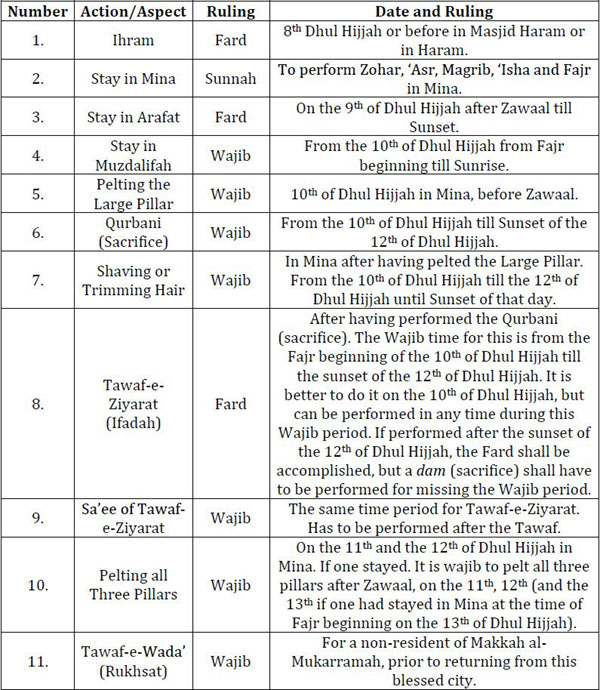
8. The table below shows the rulings of each aspect of Hajj for a Mutammati’; which is Fard (obligatory), Wajib (necessary), Sunnah, or Nafl (optional):

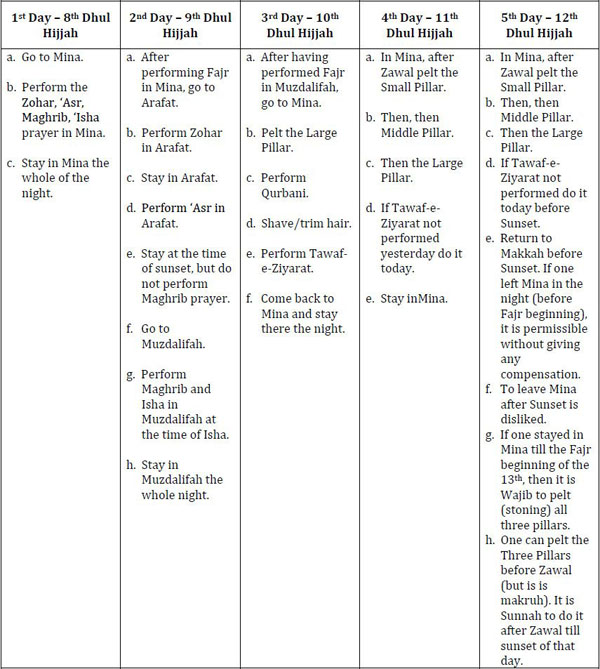
9. The 5 days of Hajj (in brief):

10. A woman who is in her menstrual cycle (haiz) cannot perform Tawaf-e-Ziyarat (Tawaf-e-Ifada) on the 10th of Dhul Hijjah. If she cannot perform this Tawaf on this date due to her menstrual cycle, then if she becomes ‘clean’ after this date until the sunset on the 12th of Dhul Hijjah, it is obligatory on her to perform this tawaf. If even after these dates, the woman has not become ‘clean’, but has become clean after these dates, then it is obligatory for her to perform this Tawaf.

a. If a woman who is in her periods (menstrual cycle) can take tablets to terminate the menstrual cycle, then she can do so. However, doing this shall cause harm to one’s health. Therefore, it is advisable not to do it. [Fatawa-e-Markazi Dar-ul-Ifta – 11th Year – 2006 – Page 35]

b. If a female can change her return date back to her country, in order for her to become ‘clean’ and thereafter perform this Fard Tawaf, then she should do so. Otherwise, if she returned back to her place of residence, not having performed this Fard Tawaf, then her Hajj is incomplete. She shall have to retrun in the “Months of Hajj” which are Shawwal, Dhul Qa’dah, first 10 days of Dhul Hijjah; and then perform the Fard Tawaf (Tawaf-e-Ziyarat). She shall also have to sacrifice an animal in the haram boundaries, as atonement for reutnring to her destination without having performed this obligatory Tawaf. [Fatawa-e-Faqih-e-Millat – Vol. 1 Page 349]

11. Those who have been blessed with performing Hajj and visiting the August Presence of the Holy Prophet SallAllaho Alaihi wa Aalihi wa Sallam should (on return to their places) draw people closer towards religion; by giving them gifts which helps them to do so. Such gifts include giving books of the Ahl al-sunnah wa al-Jama’ah, Islamic lectures, Islamic CDs and so on. Unfortunately, however, most Hajis bring with them radios for their friends and relatives by which they, most of the time, listen to music; gaining sins upon sins upon sins, not only in their Book of Deeds but also in the Book of Deeds of the one who initially gave it to them. This same ruling applies to those people who bring gold rings and/or chains or any other jewellery item for men to wear. This is because it is unlawful (Haram) for males to wear any kind of jewellery (whether it comes from the two Holy Sanctuaries or any other place) made out of any metal whatsoever, except for one silver ring which has to have one stone, and which does not weight more than 4.23 grams.

Allah Most High states:

وتعاونوا على البر والتقوى ولا تعاونوا على الاثم والعدوان

“and help one another in (matters of) virtue and piety and do not mutually cooperatw in what is sinful and wicked…” [Surah al-Ma’idah, Verse 2]

 12. A person who performed Hajj with pure Halal money (which was gained from Halal means), had a sincere intention (to perform Hajj solely for seeking the pleasure of Allah and His Beloved Messenger), did not fight, quarrel or argue in it, protected himself from all disobedincies and sins, and thereafter passed away (after having performed Hajj), but did not have the time to fulfil all of the Rights of Allah (Huququllah) or the Rights of His slaves (Huququl Ibaad), then in the situation of his/her Hajj being accepted, there is a high hope that Allah Ta’ala forgives all of His rights and through His mercy He shall forgive the rights of His slaves. There is also hope that on the Day of Resurrection Allah shall please all those whose right was upon the shoulders of this person, and protect this slave of His from contention as regards to the rights being unfulfilled. [A’jab al-Imdad fi mukaffirati Huquq al-‘Ibad – Imam Ahmed Raza Khan Rehmatullahi ‘Alayh – Fatawa-e-Razawiyyah – Vol. 24, Pages  459-476]

13. If a person stayed alive after having performed Hajj, and then as much as his/her capability, tried to fulfil the rights of Allah and the rights of His slaves; such as paying the Zakat which he/she did not pay for years that preceded; or performed the Qaza of prayers that were missed; or the fasts that had not been kept; or fulfilled the rights of those who owned that right by repaying the owner of the right or his/her next of kin, asked for forgiveness from the person to whom he/she had caused problems or had troubled; those who passed away before their rights were fulfilled, then he/she gave charity on behalf of them ; if anything remained unfulfilled from the rights of Allah and His slaves, then he did a wasiyyah (leave by will) near the time of death that the rights be fulfilled by taking that share from his/her own wealth and then giving it to the owner of the right. Conclusively, he/she tried their best to fulfil all the rights that were left unaccomplished, then there is even a greater hope for the forgiveness of such people. [A’jab al-Imdad]

14. Yes however, if one was neglectful in fulfilling these rights after having performed Hajj, and hence, he/she did not fulfill these rights then all these sins shall start to be written in his/her Book of Deeds.  This is because prior to performing Hajj, the rights of Allah and His slaves still remained on his/her responsibility to fulfill, but they delayed in fulfilling these rights and on top of this, they neglected these rights even after performing Hajj. Thus, the Hajj performed will not be sufficient to eliminate these rights that have remained on his/her responsibility. This is because, yes, Hajj does remove the sins of not performing salaah and keeping fasts in their prescribed times. However, Hajj deos not eliminate the obligation of performing the qaza of the prayers that have been missed; or keeping fasts that have been missed.

15. A sign of a person’s Hajj being accepted is that the Haji becomes more ‘religious’ after Hajj than was before. [A’jab al-Imdad]

16. Nowadays, many people have become heedless of fulfilling the rights of Allah and His slaves for many years; such as they have not performed the Qaza for their missed prayers; or not kept the fasts that they had broken or not kept; or not payed the Zakat for their previous years. This is why we see them killing one another; seizing each others property; stealing other peoples wealth; causing problems and giving distress to others. it is great misunderstanding for such people to think that after having performed Hajj all of their sins have been eradicated. If the Rights of Allah and the Rights of His slaves have been left unfulfilled, even after having performed Hajj, then they have to be accomplished as soon as possible.

We ask Almighty Allah that He gives us the tawfiq and guidance to fulfil His rights and those of His slaves… Aameen!!

Extracted From

Anwaar al-Hadith, Chapter 7, Pages 263 to 274
by Hadrat Allama Mufti Jalal al-Din Qadiri al-Amjadi

اسلامی سال کا بارہواں مہینہ ذوالحجہ ہے اس کی وجہ تسمیہ ظاہر ہے کہ اس ماہ میں لوگ حج کرتے ہیں اور اس کے پہلے عشرے کا نام قرآن مجید میں ”ایام معلومات” رکھا گیا ہے یہ دن اللہ کریم کو بہت پیارے ہیں۔ اس کی پہلی تاریخ کو سیدہ عالم حضرت خاتونِ جنت فاطمہ زہراء رضی اللہ تعالیٰ عنہا کا نکاح سیدنا حضرت شیر خدا علی مرتضیٰ کرم اللہ تعالیٰ وجہہ الکریم کے ساتھ ہوا۔
اس ماہ کی آٹھویں تاریخ کو یومِ ترویہ کہتے ہیں ۔ کیوں کہ حجاج اس دن اپنے اونٹوں کو پانی سے خوب سیراب کرتے تھے۔ تاکہ عرفہ کے روز تک ان کو پیاس نہ لگے ۔ یا اس لئے اس کو یوم ترویہ (سوچ بچار) کہتے ہیں کہ سیدنا حضرت ابراہیم خلیل اللہ علیٰ نبینا و علیہ الصلوٰۃ والسلام نے آٹھویں ذی الحجہ کو رات کے وقت خواب میں دیکھا تھا کہ کوئی کہنے والا کہہ رہا ہے کہ اللہ تعالیٰ تجھے حکم دیتا ہے کہ اپنے بیٹے کو ذبح کر۔ تو آپ نے صبح کے وقت سوچا اور غور کیا کہ آیا یہ اللہ تعالیٰ کی طرف سے ہے یا شیطان کی طرف سے ۔ اس لئے اس کو یومِ ترویہ کہتے ہیں ۔
اور اس کی نویں تاریخ کو عرفہ کہتے ہیں۔ کیوں کہ سیدنا حضرت ابراہیم علیہ الصلوٰۃ والسلام نے جب نویں تاریخ کی رات کو وہی خواب دیکھا تو پہچان لیا کہ یہ خواب اللہ تعالیٰ کی طرف سے ہے ۔ اسی دن حج کا فریضہ سر انجام دیا جاتا ہے ۔
دسویں تاریخ کو یوم نحر کہتے ہیں ۔ کیوں کہ اسی روز سیدنا حضرت اسماعیل علیہ الصلوٰۃ والسلام کی قربانی کی صورت پیدا ہوئی ۔ اور اسی دن عام مسلمان قربانیاں ادا کرتے ہیں۔
اس ماہ کی گیارہ تاریخ کو ” یوم القر” اوربارہویں، تیرہویں کو ” یوم النفر” کہتے ہیں اور اس ماہ کی بارہویں تاریخ کو حضور سراپا نور شافع یوم النشور صلی اللہ علیہ وسلم نے سیدنا حضرت علی رضی اللہ تعالی عنہ سے بھائی چارہ قائم فرمایا تھا۔ (فضائل الایام والشہور صفحہ ٤٥٩۔٤٦٠)
ماہِ ذو الحجہ کی فضیلت
ذوالحجہ کا مہینہ چار برکت اور حرمت والے مہینوں میں سے ایک ہے ۔ اس مبارک مہینہ میں کثرتِ نوافل، روزے، تلاوت قرآن، تسبیح و تہلیل، تکبیر و تقدیس اور صدقات و خیرات وغیرہ اعمال کا بہت بڑا ثواب ہے ۔ اور بالخصوص اس کے پہلے دس دنوں کی اتنی فضیلت ہے کہ اللہ تعالیٰ نے اس عشرہ کی دس راتوں کی قسم یاد فرمائی ہے ۔ چنانچہ ارشاد باری تعالیٰ ہے:
o وَالَّیْلِ اِذَا یَسْرِ o وَالشَّفْعِ وَالْوَتْرِ o وَلَیَالٍ عَشْرٍ o وَالْفَجْرِ
قسم ہے مجھے فجر کی عیدِ قربان کی اور دس راتوں کی جو ذوالحجہ کی پہلی دس راتیں ہیں ۔ اور قسم ہے جفت اور طاق کی جو رمضان مبارک کی آخری راتیں ہیں، اور قسم ہے اپنے حبیب صلی اللہ علیہ وسلم کے معراج کی رات کی۔
اس قسم سے پتہ چلتا ہے کہ عشرہ ذی الحجہ کی بہت بڑی فضیلت ہے۔ (فضائل الایام والشہور صفحہ ٤٦٣)
ماہِ ذو الحجہ کی فضیلت احادیث مبارکہ کی روشنی میں
حدیث ١
 عن أم سلمة – رضي الله عنها – قالت : قال رسول الله – صلى الله عليه وسلم – : إذا دخل العشر ، وأراد بعضكم أن يضحي فلا يمس من شعره وبشره شيئا ، وفي رواية : فلا يأخذن شعرا ، ولا يقلمن ظفرا ، وفي رواية : من رأى هلال ذي الحجة وأراد أن يضحي ، فلا يأخذ من شعره ولا من ظفاره . رواه مسلم
سیدہ حضرت ام سلمہ رضی اللہ تعالیٰ عنہا فرماتی ہیں کہ رسول خدا حبیب ِ کبریا صلی اللہ علیہ وسلم نے فرمایا : کہ جس وقت عشرہ ذی الحجہ داخل ہوجائے اور تمہارا کوئی آدمی قربانی کرنے کا ارادہ رکھتا ہو تو چاہئے کہ بال اور جسم سے کسی چیز کو مس نہ کرے۔ اور ایک روایت میں ہے کہ فرمایا کہ بال نہ کترائے اور نہ ناخن اتروائے۔ اور ایک روایت میں ہے کہ جو شخص ذی الحجہ کا چاند دیکھ لے اور قربانی کا ارادہ ہو تو نہ بال منڈائے اور نہ ناخن ترشوائے۔ (مشکوٰۃ ص ١٢٧)
حدیث ٢
عن ابن عباس رضي الله عنهما قال : قال رسول الله صلى الله عليه وسلم : ما من أيام العمل الصالح فيهن أحب إلى الله من هذه الأيام العشر , قالوا : يا رسول الله ولا الجهاد في سبيل الله ؟ قال : ولا الجهاد في سبيل الله إلا رجل خرج بنفسه وماله فلم يرجع من ذلك بشيء. [ رواه البخاري ]
سیدنا حضرت ابن عباس رضی اللہ تعالیٰ عنہما نے فرمایا کہ رسولِ خدا صلی اللہ علیہ وسلم نے فرمایا کہ کوئی دن ایسا نہیں ہے کہ نیک عمل اس میں ان ایام عشرہ سے اللہ تعالیٰ کے نزدیک زیادہ محبوب ہو۔ صحابۂ کرام رضی اللہ عنہم نے عرض کیا یا رسول اللہ صلی اللہ علیہ وسلم جہاد فی سبیل اللہ بھی نہیں ؟ فرمایا : جہاد فی سبیل اللہ بھی نہیں ! مگر وہ مرد جو اپنی جان اور مال لے کر نکلا اور ان میں سے کسی چیز کے ساتھ واپس نہیں آیا (یعنی شہادت)۔ (مشکوٰۃ ص ١٢٨)
حدیث ٣
عن ابي هريرة ان النبي (صلوات ربي وسلامه عليه) قال ما من ايام احب الى الله ان يتعبد له فيها من عشر ذي الحجة يعدل صيام كل يوم منها بصيام سنة وقيام لَيلَة فيھِن كقيام سنة
سیدنا حضرت ابو ہریرہ رضی اللہ تعالیٰ عنہ نبی کریم صلی اللہ علیہ وسلم سے روایت کرتے ہیں کہ آپ صلی اللہ علیہ وسلم نے ارشاد فرمایا کہ کوئی دن زیادہ محبوب نہیں اللہ تعالیٰ کی طرف کہ ان میں عبادت کی جائے ذی الحجہ کے ان دس دنوں سے۔ ان دنوں میں ایک دن کا روزہ سال کے روزوں کے برابر ہے اور اس کی ایک رات کا قیام سال کے قیام کے برابر ہے۔ (غنیۃ الطالبین ص ٤١٧ ، مشکوٰۃ ص  ١٢٨ ، فضائل الایام والشہور صفحہ ٤٦٤ تا ٤٦٦)
عشرہ ذی الحجہ کی فضیلت
جو شخص ان دس ایام کی عزت کرتا ہے اللہ تعالیٰ یہ دس چیزیں اس کو مرحمت فرماکر اس کی عزت افزائی کرتا ہے (١) عمر میں برکت (٢) مال میں افزونی (٣) اہل و عیال کی حفاظت (٤) گناہوں کا کفارہ (٥) نیکیوں میں اضافہ (٦) نزع میں آسانی (٧) ظلمت میں روشنی (٨) میزان میں سنگینی یعنی وزنی بنانا (٩) دوزخ کے طبقات سے نجات (١٠) جنت کے درجات پر عروج۔
جس نے اس عشرہ میں کسی مسکین کو کچھ خیرات دی اس نے گویا اپنے پیغمبروں علیہم السلام کی سنت پر صدقہ دیا۔ جس نے ان دنوں میں کسی کی عیادت کی اس نے اولیاء اللہ اور ابدال کی عیادت کی ، جو کسی کے جنازے کے ساتھ گیا اس نے گویا شہیدوں کے جنازے میں شرکت کی، جس نے کسی مومن کو اس عشرہ میں لباس پہنایا، اللہ تعالیٰ اس کو اپنی طرف سے خلعت پہنائے گا جو کسی یتیم پر مہربانی کرے گا ، اللہ تعالیٰ اس پر عرش کے نیچے مہربانی فرمائے گا، جو شخص کسی عالم کی مجلس میں اس عشرہ میں شریک ہوا وہ گویا انبیا اور مرسلین علیہم السلام کی مجلس میں شریک ہوا۔ (غنیہ الطالبین صفحہ ٤١٩)
ذوالحجہ کے پہلے نو دنوں کے روزے
ذوالحجہ مبارک کے پہلے عشرہ کے پہلے نو دن روزہ رکھنا بڑا ثواب ہے ۔ ام المؤمنین سیدہ حضرت حفصہ رضی اللہ تعالیٰ عنہا فرماتی ہیں
أربع لم يكن يدعهن النبي صلى الله عليه وسلم : صيامَ عاشورا , والعَشـْرَ , والعَشـْرَ , وثلاثة ً أيام من كل شهر , والركعتين قبل الفجر
چار چیزوں کو نبی کریم صلی اللہ علیہ وسلم نہیں چھوڑا کرتے تھے ۔ عاشورہ کا روزہ اور ذولحجہ کے دس دن یعنی پہلے نو دن کا روزہ اور ہر ماہ کے تین دن کا روزہ اور نماز فجر سے قبل دورکعتیں۔ ( مشکوٰۃ ص ١٨٠ ، فضائل الایام والشہور صفحہ ٤٦٦)
ماہِ ذی الحجہ کے نفل
٭ حدیث شریف میں ہے کہ جو شخص اول رات ذوالحجہ میں چار رکعت نفل پڑھے کہ ہر کعت میں الحمد شریف کے بعد قُلْ ہُوَ اللّٰہُ اَحَدٌ پچیس مرتبہ پڑھے تو اللہ تعالیٰ اس کے لئے بیشمار ثواب لکھتا ہے۔ (فضائل الایام والشہور صفحہ ٤٨٧)
٭ حضور رحمۃ للعالمین شفیع المذنبین صلی اللہ علیہ وسلم نے فرمایا جو شخص دسویں ذی الحجہ تک ہر رات وتروں کے بعد دو رکعت نفل پڑھے کہ ہر رکعت میں الحمد شریف کے بعد سورہ کوثر اور سورہ اخلاص تین تین دفعہ پڑھے تو اس کو اللہ تعالیٰ مقام اعلیٰ علیین میں داخل فرمائے گا اور اس کے ہر بال کے بدلہ میں ہزار نیکیاں لکھے گا اور اس کو ہزار دینار صدقہ دینے کا ثواب ملے گا۔ (فضائل الایام والشہور صفحہ ٤٨٧)
٭ اگر کوئی اس مہینہ کی کسی رات کی پچھلی تہائی رات میں چار رکعات نفل پڑھے جس کی ہر رکعت میں الحمد شریف کے بعد آیۃ الکرسی تین بار اور قُلْ ہُوَ اللّٰہُ اَحَدٌ تین بار اور قُلْ اَعُوْذُ بِرَبِّ الْـفَلَـقِ  اور  قُلْ اَعُوْذُ بِرَ بِّ النَّاسِ ایک ایک مرتبہ پڑھے اور نماز سے فارغ ہونے کے بعد اپنے دونوں ہاتھ اٹھا کر یہ دعا پڑھے
سبحان ذي العزة والجبروت سبحان ذي القدرة والملكوت سبحان ذي الحي الذي لا يموت لا اله إلا الله يحي و يميت وهو حي لا يموت سبحان الله رب العباد والبلاد والحمد لله حمدا كثيرا طيبا مباركا فيه على كل حال والله اكبر كبيرا كبرياء ربنا وجلاله وقدرته بكل مكان
پھر جو چاہے مانگے تو اس کے لئے ایسا اجر ہے جیسے کسی نے بیت اللہ شریف کا حج کیا ہو ۔ اور حضور سراپا نور شافع یوم النشور صلی اللہ علیہ وسلم کے روضہ اطہر کی زیارت کی ہوگی (غنیہ الطالبین صفحہ ٤١٧)
٭ سرکار صلی اللہ علیہ وسلم نے فرمایا کہ جو کوئی عرفہ کی رات یعنی نویں کی رات کو سو١٠٠ رکعات نفل ادا کرلے اور ہر رکعت میں الحمد شریف کے بعد ایک بار یا تین بارقُلْ ہُوَ اللّٰہُ اَحَدٌ پڑھے تو اللہ تعالیٰ اس کے تمام گناہوں کو بخش دے گا اور اس کے لئے جنت میں یا قوت کا سرخ مکان بنایا جائے گا۔
دوسری روایت میں ہے کہ عرفہ کی رات میں دو رکعات نفل پڑھے۔ پہلی رکعات میں الحمد شریف کے بعد ١٠٠ مرتبہ آیت الکرسی پڑھے اور دوسری رکعت میں الحمد شریف کے بعد قُلْ ہُوَ اللّٰہُ اَحَدٌ ١٠٠ مرتبہ پڑھے تو اللہ کریم قیامت کے دن اس نماز کی برکت سے اس کو بمعہ اس کے ستر٧٠ آدمی بخشے گا۔ (فضائل الایام والشہور صفحہ ٤٨٩)
٭ جو کوئی نحر کی رات یعنی دسویں ذوالحجہ کو جس کی صبح عید ہوتی ہے بارہ رکعات نفل پڑھے اور ہر رکعت میں الحمد شریف کے بعد قُلْ ہُوَ اللّٰہُ اَحَدٌ پندرہ دفعہ پڑھے تو اس نے ستر سال کی عبادت کا ثواب حاصل کیا اور تمام گناہوں سے پاک ہوگیا۔ اسی رات کی ایک نماز یہ بھی ہے کہ ہر رکعت میں الحمد شریف کے بعد ایک دفعہ قُلْ ہُوَ اللّٰہُ اَحَدٌ اور ایک دفعہ قُلْ اَعُوْذُ بِرَبِّ الْـفَلَـقِ اورایک دفعہ قُلْ اَعُوْذُ بِرَ بِّ النَّاسِ پڑھے اور سلام کے بعد ستر٧٠ دفعہ سُبحَانَ اللّٰہِ اور ستر٧٠ دفعہ درود شریف پڑھے تو اس کے تمام گناہ بخشے جائیں گے۔ (فضائل الایام والشہور صفحہ ٤٨٩)
٭ دسویں تاریخ کو نماز قربانی کے بعد گھر آکر چار رکعات نفل جو مسلمان ادا کرے کہ پہلی رکعت میں الحمد شریف کے بعد سَبِّحِ اسْمَ رَبِّکَ الْاَعْلٰی ایک بار اور دوسری رکعت میں الحمد شریف کے بعد وَالشَّمْسِ ایک بار اور تیسری رکعت میں الحمد شریف کے بعد وَالَّیْلِ ایک بار پڑھے اور چوتھی رکعت میں الحمد شریف کے بعد وَالضُّحٰی ایک دفعہ پڑھے ۔ پس پایا اس نے ثواب آسمانی کتابوں کو پڑھنے کا ۔ (فضائل الایام والشہور صفحہ ٤٨٩)
٭ جو شخص قربانی کے بعد دو رکعت نفل پڑھے اور ہر رکعت میں الحمد شریف کے بعد وَالشَّمْسِ پانچ بار پڑھے تو وہ شخص حاجیوں کے ثواب میں شامل ہوا اور اس کی قربانی قبول ہوئی۔ (فضائل الایام والشہور صفحہ ٤٩٠)
٭ بارگاہِ رسالت صلی اللہ علیہ وسلم میں صحابہ کرام رضی اللہ عنہم نے عرض کیا کہ یا رسول اللہ صلی اللہ علیہ وسلم ! اگر کوئی فقیر ہو اور قربانی کی طاقت نہ رکھتا ہو تو کیا کرے؟ حبیب خدا صلی اللہ علیہ وسلم نے فرمایا کہ وہ نمازِ عید کے بعد گھر میں دورکعات نفل پڑھے ۔ ہر رکعت میں الحمد شریف کے بعد سورئہ الکوثر تین مرتبہ پڑھے تو اللہ جل شانہ، اس کو اونٹ کی قربانی کا ثواب عطا فرمائے گا۔ (فضائل الایام والشہور صفحہ ٤٩٠ بحوالہ راحت القلوب)
ذی الحجہ کی اہم دعا
الحمد لله الذي في السمآء عرشه ، الحمد لله الذي في الارض قدرته ، الحمد لله الذي في القيامة هيبته ، الحمد لله الذي في القبر قضاؤه ، الحمد لله الذي في الجنة رحمته ، الحمد لله الذي في جهنم سلطانه ، الحمد لله الذي في البر والبحر برهانه ، و الحمد لله الذي في الهواء ريحه، و الحمد لله الذي لا مفر و لا ملجآ الآ اليه والحمد لله رب العلمين
ہر خوبی اللہ کے لیے ہے جس کا عرش آسمان میں ہے ، تعریف اللہ کے لیے ہے جس کی قدرت زمین پر ہے ، تعریف اللہ کے لیے ہے جس کی ہیبت قیامت میں ہے ، تعریف اللہ کے لیے ہے جس کا حکم قبروں پر ہے ، تعریف اللہ کے لیے ہے جس کی رحمت جنت میں ہے ، تعریف اللہ کے لیے ہے جس کی برہان خشکی اور سمندر میں ہے ، تعریف اللہ کے لیے ہے جس کی خوشبو ہوا میں ہے ، تعریف اللہ کے لیے ہے کہ سوائے اس کی ذات کے کوئی پناہ کی جگہ نہیں ہے تعریف اللہ کے لیے ہے جو رب العالمین ہے۔
ذو الحجہ شریف میں رونما ہونے والے اہم واقعات
٭ اعلان نبوت کے بارہویں سال اہل مدینہ کی جانب سے تیسری بیعت عقبہ جس میں ٢٩ مرد اور دو عورتیں مشرف بہ اسلام ہوئیں ، اہل مدینہ کے لیے بارہ نقیب مقرر۔۔۔۔۔۔١ھ ٭ حضرت عبد اللہ بن زبیر رضی اللہ عنہ، کی ولادت بمقام ”قباء”۔۔۔۔۔۔١ھ ٭ غزوہ سویق۔۔۔۔۔۔٢ھ ٭ سیدتنا فاطمہ رضی اللہ عنہا بنت رسول اللہ صلی اللہ علیہ وسلم کی شادی ۔۔۔۔۔۔٢ھ ٭ غزوہ بنی قریظہ۔۔۔۔۔۔٥ھ ٭ وفات حضرت سعد بن معاذ سید الاوس۔۔۔۔۔۔٥ھ ٭ حضرت ابو بکر صدیق رضی اللہ تعالی عنہ امیر حج بنے۔۔۔۔۔۔٩ھ ٭ حجۃ الوداع (عرفات اور منیٰ میں عظیم خطبات کے ذریعہ منشور انسانیت کا اعلان) ۔۔۔۔۔۔١٠ ھ ٭ حجۃ الوداع سے واپسی پر خطبہ غدیر خم میں حضرت علی کو مولائے کائنات کا منصب اور اہلبیت کو قرآن کی عملی تفسیر اور ھادی قرار دیا۔۔۔۔۔۔١٠ھ ٭ وفات ابو العاص (دامادِ رسول اللہ صلی اللہ علیہ وسلم)۔۔۔۔۔۔١٢ھ ٭ وفات یزید بن ابی سفیان۔۔۔۔۔۔١٨ھ ٭ وفات سعد جمحی۔۔۔۔۔۔٢٠ھ ٭ حضرت عمررضی اللہ تعالی عنہ پر قاتلانہ حملہ ۔۔۔۔۔۔٢٣ھ ٭ پہلی بحری جنگ (دور حضرت عثمان غنی رضی اللہ تعالی عنہ)۔۔۔۔۔۔٢٧ھ ٭تعمیر نہر بصرہ۔۔۔۔۔۔٢٩ھ ٭شہادتِ حضرت عثمانِ غنی رضی اللہ تعالی عنہ وخلافت حضرت علی رضی اللہ تعالی عنہ ۔۔۔۔۔۔٣٥ھ ٭ وفات محمد بن ابی بکر رضی اللہ تعالی عنہ ۔۔۔۔۔۔٣٨ھ ٭ وفات عثمان جمحی رضی اللہ تعالی عنہ ۔۔۔۔۔۔٤٢ھ ٭ وفات حضرت ابو موسیٰ اشعری رضی اللہ تعالی عنہ ۔۔۔۔۔۔٤٤ھ ٭ وفات عاصم بن عدی رضی اللہ تعالی عنہ ۔۔۔۔۔۔٤٥ھ ٭وفات جریر بن عبداللہ البجلی ۔۔۔۔۔۔٥١ھ ٭ وفات عبداللہ بن انیس رضی اللہ تعالی عنہ ۔۔۔۔۔۔٥٤ھ ٭فتح سمرقند ۔۔۔۔۔۔٦٢ھ ٭ یزیدیوں کے ہاتھوں حرمین طیبین کی بے حرمتی (واقعہ حَرہ)۔۔۔۔۔۔٦٣ھ ٭ ترمیم کعبۃ اللہ شریف ۔۔۔۔۔۔٦٤ھ ٭ کوفہ پر بنو امیہ کا قبضہ ۔۔۔۔۔۔ ٧٢ھ ٭ تعمیر نو کعبۃ اللہ شریف۔۔۔۔۔۔٧٣ھ ٭ حجاج امیر کوفہ ہوا۔۔۔۔۔۔٧٥ھ ٭ وفات خالد الحکیم ۔۔۔۔۔۔٨٥ھ ٭ وفات مقدام بن معدی کرب۔۔۔۔۔۔٨٧ھ ٭ شہادت عظیم جرنیل قتیبہ بن مسلم۔۔۔۔۔۔٩٦ھ ٭ حاکم بنو امیہ سلیمان نے حج کیا۔۔۔۔۔۔٩٧ھ ٭ وفات عظیم جرنیل و فاتح موسیٰ بن نصیر۔۔۔۔۔۔٩٧ھ ٭ علوی، فاطمی اور عباسی خلافت کیلئے سازشیں۔۔۔۔۔۔١٠٠ھ ٭ وفات ابو بردہ بن ابی موسیٰ الاشعری۔۔۔۔۔۔١٠٤ھ ٭ وفات قاسم بن محمد بن ابی بکر رضی اللہ تعالی عنہ ۔۔۔۔۔۔١٠٧ھ ٭ وفات قاسم بن مخمیر۔۔۔۔۔۔١١١ھ ٭ شہادت الجراح الحکمی۔۔۔۔۔۔١١٢ھ ٭ شہادت امام محمد باقر رضی اللہ تعالی عنہ بن امام زین العابدین رضی اللہ تعالی عنہ۔۔۔۔۔۔١١٤ھ ٭یزید بن ہشام امیر حج بنا۔۔۔۔۔۔١٢٣ھ ٭وفاتِ یزید اور خلافتِ ناقص ابراہیم۔۔۔۔۔۔١٢٦ھ ٭ مروانِ ثانی کا قتل اور بنو امیہ کی امارت کا ہمیشہ کے لیے خاتمہ اور بنو عباس کی امارت کے دور کا آغاز۔۔۔۔۔۔١٣٢ھ ٭وفات ابو العباس السفاح۔۔۔۔۔۔١٣٦ھ ٭ وفات خلیفہ منصور۔۔۔۔۔۔١٥٨ھ ٭ خلافت مہدی۔۔۔۔۔۔١٥٨ھ ٭ خلیفہ مہدی امیر حج۔۔۔۔۔۔١٦٠ھ ٭ وفات حماد بن دینار۔۔۔۔۔۔١٦٧ھ ٭ وفات الخیزران (والدہ ہارون رشید) ۔۔۔۔۔۔١٧٢ھ ٭ ہارون رشید کا حج ۔۔۔۔۔۔ ١٧٤ھ ٭ وفات حماد زید بن بصری ۔۔۔۔۔۔١٧٩ھ ٭ ہارون رشید کا حج۔۔۔۔۔۔١٨٦ھ ٭ ہارون رشید کا حج۔۔۔۔۔۔١٨٨ھ ٭ اعلان خلافت ابراہیم بن المبارک۔۔۔۔۔۔٢٠١ھ ٭ خراسان میں زلزلہ۔۔۔۔۔۔٢٠٣ھ ٭ وفات المنتصر و حکومت عبدالرحمن۔۔۔۔۔۔٢٠٦ھ ٭ وفات ابو عبیدہ معمرہ الغوی۔۔۔۔۔۔٢٠٩ھ ٭ وفات معلی الرازی ۔۔۔۔۔۔ ٢١١ھ ٭ وفات مفتی اندلس عیسیٰ الغافقی۔۔۔۔۔۔٢١٢ھ ٭ وفات الحافظ شریح الجوہری۔۔۔۔۔۔٢١٧ھ ٭ فتنہ شیعہ خرمیہ۔۔۔۔۔۔٢١٨ھ ٭ وفات ابو جعفر محمد الجواد۔۔۔۔۔۔٢٢٠ھ ٭ وفات الحافظ الحکم البہرانی۔۔۔۔۔۔٢٢٢ھ ٭ وفات ابو الجماہیر الکفرسوسی۔۔۔۔۔۔٢٢٤ھ ٭ محمد بن سلام البیکندی ۔۔۔۔۔۔ ٢٢٥ھ ٭ وفات الواثق باللہ و خلافت المتوکل۔۔۔۔۔۔٢٣٢ھ ٭ وفات عبدالقواریری ۔۔۔۔۔۔٢٣٥ھ ٭ وفات محمد بن کرام بانی کرامیہ۔۔۔۔۔۔٢٥٥ھ ٭ وفات حافظ ابو زرعہ محدث۔۔۔۔۔۔٢٦٤ھ ٭ وفات قاضی صا لح بن امام احمد بن حنبل۔۔۔۔۔۔٢٦٥ھ ٭ وفات ابوبکر ابن حازم۔۔۔۔۔۔٢٧٦ھ ٭ وفات ابو عمر الراقی ۔۔۔۔۔۔٢٨٠ھ ٭ وفات ابو عمرو بن خرذ اد الانطاکی۔۔۔۔۔۔٢٨١ھ ٭ وفات ابو العباس المبرد النحوی۔۔۔۔۔۔٢٨٥ھ ٭ وفات محمد بن وضاح محدث اندلسی۔۔۔۔۔۔٢٨٦ھ ٭ وفات عبدان الجوالیقی۔۔۔۔۔۔٣٠٦ھ ٭ وفات حافظ الدولابی۔۔۔۔۔۔٣١٠ھ ٭ قرامط نے حاجیوں کا قتل عام کیا۔۔۔۔۔۔٣١١ھ ٭ وفات ابو بکر بن الباغنوی۔۔۔۔۔۔٣١٢ھ ٭ عراقی حاجی مکہ نہ جاسکے۔۔۔۔۔۔٣١٤ھ ٭ وفات ابو بکر بن بہلول الانباری۔۔۔۔۔۔٣٢٩ھ ٭ وفات ابو بکر الاخشید و ابو بکر شبلی (شیخ طریقت سلسلہ عالیہ قادریہ خلیفہ حضرت جنید بغدادی علیہ الرحمہ)۔۔۔۔۔۔٣٣٤ھ ٭٭ وفات ابو عبداللہ الاخرم۔۔۔۔۔۔٣٤٤ھ ٭عراق میں شدید ژالہ باری۔۔۔۔۔۔٣٥١ھ ٭ عید غدیر کی ابتداء ۔۔۔۔۔۔٣٥٢ھ ٭ وفات ابو بکر البزاز صاحب الغیلانیات۔۔۔۔۔۔٣٥٤ھ ٭ وفات ابو الفرج الاصفہانی صاحب الاغانی۔۔۔۔۔۔٣٥٦ھ ٭ بدامنی کی وجہ سے عراق و شام سے حاجی نہ جا سکے ۔۔۔۔۔۔٣٥٧ھ ٭ عید غدیر جبراً عوام پر مسلط کی گئی۔۔۔۔۔۔٣٥٩ھ ٭ بنیاد جامع الازہر۔۔۔۔۔۔٣٦١ھ ٭ وفات ابن البقیۃ الوزیر۔۔۔۔۔۔٣٦٧ھ ٭ وفات ابو زکریا المزکی۔۔۔۔۔۔٣٩٤ھ ٭ خلافت ہشام (دوبارہ)٤٠٠ھ ٭ وفات ابو بکر ابن الباقلانی۔۔۔۔۔۔٤٠٣ھ ٭ وفات امام الحاکم صاحب المستدرک (محدث علیہ الرحمہ)۔۔۔۔۔۔٤٠٥ھ ٭ وفات ابو الفضل الخزاعی صاحب کتاب الواضح۔۔۔۔۔۔٤٠٨ھ ٭ حکومت الظاہر الفاطمی۔۔۔۔۔۔٤١١ھ ٭ وفات فقیہ الشعیہ الشیخ المفید ۔۔۔۔۔۔ ٤١٣ ھ ٭ وفات ابو بکر المتقی۔۔۔۔۔۔٤٢٠ھ ٭ وفات القادر باللہ العباسی و خلافت القایم بامراللہ العباسی۔۔۔۔۔۔٤٢٢ھ ٭ وفات عبدالملک ابو منصور الثعالبی (مفسر قرآن) ۔۔۔۔۔۔٤٣٠ھ ٭ وفات ابو علی الاہوازی۔۔۔۔۔۔٤٤٦ھ ٭ قتل امیر البساسیری۔۔۔۔۔۔٤٥١ھ ٭ وفات القاضی ابو عبداللہ القضاعی۔۔۔۔۔۔٤٥٤ھ ٭ وفات الوزیر ابو نصر الکندی۔۔۔۔۔۔٤٥٦ھ ٭ وفات ابو القاسم المہروانی۔۔۔۔۔۔٤٦٨ھ ٭ وفات ابو بکر ابن حمدویہ۔۔۔۔۔۔٤٧٠ھ ٭ وفات ابو بکر الخراز۔۔۔۔۔۔٤٨٠ھ ٭ وفات شیخ ابو اسماعیل الانصاری ۔۔۔۔۔۔٤٨١ھ ٭ وفات ابو الفرج الشیرازی۔۔۔۔۔۔٤٨٦ھ ٭ وفات عبدالملک بن سراج اللغوی۔۔۔۔۔۔٤٨٩ھ ٭ وفات الفقیہ عبدالوہاب الفاسی۔۔۔۔۔۔٥٠٠ھ ٭ وفات ابو بکر احمد الزاہد حنبلی۔۔۔۔۔۔٥٠٣ھ ٭ بغداد میں زلزلہ۔۔۔۔۔۔٥١١ھ ٭ وفات ابو بکر بن بلتگین النحوی۔۔۔۔۔۔٥١٣ھ ٭ وفات ابو علی الحسن الحداد۔۔۔۔۔۔٥١٥ھ ٭ وفات ابو طالب الیوسفی۔۔۔۔۔۔٥١٦ھ ٭ وفات ابن عبدون اللغوی التیونسی۔۔۔۔۔۔٥١٩ھ ٭ وفات ابو الحجاج المنورقی۔۔۔۔۔۔٥٢٣ھ ٭ وفات محمد بن الحسین المزرنی۔۔۔۔۔۔٥٢٧ھ ٭ وفات ابو القاسم الثروطی۔۔۔۔۔۔٥٢٨ھ ٭ وفات ہبۃ اللہ البدیع الاسطرابی۔۔۔۔۔۔٥٣٣ھ ٭ وفات قوام الستہ الحافظ اسمٰعیل الاصبہانی۔۔۔۔۔۔٥٣٥ھ ٭ وفات زمخشری صاحب الکشاف۔۔۔۔۔۔٥٣٨ھ ٭ وفات اُمیہ بن ابی الصلت٥٤ھ ٭ وفات ابو علی البسطامی۔۔۔۔۔۔٥٤٨ھ ٭ وفات القاضی ابن راشد۔۔۔۔۔۔٥٥١ھ ٭وفات قطب المشائخ عدی الہکاری۔۔۔۔۔۔٥٥٧ھ ٭ وفات علی بن عبدوس الفقیہ۔۔۔۔۔۔٥٥٨ھ ٭ وفات نجم الدین (والد گرامی صلاح الدین ایوبی)۔۔۔۔۔۔٥٦٨ھ ٭ وفات ابو محمد بن المامون الادیب۔۔۔۔۔۔٥٧٣ھ ٭ وفات ابو الحسن بن بکروس۔۔۔۔۔۔٥٧٦ھ ٭ وفات ابن غریۃ الوارق۔۔۔۔۔۔٥٧٨ھ ٭وفات محمد بن شیر کوہ (مشہور سپہ سالار)۔۔۔۔۔۔٥٨١ھ ٭ وفات ابن جمیر الاندلسی۔۔۔۔۔۔ ٥٨٨ ھ ٭ وفات ابو الحسن الفاخرانی۔۔۔۔۔۔٥٩١ھ ٭مکہ مکرمہ میں زبردست طوفانِ باد۔۔۔۔۔۔٥٩٢ھ ٭وفات نقی الدین الثعلی۔۔۔۔۔۔٥٩٣ھ ٭ وفات امام الخشوعی مسند الشام۔۔۔۔۔۔٥٩٨ھ ٭ وفات امام ابن الاثیر الجزری۔۔۔۔۔۔٦٠٣ھ ٭شہادت حضرتشمس تبریزی۔۔۔۔۔۔٦٤٢ھ ٭وفات خواجہ نصیر الدین طوسی۔۔۔۔۔۔٦٧٢ھ ٭حکومت علاؤالدین خلجی۔۔۔۔۔۔٦٩٥ھ ٭وفات یاقوت مستعصمی کاتب۔۔۔۔۔۔٦٩٧ھ ٭وفات احمد بن اسحق الابرقوہی۔۔۔۔۔۔٧٠١ھ ٭حکومت شہاب الدین عمر خلجی۔۔۔۔۔۔٧١٥ھ ٭خلافت الحاکم الثانی۔۔۔۔۔۔٧٣٩ھ ٭وفات شہاب الدین العمری ۔۔۔۔۔۔ ٧٤٩ ھ ٭وفات بہاؤ الدین عمر الہندی۔۔۔۔۔۔٧٥٨ھ ٭وفات شیخ سراج الدین جنیدی۔۔۔۔۔۔٧٨١ھ ٭ وفات مخدوم السادات جہانیاں جہاں گشت رحمۃ اللہ علیہ (اُچ شریف )۔۔۔۔۔۔٧٨٥ھ ٭ وفات جمال الدین بن عبدالحق الحنفی۔۔۔۔۔۔٨٠٢ھ ٭ وفات تقی الدین الحرانی۔۔۔۔۔۔٨٠٤ھ ٭ وفات سراج الدین بن الکویک۔۔۔۔۔۔٨٠٧ھ ٭وفات شیخ زادہ الحنفی (مفسر، فقیہ، حاشیہ نگار)۔۔۔۔۔۔٨٠٨ھ ٭ وفات ابراہیم بن دقماق الحنفی ۔۔۔۔۔۔٨٠٩ھ ٭ وفات موفق الدین الخزر جی مؤرخ۔۔۔۔۔۔٨١٢ھ ٭وفات شمس الدین الزرکشی۔۔۔۔۔۔٨١٣ھ ٭وفات علی بن سند الادیب۔۔۔۔۔۔٨١٤ھ ٭ وفات سراج الدین عمر الفافا الہندی۔۔۔۔۔۔٨١٥ھ ٭ امارت داؤد المعتضدالثانی۔۔۔۔۔۔٨١٦ھ ٭وفات شمس الدین ابن البیطار۔۔۔۔۔۔٨٢٥ھ ٭وفات حافظ علاؤالدین دمشقی۔۔۔۔۔۔٨٢٩ھ ٭وفات عز الدین ابن انصرات۔۔۔۔۔۔٨٥١ھ ٭وفات امام ابن حجر العسقلانی شافعی (شارح بخاری)۔۔۔۔۔۔٨٥٢ھ ٭حکومت اول لودھی شاہ بہلول ۔۔۔۔۔۔٨٥٥ھ ٭وفات امام بدرالدین العینی حنفی (شارح بخاری)۔۔۔۔۔۔٨٥٥ھ ٭وفات شمس الدین النواجی الادیب۔۔۔۔۔۔٨٥٩ھ ٭ وفات منصور الکازرونی۔۔۔۔۔۔٨٦٠ھ ٭ وفات تقی الدین الشمشی۔۔۔۔۔۔٨٧٢ھ ٭ وفات ابو المحاسن تغری بردی الحنفی ۔۔۔۔۔۔٨٧٤ھ٭ وفات زین الدین بن الغضیف۔۔۔۔۔۔٨٧٨ھ ٭ وفات ریاضی سمرقندی ۔۔۔۔۔۔٨٨٤ھ ٭ دولت شاہ سمرقندی نے تذکرہئ شعراء لکھا۔۔۔۔۔۔٩٠٤ھ ٭ وفات حسین واعظ کاشفی (معروف حنفی مفسر اور سیرت نگار)۔۔۔۔۔۔٩١٠ھ ٭ وفات حمزۃ الناشری۔۔۔۔۔۔٩٢٦ھ ٭ بہمنی حکومت ٹوٹ کر چار حکومتیں بن گئیں۔۔۔۔۔۔٩٣٧ھ ٭ وفات اسمٰعیل انصقیہ الحنفی۔۔۔۔۔۔٩٤٢ھ ٭ وفات قاسم بن خلیفہ حلبی۔۔۔۔۔۔٩٤٨ھ ٭ حکومت محمد عادل شاہ سوری۔۔۔۔۔۔٩٦٠ھ ٭ وفات عبدالعزیز المکناسی۔۔۔۔۔۔٩٦٤ھ ٭ وفات عبدالمعطی الحضرمی (احمد آباد)٩٨٩ھ ٭ وفات نور الدین ظہوری۔۔۔۔۔۔١٠١٦ھ ٭ وفات کلیم ہمدانی۔۔۔۔۔۔١٠٦١ھ ٭ قتل دارِ شکوہ۔۔۔۔۔۔١٠٦٩ھ ٭ مولائی اسمٰعیل مراکش کا سلطان بنا۔۔۔۔۔۔١٥ ذوالحجہ، ١٠٧٩ھ ٭ حکومت قطب الدین بہادر شاہ اول۔۔۔۔۔۔١١١٨ھ ٭ حکومت فرخ سیر (دہلی)۔۔۔۔۔۔١١٢٤ھ ٭ وفات عبداللہ قطب الملک۔۔۔۔۔۔١١٣٥ھ ٭ وفات علامہ حکیم محمد حسین شہرت۔۔۔۔۔۔١١٤٩ھ ٭ قتل قائم خان(فرخ آباد) ۔۔۔۔۔۔١١٦١ھ ٭ مسعود بن عبدالعزیز نے کربلا پر حملہ کیا۔۔۔۔۔۔١٢ پریل/١٨ذی الحجہ، ١٢١٦ھ ٭ وفات مولوی محمد باقر آگاہ۔۔۔۔۔۔١٢٢٠ھ ٭ حاکم یاغستان یار محمد خان نے بالاکوٹ کے مقام پر بدعقیدگی اور توہین رسالت کا ارتکاب کرنے پر احمد رائے بریلوی اور مولوی اسماعیل دہلوی کو قتل کیا۔۔۔۔۔۔١٢٤٦ھ ٭ خلافت عبدالعزیز عثمانی ۔۔۔۔۔۔ ١٢٧٧ھ ٭ وفات مولوی چراغ علی۔۔۔۔۔۔١٣١٢ھ ٭ وفات داغ دہلوی (مشہور شاعر) ۔۔۔۔۔۔١٣٢٢ھ ٭ وفات شبلی نعمانی۔۔۔۔۔۔١٣٣٢ھ ٭ وفات حفیظ اللہ بندوی۔۔۔۔۔۔١٣٦٢ھ ٭ وفات آغا خان (سوم) ١٣٧٦ھ ٭ آزادی کویت۔۔۔۔۔۔١٣٨٠ھ ٭ وفات یوسف کاندھلوی وہابی۔۔۔۔۔۔١٣٨٤ھ ٭ میدان منیٰ میں ایرانی ، عراقی و شامی شیعہ حاجیوں کا احتجاج ، سعودی حکومت نے گن شپ ہیلی کاپٹر سے فائرنگ کی ہزاروں مارے گئے جبکہ زخمیوں کو برقی بھٹی میں جھونک دیا ۔۔۔۔۔۔١٤٠٧ھ/١٩٨٧ء ٭ مکۃ المکرمہ پر یمنیوں کا قبضہ، توپ کے گولوں سے کعبۃ اللہ شریف کو نقصان پہنچا اور مسجد حرام کے مینار شہید ہوگئے ۔۔۔۔۔۔١٤٠٧/١٩٨٧ء٭ تین سال متواتر منیٰ میں آتشزدگی کے واقعات ۔۔۔۔۔۔١٤١٥ ھ/مئی ١٩٩٥ء، دوسری ١٤١٦ ھ/اپریل ١٩٩٦ء، تیسری سے بڑی اور خطرناک آتشزدگی ہزاروں حاجی جھلس کر شہید ہوگئے ۔۔۔۔۔۔١٤١٧ ھ /اپریل ١٩٩٧ء مدینۃ المنورہ میں ایک مکان سے حضرت عبد اللہ رضی اللہ عنہ (والد ماجد حضور علیہ الصلوٰہ والسلام) حضرت عکاشہ اور پانچ دیگر اصحاب رضوان اللہ تعالیٰ علیہم اجمعین کی قبور مبارکہ سے ان کے مبارک جسموں (جو صحیح حالت میں تھے) کو جنۃ البقیع میں منتقل کیا گیا۔۔۔۔۔۔٨ ذی الحجہ ١٣٩٨ھ/١٠ نومبر ١٩٧٨ء
ذی الحجہ میں وفات پانے والے بزرگان دین رضوان اللہ علیہم اجمعین
یکم ذی الحجہ
٭ حضرت سید عبدالاول سمر قندی ٩٠٥ھ ٭ حضرت خواجہ طاہر رفیق کشمیری ١٠٠١ھ ٭ خواجہ عبدالرحمان چھوہروی ١٣٤٢ھ ٭ حضرت بابا یوسف شاہ تاجی (تلمیذ اعلیٰ حضرت) ١٣٦٦ھ
٢ ذی الحجہ
٭ حضرت سیدنا ذکریا علیہ السلام ٭ حضرت بُشر قریشی ٢١٨ھ ٭ حضرت ابو الحسن بخار ٤٨١ھ ٭ حضرت سید محمد فاضل متوکل ١١١٢ھ ٭ حضرت خواجہ نور محمد عرف شاہ بھیل موہاروی ١٢٠٥ھ ٭ حضرت مرزا حیات بیگ کشمیری ١١٢٠ھ ٭ حضرت شاہ غلام رسول رسول نمارائے بریلوی ١٢٨٩ھ ۔ ٭ حضرت سید محمد میاں جیلانی نو ساروی
٣ ذی الحجہ
٭ حضرت ایوب علیہ السلام ٭ حضرت سلیمان علیہ السلام ٭ حضرت ابو سعید احمد بروعے ٣١٧ھ ٭ حضرت شیخ محمد سلیم صابری ١٠٣٠ھ ٭ حضرت خواجہ حافظ احمد یسوی ١١١٦ھ ٭ حضرت شیخ محمد سلیم چشتی ١١٥١ھ ٭ حضرت حافظ عبدالواحد خالصپوری ١٣٠٤ھ ٭ حضرت قطبِ مدینہ مولانا ضیاء الدین مدنی علیہ الرحمہ ٭ شیخ عبد القادر حیدرآبادی ١٣٢٩ھ ٭ حضرت پیر محمد اسحق جان سرہندی (ممبر ورکنگ کمیٹی صوبائی مسلم لیگ سندھ ١٩٤٠ئ) ١٣٩٥ھ ٭ حضرت مولانا ذاکر جھنگوی (رہنما جمعیت علماء پاکستان و رہنما تحریک پاکستان)
٤ ذی الحجہ
٭ حضرت خواجہ ابو الحسن فضیل ٭ حضرت سخی سرور سلطان وزیر آبادی
٥ ذی الحجہ
٭ حضرت شیخ قیام الدین ٩٠٣ھ ٭ حضرت حاجی شاہ محمد بشیر میاں صاحب (پیلی بھیت )
٦ ذی الحجہ
٭ حضرت امام المسلمین سیدنا محمد تقی رضی اللہ عنہ ٢٢٠ھ ٭ حضرت امیر کبیر سید علی ہمدانی ٧٧٠ھ ٭ حضرت خواجہ قاسم سمر قندی ٨٩١ھ ٭ حضرت زندہ شاہ (١٣٦٢ ھ میں مزار ظاہر ہواجب حضرت نے کسی کو خواب میں بشارت دی) ٭ حضرت مولانا عبد الغفور صاحب (نصیر آباد بلوچستان)
٧ ذی الحجہ
٭ حضرت امام المسلمین سیدنا محمد باقر رضی اللہ عنہ،١١٧ھ ٭ حضرت ابو بکر احمد خطیب بغدادی٤٦٢ھ ٭ حضرت شیخ محمد عارف صابری چشتی١٠٧١ھ ٭ حضرت عبدالخالق گجرای ١٠٧٨ھ ٭ حضرت کمال الدین عرف سید شاہ کلیم پوری ١٢٦٦ھ ٭ مولانا حبیب الرحمان شیروانی ١٣٧٠ھ ٭ میاں محمد بخش ابدال
٨ ذی الحجہ
٭ حضرت شاہ احمد علی قادری ٭ حضرت قطب الدین قطب عالم اوچی ٨٥٦ھ ٭ حضرت سید برہان الدین قطب عالم ٥٨٦ھ ٭ حضرت سخی سلطان منگھوپیر ٭ حضرت محمد صدیق چشتی صابری لاہوری ١٠٨٤ھ
٩ ذی الحجہ
٭ حضرت سیدنا امام مسلم بن عقیل رضی اللہ عنہ، ٭ حضرت سیدی عبداللہ (صاحب مسند داری) سمر قندی ٢٥٥ھ ٭ حضرت حارث بن اُسامہ (صاحب مسند)٢٨٢ھ ٭ حضرت ابو بکر عبداللہ بن باہر دینوی ٣٣٠ھ ٭ حضرت ابو الحسن بن عالم بصری ٣٦٠ھ ٭ حضرت سید زین الدین ٨١٣ھ ٭ حضرت خواجہ ابو المساکین شیخ محمد ٹھٹھوی ٭ شیخ محمد فاضل سعدی گجراگی سورتی ١٣٠٢ھ ٭ حضرت علامہ محمد عادل حنفی الہ آبادی ثم کانپوری ١٣٢٥ھ ٭ محمد ابراہیم جیلانی المعروف سید سخی وجڑی والا (حیدرآباد) ٭ حضرت سید قطب شاہ عرف ظہور شاہ (بھیم پورہ نشتر روڈ، کراچی) ٭ حضرت علامہ ولایت حسین بن خیرات حسین حنفی (وصال بر موقع وقوف عرفات)١٣٤٠ھ
١٠ ذی الحجہ
٭ حضرت فتح موصلی ٢٢٠ھ ٭ حضرت شیخ محمد سعد عرف سعد الدین جموی ٦٥٠ھ ٭ حضرت سید جلال الدین مخدوم جہانیاں جہاں گشت ٧٥٠ھ ٭ حضرت خواجہ حسن عطار ٨٢٦ھ ٭ حضرت قاضی القضا شمس الدین محمد جزری (مصنف حصن حصین) ٨٣٣ھ ۔ ٭ حضرت سرکار پٹنہ ٭ بابا بھولے شاہ فیروز پوری ٭ حضرت علامہ وکیل احمد سکندر پوری حنفی (پچاس کتب کے مصنف خصوصاً ” الکلام المقبول فی اثبات اسلام آباء الرسول ا” )١٣٢٢ھ ٭ حضرت مفتی لطف اللہ علی گڑھی ١٣٣٤ھ ٭ پیر طریقت صاحبزادہ ظہور الحق گورداسپوری ١٤٠٤ ھ
١١ ذی الحجہ
٭ حضرت عبدالعزیزی تمیمی ٣٣٢ھ ٭ حضرت ابو الحسن فتح بن شمعون ٤٥٢ھ ٭ حضرت شیخ بہاؤلدین شطاری دولت آبادی ٩٢١ھ ٭ سید شہاب الدین سہروردی بن میراں موج دریا بخاری ١٠٤١ھ ٭ حضرت ابو طاہر محمد دہلوی ١١٥٩ھ ٭ حضرت شاہ محمد طاہر فاخر الہ آبادی ١١٦٤ھ ٭ حضرت سید امین الدین عرف ارحام الدین ٭ حضرت شاہ مقیم حجرہ شریف ٭ حضرت حاکم علی نقشبندی کوٹلی ١٢٥٨ھ ٭ حضرت سید سید محمود آغا نقشبندی ١٢٩١ھ ٭ حضرت پیر امیر شاہ قادری (مظفر آباد) ٭ حضرت پیر فضل حق گل آبا کوہاٹی نقشبندی قادری ١٣٧١ھ/٢ ستمبر ١٩٥٢ء (رہنما تحریک پاکستان)
١٢ ذی الحجہ
٭ حضرت ابو حمزہ محمد بن ابراہیم بغدادی ٢٦٧ھ ٭ حضرت شیخ اختیار الدین ٨٣٨ھ ٭ حضرت سید شفیق مرغول ابدال ٨٩٧ھ ٭ حضرت مخدوم جہانیاں جہان گشت جلال بخاری دوران فلک ٩٠٣ھ ٭ حضرت مفتی ابو الصفا دمشقی ١١٢٠ھ ٭ حضرت پیر شاہ سرہندی ١١٤٥ھ ٭ حضرت شاہ خدا بخش ١٢٦٩ھ ۔
١٣ ذی الحجہ
٭ حضرت ابو اسحق ابراہیم کرمان شاہی ٣٣٧ھ ٭ حضرت سید عبدالقادر انییاد ٧٢٥ھ ٭ حضرت سائیں محمد عبد اللہ ساقی سرمست قلندر (مستجاب الدعوات)١٣٧٦ھ
١٤ ذی الحجہ
٭ حضرت ابو عمر محمد بن احمد نجند نیشاپوری ٣٦٦ھ ٭ حضرت شاہ عبدالغفار ٣٩٧ھ ٭ حضرت ابو سعید قیلوی ٥٥٧ھ ٭ حضرت شیخ عبدالرؤف ٧٠٠ھ ٭ حضرت شاہ سوندھا حق نما ٧٩٢ھ ٭ حضرت شیخ بایزید بغدادی ٧٩٧ھ ٭ حضرت سید محمد طفیل اتردلوی ١١٥١ھ ٭ حضرت شیخ محمد فاضل مجددی ١١٥١ھ ٭ حضرت شاہ حسین گجراتی ١١٨٣ھ ٭ حضرت اخون شاہ سُدَنی ١١٩١ھ ٭ حضرت حافظ ہدایت اللہ رامپوری ١٢٥٩ھ ٭ حضرت شاہ ابو الفضل ظہیر الدین محمد پناہ عطا عرف میاں جی ١٢٧٥ھ ۔
١٥ ذی الحجہ
٭ حضرت سیدنا یقوب علیہ السلام ٭ حضرت خواجہ اسحق بہاولپوری ٨٨٨ھ ٭ حضرت مولانا محمد افضل الہ آبادی ١١٢٤ھ ٭ حضرت مولانا رفیع الدین مراد آبادی ١٢١٨ھ ٭ حضرت خواجہ عبد الصمد خان المعروف حضور جی ١٣٦٩ھ/٢٧ ستمبر ١٩٥٠ء (رہنما تحریک پاکستان)
١٦ ذی الحجہ
٭ حضرت سید محمد حسن نوری بخاری ١٣٣ھ ٭ حضرت شیخ احمد نوریزی٢٤٤ھ ٭ حضرت ابو عبداللہ مغربی ٣٦٧ھ ٭ حضرت ابو المنصور اصفہانی ٤١٨ھ ٭ حضرت ابو الفرح فراغی ٤٩٧ھ ٭ حضرت مسعود شوغی دغ ابدال ٦١٣ھ ٭ حضرت سید علی بن احمد ٧٠٠ھ ٭ حضرت مولوی محمد امین بدایونی ١٢٥٥ھ ۔
١٧ ذی الحجہ
٭ حضرت ابو الحسن علی بصری ٣٧١ھ ٭ حضرت ابو محمد بصری ٣٨٥ھ ٭ حضرت ابو بکر محمد بن ابراہیم سوسی ٣٨٦ھ ٭ حضرت شیخ عثمان بن عمرو باقلانی ٤٠٢ھ ٭ حضرت سیدی ابو عبداللہ محمد حمیدی اندلسی ٤٨٨ھ ٭ حضرت شاہ خدا قلی ٥٢١ھ ٭ حضرت خواجہ فخرالدین زاہد ٧٠٤ھ ٭ حضرت خواجہ خورد محمد بن حضرت عزیزان علی رامتینی خوارزمی ٧١٥ھ ٭ حضرت شیخ فضل اللہ الہٰ آبادی ١١٦٧ھ ٭ حضرت شاہ باسط علی قلندر ١١٩٦ھ ٭ حافظ محمد امین چشتی لاہوری ١٣٦٣ھ ٭ پیر سید سچل شاہ جیلانی (خیرپورسندھ)
١٨ ذی الحجہ
٭ حضرت امیر المؤمنین سیدنا عثمانِ غنی رضی اللہ عنہ ٣٥ھ ٭ حضرت شیخ محی الدین عاصم ٧٦٥ھ ٭ حضرت محب اللہ شامی ١١٠٣ھ ٭ شاہ آل رسول مارہروی ١٢٩٦ھ ٭ صدر الافاضل حضرت مولانا نعیم الدین مرادآبادی ٭ حضرت شیخ احمد بن صبغت اللہ شافعی مدراسی محدث (مصنف فتاوی صبغیہ) ١٣٠٧ھ ٭ حضرت سیف الدین چشتی (شجاع آباد)
١٩ ذی الحجہ
٭ حضرت ابوالحسن احمد نوری ٢٩٤ھ ٭ حضرت عبدالستار کاشغری ٦٨٧ھ ٭ حضرت شاہ ابو المکارم فاضل ٨٣٩ھ ٭ حضرت شیخ سعدی وزیر آبادی ١١٠٢ھ ٭ حضرت سید نور محمد گیلانی ١١٢٦ھ ٭ حضرت شیخ خیر الدین خیر شاہ چشتی ١٢٢٨ھ ٭ حضرت شیخ محمد سعید چشتی ١٢٣٠ھ ۔
٢٠ ذی الحجہ
٭ حضرت عبداللہ شاہ غازی (بن سید محمد نفس ذکیہ بن سید عبد اللہ المحض شہید ) ١٥١ھ ٭ حضرت شیخ جمال الدین جمن ٩٠٤ھ ٭ حضرت سید جلال الدین حمید ١١١٤ھ
٢١ ذی الحجہ
٭ حضرت محمد جام طوسی ٣٣٧ھ ٭ حضرت شیخ برہان الدین ابو محمد حسین ہمدانی ٥٨٩ھ ٭ حضرت سید اسمٰعیل اکبری ٥٩٨ھ ٭ حضرت شیخ عبدالحمید غوری ٤٣٧ھ ٭ حضرت سید عبدالاول سنبری ٥٥٣ھ ٭ حضرت شاہ صدر الدین قسیم العباد ٨٠٩ھ ٭ حضرت شیخ نظام ارنولی چشتی ٩٩٧ھ ٭ حضرت حاجی رفیع الدین ١٢٥٩ھ ٭ حضرت سید علی مردان شاہ جیلانی قادری (نورائی شریف)١٣٦٩ھ
٢٢ ذی الحجہ
٭ حضرت شیخ ابو العباس ٢٠١ھ ٭ حضرت شیخ ماد ہو قادری لاہوری ١٠٥٦ھ ٭ حضرت شاہ الہدیہ قلندر ١١٤٧ھ ۔ ٭ حضرت مولانا شاہ عبدالعلیم میرٹھی
٢٣ ذی الحجہ
٭ حضرت ام المؤمنین صفیہ رضی اللہ عنہا ٢٥ھ ٭ حضرت ابو الحسن علی بن ادریس یعقوبی٦٢١ھ ٭ حضرت شیخ صدر الدین عارف سہروردی ٦٨٤ھ ٭ خواجہ محمد حامد تونسوی ٭ حضرت محمد خدایار چشتی ٭ حضرت سید ابو محمد امام شاہ (لودھراں) ٭ حضرت بابا سید حیدر علی شاہ ٭ حضرت سید قاسم علی گیلانی (مکھر شریف اٹک)
٢٤ ذی الحجہ
٭ حضرت ابو القاسم عبدالصمد واعظ دینوری ٣٩٧ھ ٭ حضرت سید جلال عبدالقادر عرب سید احمد ٦٩٩ھ ٭ حضرت سید محمد محی الدین جوز البطعی ٧٤٥ھ ٭ حضرت خواجہ محمد عرف عمر پارسا نقشبندی(خلیفہ حضرت خواجہ بہاؤ الدین نقشبند) ٨٢٢ھ ٭ حضرت شاہ نعمت اللہ ولی ٨٣٤ھ ٭ حضرت نجم الدین غوث الدہر ٨٣٧ھ ٭ حضرت شیخ جلال الدین صابری کریم الطرفین ٩٨٩ھ ٭ حضرت مولوی مفتی غلام سرور لاہوری ١٣٠٧ھ ۔
٢٥ ذی الحجہ
٭ حضرت ابو المغیت حسین بن منصور حلاج ٣٠٩ھ ٭ آغا سید رہبر حسین شاہ مظہر گیلانی (مترجم قصیدئہ غوثیہ بر زبان سندھی و راہنما تحریک پاکستان) ١٣٩٢ھ
٢٦ ذی الحجہ
٭ حضرت ابو عمر عبدالملک گازرونی ٣٥٨ھ ٭ حضرت جمال شاہ قادری چشتی (مچھی میانی ، کھارادر، کراچی) ٭ خواجہ عبد الخالق اویسی (چشتیاں) ٭ حضرت مولانا حکیم گل محمد قریشی (ملتان) ٭ حضرت خواجہ در محمد غریب نواز (رحیم یار خان)
٢٧ ذی الحجہ
٭ حضرت شیخ اسعد ٢٤٩ھ ٭ حضرت ابو بکر جعفر المقلب پشبلی جنان الفردوس ٣٣٤ھ ٭ حضرت مولانا بہاؤالدین یمنی ٦٢٨ھ ٭ حضرت عبدالغفار صدیقی٧٢٧ ٭ حضرت صدر الدین انقلاب نفس ٨٦٣ھ ٭ حضرت شاہ فیض اللہ روح العالمین ٨٩٩ھ ٭ حضرت خواجہ بہاؤ الحق خاصہئ خدا ٩٢٢ھ ٭ حضرت شاہ قاسم سلیمانی ٩٧٥ھ ٭ حضرت سید عبدالصمد خدا نما ٩٩٩ھ ٭ حضرت حاجی محمد عبداللہ بغدادی ١٢٠١ھ ٭ حضرت شاہ داؤد مصری ١٢١١ھ ٭ حضرت شاہ کریم بخش ١٢٧٩ھ ٭ استاذ العلماء مولانا وجیہ الدین مدراسی ١٣١٠ھ
٢٨ ذی الحجہ
٭ حضرت امیر المؤمنین عمرفاروق رضی اللہ تعالی عنہ ٢٣ھ ٭ حضرت قاضی القضاہ شہاب الدین احمد حجر عسقلانی ٨٥٢ھ ٭ حضرت سید حسام الدین ٩٨٢ھ ٭ حضرت شیخ عبدالواحد صفاتی فنا ١٠٠٧ھ ٭ حضرت شیخ محمد صدیق صابری ١٠٨٤ھ ٭ حضرت شیخ عبدالاحد سرہندی ١١٤٢ھ ٭ حضرت پیر بچل شاہ عرف مستان شاہ (گاڑی کھاتہ ، ایم اے جناح روڈ، کراچی) ١٢٩١ھ
٢٩ ذی الحجہ
٭ حضرت ابو عبداللہ سنجری ٢٥٥ھ ٭ حضرت سیدی ابو عبداللہ محمد سلامہ فضاعی ٤٥٤ھ ٭ حضرت خواجہ علیم الدین چشتی ٨٠٥ھ ٭ حضرت مرزا کامل بدخشی ١١٣٠ھ ٭ حضرت سید محمد کریم قول الارواح ١١٨٨ھ ٭ حضرت محمد ظہیر قاسمی چیچہ وطنی
٣٠ ذی الحجہ
حضرت ابو عمر بغدادی ١٨٧ھ
(رضی اللہ تعالیٰ عہنم اجمعین و رحمہما اللہ)
تحریر: علامہ نسیم احمد صدیقی مدظلہ عالی

Once more a period of divine blessing has dawned upon us, bringing with it its zephyrs of divine mercy and opportunity. For truly, it is not that one sacred season of devotion ends, except that another opportunity for attaining Allah’s forgiveness, bounty, and self-purification begins. In these cycles of sacred times, we find the heavenly gift of a renewed chance to replenish our souls and seek Allah’s reward and proximity.

Among the reports transmitted regarding the sanctity of the first ten days of Dhul Hijjah, the following has been related on the authority of Hadrat Sayyiduna Ibn Abbas (Radi Allahu Anhu) that the Prophet (SallAllahu Alayhi wa Sallam) said: “There are no days in which actions are superior than in these days.” It was asked, “Not even fighting for the sake of Allah?” He replied, “Not even fighting for the sake of Allah, except that a person sets out with his life and his wealth and returns with neither.” [Musnad al-Imam Ahmad,Vol. 1, Page 346]

On the authority of Hadrat Sayyiduna Abu Hurayrah (Radi Allahu Anhu), the Messenger of Allah (SallAllahu Alayhi wa Sallam) said: “There are no days more beloved to Allah that He be worshiped in them than the ten days of Dhul Hijjah. Each day of fasting in it is equivalent to the fast of an entire year. And each night standing in prayer is equivalent to standing in prayer on the Night of Power (Laylat al-Qadr).” [Jaami’ al-Tirmidhi, Vol. 3, Hadith 758]


Also due to the stature and merits of these days, Allah swore by them when He said: “By oath of the (particular) dawn. And by oath of ten nights. [al-Fajr: 1-2],” and in them, He bestowed many of His bounties on His Prophets. Hadrat Sayyiduna Ibn Abbas (Radi Allahu Anhu) relates that in the ten days of Dhul Hijjah, Allah accepted the repentance of Prophet Adam (Ala Nabiyyina wa Alayhis Salam), and in it Prophet Ibrahim (Ala Nabiyyina wa Alayhis Salam) became the intimate friend (khalil) of Allah “…And Allah made Ibrahim His close friend. [al-Nisa: 125].” Hence, he submitted his wealth to the two noble guests (i.e. the angels sent to the people of Lut [Hud: 69-79]), his soul to the flames, his son to sacrifice, and his heart to the Most-Merciful One (al-Rahman). In it the Prophet Musa (Ala Nabiyyina wa Alayhis Salam) was also honored with the following call, “Said Allah, “O Moosa! I have chosen you from mankind by (bestowing) My messages and by My speech; so accept what I have bestowed upon you and be among the thankful.” [al-A’raaf: 144],” and Prophet Dawud (Ala Nabiyyina wa Alayhis Salam) was granted forgiveness, “We therefore forgave him this; and indeed for him in Our presence are, surely, proximity and an excellent abode. [Saad: 25].”

It is said that the chief of all the months is Ramadan and the most sanctified of the sacred months (Ash’hur al-Hurum) is Dhul Hijjah and the most beloved days of this month to Allah is the first ten. Good works in them are multiplied. It is also said that whoever honors these ten days, Allah honors him with ten bounties: blessing in his life, increase in his wealth, protection of his family, atonement for his sins, multiplication of his good deeds, ease in his last days of life, light for his darkness, weight on his scale, salvation from descending , and ascension into .

It is reported that al-Awza’i said: “It has reached me that good works in the ten days have the worth of fighting for the sake of Allah. fasts its day and worships during its night, except that Allah records for him martyrdom for the sake of Allah.”

For this reason, it is encouraged for one to strive to worship and perform good deeds during these days; including acts such as fasting, prayer, remembrance (dhikr), visiting the sick, showing kindness to orphans, attending gatherings of knowledge, and turning one’s focus towards Allah. It is also reported that Hadrat Sayyiduna Umar bin al-Khattab and Ibn Abbas (Radi Allahu Anhuma) used to go out to the marketplace and exalt Allah through saying Takbir and that the people used to join them in their exaltation of Allah. Among the distinct days of these ten, is the eighth of Dhul Hijjah known as the Day of “Watering” (Yawm al-Tarwiyah) because on this day the pilgrims in Makkah al-Mukarramah are given drink and they fill their vessels in preparation for the Day of ‘Arafah.

However, the most distinguished and significant day of these ten days of Dhul Hijjah is the Day of ‘Arafah which is considered amongst the most important days of the year. There are various reports as to how this day acquired its name. One report is that on this day, Allah presents (yu’arrifu) his worshipful servants to His angels and exalts them. Another report is that this was the day that Adam (Ala Nabiyyina wa Alayhis Salam) became reunited (ta’arrafa) with his wife Hawwa.

The Day of Arafah is a day of immense significance to the Muslim community. In it, Muslims are reminded of the many blessings bestowed upon them by Allah, including their brotherhood and their dissimilarity to divided peoples who possess neither bonds of unity nor a common belief system that brings their hearts together. They are also reminded of the completion of the Qur’an and the fulfillment of Allah’s blessings upon them, as it was on the Day of Arafah that the verse, “This day have I perfected your religion for you and completed My favour upon you, and have chosen Islam as your religion; [al-Ma’ida: 3]” was revealed.

In regards to the merits of this day, the Messenger of Allah (SallAllahu Alayhi wa Sallam) said: “There is no day more venerable to Allah than the Day of Arafah. Allah’s mercy descends to the Heavens of the earth and exalts the people of the earth to the inhabitants of the Heavens. He says: ‘Look at my servants disshelved, dustied, and fatigued. They have come from every far off corner of the earth. They have not witnessed my mercy and they have not witnessed my punishment. And I do not see a day in which more people are saved from the Hellfire than the Day of Arafah.’” [Majma’ al-Zawa’id, Vol. 3, Page 253]

And in another transmission it is worded, “You have come to me disshelved, dustied, and fatigued from every far off corner of the earth. Bear witness that I have forgiven you .” [Shu’ab al-Iman, Vol. 3, Page 25, Hadith 4068]

It is reported on the authority of Hadrat Sayyiduna Ibn Umar (Radi Allahu Anhu) saying: “The Messenger of Allah (SallAllahu Alayhi wa Sallam) said: ‘When the evening of Arafah arrives, nobody with a mustard seed’s weight of faith (Iman) in their hearts is left, except that they are forgiven.” It was said: ‘O Messenger of Allah, is this restricted only to the people on Arafah?’ He said: ‘No, it is for all of the Muslims.’” [Majma’ al-Zawa’id, Vol. 3, Page 252]

Meanwhile on this day, in the midst of all of these spiritual openings and the cascade of divine mercy, the devil is in the ultimate state of humiliation and disgrace. It is reported on the authority of Hadrat Talha bin Ubayd Allah bin Kariz (Radi Allahu Anhu) that the Messenger of Allah (SallAllahu Alayhi wa Sallam) said: “The Devil has not been seen more abased, repelled, humiliated, and furious than on the Day of Arafah. This is due to what he has seen from the descent of mercy and Allah’s forgiveness of grave sins. With the exception to what he was shown on the Day of Badr.” It was said: “And what did he see on the Day of Badr, O Messenger of Allah?” He said: “He saw Jibril preparing the angels .” [Al-Muwatta’, Page 291]

From among the commendable acts on this day is fasting (for the non-pilgrim), and being abundant in supplication, remembrance (Adhkar), particularly in repeating La ilaha Illa Allah with sincerity and contemplation. The Prophet (SallAllahu Alayhi wa Sallam) encouraged us to fast and engage in remembrance by citing their merits and significance. It is related on the authority of Hadrat Sayyiduna Abi Qatadah (Radi Allahu Anhu) that the Messenger of Allah (SallAllahu Alayhi wa Sallam) said: “The fast on the Day of Arafah is counted by Allah as a expiation that came the year before and the year after it.” [Sahih Muslim, Vol. 2, Hadith 196]

And on the authority of Hadrat Sayyidatuna Ayesha (Radi Allahu Anha) the Prophet (SallAllahu Alayhi wa Sallam) used to consider fasting the Day of Arafah as fasting one thousand days. [Majma’ al-Zawa’id, Vol. 3, Page 189]

It has also been reported on the authority of Hadrat Sayyiduna Ali bin Abi Talib (Radi Allahu Anhu) saying: “The Messenger of Allah (SallAllahu Alayhi wa Sallam) said: ‘The most abundant supplication of mine and supplication of the Prophets who came before me on Arafa was: La Ilaha Illa Allahu wahdahu la sharika lahu, lahul mulk wa lahul hamd, wa huwa ala kulli shay’in qadeer (there is no God but Allah, the One Who has no partners, to Him is the dominion and to Him is gratitude, and he is All-Powerful over all things).’” [Al-Sunan al-kubra, Vol. 5, Page 117]

Also it has been transmitted on his (Radi Allahu Anhu) authority saying, “The best supplication is the supplication of the Day of Arafah. And the best of what I have said and what the Prophets before me have said is: La Ilaha Illa Allahu wahdahu la sharika lahu.” [Al-Muwatta’: Page 291] This pertains both to the pilgrim and the non-pilgrim.

As for the hadiths regarding the merits of fasting on the Day of Arafah, they are intended for the non-pilgrim since the person performing the Hajj is forbidden to fast. This is to ensure that he preserves his energy to perform the rites of pilgrimage in the best fashion as well as to worship and supplicate rigorously on this rare opportunity. This is also reflective of the realism and moderation with which the great Islamic tradition has been endowed.

All Praises is due to Almighty Allah SubHanuhu wa Ta’ala, Peace and Blessings be upon the most perfect of creations, His Beloved Habeeb, Sayyiduna Rasoolullah SallAllaho Alaihi wa Sallam his noble Family and the illustrious Sahaba Riwanullahi Ta’ala Alaihim Ajma’een and all the pious servants of Almighty Allah SubHanuhu wa Ta’ala.

LAWFUL AND UNLAWFUL ANIMALS

I. Hadrat Jabir reported that on the day (battle) of Khaybar the Messenger of Allah declared domestic asses, the flesh of mules, every beast of prey and every bird which preys with its talon to be unlawful. [Sunan Tirmidhi, Vol. 1, Page 273]

II. Hadrat Safinah reported, “I ate with the Messenger of Allah the flesh of a bustard.” [Mishkat, Page 361]

(a bird with a long neck, a long beak, grey-coloured, looks like a goose in its appearance) – [al-Mu’jam al-Wasit – Page 151]

III. Hadrat Abu Musa reported, “I saw the Messenger of Allah eating poultry.” [Mishkat, Page 361]

IV. Hadrat Abu Qatadah reported that he saw a wild ass and killed it. The Holy Prophet asked, “Have you any of its flesh?” They said, “We have a leg.” The Messenger of Allah was offered a piece, which he accepted and ate. [Mishkat, Page 359]

V. Hadrat Ibn-e-‘Umar reported that the Messenger of Allah has said, “Two dead creatures and two bloods have been made lawful for us. The two dead creatures are fish and locust and the two bloods are liver and spleen.” [Mishkat, Page 361]

VI. Hadrat Abu al-Zubair reported from Hadrat Jabir who reported that the Messenger of Allah has said, “What the sea throws up and is left by the tide (i.e. the fish) you may eat. But what dies in the sea and floats you must not eat.” [Mishkat, Page 361]

VII. Hadrat ‘Ikramah reported from Hadrat Ibn-e-‘Abbas – saying he was sure that he transmitted it back to the Holy Prophet – that he used to order snakes to be killed and he used to say, “Whoever leaves them fearing that they might come to take revenge does not belong to us.” (is not on our path) [Mishkat, Page 361]

VIII. Hadrat Abu Hurairah reported that the Messenger of Allah has said, “Whoever kills a gecko with the first blow one hundred virtues are recorded for him; and less if he kills it with the second; and even less if he kills it with the third.” [Mishkat, Page 361]

IMPORTANT NOTES:

1. It is Haram to eat Ghurab al-Abqa’ – a type of crow that eats the dead (like a vulture) as stated in al-Durr al-Mukhtar on Page 642 and also in al-Mu’jam al-Wasit Page 647.

2. Mahuka[1] – a crow-like bird which resembles a cuckoo in its features is Halal [Radd al-Mohtar]. This is because the latter eats only grains and seeds whereas the common crow eats dead carcasses. [al-Bahr al-Ra’iq – Vol. 8, Page 313, Fatawa-e-Razawiyyah – Vol. 20 Pgs. 319-320, Firozul Lughat – Page 1364]

3. All sea creatures except fish are all Haram, such as a crab or a crocodile, an eel and so on. [al-Durr al-Mukhtar – Page 642]

4. There is disagreement amongst the scholars as regards prawn – is it considered in the group of ‘fish’ or not? Thus, it is best to avoid it.

5. If someone placed a substance (a chemical for example) by which the fish died, and it is known that the fish dided due to the cuase of placing that substance in the water, then that fish is still Halal. [al-Durr al-Mukhtar – Page 642]

6. A rabbit is Halal to eat. [al-Hidayah Page 425, al-Durr al-Mukhtar Page 642]

HUNTING AND SLAUGHTER

I. Hadrat ‘Adi ibn Hatim reported: I asked, “O Messenger of Allah! When anyone of us catches a game and has no knife, can he cut its throat with a flint and a splinter of a stick?” He said, “Let the blood flow with whatever you like and mention the Name of Allah.” [Mishkat, Page 358]

II. Hadrat ‘Adi ibn Hatim reported that the Holy Prophet has said, “Eat whatever is caught for you by a dog or a hawk (but the prey is not devoured by themselves) which you have trained and set off after mentioning the Name of Allah. I asked: “Even though it kills it (i.e. the animal)?” He said, “When it kills it without eating anything of it, because it has caught it for you.” [Mishkat, Page 358]

III. Hadrat Abu Hurairah reported that the Messenger of Allah has said, “Whoever keeps a dog, except a sheepdog or a hunting dog or a farm dog, a qiraat of his reward is deducted daily.” [Mishkat, Page 358]

IV. Hadrat ‘Abdullah ibn ‘Amr ibn al-‘As reported that the Messenger of Allah has said, “Whoever kills a sparrow or any creature larger than that, Allah will question him about killing it.” It was asked: “O Messenger of Allah, what is the right of (these) birds?” He said, “To cut its throat and eat it, but not to cut off its head and throw it away.” [Mishkat, Page 359]

V. Hadrat ‘Aisha reported that (some) people said, “O Messenger of Allah! There are people here who have recently reverted from polytheism. They bring to us meat and we do not know whether or not they have mentioned the Name of Allah over it.” He said, “Mention the Name of Allah yourselves and eat it.” [Mishkat, Page 357]

VI. Hadrat Shaddad ibn Aws reported that the Messenger of Allah has said, “Allah the Blessed and Exalted has decreed kindness for everything. So when you kill, use a good method; and when you slaughter use a good method. You should sharpen the knife and give the animal as little pain as possible.” [Mishkat, Page 357]

IMPORTANT NOTES:

1. There are 4 veins cut when slaughtering an animal; the windpipe (channel of breath), the gullet (channel of food and drink which lies beneath the windpipe), and the 2 carotid arteries which are two blood vessels on the sides of the neck encompassing the windpipe, they are called wadajain. [Bahar-e-Shari’at and al-Durr al-Mukhtar – Page 640]

2. If 3 from the 4 veins were cut or most part of each vein was cut, then the slaughtered animal is Halal.

3. It is Haram to eat an animal slaughtered by an infidel, a Wahhabi, an apostate, Dehriyah or a neichri, and every other heretic.

4. A Hindu said, “This animal has been slaughtered by a Muslim,” then to eat the animal is not permissible. If the Hindu said, “I have bought this from a Muslim,” then it is permissible to eat it. [al-Durr al-Mukhtar – Page 640]

5. If one did not mention the Name of Allah purposely, when slaughtering the animal, then the slaughtered animal has become Haram to eat. If one unintentionally forgot to pray it then it is Halal. [al-Hidayah Vol. 4 Page 419, Bahar-e-Shari’at]

6. Likewise, to slaughter in such a manner that the knife stroke reaches the cerebellum (the brain) or the head is chopped off then it is makruh (offensive) to eat the meat, though the meat is lawful (the offensiveness is in the method of slaughtering not the meat). [al-Hidayah, Bahar-e-Shari’at]

7. There are 22 things which are not permissible (to eat) from a sheep, a cow, or any other animal slaughtered:

a) Guts.
b) Intestines.
c) Bladder.
d) Testicles.
e) Penis (the sign of a masculine).
f) Vagina (the sign of a feminine).
g) Anus.
h) Blood in the arteries/veins.
i) The blood that is in the meat, that is left even after the animal has been sacrificed.
j) The blood of the heart.
k) Blood of the liver.
l) Blood of the spleen.
m) Gall bladder.
n) The bile (yellow substance) that is excreted from the gall bladder.
o) The gland.
p) Spinal Marrow (nukha’).
q) The two muscles/tendons of the neck which stretch till the shoulders.
r) The moisture that is in the nose.
s) Semen and sperm, whether the sperm of the male is found in the female (animal), or whether it is the animals own sperm/semen.
t) That blood which is created in the womb by semen.
u) That flesh which has formed in the womb by seminal fluid, whether the flesh has developed a body (with its parts) or not.
v) That animal which has been fully developed in the womb, but which came out (of the womb) dead, or died without slaughter.

8. It is permissible to eat the meat of an animal which has been sacrificed with the name of Allah ‘Azz wa Jall for the reward to be sent to any Friend (Wali) of Allah. The condition is that the Name of Allah is mentioned as such: “Bismillahi Allahu Akbar.”

9. If a trained hunting animal brought down a game animal, then it is lawful to eat it (the game animal) on the following conditions:

a. The hunting animal belongs to a Muslim and should also be trained

b. The animal did not die due to the pouncing upon it of the hunting animal, but due to the wound made by the hunting animal

c.The trained hunting aninmal was set free after the hunter mentioned the Name of Allah the Most Exalted (“Bismillahi Allahu Akbar”)

d. The animal reached the hunter before it dies, and thence, he mentioned the Name of Allah and then properly slaughtered it.

If any of the above conditions are not fulfilled; or if any condition is not found then the animal shall be unlawful to eat. [Khaza’in al-‘Irfan – Sadr al-Afadhil al-Sayyid Na’im al-Din al-Muradabadi]

10. The sign if an animal is for hunting or not is that if it is set free to hunt, then it shall run towards the prey (game), and if it is stopped then it stops. The trained hunting animal shall also leave the hunted animal (prey) for its owner, and shall not eat anything from it. This has been stated in Tafsir al-Jalalain Page 93.

11. If an animal which has been shot with a gun or with a bow arrow dies, then it is Haram to eat it. [Radd al-Mohtar, Bahar-e-Shari’at, Fatawa-e-Qadi Khan]

12. Hunting for mere enjoyment, entertainment, or amusement is Haram; whether the animal is shot with a gun or an arrow and whether it is fishing occasionally, or rarely.

13. Some people when fishing, place fish or toads (both of which are still living) into the rod to catch large fish. This is prohibited as one is giving pain to the animal. Likewise, some people catch fish by placing live earthworms or maggots into the rod; this is also prohibited. [Bahar-e-Shari’at – Vol. Chapter 17, Page 273]

14. Some people feel that it is disliked to work as a butcher. This is wrong, as there is nothing transmitted from anyone to say that such an occupation is disliked. [Bahar-e-Shari’at with reference from Radd al-Mohtar]

SACRIFICING ANIMALS

I. Hadrat Zaid ibn Arqam reported that the companions of the Messenger of Allah asked: “O Messenger of Allah! What is this sacrifice?” He said, “It is the practice of your father Abraham.” They asked, “What is the reward for us in it?” He said, “For every hair, you will be rewarded.” They asked, “for the wool, O Messenger of Allah?” He said, “For every strand of wool you will be rewarded.” [Sunan Ibn Majah, Vol. 1, Page 226]

II. Hadrat ‘Aisha reported that the Messenger of Allah has said, “On the day of sacrifice no one does a deed more pleasing to Allah than the shedding of blood. The sacrifice will come on the Day of Resurrection with its horns, its hairs and its hooves; and the blood finds acceptance with Allah before it falls on the ground.” [Sunan Tirmidhi, Vol. 1, Page 275]

III. Hadrat Hanash reported: I saw Hadrat ‘Ali sacrificing two rams. I asked him: “what is this?” He said, “The Messenger of Allah had enjoined me to sacrifice on his behalf; so I am sacrificing on his behalf.” [Mishkat, Page 128]

IV. Hadrat Abu Hurairah reported that the Messenger of Allah has said, “Such a person who had the ability and means to sacrifice an animal, but (despite this) he did not do so; should never come near our Eidgah (place where the Eid prayers are performed).” [Sunan Ibn Majah, Vol. 1, Page 226]

V. Hadrat Umm-e-Salmah reported that the Messenger of Allah has said, “when you see the new moon of Dhul Hijjah and one of you intends to make sacrifice, he must not shave his hair, trim it, or clip his nails.” [Sahih Muslim, Vol. 2, Page 160]

IMPORTANT NOTES:

1. For the condition of sacrificing, the Malik-e-Nisab is the person who possesses 52 ½ tolas (620 grammes) of silver or 7 ½ tolas (88 grammes) of gold; or they have the same amount equivalent to either of the above item in value in business goods or non-business goods, which are not goods that are the basic necessities of life. The wealth and/or property should be ‘extra’/above one’s basic necessities (hajat-e-asliyyah).

2. Nowadays, the price of silver is less. The price of silver in current-day value is approximately £2 per tola. Therefore, anyone who possess the value of: £2 x 52 ½ tola = £105 – which exceeds his/her basic necessities and also the debt which is to be paid back – then it is wajib on such a person to sacrifice an animal.

3. Such a Malik-e-Nisab who has already sacrificed an animal on behalf of himself, and the following year he is still a Malik-e-Nisab then again it is wajib upon him to sacrifice an animal on his behalf. This ruling applies for each year (that sacrificing is wajib if a person is a Malik-e-Nisab). It has been stated in a Hadith: “It is wajib upon every household to sdacrifice an animal each year.”

4. If a Malik-e-Nisab sacrifices on behalf of someone else, instead of sacrificing an animal on behalf of himself (i.e. does not sacrifice an animal on his behalf), then he has committed a great sin. Thus, if he wants to sacrifice on someone else’s behalf, then he should make preparations to buy another animal and sacrifice it.

5. Some people who think that, “It is wajib only once in a lifetime to sacrifice an animal on one’s behalf” is farce and wrong, which has no proof; as it is wajib upon a Malik-e-Nisab to sacrifice an animal on his behalf each year.

6. In villages, it is permissible to sacrifice animals on the 10th of Dhu’l Hijjah after the break of dawn (Subh-e-Sadiq). However, it is Mustahab to sacrifice it after sunrise. [Fatawa-e-‘Alamgiri Vol. 5 Page 260]

7. It is not permissible to sacrifice animals before the Eid prayer in cities and towns. [Bahar-e-Shari’at]

8. Such a poor person – who cannot afford to sacrifice an animal – should also refrain from shaving or trimming hair and clipping nails; so as to resemble the pilgrims on the 10th of Dhul Hijjah.

9. It is permissible for a resident of a city or a town to send his animal to a person living in a village; and have it sacrificed before the Eid prayer; and then have the meat sent back to him in the city or town. [al-Durr al-Mukhtar]

10. It is not permissible to give the skin or the meat of the sacrificed animal as the wage to the butcher or the one who has sacrificed the animal. [al-Durr al-Mukhtar]

11. It is not permissible to give the meat of a sacrificed animal to any infidel.

12. The method of sacrificing an animal is to lay it on its left, such that its face is towards the Qiblah and then place the right foot on its side and holding a sharp knife (concealed obviously from the animal or if it is blind-folded then there is no harm).

13. if the Qurban has been performed on behalf of someone who has passed away, then the meat cannot be eaten by the person himself nor can it be given to a rich person. It is wajib to give all the meat to the poor as sadaqah. [Bahar-e-Shari’at]

14. The animal’s skin, reins, saddle etc should all be given in sadaqah, one can use the skin for their own usage, such as to make the skin into a leather bag or a prayer mat. However, one cannot sell the skin to someone else, and then use the money for their own benefit. If this has been done, then the money received should be given as sadaqah.

15. Nowadays, people give the animal skin to Madrissahs and other Islamic institutions. This is perfectly permissible. If one sells the skin with the intention of giving the money received to the Madrissa, then this is also permissible. [‘Alamgiri, Bahar-e-Shari’at]

16. The skin of the sacrificed animal cannot be given to the Imam as his wage. Yes, however, it can be given to him as a gift or for his benefit. [Bahar-e-Shari’at]

17. A camel must be at least five years old; a buffalo should be at least two years old; and a sheep, lamb or a goat should be at least one year old. [al-Durr al-Mukhtar]

18. The animal intended to be slaughtered should be big and health, and should be free from any faults or defects. If there is a minor defect in the animal, then the Qurbani will count, but it is Makruh. If there is a major defect, then the Qurbani will not count. [al-Durr al-Mukhtar, Radd al-Muhtar, Fatawa-e-‘Alamgiri]

Some think that sacrificing one animal will suffice for one whole household; all of whom are Malik-e-Nisab. This is wrong. Each and every person from such a household should sacrifice an animal on their behalf. Yes, however, a household can share seven parts from a ‘large’ animal such as a camel, cow, buffalo etc.

Footnote [1]:

The great Imam Ahmed Raza Khan has stated that the Ghurab al-Zar’ eats only grains, and is small and has a red/orange coloured beak. [Fatawa-e-Razawiyyah – Vol. 20, Page 320].

The common crow is classed as khabith in a Hadith, because “of all birds the carrion crow is the most detested by gamekeepers and country people who rear flocks of poultry, because it is the craftiest of egg thieves. Wild birds also suffer acutely from its depredations.”

[www.birdsofbritain.co.uk] It has also been mentioned on this website that, “outside the breeding season, crows often patrol the waterside, picking up carrion and attacking wounded birds in the shooting season. Some of them haunt beaches and estuaries where they eat shore-crabs and mussels, whose shells they crack by dropping them from a height.”

There is another species of the “crow” family called: the American Crow or Corvus Brachyvrhyncos. “American Crows eat a wide variety of foods, including: fruits, grains, nuts, acorns, snails, mussels, small birds, eggs, rabbits, mice, toads, crayfish, snakes, lizards, salamanders, rats, grasshoppers, cutworms, Junebugs, grubs, weevils, and other insects.”

It is quite surpirising to see that there were and still are some who call themselves as “scholars”, yet they declare things to be Halal which the Messenger of Allah declared Haram! Take for example, the common crow, which is classed as fasiq in the Hadith narrated by ibn Majah in his Sunan on the authority of Hadrat ‘Abdullah ibn ‘Umar [Sunan ibn Majah – Vol. 2 Page 294 – Hadith: 1036] and also in the same book there is also the Hadith narrated on the authority of Hadrat ‘Aisha in which the crow is named as fasiq, and cannot be eaten. [Sunan ibn Majah – Vol. 2, Page 293, Hadith: 1037]. Despite all this, these “scholars for dollars” have issued fatawa that to eat the crow is Halal! [see Fatawa-e-Rashidiyah – Page 296 and the Nawa-e-Waqt newspaper – 6th and the 7th of August 1976]

I. Hadrat Zaid ibn Arqam Radi Allahu Ta’ala Anhu reported that the companions of the Messenger of Allah SallAllaho Alaihi wa Aalihi wa Sallam asked:

يا رسول الله ما هذه الأضاحى قال: سنة أبيكم إبراهيم. قالوا فما لنا فيها يا رسول الله قال: بكل شعرة حسنة. قالوا فالصوف يا رسول الله قال: بكل شعرة من الصوف حسنة

“O Messenger of Allah! What is this sacrifice?” He said, “It is the practice of your father Abraham.” They asked, “What is the reward for us in it?” He said, “For every hair, you will be rewarded.” They asked, “for the wool, O Messenger of Allah?” He said, “For every strand of wool you will be rewarded.” [Sunan Ibn Majah, Vol. 1, Page 226, Hadith 3247]

II. Hadrat ‘Ayesha Radi Allahu Ta’ala Anha reported that the Messenger of Allah SallAllaho Alaihi wa Aalihi wa Sallam has said,

ما عمل آدمى من عمل يوم النحر أحب إلى الله من إهراق الدم إنها لتأتى يوم القيامة بقرونها وأشعارها وأظلافها وإن الدم ليقع من الله بمكان قبل أن يقع من الأرض فطيبوا بها نفسا

“On the day of sacrifice no one does a deed more pleasing to Allah than the shedding of blood. The sacrifice will come on the Day of Resurrection with its horns, its hairs and its hooves; and the blood finds acceptance with Allah before it falls on the ground.” [Sunan Tirmidhi, Vol. 1, Page 275, Hadith 1572]

III. Hadrat Hanash Radi Allahu Ta’ala Anhu reported:

رأيت عليا رضي الله عنه يضحي بكبشين فقلت له : ما هذا ؟ فقال : إن رسول الله صلى الله عليه وسلم أوصاني أن أضحي عنه فأنا أضحي عنه

I saw Hadrat ‘Ali sacrificing two rams. I asked him: “what is this?” He said, “The Messenger of Allah had enjoined me to sacrifice on his behalf; so I am sacrificing on his behalf.” [Mishkat, Page 128, Hadith 1642]

IV. Hadrat Abu Hurairah Radi Allahu Ta’ala Anhu reported that the Messenger of Allah SallAllaho Alaihi wa Aalihi wa Sallam has said,

من وجد سعة فلم يضح فلا يقربن مصلانا

“Such a person who had the ability and means to sacrifice an animal, but (despite this) he did not do so; should never come near our Eidgah (place where the Eid prayers are performed).” [Musnad Ahmad, Vol. 18, Page 27, Hadith 8496]

V. Hadrat Umm-e-Salmah Radi Allahu Ta’ala Anha reported that the Messenger of Allah SallAllaho Alaihi wa Aalihi wa Sallam has said,

إذا رأيتم هلال ذى الحجة وأراد أحدكم أن يضحى فليمسك عن شعره وأظفاره

“when you see the new moon of Dhul Hijjah and one of you intends to make sacrifice, he must not shave his hair, trim it, or clip his nails.” [Sahih Muslim, Vol. 2, Page 160, Hadith 5234]

IMPORTANT NOTES:

1. For the condition of sacrificing, the Malik-e-Nisab is the person who possesses 52 ½ tolas (620 grammes) of silver or 7 ½ tolas (88 grammes) of gold; or they have the same amount equivalent to either of the above item in value in business goods or non-business goods, which are not goods that are the basic necessities of life. The wealth and/or property should be ‘extra’/above one’s basic necessities (hajat-e-asliyyah).

2. Nowadays, the price of silver is less. The price of silver in current-day value is approximately £2 per tola. Therefore, anyone who possess the value of: £2 x 52 ½ tola = £105 – which exceeds his/her basic necessities and also the debt which is to be paid back – then it is wajib on such a person to sacrifice an animal.

3. Such a Malik-e-Nisab who has already sacrificed an animal on behalf of himself, and the following year he is still a Malik-e-Nisab then again it is wajib upon him to sacrifice an animal on his behalf. This ruling applies for each year (that sacrificing is wajib if a person is a Malik-e-Nisab). It has been stated in a Hadith: “It is wajib upon every household to sdacrifice an animal each year.”

4. If a Malik-e-Nisab sacrifices on behalf of someone else, instead of sacrificing an animal on behalf of himself (i.e. does not sacrifice an animal on his behalf), then he has committed a great sin. Thus, if he wants to sacrifice on someone else’s behalf, then he should make preparations to buy another animal and sacrifice it.

5. Some people who think that, “It is wajib only once in a lifetime to sacrifice an animal on one’s behalf” is farce and wrong, which has no proof; as it is wajib upon a Malik-e-Nisab to sacrifice an animal on his behalf each year.

6. In villages, it is permissible to sacrifice animals on the 10th of Dhu’l Hijjah after the break of dawn (Subh-e-Sadiq). However, it is Mustahab to sacrifice it after sunrise. [Fatawa-e-‘Alamgiri Vol. 5 Page 260]

7. It is not permissible to sacrifice animals before the Eid prayer in cities and towns. [Bahar-e-Shari’at]

8. Such a poor person – who cannot afford to sacrifice an animal – should also refrain from shaving or trimming hair and clipping nails; so as to resemble the pilgrims on the 10th of Dhul Hijjah.

9. It is permissible for a resident of a city or a town to send his animal to a person living in a village; and have it sacrificed before the Eid prayer; and then have the meat sent back to him in the city or town. [al-Durr al-Mukhtar]

10. It is not permissible to give the skin or the meat of the sacrificed animal as the wage to the butcher or the one who has sacrificed the animal. [al-Durr al-Mukhtar]

11. It is not permissible to give the meat of a sacrificed animal to any infidel.

12. The method of sacrificing an animal is to lay it on its left, such that its face is towards the Qiblah and then place the right foot on its side and holding a sharp knife (concealed obviously from the animal or if it is blind-folded then there is no harm). The animal should be sacrificed using a sharp knife.

13. If the Qurban has been performed on behalf of someone who has passed away, then the meat cannot be eaten by the person himself nor can it be given to a rich person. It is wajib to give all the meat to the poor as sadaqah. [Bahar-e-Shari’at]

14. The animal’s skin, reins, saddle etc should all be given in sadaqah, one can use the skin for their own usage, such as to make the skin into a leather bag or a prayer mat. However, one cannot sell the skin to someone else, and then use the money for their own benefit. If this has been done, then the money received should be given as sadaqah.

15. Nowadays, people give the animal skin to Madrissahs and other Islamic institutions. This is perfectly permissible. If one sells the skin with the intention of giving the money received to the Madrissa, then this is also permissible. [‘Alamgiri, Bahar-e-Shari’at]

16. The skin of the sacrificed animal cannot be given to the Imam as his wage. Yes, however, it can be given to him as a gift or for his benefit. [Bahar-e-Shari’at]

17. A camel must be at least five years old; a buffalo should be at least two years old; and a sheep, lamb or a goat should be at least one year old. [al-Durr al-Mukhtar]

18. The animal intended to be slaughtered should be big and health, and should be free from any faults or defects. If there is a minor defect in the animal, then the Qurbani will count, but it is Makruh. If there is a major defect, then the Qurbani will not count. [al-Durr al-Mukhtar, Radd al-Muhtar, Fatawa-e-‘Alamgiri]

Some think that sacrificing one animal will suffice for one whole household; all of whom are Malik-e-Nisab. This is wrong. Each and every person from such a household should sacrifice an animal on their behalf. Yes, however, a household can share seven parts from a ‘large’ animal such as a camel, cow, buffalo etc.

Extracted From
Anwaar al-Hadith, Chapter 10, Pages 323 to 328
by Hadrat Allama Mufti Jalal al-Din Qadiri al-Amjadi

In this day and age, many people eagerly await the end of Ramadan and the coming of Eid al-Fitr to gain their ‘freedom’ in order to go back to committing sin and disobeying Almighty Allah . Many people start on the day of Eid itself and engage in shameful and reprehensible behaviour in the name of celebration. We should remember that celebration does not mean committing sin, but rather it involves remembering Allah Ta’ala and being grateful to Allah Ta’ala for showering His Mercy and Bounties upon us. Let us look at the true essence and significance of Eid-ul-Fitr, and the way in which those pious servants close to Almighty Allah celebrated Eid.

Eid is a day of celebration for Muslims, a day of happiness. On this day, Muslims perform two rakaats of prayer, meet one another, shake hands and embrace and give charity to the poor and needy. Islam teaches protecting the poor, helping the helpless, and easing the pain and sufferings of orphans and the meek at every turn, and they should not be forgotten, especially on the day of Eid. That is why Rasoolullah (Sallallahu Alaihi Wasallam) ordered us to pay the Sadqa-e-Fitr before performing the Eid Salaah so that Muslims remember their poor brothers on this occasion and include them in their happiness.

It is reported on the authority of Hadrat Anas (Radiallahu Ta’ala Anh) that when Rasoolullah (Sallallahu Alaihi Wasallam) came to Madina Shareef, the people of Madina would celebrate two festivals. They were asked what these days were and they replied, “We used to celebrate on these days in the days of ignorance.” Rasoolullah (Sallallahu Alaihi Wasallam) said, “Allah Ta’ala has granted you two better days than these days; Eid-ul-Fitr and Eid-ul-Adha.”

Regarding Eid-ul-Fitr, Rasoolullah (Sallallahu Alaihi Wasallam) once said, “When the month of Ramadaan is over, and the night of Eid-ul-Fitr has arrived, that night is called the Night of Prize. Then, in the early morning of Eid-ul-Fitr Allah Ta’ala will send His angels forth to visit all the towns and cities on the earth below. Once they have made their descent, they will position themselves at the entrances to all the streets and alleys. There, in a voice that is audible to every being created by Allah Ta’ala, apart from the jinn and humankind, they will issue a proclamation saying, “O Community of Muhammad (Sallallahu Alaihi Wasallam), come forth into the presence of a Noble and Generous Lord, who will grant you gifts in abundance and forgive your terrible sin!” Then when the believers have emerged and presented themselves at their place of prayer, Allah Ta’ala will say to His angels, “O My angels, what is the recompense of the hired labourer, once he has done his job?” The angels will reply, “Our Lord and our Master, You will pay him his wages in full!” So Allah Ta’ala will say, “I now call upon you to bear witness, O My angels, that I have conferred My acceptance and My forgiveness as the reward for their fasting and night vigil during the month of Ramadaan.” Allah Ta’ala will then say, “O My servants put your requests to Me now, for this I swear by My Might and My Majesty, you will not ask Me this day, in this gathering of yours for anything connected with your life hereafter, without My granting it to you; nor for anything connected with your life in this lower world, without My attending to your need. By My Might and My Majesty, I will not put you to shame, nor will I expose you to disgrace amongst those who are faithfully committed to observing the laws (of Shariah). Now you may depart, knowing that you have been forgiven. You have won My approval, and I am well pleased with you.”” [Ghunyalit Taalibi Tareeqal Haq, Vol. 3]

SubHanALLAH! How Merciful is our Rabb, even though we are such wretched sinners.

Before the advent of Eid-ul-Fitr we need to ask ourselves, “Have we reflected on whether we have respected and honoured the month of Ramadaan as it should be respected and honoured? Have we worshipped in it as we should have?” The final night of Ramadaan is the night for collecting the rewards for all the goodness that was done throughout the month. If we are neglectful of Allah Ta’ala on this night, then our efforts of the whole month might be ruined and will go to waste. Therefore, read the following Hadith and try to spend the last night of Ramadaan remembering Allah Ta’ala and evaluating the deeds that have been performed during the month.

The excellence of remembering Allah Ta’ala on this night is reported in a Hadith in which Hadrat Abu Amamah (Radiallahu Ta’ala Anh) narrates that Rasoolullah (Sallallahu Alaihi Wasallam) said, “The hearts of the people who stand in prayers on the night of Eid will not die on the day when all hearts will die.” In another narration, Hazrat Mu’az bin Jabal (Radiallahu Ta’ala Anh) reports that Rasoolullah (Sallallahu Alaihi Wasallam) has stated, “Paradise is compulsory (Wajib) for one who stays up and worships on five nights – the nights of the 8th, 9th and 10th of Zul Hijjah, the night of Eid-ul-Fitr, and the 15th night of Shabaan.” We can therefore understand the significance of the night of Eid from these Ahadith and we should try as much as possible to busy ourselves in the remembrance of Allah Ta’ala, even if it is for a portion of the night.

If we study the lives of the Companions and our pious predecessors we will see that even though they used to worship extensively in the month of Ramadaan, they would still feel regret and sorrow on the day of Eid. They were constantly worried about the fact of whether or not they had fulfilled the rights of Ramadaan, just as it is reported about Hazrat Umar (Radiallahu Ta’ala Anh) that on the day of Eid, he sat in a corner and cried so much that his blessed beard became soaked. When people asked the reason for this, he replied, “How can a person who does not know if his fasts have been accepted celebrate Eid?” That Hazrat Umar (Radiallahu Ta’ala ‘Anh) about whom Rasoolullah (Sallallahu Alaihi Wasallam) said that his good deeds are equivalent to the number of stars in the sky, is crying upon reflecting as to whether his fasts have been accepted or not, whether he has obeyed the orders of Almighty Allah properly and if Allah Ta’ala is pleased with them. Allahu Akbar! And yet sinners like us are absolutely carefree and cannot wait to engage ourselves into sin again!

It was on the day of Eid-ul-Fitr that a man once entered the presence of Hadrat Ali (Radiallahu Ta’ala Anh) and found him eating coarse brown bread. “Today is the day of Eid, yet here you are, eating coarse brown bread!” the man exclaimed. So Hadrat Ali (Radiallahu Ta’ala Anh) replied to the visitor, saying, “Today is the day of Eid for someone whose fast has been accepted, whose effort has been deemed worthy, and whose sin has been forgiven. Today is Eid for us, and tomorrow is Eid for us. Every day in which we do not disobey Allah Ta’ala is an Eid for us.”

Commenting on this incident, Sayyiduna Ghawth al-Aa’zam Hazrat Shaykh Sayyid Abdul Qadir Jilani (Radiallahu Ta’ala Anh) says that it is therefore important for every intelligent person to stop focusing on the external aspect, and not to let it capture his attention. His perspective on the day of Eid should be from the standpoint of contemplation and reflection.

Eid-ul-Fitr is not all about dressing up in fine new clothes, eating delicious treats and pursuing carnal pleasures and delights. In its outward celebration Eid-ul-Fitr is actually meant to symbolize the acceptance of acts of worshipful obedience; the remission of sins and mistakes; the conversion of bad deeds into good deeds; the glad tidings of promotion to higher spiritual degrees and the conferring of robes of honour, gifts and gracious favours. Eid should be celebrated, but together with celebrating it, Allah Ta’ala should also be remembered. Whether there is happiness or sadness, He should never be forgotten; just as Rasoolullah (Sallallahu Alaihi Wasallam) has said, “The people who will be called towards Paradise first on the Day of Judgment are those who praised Allah Ta’ala during happiness and sadness.”

..:: The Blessed Sunnah to be Followed on Eid Day ::..

Lastly, on this joyous occasion we should try as much as possible to follow the beautiful Sunnah of our Beloved Rasool (Sallallahu Alaihi Wasallam). Some of the Sunnahs are listed below, and what better way could we spend our day of Eid, than following in the footsteps of our Beloved Aaqa (Sallallahu Alaihi Wasallam):

  • Cut the hair
  • Trim the nails
  • Have a bath (Ghusl)
  • Use a Miswaak
  • Wear nice clothes – if you have new clothes then wear new, otherwise nice clean clothes.
  • Wear an Amaama
  • Put on Itr (perfume without Alcohol)
  • Put Surma (Kohl)
  • Perform the morning prayer in the local Masjid
  • Go to the Eid Gah early
  • Pay the Sadqa-e-Fitr before the Eid Salaah
  • Walk to the Eid Gah and take a different route on the way back home.
  • Eat some dates before leaving home for the Eid Salaah (3, 5 or any amount that is an odd number). If there are no dates available, then you should eat anything sweet.
  • Express happiness, give lots of charity, go to the Eid Gah calmly, relaxed and dignified, with the gaze lowered.

May Allah Ta’ala grant us the Taufeeq and Hidayat to celebrate Eid the way His pious servants celebrated it, and the Taufeeq to always stay away from sins, but especially during this Mubarak Day… Aameen!!

I. Hadrat Anas reported that when the Holy Prophet came to Madinah, the people had two days in which they used to entertain and amuse themselves. He asked: “What are these two days?” They said: “We used to amuse ourselves and take pleasure in these two days during the Days of Ignorance (jahiliyyah). The Messenger of Allah said, “Allah has substituted for you something better than these two; the Eid of Adha  (sacrifice) and the Eid of Fitr . [Sunan Abi Dawood – Book on Prayer, Vol 1, Page 162]

II. Hadrat Abu al-Huwairith reported that the Messenger of Allah wrote to Hadrat ‘Amr ibn Hazm, when he was in Najran, asking him to observe the prayer early on the Eid of Adha (sacrifice) and late on the Eid of Fitr, and to admonish the people. [Mishkaat – Book on Prayer, Vol 1, Page 127]

III. Hadrat Jabir ibn Samurah reported, “I prayed with the Messenger of Allah the two Eid prayers more than once or twice, without an Adhan or Iqamah.” [Sahih Muslim – Book on the two Eid Prayers, Vol 1, Page 290]


IV. Hadrat Anas reported that the Messenger of Allah did not go (to the place of prayer) in the morning on the day of Eid-ul-Fitr till he ate some dates, and he used to eat an odd number. [Sahih Bukhari – Book on the two Eid Prayers, Vol 1, Page 130]

V. Hadrat Buraidah reported that the Holy Prophet did not go out on the day of Eid-ul-Fitr till he had eaten some food; and that he did not eat any food on the day of Eid-ul-Adha (sacrifice) till he had prayed. [Sunan Tirmidhi – Book on the two Eid Prayers, Vol 1, Page 120]

VI. Hadrat Jabir reported that on the day of Eid the Holy Prophet used to return by a different route from the one he had taken when going out. [Sahih Bukhari – Book on the two Eid Prayers, Vol 1, Page 134]


Important Notes:

1. To greet, embrace and shake hands with one another, after the Eidain prayer is an act of reward; and which is also a means of increasing love and affection between Muslims and a way of expressing ones joy and happiness.

2. It is not permissible for females to perform the Eidain prayers, as there shall be mixing between the men and the women in the Eidgah (place where the Eid prayer is performed). This is why it is not permissible for females to go to the Masajid to perform salaah with congregation; whether they go in day or at night; whether for Jum’ah or for Eidain; whether they are old or young. [This has been stated in Tanwir al-Absar and al-Durr al-Mukhtar Page 114]

Yes, however, before Zawal women can perform the 2 or 4 rak’ats Chasht (Salatud Duha) prayer at home, after the Eidain prayer has finished. [Bahar-e-Shari’at – Vol. 1, Chapter 4, Page 94]

3. If only the women have their own congregation for salaah, then this is also not permissible, as the congregation held by women between themselves (to perform salaah) is not allowed, in fact it is strictly disliked (Makruh-e-Tehrimi). [This has been stated in Fatawa-e-’Alamgiri Vol. 1 Page 80, also in al-Durr al-Mukhtar Page 77]

4. Even if women pray the Eidain prayer on their own, then this is also not permissible as it is a condition to establish the Eidain prayer that it is performed with a congregation. Yes! Women should pray the nafl (supererogatory) salaah on that day; at home, on their own. Insha’Allah they shall receive the blessings and rewards of that day.


Method for performing the Eid Prayer

The method is to make intention for Eid-ul-Fitr or Eid-ud-Duha for two Rakats Wajib and then lift your hands up to your ears and say ‘Allahu Akbar’ and then fold them below the navel as normal.

Now pray ‘Sana’ and then say Allahu Akbar and lift your hands up to your ears and release them and again lift your hands and say Allahu Akbar and release them again and then lift your hands again and say Allahu Akbar and then fold them.

This means fold your hands after the first and fourth Takbeer and in the second and third Takbeers release your hands. The best way to remember is that if the Imam shall recite after the Takbeer then fold your hands and when he shall not recite (after a Takbeer) release your hands and hang them on the side.

After folding your hands after the fourth Takbeer the Imam will silently recite ‘A’udhubillah’ and ‘Bismillah’ and then he will pray Surah al-Fatiha (‘Alhamd Sharif’) and a Surat loudly and then go into Ruku and Sijdah and (thus,) complete one Rak’at (unit).


Then in the second Rak’at the Imam will first pray the Alhamdu and a Surat then lift your hands to your ears and say Allahu Akbar and release them; and do not fold them and repeat this twice. Therefore a total of three times the Takbeer shall be said. On the fourth time say Allahu Akbar and without lifting your hands go into Ruku.

This therefore means that in the Eid prayer there are six extra Takbeers; three before Qira’at (recitation) and after Takbeer-e-Tahrima in the first Rak’at and three after Qira’at in the second Rakat and before the Takbeer for Ruku.

Also in all the extra Takbeers you must lift your hands and between two Takbeers a gap of three Tasbeehs should be made and it is Mustahab in the Eid prayer to recite after Alhamdu, ‘Surah al-Jumu’ah’ in the first Rak’at and ‘Surah al-Munafiqun’ in the second or in the first pray ‘Sabbih Isma Rabbik al-A’la’ and in the second ‘Hal Ataaka Hadeethul Ghasihiyah’. [al-Durr al-Mukhtar Pgs. 113-114, Bahar-e-Shari’at]

Method of performing the Eid prayer has been taken from the English version of the book “Qanoon-e-Shari’at”, by ‘Allama Shamsul ‘Ulama Shamsuddin Ahmed al-Radawi, the student of Sadr al-Shari’ah, Allama Mufti Amjad ‘Ali al-‘A’azmi.

I. Hadrat ibn ‘Umar said, “The Prophet made incumbent on every male or female, free man or slave, young or old, the payment of one Sa’ of dates or barley as Sadaqat-ul-Fitr. The Messenger of Allah commanded that this sadaqah be paid before one goes to perform the Eid prayer.” [Sahih Bukhari – Book on Zakah, Volume 1, Page 204]

II. Hadrat Hasan said: Hadrat Ibn Abbas preached the people towards the end of Ramadan, standing on the pulpit (in the masjid) of al-Basrah. He said: “Bring forth the sadaqah relating to your fast.” The people, as it were, could not understand. “Which of the people of Medina are present here? Stand for your brethren, and teach them, for they do not know” said Hadrat ibn ‘Abbas. He further added: “The Messenger of Allah prescribed this sadaqah as one sa’ of dried dates or barley, or half a sa’ of wheat payable by every freeman or slave, male or female, young or old.” When Hadrat Ali came (to Basrah), he found that the price had come down. He said: “Allah has given prosperity to you, so give one sa’ of everything (as sadaqah).” [Sunan Abi Dawood – Book on Zakah, Volume 1, page 229]

 
III. Hadrat ‘Abdullah ibn Tha’laba or Tha’laba ibn ‘Abdullah (narrator cannot recall exactly what the name was) ibn Abu Saghir, who narrates from his father that the Messenger of Allah said, “One sa’ of wheat is enough from every two; young or old; freeman or slave; male or female. Those of you who are rich will be purified by Allah, and those of you who are poor will have more than they gave returned by Him to them.” [Sunan Abi Dawood – Book on Zakah, Volume 1, Page 228] IV. Hadrat ‘Abdullah ibn ‘Abbas reported that the Messenger of Allah prescribed Sadqatul Fitr, so that the fasts (kept throughout the month of Ramadan) may be purified from any falsehood, wrongdoing or evil talk, and (at the same time) it shall assist to feed the poor and the needy. [Sunan Abi Dawood – Book on Zakah, Volume 1, Page 227]
V. Hadrat ‘Amr ibn Shu’aib reports from his father, who reports from his grandfather that the Holy Prophet sent a person that he calls out loud in the streets of Makkah al-Mukarramah that Sadaqat ul Fitr is Wajib (necessary) upon every muslim male or female; freeman or a slave; young or old. [Sunan Tirmidhi – Book on Zakah, Volume 1, Page 146]


Important Notes:

1. Sadaqa-e-Fitr is Wajib upon such a person who owns assets, which equal the value of the Nisab. Such individuals should give Sadaqa-e-Fitr on their behalf and on behalf of their children, if they do not own assets equal to the value of Nisab. Yes, however, if the children do own assets which are equal to or more than the Nisab limit, then the Sadaqa-e-Fitr shall be given from their own wealth. [al-Durr al-Mukhtar, Bahar-e-Shari’at]
2. The owner of Nisab in the ruling as regards Sadaqa-e-Fitr is such a person who has 7 ½ Tola gold (93 grammes 312 milligrammes,) or 52 ½ Tola silver (653 grammes 184 milligrammes), or their equivalent value in money or any other form of asset.  Or, one owns business or non-business stock equivalent to that value, and these goods are additional to the basic necessities of living (Hajat-e-Asliyyah).
3. For the Sadaqa-e-Fitr to become Wajib it is not necessary that one has fasted. Therefore, if anyone did not fast due to any excuse valid in the eyes of the Islamic Law; such as one is a musafir (travelling to a destination which is at a distance of approximately 57 ½ miles or 92 kilometres), or is ill such that his illness shall become worse if he fasts, or because of weakness caused by old age, or – Allah forbid! – one did not keep the fasts due to any non-valid reason, then the Sadaqa-e-Fitr is still Wajib upon the person. [Radd al-Muhtar – Vol. 2 Page 76 and Bahar-e-Shari’at]
4. If the father is so poor (that he cannot give his own Sadaqa-e-Fitr let alone on behalf of his children,) or has passed away, then it is Wajib on the grandfather to give Sadaqa-e-Fitr on behalf of his grandchildren. [al-Durr al-Mukhtar]
5. If one wants to give anything besides wheat, barley, dates or raisins; for example, rice, millet or any other linseed, then the price of 1 sa’ of wheat or ½ sa’ of barley should be taken into consideration.
6. In terms of weight, one Sa’ is four pounds, six and a half ounces (4lb 6.5 oz) and half a Sa’ is two pounds, three and a quarter ounces (2lb 3.25 oz).
7. It is Mustahab (act of great reward) to give the Sadaqa-e-Fitr on the morning of Eid day (after the beginning time for Fajr), before going to the Eidgah to perform the Eid prayer. [Fatawa-e-‘Alamgiri – Vol. 1, Page 180]
8. It is permissible to give Sadaqa-e-Fitr prior to the month of Ramadan or in Ramadan before the day of Eid. [Fatawa-e-‘Alamgiri – Vol. 1 Page 179 and al-Durr al-Mukhtar]


Extracted From
Anwaar alHadith, Page 146 to 148
by Hadrat Allama Mufti Jalal al-Din Qadiri al-Amjadi 

The Benefits of the Prayer (Fazeelat):

The Holy Prophet Muhammad (Sallallaho Alaihi wa Sallam) has recommended the recitation of an important prayer, to be performed on the first Thursday of Rajab, which will give us the following benefits:

1. Forgiveness of major sins.

2. Safety from troubles of the first night in the grave, and shelter on the day of resurrection, after the Trumpet is blown. The prayer will take shape of a fine, smiling person, and he will enter the grave of the one who performed it with the following words:

“My dear friend, good news for you! You are safe from all troubles!”

The dead one will ask: “But may I know who you are please? I have never seen a face better than yours; nor have I heard words sweeter than the words from your tongue; nor have I smelled a perfume more refreshing than from you!”

“My dear, I am the act, which you performed on that particular night, month and year, and in that particular country. I have come tonight, in your loneliness and hopelessness. And when the siren on the Day of Judgement will be heard, I will take you out, I will provide you with a cool cover over your head. So, be full of joy. No goodness will be denied to you.”

How to perform it?

1. Fast on the first Thursday of the holy month of Rajab.

2. In the evening between Maghrib and ‘Isha, perform 12 units (Rakah) of Namaz, in two’s (i.e. two at a time). In each unit recite:

– Sura Al-Fatiha Once;

– Sura al Qadr thrice;

– Sura al Ikhlas (12 times)

3. After the 12 Raka’ats are over

– Recite Salawaat (70 times) while sitting:

اللھم صل علی محمد النبي الامي وعلی آله
Allahumma Salli ‘Ala Muhammad, AnNabiyyil Ummiyi, Wa ‘Ala Aalihi
O Allah send blessings on Muhammad, the Ummi Prophet, and on his descendants.

– Tasbeeh (70 times) in Sajdah:

سبوح قدوس رب الملائكة والروح
SubbuHun Quddusun, Rabbul Malaikati WarruH
Holy and most Holy is the Lord of the Angels and spirts.
– Isteghfar (70 times) while sitting: 
رب اغفر و ارحم وتجاوز عما تعلم انك انت العلي الاعظم
Rabbigh-Fir, War-Ham, Watajawaz ‘Amma Ta’lamu, Innaka antal ‘Aliyyul Aa’zam
O Lord! Forgive, have mercy and be indulgent about that which you know well, verily you are Sublime, Mighty.
– Tasbeeh (70 times) in Sajdah:
سبوح قدوس رب الملائكة والروح
SubbuHun Quddusun, Rabbul Malaikati WarruH
Holy and most Holy is the Lord of the Angels and spirts.
Then Seek your needs, they will be granted, InshaALLAH.
(Mafatih-ul-Jinaan, Page 139 Arabic – Page 466 Gujrati)
وجہ تسمیہ :۔
قمری تقویم (ہجری کیلنڈر) اسلامی سال کے ساتویں مہینہ کا نام رجب المرجب ہے اس کی وجہ تسمیہ یہ ہے کہ رجب ترجیب سے ماخوذ ہے اور ترجیب کے معنی تعظیم کرنا ہے۔ یہ حرمت والا مہینہ ہے اس مہینہ میں جدال و قتال نہیں ہوتے تھے اس لیے اسے “الاصم رجب” کہتے تھے کہ اس میں ہتھیاروں کی آوازیں نہیں سنی جاتیں۔ اس مہینہ کو “اصب” بھی کہا جاتا ہے کیوں کہ اس میں اللہ تعالیٰ اپنے بندوں پر رحمت و بخشش کے خصوصی انعام فرماتا ہے۔ اس ماہ میں عبادات اور دعائیں مستجاب ہوتی ہیں۔ دور جہالت میں مظلوم، ظالم کے لئے رجب میں بددعا کرتا تھا۔ (عجائب المخلوقات)
ماہ رجب کی فضیلت :۔
رجب ان چار مہینوں میں سے ایک ہے جن کو قرآن کریم نے ذکر فرمایا ہے :
اِنَّ عِدَّۃَ الشُّہُوْرِ عِنْدَ اللّٰہِ اِثْنَا عَشَرَ شَھْرًا فِیْ کِتٰبِ اللّٰہِ یَوْمَ خَلَقَ السَّمٰوٰتِ وَ الْاَرْضِ مِنْھَا اَرْبَعَۃٌ حُرُمٌ ط ذٰلِکَ الدِّیْنُ الْقَیِّمُ فَلَا تُظْلِمُوْا فِیْھِنَّ اَنْفُسِکُمْ (پارہ ١٠، سورہ توبہ، آیت ٣٦)
ترجمہ :۔”بے شک مہینوں کی گنتی اللہ کے نزدیک بارہ مہینے ہیں اللہ کی کتاب میں جب سے اس نے آسمان اور زمین بنائے ان میں چار حرمت والے ہیں یہ سیدھا دین ہے تو ان مہینوں میں اپنی جان پر ظلم نہ کرو”۔ (کنز الایمان)
سرکار غوث الثقلین رضی اللہ عنہ لکھتے ہیں کہ “رجب کا ایک نام مطھر ہے۔ ” (غنیتہ الطالبین ص ٣٥٣)
نبی کریم صلی اللہ تعالیٰ علیہ والہ و صحبہ وسلم نے ارشاد فرمایا :۔ رجب اللہ تعالیٰ کا مہینہ ہے اور شعبان میرا مہینہ ہے اور رمضان میری امت کا مہینہ ہے ۔ (ما ثبت من السنۃ ص ١٧٠)
ایک اور جگہ نبی کریم صلی اللہ تعالیٰ علیہ و الہ و صحبہ وسلم نے یوں ارشاد فرمایا :۔ رجب کی فضیلت تمام مہینوں پر ایسی ہے جیسے قرآن کی فضیلت تمام ذکروں (صحیفوں) کتابوں پر ہے اور تمام مہینوں پر شعبان کی فضیلت ایسی ہے جیسی محمد مصطفی صلی اللہ تعالیٰ علیہ و الہ و صحبہ وسلم کی فضیلت باقی تمام انبیائے کرام پر ہے اور تمام مہینوں پر رمضان کی فضیلت ایسی ہے جیسے اللہ تعالیٰ کی فضیلت تمام (مخلوق) بندوں پر ہے (ما ثبت من السنہ ، ص ١٧٣)
رجب کی خصوصی فضیلت اور واقعہ معراج شریف
حدیث شریف کے مطابق “رجب المرجب” اللہ کا مہینہ ہے۔ یہی وجہ ہے کہ اللہ تعالیٰ جل مجدہ نے اپنے محبوب سید المرسلین صلی اللہ علیہ وآلہ وسلم کو اپنی حسن الوہیت و ربوبیت کی جلوہ گاہوں میں ستائیس (٢٧) رجب کی شب بلوا کر “معراج شریف” سے مشرف فرمایا۔ ستائیسویں شب میں آقائے دو جہاں علیہ الصلوۃ والسلام حضرت ام ہانی رضی اللہ تعالیٰ عنہا کے مکان (واقع بیت اللہ شریف کی دیواروں موسوم مستجار اور مستجاب کے کارنر رکن یمانی کے سامنے) میں تشریف فرما تھے اور یہیں حضرت جبرئیل امین علیہ السلام ستر یا اسی ہزار ملائکہ کی رفاقت میں رسول اکرم صلی اللہ علیہ وآلہ وسلم کی خدمت میں حاضر ہوئے تھے، اس موقع پر حضرت جبرئیل علیہ السلام اور حضرت میکائیل علیہ السلام کے ذمہ اللہ تعالیٰ نے یہ کام سونپے کہ میرے محبوب کو براق پر سوار کرانے کے لئے اے جبرئیل تمہارے ذمہ رکاب تھامنا اور اے میکائیل تمہارے ذمہ لگام تھامنا ہے۔ سند المفسرین امام فخر الدین رازی رحمۃ اللہ علیہ نے لکھا ہے، ” حضرت جبرئیل علیہ السلام کا براق کی رکاب تھامنے کا عمل، فرشتوں کے سجدہ کرنے سے بھی افضل ہے۔” (تفسیر کبیر جلد دوم صفحہ نمبر ٣٠١ مطبوعہ مصر)
مکتبہ حقانیہ پشاور کی بددیانتی:۔ امام رازی رحمۃ اللہ علیہ کی متذکرہ تفسیر کبیر کا حوالہ مصری نسخہ سے پیش کیا گیا ہے، جب کہ مکتبہ حقانیہ پشاور (جسے علمائے دیوبند کی سرپرستی حاصل ہے) نے تفسیر کبیر شائع کی ہے۔ اس کی جلد دوم صفحہ ٤٤٥ میں عبارت میں تحریف کر کے یوں چھاپا ہے۔
“ان جبرئیل علیہ السلام اخذ برکاب محمد صلی اللہ علیہ وآلہ وسلم حتی ارکبہ علی البراق لیلۃ المعراج و ھذا یدل علی ان محمدا صلی اللہ علیہ وآلہ وسلم افضل منہ”
پہلی عبارت میں حضرت جبرئیل علیہ السلام کی خدمت کو “سجود ملائکہ سے افضل” قرار دیا ہے، جب کہ تحریف و بددیانتی کے بعد، “حضرت محمد مصطفی صلی اللہ علیہ وآلہ وسلم کو حضرت جبرئیل سے افضل” قرار دیا گیا ہے۔ حالانکہ یہ تو حقیقت ہے اس لئے کہ حضور علیہ الصلوۃ والسلام “سید المرسلین” ہے لہذا “سید الملائکہ” بھی ہیں حضرت جبرئیل سے افضل ہیں۔ اس میں کوئی کلام ہے ہی نہیں۔
جشن معراج النبی اور ہماری ذمہ داریاں
اسلامی بھائیوں اور بہنوں! جس طرح ہم ماہ ربیع الاول شریف میں جشن عید میلاد النبی صلی اللہ علیہ وآلہ وسلم کا انعقاد کرتے ہیں ایسے ہی رجب شریف میں جشن معراج النبی صلی اللہ علیہ وآلہ وسلم کا انعقاد کریں مساجد و مدارس ہی نہیں بلکہ اپنے گھروں میں بھی چراغاں کریں ، اجتماعات منعقد کریں، علمائے اہلسنّت کے مواعظ حسنہ (تقاریر) سننے کا اہتمام کریں، اپنے گھر میں اہل خانہ خصوصاً بچوں کو لے کر ادب کے ساتھ بیٹھ کر محفل منعقد کریں ، بچوں کو بتائیں کہ آج کی شب آقائے دو جہاں صلی اللہ علیہ وآلہ وسلم لا مکاں کی اس منزل تک پہنچے جہاں مخلوق میں سے کسی کی رسائی نہیں اور بلا حجاب اللہ تعالیٰ کا دیدار عطا ہوا، اللہ تعالیٰ کی بے شمار نشانیوں کو ملاحظہ فرمایا، اللہ تعالیٰ جل شانہ کے اسمائ صفات کی تجلیات کے ظہور کے مقامات و طبقات سے گذر کر ان ہی صفات سے متصف ہو کر اللہ تعالیٰ کی ذات و صفات کے مظہر ہوئے، جنت و دوزخ کو ملاحظہ فرمایا، بعد از قیامت اور بعد از جزا سزا جو کچھ ہوگا آپ صلی اللہ علیہ وآلہ وسلم نے دیکھا اور یہ کمال اللہ تعالیٰ نے آپ کو ہمیشہ کے لیے عطا فرمایا، یعنی اللہ سبحانہ و تعالیٰ عزوجل نے ماضی و مستقبل (جو کچھ ہو چکا اور جو ہونے والا ہے ) کا علم عطا فرمایا جسے شرعی اصطلاح میں علم ما کان و ما یکون کہتے ہیں ۔ امت کے لیے شفاعت کا حق حاصل کیا، شب معراج میں انبیائ و مرسلین علیہم الصلوٰۃ و السلام اجمعین سے نہ صرف ملاقا ت کی بلکہ ان سب پر آپ اکی فضیلت واضح کرنے کے لیے امامت عظمیٰ و کبریٰ کا منصب آپ صلی اللہ علیہ وآلہ وسلم ہی کو عطا ہوا۔ نماز کی فرضیت کا حکم اللہ تعالیٰ عزاسمہ نے خاص اپنی حسن الوہیت و ربوبیت کی جلوہ گاہوں میں عطا کیا، اول پچاس نمازیں فرض ہوئیں پھر بتدریج کم ہوتے ہوتے پانچ باقی رہیں۔ نماز کی فرضیت و اہمیت سے بچوں کو آگاہ کریں۔ یہ بھی یاد رکھیں کہ معراج شریف کے سفر مقدس کے تین مرحلے ہیں۔
اول ۔۔۔۔۔۔۔۔۔۔۔۔۔۔۔۔۔۔ اسریٰ، یعنی مسجد حرام سے مسجد اقصیٰ تک۔
دوم ۔۔۔۔۔۔۔۔۔۔۔۔۔۔۔۔۔۔ معراج۔
(حصہ اول )۔۔۔۔۔۔۔۔۔۔۔۔ یعنی مسجد اقصیٰ سے کہکشاؤں کا سفر آسمان اول تک ۔
(حصہ دوم)۔۔۔۔۔۔۔۔۔۔۔۔ یعنی آسمان اول سے آسمان ہفتم اور سدرۃ المنتہیٰ تک۔
سوم ۔۔۔۔۔۔۔۔۔۔۔۔ اعراج، یعنی سدرۃ المنتہیٰ (حضرت جبریل امین علیہ السلام کا مقام آخر) سے لے کر عرش و کرسی اور لامکاں ، اللہ تعالیٰ جل شانہ کی حسن الوہیت ، جمال ربوبیت اور جلال تقدس و تجرد کی جلوہ گاہ تک۔
خود بھی تلاوت قرآن کریں اور بچوں کو بھی ترجمہ اعلیٰ حضرت علیہ الرحمہ کنز الایمان کے ساتھ قرآن مجید کی تلاوت کا عادی بنائیں۔ معراج شریف سے متعلق مضامین والی آیات مقدسہ، سورئہ الاسرائ (بنی اسرائیل) اور سورئہ النجم کی تلاوت ضرور کریں۔ واقعہ معراج شریف سے متعلق بچوں کو بتائیں کہ یہ عقلوں کو دنگ کرنے والا سفر ایک لمحے میں ہوا۔
چلے جب عرش کی جانب محمد تو ساکت ہوگئی تھی زندگی تک
نہ تھی دریا کی موجوں میں روانی تھا ساکت ہر سمندر ہر ندی تک
زمیں نے چھوڑ دی تھی اپنی گردش خلا میں انتظار روشنی تک
رہا کس طرح بستر گرم ان کا محقق محو حیرت ہیں ابھی تک
عناصر زندگی کے منجمد تھے شب اسریٰ میں ان کی واپسی تک
نہیں سائنس میں ایسی مثالیں ازل کے روز سے پندرہ صدی تک (خالد عرفان)
ماہ رجب کے نوافل
لیلۃ الرغائب کی فضیلت :۔
شیخ عبد الحق محدث دہلوی علیہ الرحمہ نے جامع الاصول کے حوالہ سے یہ حدیث نقل کی ہے ” حضرت انس رضی اللہ تعالیٰ عنہ سے مروی ہے کہ نبی کریم صلی اللہ تعالیٰ علیہ و الہ و صحبہ وسلم نے “لیلۃ الرغائب” کا تذکرہ فرمایا وہ رجب کے پہلے جمعہ کی رات ہے (یعنی جمعرات کا دن گزرنے کے بعد)
اس رات میں مغرب کے بعد بارہ رکعات نفل چھ سلام سے ادا کی جاتی ہے ہر رکعت میں سورئہ فاتحہ کے بعد سورئہ القدر تین دفعہ اور سورئہ اخلاص بارہ بارہ دفعہ پڑھے۔ نماز سے فارغ ہونے کے بعد یہ درود شریف ستر (٧٠) مرتبہ پڑھے۔
٭ اَللّٰھُمَّ صَلِّ عَلٰی مُحَمَّدِ نِ النَّبِیِّ الْاُ مِّیِّ وَعَلٰی اٰلِہ وَاَصْحَابِہ وَسَلِّمْ
(ترجمہ:۔ اے اللہ! رحمت فرما حضرت محمد بنی امی پر اور ان کی آل و اصحاب پر اور بھی اور سلامتی کا نزول فرما)
٭ پھر سجدہ میں جا کر ستر (٧٠) مرتبہ یہ پڑھے:  سُبُّوْحٌ قُدُّوْسٌ رَبُّنَا وَ رَبُّ الْمَلٰئِکَۃِ وَالرُّوْحِ
(یعنی پاک و مقدس ہے ہمارا رب اور فرشتوں اور حضرت جبرئیل کا رب)
٭پھر سجدے سے سر اٹھا کر ستر بار یہ پڑھے:۔ رَبِّ اغْفِرْ وَ ارْحَمْ وَ تَجَاوَزْ عَمَّا تَعْلَمُ فَاِنَّکَ اَنْتَ الْاَعَزُّ الْاَکْرَمْ
(یعنی اے اللہ! بخش دے اور رحم فرما اور تجاوز فرما اس بات سے جسے تو جانتا ہے بے شک تو بلند و برتر اور عظیم ہے)
٭ پھر دوسرا سجدہ کرے اور اس میں وہی دعا پڑھے اور پھر سجدے میں جو دعا مانگے گا قبول ہوگی۔ (ما ثبت من السنۃ ، ص ١٨١)
حضرت سلطان المشائخ سے منقول ہے کہ جو شخص لیلۃ الرغائب کی نماز ادا کرے اس سال اسے موت نہ آئے گی۔ (لطائف اشرفی جلد دوم ص ٣٤٣)
حافظ عراقی علیہ الرحمہ اپنی تالیف” امالی” میں بحوالہ حافظ ابو الفضل محمد بن ناصر سلامی علیہ الرحمہ سے ناقل ہیں ” حضرت انس رضی اللہ عنہ سے مرفوعاً یہ حدیث مروی ہے کہ “جس نے رجب کی پہلی رات بعد مغرب بیس رکعات پڑھیں تو وہ ” پل صراط” سے بجلی کی مانند بغیر حساب و عذاب کے گزر جائے گا”۔ (ما ثبت من السنۃ ص ١٨٣)
محبوب یزدانی حضرت مخدوم سید اشرف جہانگیر سمنانی قدس السرہ النورانی لکھتے ہیں :” ماہ رجب کی پہلی شب میں نماز مغرب کے بعد بیس رکعت نماز ادا کریں، اس کے ہر رکعت میں سورہ فاتحہ کے بعد سورہ اخلاص پڑھیں۔ بیس رکعات مکمل ہونے کے بعد یہ کلمہ شریف پڑھیں، “لاَ اِلٰہَ اِلَّا اللّٰہُ وَحْدَہ، لَاشَرِیْکَ لَہ، مُحَمَّدٌ الرَّسُوْلُ اللّٰہِ اس کی بہت فضیلت ہے۔ (لطائف اشرفی جلد دوم ،ص ٣٤٢)
رجب کی پندرہ تاریخ میں مدد چاہنے کے لئے، اشراق کے بعددو دو رکعت سے (پچیس دفعہ میں) پچاس رکعات نماز ادا کریں۔ اس کی ہر رکعت میں فاتحہ کے بعد، سورۃ الاخلاص اورمعوذ تین پڑھیں اور پھر دعا کریں۔ یہ نماز ١٥ رجب کے علاوہ ١٥ رمضان میں بھی ادا کی جاتی ہے۔ (لطائف اشرفی جلد دوم صفحہ ٣٤٤)
رجب کی پندرہ تاریخ میں مشائخ کا معمول رہا ہے کہ دس رکعات نماز ادا کیجئے۔ ہر رکعت میں فاتحہ کے بعد تین بار اور دوسرے قول کے مطابق دس مرتبہ سورہ اخلاص پڑھیئے، جب نماز سے فارغ ہوں تو سو (١٠٠) مرتبہ یہ تسبیح پڑھیں: سبحان اللہ والحمد للہ ولا الہ الا اللہ واللہ اکبر (اللہ پاک ہے اور تعریف اسی کے لئے ہے اللہ کے سوا کوئی معبود نہیں ہے اور اللہ ہی سب سے بڑا ہے)
تیرہ، چودہ اور پندرہ (یعنی ایام بیض) رجب کی راتوں میں بیدار ہوں اور ان تینوں راتوں میں ہر شب سو سو رکعات نماز ادا کریں (یعنی تینوں راتوں میں مجموعی طور پر تین سو (٣٠٠) رکعات ادا کریں) ہر رکعت میں سورہ فاتحہ ایک مرتبہ اور سورہ اخلاص دس مرتبہ پڑھیں جب نماز سے فارغ ہوں تو ایک ہزار مرتبہ استغفار پڑھیں۔ ان شاء اللہ تعالیٰ عزوجل زمانے کی جملہ بلاؤں اور آسمان کی آفتوں سے محفوظ رہیں گے اور فلکی شر اور زمینی خرابیوں سے سلامت رہیں گے اور اگر ان راتوں میں موت واقع ہو جائے تو شہید کا درجہ پائیں گے۔ (لطائف اشرفی جلد دوم صفحہ ٣٤٤)
٢٧ ویں شب کی خصوصی عبادات:۔ حافظ ابن حجر مکی علیہ الرحمہ کہتے ہیں ہمیں حضرت انس رضی اللہ تعالیٰ عنہ سے مرفوعاً حدیث پہنچی کہ ” رجب میں ایک رات ہے جس میں عمل کرنے والے کے لیے سو برس کی نیکیاں لکھی جاتی ہیں اور یہ رجب کی ٢٧ویں شب ہے اس میں بارہ رکعات دو دو کر کے ادا کریں پھر آخر میں سُبْحَانَ اللّٰہِ وَ الْحَمْدُ لِلّٰہِ وَ لَااِلٰہَ اِلَّا اللّٰہُ وَ اللّٰہُ اَکْبَرُ سو مرتبہ ، پھر استغفار سو مرتبہ ، پھر درود شریف سو مرتبہ پڑھ کر اپنے امور کی دعا مانگے اور صبح کو روزہ رکھے تو اللہ تعالیٰ اس کی تمام دعائیں قبول فرمائے گا دوسری روایت میں ہے کہ” اللہ تعالیٰ ساٹھ سال کے گناہ مٹا دے گا”۔ (ما ثبت من السنۃ ص ١٨٤)
ستائیسویں رجب کی عبادات:۔ ٢٦ رجب کا روزہ رکھیں مغرب سے قبل غسل کریں، اذان مغرب پر افطار کریں مغرب کی نماز ادا کریں پھر ستائیسویں شب میں بیدار رہیں۔ عشائ کے بعد دو رکعت نماز نفل ادا کریں اور ہر رکعت میں الحمد شریف یعنی سورہ فاتحہ کے بعد سورہئ اخلاص اکیس مرتبہ پڑھیں۔ نماز سے فارغ ہو کر مدینۃ المنورہ کی جانب رخ کر کے گیارہ مرتبہ درود شریف پڑھیں، پھر اس کے بعد یہ دعا پڑھیں۔
اَللّٰھُمَّ اِنِّیْ اَسْئَلُکَ بِمُشَاھِدَۃِ اَسْرَارِ الْمُحِبِّیْنَ وَبِالْخِلْوَۃِ الَّتِیْ خَصَّصْتَ بِھَا سَیِّدُ الْمُرْسَلِیْنَ حِیْنَ اَسْرَیْتَ بِہ لَیْلَۃِ السَّابِعِ وَالْعِشْرِیْنَ اَنْ تَرْحَمَ قَلْبِیْ الْحَزِیْنَ وَ تُجِیْبُ دَعْوَتِیْ یَا اَکْرَمَ الْاَکْرَمِیْنَ
تو اللہ تعالیٰ شب معراج کے وسیلہ سے دعا قبول فرمائے گا، اور رجب دوسروں کے دل مردہ ہو جائیں گے تو ان کا دل زندہ رکھے گا جو یہ دعا پڑھیں گے۔ (نزہۃ المجالس جلد اول صفحہ ١٣٠ فضائل الایام والشہور، صفحہ ٤٠٣)
قطب الاقطاب، غوث الاغواث، سرکار فرد الافراد، سید الاوتاد، شہنشاہ بغداد، غوث اعظم الشیخ محی الدین عبدالقادر جیلانی قدس سرہ النورانی تحریر فرماتے ہیں، “رجب المرجب کی ستائیسویں رات بڑی بابرکت ہے کیوں کہ اسی شب میں سید الانبیائ والمرسلین صلی اللہ علیہ وآلہ وسلم کو اللہ تعالیٰ نے معراج شریف کا معجزہ عطا فرمایا۔ (غنیتہ الطالبین صفحہ ٣٦٣)
حضرت مولا علی مشکل کشا کرم اللہ تعالیٰ وجہہ کی تعلیم کردہ دعا:۔
اَللّٰھُمَّ اِنِّیْ اَسْئَلُکَ یَا عَالِمُ الْخَفِیَّۃِ وَ یَا مَنِ السَّمَائُ بِقُدْرَتِہ مَبْنِیَّۃٌ وَّیَا مَنِ الْاَرْضُ بِعِزَّتِہ مَدْحِیُّۃٌ وَّ یَا مَنِ الشَّمْسُ وَالْقَمَرُ بِنُوْرِ جَلَالَہ، مُشْرِقَۃٌ مُّضِیَّۃٌ وَ یَا مُقْبِلًا عَلٰی عُلِّ نَفْسٍ مُّؤْمِنَۃٍ ذَکِیَّۃٍ وَّ یَا مَسْکَنُ رُعْبَ اَخَائِفِیْنَ وَاَھْلُ التَّقِیَّۃٌ وَّ یَامَنْ حَوَائِجُ الْخَلْقِ عِنْدَہ، مَقْضِیَّۃٌ وَّ یَامَنْ نَجٰی یُوْسَفَ مِنْ رِّقَ الْعُبُوْدِیَّۃٍ وَّ یَامَنْ لَّیْسَ لَہ، بَوَّابٌ یُّنَادِیْ وَلَا صَاحِبٌ یَّغْشٰی وَلَا وَزِیْرٌ یُّغْطٰی وَلَا غَیْرَہ، رَبٌ یُّدْعٰی وَلَا یَزَادَ عَلٰی کَثْرَۃِ الْحَوَائِجِ اِلَّا کَرَمًا وَّجُوْدًا وَّصَلِّ عَلٰی مُحَمَّدٍ وَّاٰلِہ اَعْطِنِیْ سُوْئَ الِیْ اِنَّکَ عَلٰی کُلِّ شَیْئٍ قَدِیْرٌ
(ترجمہ) اے اللہ! میں تجھ سے سوال کرتا ہوںّ اے پوشیدہ چیزوں کے جاننے والے، اے وہ ذات! جس نے اپنی قدرت سے آسمان بنائے، اے وہ ذات! جس کی قدرت سے زمین بچھائی گئی۔ اے وہ ذات! جس کے نور جلال سے سورج اور چاند روشن اور پرنور ہیں، اے وہ ذات! جس کی توجہ ہر پاک نفس کی طرف ہوتی ہے، اے وہ ذات جو ،ہراساں اور ترساں لوگوں کو خوف سے تسکین دینے والی ہے، اے وہ ذات! جس کے یہاں مخلوق کی حاجتیں پوری ہوتی ہیں اے وہ ذات! جس نے نجات بخشی یوسف (علیہ السلام) کو غلامی کی ذلت سے، اے وہ ذات! جس کا کوئی دربان نہیں جس کو پکارا جائے اور نہ کوئی مصاحب ہے جس کے پاس حاضری دی جائے اور نہ کوئی وزیر ہے کہ جس کو نذر پیش کی جائے اور نہ اس کے علاوہ کوئی رب ہے کہ اس سے دعا کی جائے، اے! وہ کہ جس کا کرم اور جود، حاجتوں کی کثرت کے باوجود بڑھتا ہی جاتا ہے، میں تجھ سے درخواست کرتا ہوں کہ حضرت محمد صلی اللہ علیہ وآلہ وسلم اور آپ کی آل پر رحمت نازل فرما اور مجھے میری مراد عطا کر، بے شک تو ہر چیز پر قادر ہے۔ (غنیۃ الطالبین صفحہ ٣٦٩)
رجب میں شب بیداری اور قیام
ماہ رجب کی پہلی، پندرہویں اور ستائیسویں شب میں بیدار ہونا اور عبادات میں مشغول ہونا چاہئے۔ نیز رجب کی پہلی جمعرات (نوچندی) کا روزہ رکھیں اور پہلی شب جمعہ میں قیام کریں۔ حضور اکرم نور مجسم صلی اللہ علیہ وآلہ وسلم نے ارشاد فرمایا، پہلی شب جمعہ کو فرشتے “لیلۃ الرغائب” (مقاصد کی رات) کہتے ہیں، جب اس رات کی اول تہائی گزر جاتی ہے تو تمام آسمانوں اور زمینوں میں کوئی فرشتہ ایسا باقی نہیں رہتا جو کعبہ یا اطراف کعبہ میں جمع نہ ہو جائے، اس وقت اللہ تعالیٰ تمام ملائکہ کو اپنے دیدار سے نوازتا ہے اور فرماتا ہے مجھ سے مانگو جو چاہو، فرشتے عرض کرتے ہیں اے رب! عرض یہ ہے کہ تو رجب کے روزہ داروں کو بخش دے، اللہ تعالیٰ فرماتا ہے میں انھیں بخش دیا۔ (غنیۃ الطالبین صفحہ ٣٦٢)
ماہ رجب کی راتوں میں بالخصوص پہلی رات کی دعائیں:۔
اِلٰھِیْ تَعَرَّضَ لَکَ فِیْ ھٰذِہِ الَّیْلَۃَ الْمُتَعَرِّضُوْنَ وَ قَصْدَکَ الْقَاصِدُوْنَ وَاَھْلُ فَضْلِکَ وَ مَعْرُوْفِکَ الطَّالِبُوْنَ وَلَکَ فِیْ ھٰذِہِ الَّیْلَۃِ نَفَحَاتُ وَ جَوَائِزُ وَ عَطَایَا وَ مَوَاھِبَ تَمُنُّ بِھَا عَلٰی مَنْ تَشَائُ مِنْ عِبَادِکَ وَتَمْنَعُھَا مِمَّنْ لَّمْ تَسْبِقُ لَہ، الْعِنَایَۃُ مِنْکَ وَھَا اَنَا عَبْدُکَ الْفَقِیْرِ اِلَیْکَ الْمُوَمِّلُ فَضْلُ وَ مَعْرُوْفِکَ فَاِنَّ کُنْتَ یَا مَوْلَایَ تَفْضَلْتَ فِیْ ھٰذِہِ الَّیْلَۃِ عَلٰی اَحَدٍ مِّنْ خَلْقِکَ وَجَدْتُ عَلَیْہِ بِعَائِدَۃٍ مِّنْ عَطْفِکَ فَصَلِّ عَلٰی مُحَمَّدٍ وَّاٰلِہ وَجُدْ عَلَیَّ بِفَضْلِکَ وَ مَعْرُوْفِکَ یَا رَبَّ الْعَالَمِیْنَ۔
یا الٰہی! اس رات میں بڑھنے والے تیرے حضور میں بڑھے اور تیری طرف قصد کرنے والوں نے قصد کیا، اور طالبوں نے تیری بخشش اور تیرے احسان کی امید رکھی، اس رات میں تیری طرف سے مہربانیاں، عطیے اور بخششیں ہیں تو ہی ان پر احسان کرتا ہے جن کو چاہتا ہے اور جن پر تیری عنایت نہ ہوگی ان سے روک لے گا( میں تیرا محتاج بندہ ہوں، تیرے فضل و کرم کا امیدوار ہوں، میرے مولا! اس رات اگر تو کسی مخلوق پر فضل کرے اور اپنی عنایت سے کسی کو نوازے تو سب سے پہلے محمد صلی اللہ علیہ وآلہ وسلم اور آپ کی آل پر رحمت نازل فرما اور اپنے فضل و احسان سے مجھ پر نوازش فرما! یا رب العالمین) روایت ہے کہ حضرت علی حیدر کرار رضی اللہ تعالیٰ عنہ کا دستور تھا کہ آپ سال میں چار راتیں ہر کام سے خالی کر کے عبادت کے لئے مخصوص فرمایا کرتے تھے۔ رجب کی پہلی رات، عیدالفطر کی رات، عیدالاضحی کی رات اور شعبان کی پندرہویں شب۔ پھر ان راتوں میں یہ دعا پڑھتے تھے۔
اَللّٰھُمَّ صَلِّ عَلٰی مُحَمَّدٍ وَّاٰلِہ مَصَابِیْحَ الْحِکْمَۃِ وَمَوَالِیَ النِّعْمَۃِ وَ مَعَادِنِ الْعِصْمَۃِ وَاعْصِمْنِیْ بِھِمْ مِّنْ کُلِّ سُوْئٍ وَّلَا تَاْخُذْنِیْ عَلٰی غَرَّۃٍ وَّلَا عَلٰی غَفْلَۃٍ وَّلَا تَجْعَدْ عَوَاقِبَ اَمْرِیْ حَسْرَۃً وَّ نَدَامَۃً وَّارْضَ عَنِّیْ فَاِنَّ مَغْفِرَتِکَ لِلظَّالِمِیْنَ وَاَنَا مِنَ الظَّالِمِیْنَ اَللّٰھُمَّ اغْفِرْلِیْ مَالَا یَضُرُّکَ واَعْطِنِیْ مَالَا یَنْفَعْنِیْ فَاِنَّکَ الْوَسِیْعَۃُ رَحْمَۃَ الْبَدِیْعَۃُ حِکْمَۃُ فَاعْطِنِیْ السَّعَۃَ وَالدَّعَۃَ وَالْاَمِنُ وَالصِّحَۃُ وَالشُّکْرُ وَالْمُعَافَاۃِ وَالتَّقْوٰی وَالصَّبْرَ وَ الصِّدْقَ وَعَلَیْکَ وَعَلٰی اَوْلِیَائِکَ اَعْطِنِیْ الْیُسْرَ مَعَ الْعُسْرِ وَالْاَمْنَ بِذَالِکَ اَھْلِیْ وَوَلَدِیْ وَاِخْوَانِیْ فِیْکَ وَمِنْ وِّالْدَانِ مِنَ الْمُسْلِمِیْنَ وَالْمُسْلِمَاتِ وَالْمُؤْمِنِیْنَ وَالْمُؤْمِنَاتِ
(ترجمہ) یا اللہ! محمد صلی اللہ علیہ وآلہ وسلم اور آپ کی آل پر درود اور رحمت بھیج، یہ لوگ حکمت و دانائی کے چراغ ہیں، نعمتوں کے مالک ہیں، عصمت و پاکی کی کانیں ہیں، مجھے بھی ان کے ساتھ ہر بدی سے محفوظ رکھ، غرور اور تکبر کے سبب مجھے نہ پکڑ، میرے انجام کو حسرت و ندامت والا نہ بنا۔ تو مجھ سے راضی ہوجا، بے شک تیری مغفرت ظالموں کے لئے ہے اور میں ظالموں میں سے ہوں۔ الہٰی مجھے وہ چیز عطا فرما جو تجھے ایذا نہیں دیتی، اور مجھے وہ چیز بخش دے جو مجھے فائدہ دینے والی ہے، تیری رحمت وسیع ہے، تیری حکمت نادر ہے اور عجیب ہے، مجھے راحت اور کشادگی عطا فرما، امن و تندرستی دے، نعمت پر شکر کی توفیق دے، عافیت اور پرہیز گاری اور صبر عطا فرما ، اپنے اور اپنے دوستوں کے نزدیک مجھے راست اور لطف و عنایت فرما، سختی کے بعد آسانی دے، میرے اہل میرے فرزندوں اور میرے بھائیوں پر جو تیری راہ پر چلنے والے ہیں اور مسلمانوں کے بیٹوں اور بیٹیوں پر مسلمان مرد اور عورتوں پر اپنی رحمت عام فرما دے اور سب کو اپنی رحمت میں شامل فرما۔ آمین
رجب کے نفلی روزے اور جنت کے آٹھوں دروازے
حضرت نوح علی نبینا علیہ الصلوۃ والسلام نے جب اللہ تعالیٰ کی بارگاہ میں کفر و طاغوتی طاقتوں کی تباہی کے لئے دعا کی اور اللہ تعالیٰ کا عذاب بصورت طوفان نازل ہونا شروع ہوا اور اللہ تعالیٰ نے آپ علیہ السلام کو کشتی میں اہل ایمان کے ساتھ سوار ہونے کا حکم فرمایا تو وہ رجب کا مہینہ تھا جب حضرت نوح علیہ السلام کشتی پر سوار ہوئے تو آپ نے روزہ رکھا ہوا تھا اور آپ کی ہدایت پر آپ کے ساتھیوں نے بھی روزہ رکھا تھا، اس کی برکت سے کشتی چھ ماہ چلتی رہی اور دس محرم (یوم عاشورہ) کو ” جودی پہاڑ” پر ٹھہری۔ اور جب کشتی سے اترے تو آپ اور آپ کے رفقائ نے اللہ کا شکر ادا کیا اور شکرانہ کا روزہ یوم عاشورا رکھا۔ (ماثبت من السنۃ صفحہ ١٧٣)
سرکار غوث اعظم رضی اللہ تعالیٰ عنہ، حضرت ابو سعید خدری رضی اللہ تعالیٰ عنہ سے روایت کردہ طویل حدیث نقل کرتے ہیں، کہ رجب کے روزوں کا ثواب اس طرح ہوگا۔
ایک روزے کا ثواب: اللہ تعالیٰ کی خوشنودی اور فردوس اعلیٰ۔
دو روزوں کا ثواب: دو گنا اجر۔ ہر اجر کا وزن دنیا کے پہاڑوں کے برابر۔
تین روزوں کا ثواب: گہری خندق کے ذریعے جہنم ایک سال مسافت جتنی دور ہوگی۔
چار روزوں کا ثواب: امراض جذام، برص اور جنون سے محفوظ اور فتنہ دجال سے محفوظ۔
پانچ روزوں کا ثواب: عذاب قبر سے محفوظ۔
چھ روزوں کا ثواب: حشر میں چہرہ چودھویں کے چاند کی مانند۔
سات روزوں کا ثواب: دوزخ کے سات دروازے بند۔
آٹھ روزوں کا ثواب: جنت کے آٹھوں دروازے کھلیں گے۔
نو روزوں کا ثواب: کلمہ شہادت پڑھتے ہوئے قبر سے اٹھنا اور منہ جنت کی طرف۔
دس روزوں کا ثواب: پل صراط کے ہر میل پر آرام دہ بستر فراہم ہوگا۔
گیارہ روزوں کا ثواب: حشر کے دن عام لوگوں میں سب سے افضل ہوگا۔
بارہ روزوں کا ثواب: اللہ تعالیٰ روز حشر دو جوڑے پہنائے گا جس کا ایک جوڑا ہی کل متاع دنیا سے افضل اور قیمتی ہوگا۔
تیرہ روزوں کا ثواب: روز حشر سایہ عرش میں خوان نعمت (انواع و اقسام) تناول کرے گا۔
چودہ روزوں کا ثواب: روز حشر اللہ تعالیٰ کی خاص عطا، جو بصارت، سماعت، وہم و خیال سے ورائ ہوگی۔
پندرہ روزوں کا ثواب: روز حشر موقف امان میں، مقرب فرشتے یا نبی یارسول مبارک باد دیں گے۔
سولہ روزوں کا ثواب: دیدار الہٰی اور ہمکلام ہونے والوں کی پہلی صف میں شمولیت
سترہ روزوں کا ثواب: اللہ تعالیٰ پل صراط کے ہر میل پر آرامگاہ فراہم فرمائے گا۔
اٹھارہ رزوں کا ثواب: حضرت ابراہیم علیہ السلام کے قبہ میں قیام نصیب ہوگا۔
انیس روزوں کا ثواب: حضرت آدم اور حضرت ابراہیم علیہما السلام کے محلات کے روبرو ایسے محل میں قیام، جہاں اس کے سلام نیاز و عقیدت کا جواب دونوں نبی علیہما السلام دیں گے۔
بیس روزوں کا ثواب: آسمان سے ند،ا مغفرت کا مژدہ۔
ان شاء اللہ تعالیٰ و ان شاء الرسول صلی اللہ علیہ وآلہ وسلم (غنیۃ الطالبین صفحہ ٣٥٢)
رجب میں کار خیر اور صدقہ و خیرات
٭حضرت عبداللہ ابن زبیر رضی اللہ عنہما سے مروی ہے انھوں نے فرمایا “جس نے اپنے مسلمان بھائی سے رجب کے مہینے میں (جو اللہ کا ماہ “اصم” ہے)غم دور کیا تو اللہ اس کو فردوس میں نگاہ کی رسائی کے بقدر (حد نظر تک) وسیع محل مرحمت فرمائے گا، خوب سن لو! تم ماہ رجب کی عزت کرو گے اللہ تعالیٰ تمہیں ہزار درجہ بزرگی عطا فرمائے گا۔” (غنیۃ الطالبین صفحہ ٣٥٥)
٭حضرت عقبہ رحمۃ اللہ علیہ بن سلامہ بن قیس نے مرفوعا روایت کی ہے کہ نبی کریم صلی اللہ علیہ وآلہ وسلم نے فرمایا کہ جس نے ماہ رجب میں صدقہ دیا تو اللہ تعالیٰ اس کو جہنم سے اتنا دور کر دے گا جتنا کوا ہوا میں پرواز کر کے اپنے آشیانہ سے اس قدر دور ہو جائے کہ اڑتے اڑتے بوڑھا ہو کر مر جائے (بیان کیا جاتا ہے کہ کوے کی عمر پانچ سو سال ہوتی ہے) (غنیۃ الطالبین صفحہ ٣٥٥)
حضرت سلمان فارسی رضی اللہ عنہ نے کہا حضور علیہ الصلوۃ والسلام ارشاد فرماتے ہیں، جس نے رجب میں کچھ بھی خیرات کی اس نے گویا ہزار دینار خیرات کئے اللہ تعالیٰ اس کے بدن کے ہر بال کے برابر نیکی لکھے گا اور ہزار درجہ بلند فرما کر ہزار گناہ مٹا دے گا۔ (غنیۃ الطالبین صفحہ ٣٥٧)
٭۔۔۔۔۔۔۔۔۔۔۔۔ رجب ظلم چھوڑ دینے کا مہینہ ہے۔
٭۔۔۔۔۔۔۔۔۔۔۔۔ رجب توبہ کا مہینہ ہے۔
٭۔۔۔۔۔۔۔۔۔۔۔۔ رجب عبادت کا مہینہ ہے۔
٭۔۔۔۔۔۔۔۔۔۔۔۔ رجب نیکیوں میں اضافہ کا مہینہ ہے۔
٭۔۔۔۔۔۔۔۔۔۔۔۔ رجب کھیتی (فصل) بونے کا مہینہ ہے۔
٭۔۔۔۔۔۔۔۔۔۔۔۔ رجب معجزات کا مہینہ ہے۔
روزہ افطار کرنے کے بعد یہ دعا پڑھیں:۔
اَللّٰھُمَّ اِنِّیْ اَسْئَلُکَ بِرَحْمَتِکَ الَّتِیْ وَسِعَتْ کُلَّ شَیْئٍ اَنْ تَغْفِرَلِیْ
الہٰی میں تجھ سے تیری رحمت کے صدقے میں جو تمام چیزوں پر محیط ہے، تجھ سے مغفرت کا طلب گار ہوں۔
حضرت خواجہ حسن بصری رحمۃ اللہ تعالیٰ علیہ سے ایک مرسل روایت ہے کہ نبی کریم صلی اللہ تعالیٰ علیہ و الہ و صحبہ وسلم نے فرمایا ” بے شک رجب عظمت کا مہینہ ہے اس میں نیکیاں دگنی کی جاتی ہیں جس نے اس کے ایک دن کا روزہ رکھا وہ سال بھر کے روزے کے برابر ہے” ۔ (جامع الاصول)
امام بیہقی علیہ الرحمہ نے ام المؤمنین حضرت عائشہ صدیقہ رضی اللہ تعالیٰ عنہا سے روایت کیا اور کہا کہ اس کا مرفوع ہونا منکر ہے ” رجب بڑا مہینہ ہے اللہ تعالیٰ اس میں نیکیاں دوچند کر دیتا ہے پس جس نے رجب میں ایک دن کا روزہ رکھا گویا اس نے سال بھر روزہ رکھا اور جس نے اس میں سات دن روزے رکھے تو اس سے جہنم کے ساتوں دروازے بند کر دیئے جائیں گے اور جس نے اس کے آٹھ دن روزے رکھے تو اس کے لیے جنت کے آٹھوں دروازے کھول دیئے جائیں گے اور جس نے اس کے دس دن روزے رکھے تو وہ اللہ تعالیٰ سے جو مانگے گا ضرور عطا فرمائے گا اور جس نے اس کے پندرہ دن کے روزے رکھے تو آسمان سے منادی پکارے گا تیرے گذشتہ تمام گناہ بخش دیئے گئے اب ازسر نو عمل کر، جس نے زیادہ عمل کیے اسے زیادہ ثواب دیا جائے گا۔ (ما ثبت من السنۃ ، ص ١٧١۔١٧٠)
فاتحہ دیجئے (٤، ٦، ٢١،٢٢ اور ٢٧ رجب کی اہمیت) :۔
اعلیٰ حضرت امام احمد رضا قدس سرہ العزیز نے فرمایا کہ ٤رجب کی تاریخ عرس خواجگان کے حوالہ سے معروف ہے ۔ حضرت خواجہ عبد الرحیم مشرقی ، حضرت خواجہ عبد الکریم مغربی، حضرت خواجہ عبد الرشید شمالی، حضرت خواجہ عبد الجلیل جنوبی رحمہم اللہ تعالیٰ اوتاد ہیں۔٤رجب ان کی تاریخ وصال ہے۔ ٤ رجب کو ان کی فاتحہ دلائی جائے نیز حضرت امام محمد بن ادریس شافعی علیہ الرحمہ اور حضرت مولانا عبد الباری فرنگی محلی علیہ الرحمہ کو بھی فاتحہ میں شامل کیا جائے اور ان کے وسیلے سے دعا کی جائے یہ تاریخ اوراد و وظائف اور نقوش و تعویذات کے لیے بھی نہایت اہم ہے۔
٦ رجب، حضرت سلطان الھند خواجہ غریب نواز قدس سرہ کی چھٹی شریف کے حوالہ سے دنیا بھر میں معروف ہے، اس تاریخ کو خصوصیت کے ساتھ خواجہ صاحب علیہ الرحمہ کی فاتحہ کا اہتمام کیا جائے اور اس میں ان کے سلسلہ کے تمام مشائخ (ماقبل اور ما بعد) کو شامل کرنا چاہیے خصوصاً حضرت خواجہ حسن بصری، حضرت عمر بن عبد العزیز (مجدد اول) ، حضرت مالک بن دینار، حضرت ابراہیم بن ادھم، حضرت امام مسلم اور حضرت امام نووی (شارح مسلم) رحمھم اللہ کو شامل کیجئے۔
٢١، ٢٢ اور ٢٧ رجب کو بھی شیرینی وغیرہ پر فاتحہ کا اہتمام کریں، خصوصاً ام المومنین سیدہ حفصہ بنت عمر فاروق، حضرت عباس، ام المومنین سیدہ زینب بنت جحش، ام المومنین سیدہ میمونہ، حضرت زید بن ثابت (جامع قرآن، حضرت عبد اللہ بن سلام، حضرت اسامہ بن زید بن حارثہ، حضرت امیر معاویہ، حضرت خواجہ اویس قرنی، حضرت امام جعفر صادق، حضرت امام موسیٰ کاظم، حضرت سلطان محمود غزنوی، حضرت امام قدوری، حضرت سید الطائفہ ابو القاسم جنید بغدادی، حضرت امام ابو عیسیٰ محمد ترمذی،حضرت امام علی برہان الدین حنفی قادری، حضرت حافظ موسیٰ پاک شہید چشتی، حضرت شاہ رکن عالم سہروردی ملتانی، حضرت شیخ المشائخ ابو الحسین احمد نوری، حضرت مفتی محمد تقدس علی خان، حضرت فقیہہ ملت مفتی محمد نور اللہ نعیمی، محدث اعظم پاکستان حضرت علامہ محمد سردار احمد صاحب لائلپوری، حضرت علامہ سید محمد دیدار علی شاہ الوری (خلیفہئ اعلیٰ حضرت) ، حضرت پیر عبد الرحیم بھرچونڈوی، حضرت پیر سید امین الحسنات مانکی ، اعلیٰ حضرت سید شاہ علی حسین اشرفی جیلانی (شبیہہ غوث الاعظم)، حضرت سید سالار مسعود غازی، حضرت محدث اعظم سید محمد کچھوچھوی، حضرت پیر محمد حسن جان مجددی سرہندی، حضرت مفتی شاہ محمد مسعود (جد بزرگوار ڈاکٹر محمد مسعود احمد) ، شیخ ابو الحسن شازلی، علامہ عبد الحکیم سیالکوٹی (جد اعلیٰ قطب مدینہ)، قاضی ثنائ اللہ پانی پتی (صاحب تفسیر مظہری)، شاہ عبد القادر دہلوی اور خطیب پاکستان حضرت علامہ محمد شفیع اوکاڑویعلیہم الرضوان اجمعین
ماہ رجب کی تاریخی اہمیت (تاریخ اسلام اور عالمی اہم واقعات)
یکم رجب کو حضرت نوح علیہ السلام اور ان کے رفقائ طوفان کے موقع پر کشتی میں سوار ہوئے۔ اس مہینہ کی تمام تاریخیں انبیائے کرام علیہم الصلوٰۃ و السلام، اولیاء، علمائ و مشائخ کی ولادت اور وصال سے منسوب ہیں اور بعض اہم واقعات (سیرت طیبہ اور تاریخ اسلام سے متعلق) بھی رونما ہوئے ۔ نبی کریم صلی اللہ تعالیٰ علیہ والہ و صحبہ وسلم کے اخص خصائص معجزات میں سے واقعہئ معراج شریف رجب کی ستائیسویں شب کو پیش آیا اس تاریخ پر اکثر سیرت نگاروں اور محدثین و مؤرخین کا اتفاق ہے ۔ آیت درود شریف اور حکم نازل ہوا۔۔۔۔۔۔ ٥ھ،٭بادشاہ مقوقس نے حضور علیہ الصلوۃ والسلام کی خدمت میں تحائف بھیجے ۔۔۔۔۔۔٧ھ،٭١٠ھ میں بنو عطفان رجب ہی میں اسلام لائے۔ ٭حضرت سعد بن عبادہ رضی اللہ عنہ کا وصال ۔۔۔۔۔۔١٥ھ٭،شہر کوفہ کی تعمیر دور فاروقی ۔۔۔۔۔۔١٦ھ، ٭وصال حضرت اُسید بن حفیر انصاری رضی اللہ عنہ۔۔۔۔۔۔٢٠ ھ، ٭وصال حضرت عباس رضی اللہ تعالیٰ عنہ (عم رسول اللہ)۔۔۔۔۔۔٣٢ ھ٭جنگ صفین ٤ رجب ۔۔۔۔۔۔٣٦ھ/دسمبر ٦٥٦ء، ٭وفات مالک بن اشتر ۔۔۔۔۔۔٣٨ھ، ٭وصال ام المومنین میمونہ رضی اللہ عنہا ۔۔۔۔۔۔٣٩ھ،٭وصال ام المومنین حفصہ رضی اللہ عنہا۔۔۔۔۔۔ ٤١ھ، ٭وصال حضرت عبد اللہ بن سلام رضی اللہ عنہ ۔۔۔۔۔۔٤٣ھ، ٭وفات حضرت زید بن ثابت رضی اللہ عنہ ۔۔۔۔۔۔٤٥ھ، ٭وصال عبدالرحمن بن خالد ۔۔۔۔۔۔٤٦ھ،٭وفات حضرت عبد الرحمن بن سمرہ ۔۔۔۔۔۔٥٠ھ، ٭وفات معاویہ بن خدیج ۔۔۔۔۔۔٥٢ھ ،٭وفات حضرت اسامہ بن زید ۔۔۔۔۔۔٥٤ھ، ٭تاریخ اسلام کے خوفناک ترین ایام کا آغاز یعنی یزید کی حکمرانی کا آغاز ۔۔۔۔۔۔٦٠ھ، ٭وفات حضرت امیر معاویہ رضی اللہ عنہ۔۔۔۔۔۔ ٦٠ھ، ٭وصال حضرت عبیدۃ السلمانی ۔۔۔۔۔۔٧٢ھ،٭ عبدالملک بن مروان کی فتوحات ۔۔۔۔۔۔٧٧ھ، ٭خارجی فتنہ پرداز راس الخوارج قطری کا قتل ۔۔۔۔۔۔٧٩ھ، ٭فتح مصیصہ ۔۔۔۔۔۔٨٤ھ، ٭تعمیر جامع دمشق ۔۔۔۔۔۔٨٧ھ/جون ٧٠٥ء، ٭وفات خلیفہ راشد حضرت عمر بن عبد العزیزعلیہ الرحمہ(اول مجدد) ۔۔۔۔۔۔١٠١ھ،٭وفات حضرت خواجہ حسن بصری علیہ الرحمہ ۔۔۔۔۔۔١١٠ ھ، ٭مراکش میں بغاوت ۔۔۔۔۔۔١٢٢ھ/جون ٧٤٠ء، ٭وفات ربیعہ دمشقی ۔۔۔۔۔۔١٢٣ھ، ٭وفات حضرت مالک بن دینار علیہ الرحمہ۔۔۔۔۔۔ ١٢٧ھ، ٭رومیوں کا ملطیہ پر قبضہ ۔۔۔۔۔۔١٣٣ھ، ٭شہر بغداد کی بنیاد ۔۔۔۔۔۔١٤١ھ، ٭شہادت حضرت امام جعفر صادق رضی اللہ عنہ ۔۔۔۔۔۔١٤٨ھ، ٭مقنع (فتنہ پرور)نے آگ میں کود کر خودکشی کر لی ۔۔۔۔۔۔١٥٩ھ ٭،وفات حضرت ابراہیم بن ادھم علیہ الرحمہ ۔۔۔۔۔۔١٦٢ ھ، ٭وصال امام ابو خیثمیہ زہیر الجعفی ۔۔۔۔۔۔١٧٣ھ، ٭وفات حضرت حماد بن امام ابو حنیفہ علیہ الرحمہ ۔۔۔۔۔۔١٧٦ ھ، ٭وفات ہشام الاموی در اندلس ۔۔۔۔۔۔١٨٠ھ، ٭وصال حضرت امام موسی کاظم بن امام جعفر صادق (ائمہ اہلبیت، ساتویں امام) ۔۔۔۔۔۔١٨٣ھ، ٭ابو العمیطر کا دعوی خلافت ۔۔۔۔۔۔١٩٥ھ، ٭کوفہ میں قتل و غارت گری ۔۔۔۔۔۔١٩٩ھ، ٭وفات حضرت امام شافعی علیہ الرحمہ ۔۔۔۔۔۔٢٠٤ ھ ، ٭وفات عباسی خلیفہ مامون الرشید ۔۔۔۔۔۔٢١٨ھ، ٭وصال حافظ الحدیث امام ابو محمد یحیی بن یحیی بن کثیر مصمودی اللیثی اندلسی تلمیذ امام مالک ۔۔۔۔۔۔٢٣٤ھ، ٭وفات امیر خراسان طاہر دوم ۔۔۔۔۔۔٢٤٨ھ، ٭حافظ الحدیث صاحب المسند امام عبد بن حمید ۔۔۔۔۔۔٢٤٩ھ ٭قتل خلیفہ المعتز ۔۔۔۔۔۔٢٥٥ ھ، ٭قتل خلیفہ المہتدی ۔۔۔۔۔۔٢٥٦ ھ، ٭وصال امام مسلم ۔۔۔۔۔۔٢٦١ھ، ٭وفات المعتمد العباسی و خلافت المعتضد ۔۔۔۔۔۔٢٧٩ھ، ٭فتنہ ابو سعید قرامطی ۔۔۔۔۔۔٢٨٦ ھ، ٭عبیدیوں کے مابین فساد ۔۔۔۔۔۔٢٩٨ھ، ٭چیچک و خسرہ کا علاج دریافت کرنے والے معروف حکیم و طبیب محمد بن زکریا رازی کی وفات کا واقعہ ۔۔۔۔۔۔٣١١ ھ،٭ تخت نشینی امیر نوح سامانی ۔۔۔۔۔۔٣٣١ھ، ٭وصال محدث اندلس محمد بن مفرح ۔۔۔۔۔۔٣٨٠ھ، ٭وصال ابو نصر السراج الصوفی ۔۔۔۔۔۔٣٧٨ھ، ٭سلطان محمود غزنوی علیہ الرحمہ کا پہلا حملہ ملتان پر رجب کے مہینے میں ۔۔۔۔۔۔٣٩٦ ھ میں ہوا، ٭وصال عظیم فقیہ حنفی امام قدوری ۔۔۔۔۔۔٤٢٨ھ، ٭وصال سلطان محمود غزنوی ۔۔۔۔۔۔٤٤٠ھ ٭وصال سلطان مودود غزنوی ۔۔۔۔۔۔٤٤١ھ، ٭اسلامی سائنسی دنیا کی پہلی رصد گاہ (خلائی تحقیق کا ادارہ) کی تعمیر ملک شاہ نے کی۔۔۔۔۔۔ ٤٦٧ھ/فروری ١٠٧٥ء، ٭وصال امام علی بن محمد بزودی ۔۔۔۔۔۔٤٨٢ھ، ٭وصال ابوالحجاج النحوی ۔۔۔۔۔۔٤٩٥ھ، ٭وصال تمیم بن المعز والی افریقہ ۔۔۔۔۔۔٥٠١ھ/فروری ١١٠٨ء، ٭فرنگیوں کو شکست والی اندلس مودود کے ہاتھوں ۔۔۔۔۔۔٥٠٧ھ/دسمبر ١١١٣ء،٭ولادت صاحب ہدایہ امام ابوالحسن علی برہان الدین بن ابی بکر حنفی ۔۔۔۔۔۔٨ رجب ٥١١ھ، ٭حضرت ابراہیم علیہ السلام، حضرت اسحق علیہ السلام اور حضرت یعقوب علیہ السلام کے مقابر شریف کے نشانات معدوم ہو جانے کے بعد پھر ظاہر ہوئے اور مزارات شریف کی تعمیر شروع ہوئی، الخلیل فلسطین ۔۔۔۔۔۔٥١٣ھ اکتوبر ١١١٩ء، ٭وفات القاسم الحریری (مصنف مقامات حریری) ۔۔۔۔۔۔٥١٦ھ، ٭وصال امام ابوالبرکات ہبۃ البخاری (محدث بغداد) ۔۔۔۔۔۔٥١٩ھ، ٭وصال محدث قرطبہ ابو بحر سفیان ۔۔۔۔۔۔٥٢٠ھ، ٭وفات علی بن تاشقین سلطان الہند ۔۔۔۔۔۔٥٣٧ھ/ جنوری ١١٤٣ء، ٭وصال محدث عراق محمد بن ناصر ۔۔۔۔۔۔٥٥٠ھ/١١٥٥ء، ٭سلطان صلاح الدین ایوبی نے فلسطین بیت المقدس فتح کیا ۔۔۔۔۔۔٢٩ رجب ٥٨٣ھ/٥ اکتوبر ١١٨٧ء، ٭چنگیز خان نے چین پر تسلط حاصل کیا ۔۔۔۔۔۔٦١٢ھ/اکتوبر ١٢١٥ء، ٭خلافت المستنصر العباسی ۔۔۔۔۔۔٦٢٣ھ، ٭سلطان الہند خواجہئ خواجگاں غریب نواز چشتی اجمیری علیہ الرحمہ کا وصال بھی ۔۔۔۔۔۔رجب ٦٣٣ھ میں ہوا، ٭وصال شارح مسلم حافظ الحدیث امام نووی ۔۔۔۔۔۔١٤ رجب ٦٧٧ھ، ٭وصال عظیم مؤرخ ابوالعباس شمس الدین احمد بن محمد بن خلکان البر مکی الاربلی شافعی ۔۔۔۔۔۔١٦ رجب ٦٨١ھ، ٭ولادت امام سیوطی ۔۔۔۔۔۔٨٤٩ھ، ٭جنگ پانی پت ۔۔۔۔۔۔٩٣٢ھ، ٭وصال ابن حجر الہیتمی ۔۔۔۔۔۔٩٧٣ھ، ٭احمد نگر (انڈیا میں) کی حکومت کا خاتمہ مغل حکمراں اکبر کے ہاتھوں ۔۔۔۔۔۔٩٩٩ھ/١٥٩١ء، ٭خلافت احمد الاول العثمانی ۔۔۔۔۔۔١٠١٢ھ، ٭خلافت مصطفی اول (دوبارہ) سلطنت عثمانی ۔۔۔۔۔۔١٠٣١ھ، ٭وصال علامہ محب اللہ الہ آبادی ۔۔۔۔۔۔١٠٥٠ھ، ٭وصال علامہ عبدالحکیم سیالکوٹی (مورث اعلی قطب مدینہ شاہ ضیائ الدین قادری مدنی) ۔۔۔۔۔۔١٠٦٦ھ، ٭حکومت رفیع الدولہ شاہجہاں دوم ۔۔۔۔۔۔١١٣١ھ، ٭خلافت مصطفی الرابع ۔۔۔۔۔۔١٢٢٢ھ، ٭وصال قاضی ثنائ اللہ پانی پتی۔۔۔۔۔۔ ١٢٢٥ھ، ٭وصال شاہ عبدالقادر دہلوی ۔۔۔۔۔۔١٢٤٣ھ/١٨٢٨ء، ٭دہلی پرمکمل انگریزوں کا قبضہ اور معزولی حضرت بہادر شاہ ظفر۔۔۔۔۔۔ ١٢٧٤ھ/فروری ١٨٥٨ء، ٭فیصل بن ترکی بن عبداللہ بن محمد بن سعود نجدی اندھا ہو کر ہیضے سے مر گیا ۔۔۔۔۔۔١٢٨٢ھ/٢ دسمبر ١٨٦٥ء، ٭ولادت مفتی تقدس علی خاں بریلوی ۔۔۔۔۔۔١٣٢٥ھ، ٭ولادت مخدوم ابن محمد ثانی ہالائی ۔۔۔۔۔۔١٣٥٦ھ، ٭دوسری جنگ عظیم۔۔۔۔۔۔١٣٥٨ھ/١٩٣٩ء، ٭وفات نواب بہادر یار جنگ ۔۔۔۔۔۔١٣٦٣ھ/١٩٤٣ء، ٭فلسطین پر یہودیوں کا غاصبانہ قبضہ (روسیوں اور امریکیوں کی ہدایات پر) ۔۔۔۔۔۔١٣٦٧ھ/مئی ١٩٤٨ء، ٭مولانا عبدالستار نیازی پر قتل اور بغاوت کے مقدمات قائم ہوئے دوران تحریک ختم نبوت ۔۔۔۔۔۔١٥ رجب ١٣٧٢ھ/٣١ مارچ ١٩٥٣ء ، ٭کیمرون ملک آزاد ہوا ۔۔۔۔۔۔١٣٧٩ھ/١٩٥٩ء، ٭نواز شریف کی حکومت کا آخری دن جنرل پرویز مشرف کا ٹیک اور ۔۔۔۔۔۔١٤٢٠ھ/١٩٩٩ء،
ماہ رجب میں وصال فرمانے والے صحابہ و اولیاء وعلماء رضوان اللہ تعالی علیہم اجمعین
یکم رجب المرجب:۔
٭ حضرت احمد حوارے ۔۔۔۔۔۔٢٣٢ھ ٭حضرت ناصح الدین ابو محمد چشتی زاہد مقبول ۔۔۔۔۔۔٤٢١ھ ٭ حضرت شیخ اخی فرخ زنجانی ۔۔۔۔۔۔٤٥٧ھ ٭حضرت خواجہ قطب الدین مودود چشتی شہنشاہ الارواح ۔۔۔۔۔۔٥٣٧ھ٭حضرت شیخ علاؤالحق پنڈوی ۔۔۔۔۔۔٨٠٠ھ ٭حضرت شیخ عبدالجلیل قطب عالم چوہڑ بندگی قریشی ۔۔۔۔۔۔٩١٠ھ ٭حضرت شاہ پیرا ۔۔۔۔۔۔١٠٨٩ھ ٭حضرت شاہ بہولن چشتی ۔۔۔۔۔۔١١٠٤ھ ٭ حضرت علم الہدیٰ قاضی محمد ثنا اللہ پانی پتی ۔۔۔۔۔۔١٢٢٥ھ ٭خواجہ محمد الدین سیالوی
٢رجب المرجب:۔
٭حضرت مولانا نظام الدین گنجوی ۔۔۔۔۔۔٥٩٦ھ ٭ حضرت خواجہ علاؤالدین عطار ۔۔۔۔۔۔٨٠٢ھ ٭حضرت شیخ حبیب اللہ کافی ۔۔۔۔۔۔١٠٨٠ھ ٭حضرت مولوی عصمت اللہ لکھنوی ۔۔۔۔۔۔١١١٣ھ ٭حضرت حافظ عبدالشکور خالصپوری۔۔۔۔۔۔ ١٣٠٩ھ ٭حضرت قادر بخش بن حسن علی حنفی،سہسرامی۔۔۔۔۔۔١٣٣٧ھ ٭حضرت پیر محمد حسن جان سرہندی مجددی۔۔۔۔۔۔١٣٦٥ھ/٦جون١٩٤٦ئ ٭حضرت علامہ عین القضاۃ بن محمد وزیر بن محمد جعفر حسینی، حنفی، نقشبندی، حیدرآبادی ثم لکھنوی۔۔۔۔۔۔ ١٣٤٣ھ ٭ مفتی نور اللہ نعیمی ۔۔۔۔۔۔١٤٠٣ھ٭حضرت سید ابو الحسنات محمد احمد قادری (خلیفہ اعلیٰ حضرت)
٣رجب المرجب:۔
٭حضرت خواجہ اویس قرنی علیہ الرحمہ٭ حضرت تاج العارفین ابو الوفا کاکیش۔۔۔۔۔۔ ٣٠٥ھ ٭حضرت ابو علی محمد ثقفی۔۔۔۔۔۔ ٣٢٨ھ ٭حضرت خواجہ ناصر الدین ابو یوسف چشتی سرمدی ۔۔۔۔۔۔٤٥٥ھ ٭ حضرت خواجہ گرگ اللہ ولی ۔۔۔۔۔۔٧٠٥ھ ٭حضرت سید محی الدین سمنانی ۔۔۔۔۔۔٨٤٢ھ ٭حضرت اخون پنجوبابا افغان۔۔۔۔۔۔٩١٧ھ ٭ حضرت سید درویش احمد ۔۔۔۔۔۔٩٩٩ھ ٭ حضرت شیخ محمدی عرف شاہ فیاض چشتی صابری ۔۔۔۔۔۔١١٠٧ھ ٭حضرت شاہ سلامت اللہ کانپوری ۔۔۔۔۔۔١٢٨١ھ ٭ حضرت عبداللہ شاہ کشمیری آفاقی ۔۔۔۔۔۔١٣١٠ھ ٭حضرت سید عبدالفتاح بخاری (مجذوب) اولاد سید سخی مرتضی بخاری مزار ٹنڈو سائیں داد محمد ۔۔۔۔۔۔١٣٩٨ھ/١٠ جون ١٩٧٨ئ
٤رجب المرجب:۔
٭ حضرت ابو محمد ابو عمرو زجاجی۔۔۔۔۔۔ ٣٤٨ھ ٭ حضرت محمد فرخ شاد وحدت ۔۔۔۔۔۔١١٢٣ھ ٭ مولانا عبدالباری بن عبدالوہاب بن عبدالرزاق انصاری فرنگی محل لکھنوی ۔۔۔۔۔۔١٣٤٤ھ/١٩ جنوری ١٩٢٦ء٭حضرت امام محمد بن ادریس شافعی علیہ الرحمہ۔۔۔۔۔۔٢٠٤؁ھ
٥رجب المرجب:۔
٭حضرت امام موسیٰ کاظم ٭ حضرت امام الاولیائ خواجہ حسن بصری ۔۔۔۔۔۔١١٠ھ ٭حضرت ابو القاسم اسحٰق بغدادی ۔۔۔۔۔۔٣٤٢ھ ٭حضرت امام ابوالحسن احمد قدوری ۔۔۔۔۔۔٤٢٨ھ ٭ شیخ ابوالحسن فخر الاسلام علی بن محمد البزوری الحنفی علی بن محمد ۔۔۔۔۔۔٤٨٢ھ/١٠٨٩ئ ٭حضرت عبداللہ مسافر صحرانی قادری شطاری خلیفہ حبیب اللہ شاہ۔۔۔۔۔۔ ١٣٣٩ھ/١٦ مارچ ١٩٢١ئ
٦رجب المرجب:۔
٭ حضرت قاسم علی بن محمد حریری صاحب مقامات حریری ۔۔۔۔۔۔٥١٦ھ ٭حضرت خواجہ نیر الدین حاجی شریف زندنی نفی القضا ۔۔۔۔۔۔٥٥٤ھ ٭ حضرت خواجہ خواجگان سلطان الہند غریب نواز شیخ۔۔۔۔۔۔ ٦٣٢ھ/٦٣٣ھ ٭حضرت قطب الدین ابو لغیث جمیل یمنی سمرقندی۔۔۔۔۔۔٧٦٧ھ ٭ حضرت سید موسیٰ قطب الا عظم ۔۔۔۔۔۔٨٩٦ھ ٭ حضرت قطب اعظم شیخ عیسیٰ برھانپوری ۔۔۔۔۔۔٨٩٩ھ ٭ حضرت شاہ فتح اللہ سنبھلی ۔۔۔۔۔۔٩٩٩ھ ٭حضرت شیخ حبیب اللہ کافی ۔۔۔۔۔۔١٠٨٠ھ ٭ حضرت شیخ عبداللہ عرف حاجی بہادر ۔۔۔۔۔۔١٠٩٥ھ ٭حضرت سید عبدالرحمن شاہ شہید (مدفون احاطہ عالم شاہ بخاری) ۔۔۔۔۔۔١٣٧٥ھ/١٩ فروری ١٩٥٦ء٭حضرت صغار احمد خاں المعروف احمد بھیا حضور چشتی ۔۔۔۔۔۔١٣٩٤ھ/٢٦ جولائی ١٩٧٤ئ
٧رجب المرجب:۔
٭ حضرت عین الدین شامی ۔۔۔۔۔۔٢٠٣ھ ٭ حضرت ابو عبداللہ محمد بن سلیمان رودباری ۔۔۔۔۔۔٣٢٩ھ ٭ حضرت شاہ محمد تہاک بغدادی ۔۔۔۔۔۔٧١٧ھ ٭حضرت شیخ جلال الدین تبریزی ۔۔۔۔۔۔٧٦٢ھ ٭ حضرت دیوان محمد بہاؤ الدین ۔۔۔۔۔۔٨٤٢ھ ٭حضرت میر طاہر تیزرو بدخشی جونپوری ۔۔۔۔۔۔١٠٤٧ھ ٭حضرت شاہ عمر بہاری ٭حضرت حاجی عبدالکریم چشتی(مصنف شرح خصوص الحکم)۔۔۔۔۔۔١٠٤٥ھ ٭حضرت غلام دستگیر نامی
٨رجب المرجب:۔
٭امام دار قطنی محدث٭ حضرت شیخ زین العابدین ابن نجیم حنفی مصری(صاحب الاشباہ والنظائر) ۔۔۔۔۔۔٩٧٠ھ ٭حضرت خواجہ نظام الدین صابری تھانیسری بلخی ۔۔۔۔۔۔١٠٢٤ھ٭ حضرت علامہ جلال تھانیسری ۔۔۔۔۔۔١٠٣٦ھ ٭ حضرت سید محمود بغدادی ۔۔۔۔۔۔١٠٧٧ھ ٭حضرت قاضی محمدعاقل چشتی ۔۔۔۔۔۔١٢٢٩ھ ٭حضرت مولوی عبدالصمد خالصپوری۔۔۔۔۔۔١٢٨٩ھ ٭حضرت شاہ عبد الرب
٩رجب المرجب:۔
٭حضرت ابو جعفر احمد بن وہب بصری ۔۔۔۔۔۔٢٧٠ھ ٭حضرت ابو عبداللہ علی ماکور ۔۔۔۔۔۔٤٤٢ھ ٭محدث ابو شجاع حافظ شیرویہ بن شہردار بن شیرویہ ہمدانی (اولاد صحابی رسول و قاتل اسود عنسی فیروز دیلمی رضی اللہ عنہ) مصنف فردوس، تاریخ ہمدان، ولادت ۔۔۔۔۔۔٤٤٥ھ وفات ٥٠٩ھ ٭ شہردار دیلمی کا انتقال ۔۔۔۔۔۔٥٥٨ھ٭ حضرت خواجہ شمس الدین محمد تبریزی ۔۔۔۔۔۔٦٤٥ھ ٭حضرت عبدالجلیل چوہڑ بندگی سہروردی لاہوری ۔۔۔۔۔۔٩١٠ھ ٭حضرت شیخ برکیہ بن شاہوکاتیار (مجذوب سندھ) ۔۔۔۔۔۔٩٩٧ھ ٭حضرت سالار سرمست ۔۔۔۔۔۔١٠٨٧ھ ٭ حضرت سید جعفر گیلانی ۔۔۔۔۔۔١١٠٧ھ ٭حضرت شیخ فیض بخش لاہوری چشتی (صاحب حال و قال)۔۔۔۔۔۔١٢٨٦ھ ٭حضرت علامہ محمد حسین بن تفضل حسین، عمری الہ آبادی ۔۔۔۔۔۔١٣٢٣ھ ٭حضرت مولانا مفتی نور محمد بن شیخ احمد حنفی فتحپوری تلمیذ مفتی عبداللہ ٹونکی ۔۔۔۔۔۔١٣٤٢ھ ٭حضرت شاہ گدا رحمن٭حضرت حافظ موسیٰ پاک چشتی
١٠رجب المرجب:۔
٭حضرت ابو محمد عبدالرحیم مغربی ۔۔۔۔۔۔٥٩٢ھ ٭ حضرت سلطان ولد بن مولانا روم ۔۔۔۔۔۔٧١٢ھ ٭ولادت امام تقی علیہ الرحمہ٭ وصال علامہ مفتی شاہ محمد مسعود ۔۔۔۔۔۔١٣٠٩ھ/١٨٩٢ئ
١١رجب المرجب:۔
٭حضرت شیخ علی عجمی ۔۔۔۔۔۔٣٤٦ھ ٭ حضرت رکن الاسلام ابو محمد عبداللہ جوینی کوفی ۔۔۔۔۔۔٤٣٢ھ ٭ حضرت سید محمد مدنی ۔۔۔۔۔۔٤٩٤ھ ٭حضرت شیخ منصور زاہد طایحیٰ ۔۔۔۔۔۔٥٥٠ھ ٭ حضرت قصیب البان موصلی ۔۔۔۔۔۔٥٧٩ھ ٭ حضرت شیخ ابی عبداللہ محمد بغدادی ۔۔۔۔۔۔٨٩٧ھ ٭ حضرت شاہ فضل اللہ مداری ۔۔۔۔۔۔٩٧٩ھ ٭ حضرت شاہ شمس الدین قادری لاہوری ۔۔۔۔۔۔١٠٢١ھ ٭حضرت شاہ شکور اللہ قلندری ۔۔۔۔۔۔١١٠٩ھ ٭حضرت شاہ محمد حامد صابری امروھوی ۔۔۔۔۔۔١١٥٠ھ ٭حضرت شیخ حبیب مصری ۔۔۔۔۔۔١٢٢١ھ ٭حضرت شاہ علی حسین اشرفی٭شیخ المشائخ حضرت امام ابو الحسین احمد نوری مارہروی ٭حضرت شاہ نصر اللہ لکھنوی٭شاہ مخدوم محمد منعم (پٹنہ)
١٢رجب المرجب:۔
٭ حضرت شیخ ابو الحسن فراری ۔۔۔۔۔۔٢٩٧ھ ٭ حضرت ابو عبداللہ محمد بن فضیل سمر قندی ۔۔۔۔۔۔٣١٩ھ ٭شیخ نجم الدین بن امام ظاہر کوفی ۔۔۔۔۔۔٣٣٦ھ ٭حضرت شیخ محمد فیاض ۔۔۔۔۔۔٧٤٧ھ٭حضرت سید الیاس بصری۔۔۔۔۔۔٩١٩ھ ٭حضرت سید محمد مقبول عالم ۔۔۔۔۔۔١٠٤٥ھ ٭ حضرت شیخ عبدالخالق چشتی ۔۔۔۔۔۔١٠٥٩ھ ٭ حضرت شیخ ارزانی قادری ۔۔۔۔۔۔١٠٧٢ھ ٭ حضرت شیخ عصمت اللہ نوشاہی ۔۔۔۔۔۔١١٣٧ھ ٭ حضرت مولانا ابو العباس عبدالحی محمد بحر العلوم لکھنوی ۔۔۔۔۔۔١٢٢٥ھ ٭حضرت پیر محمد حسن جان سرہندی (راہنما تحریک پاکستان) ۔۔۔۔۔۔١٣٦٥ھ/١٩٤٦ئ
١٣رجب المرجب:۔
٭ حضرت ابو عیسی محمد بن عیسی ترمذی ۔۔۔۔۔۔٢٧٩ھ٭حضرت خواجہ عبداللہ محمد مغربی۔۔۔۔۔۔ ٣٣٥ھ ٭حضرت ابو القاسم جعفر رازی ۔۔۔۔۔۔٣٧٨ھ ٭ حضرت ظہیر الدین بخاری ۔۔۔۔۔۔٦٩٥ھ ٭ حضرت شیخ ابی الحسن محمد ۔۔۔۔۔۔٧٩٧ھ ٭ حضرت محمد علی نور بخش ۔۔۔۔۔۔٨٥٧ھ٭حضرت محمد ابراہیم ابرجی ۔۔۔۔۔۔٩٨٧ھ ٭حضرت محمود درّانی ۔۔۔۔۔۔٩٩٨ھ ٭حضرت سید عبدالقادر لاہوری ۔۔۔۔۔۔١٠٧٧ھ ٭ حضرت شاہ نعیم گامی ۔۔۔۔۔۔١١٢١ھ٭ حضرت سید عبداللطیف عرف محی الدین دیلوروی ۔۔۔۔۔۔١١٩٤ھ ٭حضرت خواجہ محمد زبیر کشف الغیب ۔۔۔۔۔۔١١٩٩ھ ٭حضرت شہ محمد خادم صفی چشتی ۔۔۔۔۔۔١٢٨٧ھ ٭حضرت خواجہ نیر الدین عرف حاجی شریف قنوجی
١٤رجب المرجب:۔
٭حضرت ام المومنین زینب بنت جحش رضی اللہ عنہا ۔۔۔۔۔۔٢١ھ٭حضرت طاؤس الحرمین ابو الخیر اقبال حبشی مکی۔۔۔۔۔۔٣٨٣ھ ٭ حضرت ابو المسعود بن اشبیل ۔۔۔۔۔۔٥٦٥ھ ٭امام ابوزکریا محی الدین یحیی بن شرف النواوی ۔۔۔۔۔۔٦٧٧ھ/یکم دسمبر ١٢٧٨ئ ٭حضرت شیخ محمود اسفراری المدنی ۔۔۔۔۔۔٦٩٨ھ٭مخدوم ساہر بن مخدوم معز الدین (خلیفہ مخدوم بلال و مخدوم نوح ہالائی)۔۔۔۔۔۔٩٨٠ھ ٭سید نتھے شاہ۔۔۔۔۔۔ ١١١١ھ٭حضرت سید سالار مسعود غازی٭حضرت سید سمن شاہ بخاری سرکار مجذوب تحصیل ٹنڈو باگوبدین ۔۔۔۔۔۔١٣٤٩ھ/دسمبر ١٩٢٩ئ
١٥رجب المرجب:۔
٭حضرت امام المسلمین سیدنا محمد جعفر صادق ص ۔۔۔۔۔۔١٤٨ھ ٭ حضرت امام المسلمین سیدنا موسی کاظم ص ۔۔۔۔۔۔١٨٣٭حضرت ابو الحسن علی صائغ دینوری ۔۔۔۔۔۔٣٣٠ھ ٭ حضرت قطب الدین محمود فروضنی ۔۔۔۔۔۔٣٩٢ھ٭حضرت شاہ بدر علی لکھنوی ٭شیخ محمد حضرت ابو عبداللہ محمد بن یوسف بن محمد بن احمد بن ابراہیم سورتی ١٣٦١ھ
١٦رجب المرجب:۔
٭حضرت سید یعقوب زنجانی ۔۔۔۔۔۔٦٤ھ ٭ حضرت ابو حمزہ خراسانی۔۔۔۔۔۔٢٩٠ھ ٭ حضرت ابو الفضل محمد۔۔۔۔۔۔ ٣٩٧ھ ٭ حضرت سید محمد عبداللہ اویسی غزنوی۔۔۔۔۔۔٥٠٥ھ ٭ابوالعباس احمد بن محمد بن خلکان (مؤرخ) ۔۔۔۔۔۔٦٨١ھ ٭حضرت ابو الفتح رکن الدین سہروردی بن صدر الدین بن بہاؤ الدین زکریا۔۔۔۔۔۔٧٣٥ھ ٭ حضرت محمد شیریں المتخلص مرغابی۔۔۔۔۔۔٨٠٩ھ ٭حضرت شاہ بندہ نوازی الدین۔۔۔۔۔۔٨٥٣ھ ٭ حضرت شاہ مجتبیٰ رومی۔۔۔۔۔۔ ٨٩٩ھ ٭ حضرت خواجہ عبدالحق عرف محی الدین۔۔۔۔۔۔ ٩٥٧ھ ٭حضرت خواجہ جمال الدین چشتی قندھاری۔۔۔۔۔۔٩٩٧ھ ٭ حضرت عبداللہ وحدت پوش بغدادی ۔۔۔۔۔۔١٠٧٣ھ ٭حضرت محدث اعظم کچھوچھوی۔۔۔۔۔۔١٣٨١ھ ٭حضرت حافظ محمد شعیب مردانی
١٧ رجب المرجب:۔
٭ حضرت ابوالفضل عباس عم رسول اللہ ا۔۔۔۔۔۔ ٣٢ھ ٭خواجہ ابو یوسف ہمدنی ٭ حضرت امام حسن مثنی۔۔۔۔۔۔ ٦٣ھ ٭ حضرت عمر اشبکی بن داؤد قرشی ۔۔۔۔۔۔١٨٧ھ ٭حضرت ابو العباس قاسم سیاری ۔۔۔۔۔۔٣٤٢ھ ٭ حضرت ابوعبداللہ محمد بن خفیف شیرازی ۔۔۔۔۔۔٣٧١ھ ٭ حضرت ابو عبداللہ محمد داستانی ۔۔۔۔۔۔٤١٧ھ ٭ حضرت سید حسین خنک سوار ۔۔۔۔۔۔٦١٠ھ ٭ حضرت شیخ ابو الحسن علی شاذلی مغربی ۔۔۔۔۔۔٦٥٤ھ ٭حضرت محمد رہبر سندہی ۔۔۔۔۔۔١١٩٩ھ ٭ حضرت شیخ محمد مراد کشمیری ۔۔۔۔۔۔١١٣١ھ ٭حضرت وجھن شاہ نواب گنجی٭ حضرت شاہ تقی علی قلندر ۔۔۔۔۔۔١٢٩٠ھ
١٨رجب المرجب:۔
٭شیخ طریقت علامہ علی اکبر بن حیدر علی بن تراب علی علوی، حنفی کاکوروی قلندری ۔۔۔۔۔۔١٣١٤ھ ٭ حضرت ابو محمد عبداللہ مرغابی تونسی ۔۔۔۔۔۔٦٩٩ھ ٭ حضرت شیخ حسن سرمدی ۔۔۔۔۔۔٧٩٩ھ ٭حضرت بدلی شاہ
١٩رجب المرجب:۔
٭حضرت میر سید محمد اودھی ۔۔۔۔۔۔٩٨٩ھ ٭ حضرت شاہ محمد انبیا دل خراسانی ۔۔۔۔۔۔٩٨٩ھ ٭ حضرت شاہ عبدالقادر دہلوی ۔۔۔۔۔۔١٢٣٠ھ ٭ حضرت سید ابوالحسین احمد نوری بن ظہور حسن بن حضرت سید آل رسول مارہروی علیہ الرحمہ ۔۔۔۔۔۔١٣٢٤ھ
٢٠رجب المرجب:۔
٭حضرت علاؤالدین عامل بادشاہ عامل حزب۔۔۔۔۔۔٨٢٠ھ ٭حضرت شاہ اویس بلگرامی ۔۔۔۔۔۔١٠٨٧ھ ٭ حضرت امام محی الدین نووی علیہ الرحمہ
٢١رجب المرجب:۔
٭حضرت دیوان محمد ابراہیم کلان ۔۔۔۔۔۔٩٥٩ھ ٭حضرت علامہ مفتی مسیح الدین بن مفتی جمال الدین حنفی حیدرآباد ۔۔۔۔۔۔١٣٢١ھ٭حضرت شیخ نظام الدین بلخی ٭خطیب اعظم پاکستان مولانا محمد شفیع اوکاڑوی
٢٢رجب المرجب:۔
٭حضرت ابو عبداللہ محمد اسماعیل مغربی۔۔۔۔۔۔ ٢٧٩ھ ٭حضرت ابو اسمٰعیل احمد عموہروی ۔۔۔۔۔۔٤٤١ھ ٭حضرت سید موسیٰ بن داؤد ۔۔۔۔۔۔٦٨٧ھ ٭ حضرت شیخ مخدوم حسن۔۔۔۔۔۔ ٧٩٨ھ ٭ حضرت قاضی ضیائ الدین عرف خیا ۔۔۔۔۔۔٩٨٩ھ ٭حضرت قاضی عبدالکریم نگرامی۔۔۔۔۔۔١٢٤٩ھ ٭حضرت علامہ سید دیدار علی شاہ الوری (خلیفہ اعلیٰ حضرت)۔۔۔۔۔۔١٣٥٤ھ ٭ حضرت سید علی احمد بن سید عبدالعلی شاہ کچھلی قادری (ڈیرہ غازی خان)۔۔۔۔۔۔١٣٨٢ھ ٭حضرت شمس الدین صحرائی
٢٣رجب المرجب:۔
٭ حضرت شیخ زکریا ہروی ۔۔۔۔۔۔٢٥٥ھ ٭حضرت خواجہ احمد معروف بہ رکن الدین علائ الدولہ سمنائی ۔۔۔۔۔۔٧٣٦ھ ٭ حضرت شاہ فرہاد صفات جمالی ۔۔۔۔۔۔١١٩٩ھ ٭حضرت مولانا سیف الدین کشمیری ۔۔۔۔۔۔١٢٢٧ھ
٢٤رجب المرجب:۔
٭ حضرت سید مسلم بن حجاج نیشا پوری (صاحب صحیح مسلم شریف) ۔۔۔۔۔۔٢٦١ھ ٭حضرت امام محی الدین یحییٰ نووی ۔۔۔۔۔۔٦٧٦ھ ٭حضرت بندگی مبارک چشتی۔۔۔۔۔۔ ٩٧٦ھ
٢٥رجب المرجب:۔
٭ حضرت امیر المؤمنین عمر بن عبدالعزیز ص ۔۔۔۔۔۔١٠١ھ٭ حضرت شیخ ابو محمد حریری ۔۔۔۔۔۔٣١١ھ ٭حضرت شیخ ابو اسحق گرم دیوان ۔۔۔۔۔۔١١٧٨ھ ٭حضرت شاہ عبدالرحمن قلندر خراسانی ۔۔۔۔۔۔١١٨٣ھ ٭ حضرت محمد دمشقی ۔۔۔۔۔۔١٢٣١ھ ٭حافظ محمد عبداللہ بھرچونڈوی بن قاضی اللہ بخش (خلیفہ حافظ محمد صدیق بھرچونڈی) ۔۔۔۔۔۔١٣٤٦ھ٭حضرت امام مسلم٭قطب الاقطاب شیح رحمکارکاکا (نوشہرہ)
٢٦رجب المرجب:۔
٭ حضرت حسن شاہ پیر غازی (برادر اصغر حضرت عبداللہ شاہ غازی) جوڑیا بازار، کراچی۔
٢٧رجب المرجب:۔
٭حضرت ابو صالح نصر٭حضرت ابو یعقوب سوسی ۔۔۔۔۔۔١٧٩ھ ٭حضرت قاضی القضاۃ امام المسلمین سیدنا ابو یوسف یعقوب بغدادی ۔۔۔۔۔۔١٨٢ھ٭ حضرت سیدی ابو عیسیٰ محمد ترمذی (صاحب سنن) ۔۔۔۔۔۔٢٧٩ھ ٭ حضرت ابو عبداللہ عمرو مکی ۔۔۔۔۔۔٢٩١ھ ٭ حضرت سید الطائفہ ابو القاسم جنید بغدادی ۔۔۔۔۔۔٢٩٧ھ ٭ حضرت عبدالواحد سیاری ۔۔۔۔۔۔٣٣٧ھ ٭حضرت امام ابو یعقوب ہمدانی مروزی ۔۔۔۔۔۔٥٣٥ھ٭ حضرت ابو الحسن علی بن حرازم ۔۔۔۔۔۔٥٤٨ھ ٭ حضرت سراج الدین عبدالجبار بن غوث اعظم ۔۔۔۔۔۔٦٠٥ھ ٭عماد الدین ابو صالح نصر نبیرئہ غوث اعظم ۔۔۔۔۔۔٦٣٢ھ٭ حضرت سید عبدالعزیز بغدادی ۔۔۔۔۔۔٦٩٥ھ ٭ حضرت شیخ علاؤالدین لاہوری ۔۔۔۔۔۔٧٩٧ھ ٭حضرت شاہ عبد القدوس قلندر بصری ۔۔۔۔۔۔٩١٢ھ ٭ حضرت شیخ محمد حسن عرف شاہ خیالی جونپوری ۔۔۔۔۔۔٩٤٤ھ ٭حضرت شیخ داؤد چونیاں ۔۔۔۔۔۔٩٩٢ھ ٭ حضرت عبدالرحمن بدخشی ۔۔۔۔۔۔١٠٢٩ھ ٭حضرت شاہ اسکندر ۔۔۔۔۔۔١٠٣٣ھ ٭حضرت شیخ حاجی عبدالکریم چشتی ۔۔۔۔۔۔١٠٤٥ھ ٭ حضرت شیخ عبدالرشید دہلوی ۔۔۔۔۔۔١١٥٥ھ ٭حضرت شیخ احمد تحلی پہاڑی۔۔۔۔۔۔١١٩٠ھ ٭ حضرت رکن الدین آثار الوحدت ٭ حضرت پیر سید امین الحسنات (مانکی شریف راہنما تحریک پاکستان)
٢٨رجب المرجب:۔
٭ حضرت میر تراب لکھنوی ٭حضرت شاہ عفد الدین صابری امروہی ۔۔۔۔۔۔١٢٧٤ھ٭ حضرت پیر امین الحسنات مانکی شریف
٢٩رجب المرجب:۔
حضرت حافظ احمد علی خاں لکھنوی ۔۔۔۔۔۔١٢٧٥ھ ٭ حضرت قطب علی شاہ ۔۔۔۔۔۔١٣١٩ھ ٭ حضرت خواجہ کمال الدین کشمیری ۔۔۔۔۔۔١١٨٧ھ٭ حضرت شاہ لطف علی۔۔۔۔۔۔١٢٧٥ھ ٭حضرت دیوان محمد فضیل۔۔۔۔۔۔٧٥٦ھ٭میر نجف علی شاہ ۔۔۔۔۔۔١٢٧٥ھ ٭حضرت شاہ نوازش علی کابلی ۔۔۔۔۔۔١٢٨٩ھ٭محدث اعظم پاکستان علامہ سردار احمد خان لائل پوری٭حضرت علامہ امیر الدین جیلانی
٣٠رجب المرجب:۔
٭ حضرت امام المسلمین سید نا محمد بن ادریس الشافعی ۔۔۔۔۔۔٢٠٤ھ٭ حضرت شیخ غلام نقشبند لکھنوی ۔۔۔۔۔۔١١٢٦ھ ٭حضرت پیر عبد الرحیم بھرچونڈی۔۔۔۔۔۔ ١٣٩١ھ
نوٹ : خیال رہے کہ بعض بزرگوں کے وصال کی تاریخ ، تدفین کی تاریخ اور عرس کی تاریخ الگ الگ معروف ہیں لہٰذا ایسے بزرگوں کا تذکرہ دو یا تین مقامات پر نظر آئے تو اسے صحیح یا غلطی پر محمول نہ فرمائیں۔
بیہقی شعب الایمان اور دیلمی نے مسند الفردوس میں سلمان فارسی رضی اﷲ تعالیٰ عنہ سے مرفوعاً روایت كی
فی رجب یوم ولیلة من صام ذٰلك الیوم وقام تلك اللیلة كان كمن صام من الدهر مائة سنة وقام مائة سنة وھو  لثلث بقین من رجب وفیه بعث اﷲ تعالٰی محمدا صلی اﷲ تعالٰی علیه وسلّم
رجب میں ایک دن اور رات ہے جو اس دن كا روزہ ركھے اور وُہ رات نوافل میں گزارے سَو برس كے روزوں اور سَو برس كے شب بیداری كے برابر ہو، اور وہ ۲۷رجب ہے اسی تاریخ اﷲ عزوجل نے محمد صلی اﷲ تعالیٰ علیہ وسلم كو مبعوث فرمایا۔
الفردوس بمأثور الخطاب حدیث ٤۳۸۱ دارالكتب العلمیہ بیروت ۳ /۱٤۲
شعب الایمان حدیث ۳۸۱۱ دارالكتب العلمیہ بیروت ۳ /۳۷٤
نیز اسی میں بطریق ابان بن عیاش حضرت انس رضی اﷲ تعالیٰ عنہ سے مرفوعاً مروی
فی رجب لیلة یكتب للعامل فیھا حسنات مائة سنة، وذٰلك لثلٰث بقین من رجب فمن صلی فیه اثنتی عشرة ركعة یقرأ فی كل ركعة فاتحة الكتاب وسورة من القرأن، ویتشھد فی كل ركعة ویسلم فی اٰخرهن، ثم یقول، سبحٰن اﷲ والحمدﷲ ولاالٰہ الااﷲ واﷲ اكبر مائة مرة ویستغفر اﷲ مائة مرة ویصلی عن النّبی صلی اﷲتعالٰی علیہ وسلم مائة مرة ویدعو لنفسہ ماشاء من امر دنیاه واٰخرته ویصبح صائما فان اﷲ یستجیب دعاء كلہ الاان یدعوفي معصیة۔
رجب میں ایک رات ہے كہ اس میں عمل نیك كرنے والے كو سَو برس كی نیكیوں كا ثواب ہے اور وہ رجب كی ستائیسویں شب ہے جو اس میں بارہ ركعت پڑھے ہرركعت میں سورہ فاتحہ اور ایك سورت، اور ہر دوركعت پر التحیات اور آخر میں بعد سلام سبحن اﷲ والحمد ﷲ ولاالٰہ الا اﷲ واﷲ اكبرسو بار، استغفار سَو بار، درود سو بار، اور اپنی دنیا وآخرت سے جس چیز كی چاہے دعا مانگے اور صبح كو رزہ ركھے تو اﷲ تعالیٰ اس كی سب دعائیں قبول فرمائے سوائے اس دُعا كے جو گناہ كے لیے ہو۔ (شعب الایمان حدیث ۳۸۱۲۱ دارالكتب العلمیہ بیروت ۳ /۳۷٤)
فوائد ہناد میں انس رضی اﷲ تعالٰی عنہ سے مروی
بعث نبیا فی السابع والعشرین رجب فمن صام ذٰلك الیوم ودعا عند افطارہ كان لہ كفارة عشر سنتین۔
۲۷ رجب كو مجھے نبوت عطا ہُوئی جو اس دن كا روزہ ركھے اور افطار كے وقت دُعا كرے دس برس كے گناہوں كا كفارہ ہو۔ (تنزیه الشریعة بحوالہ فوائد ہناد كتاب الصوم حدیث ٤۱ دارالكتب العلمیة بیروت ۳ /۱٦۱)
جزء ابی معاذ مروزی میں بطریق شہر ابن حوشب ابوھریرہ رضی اﷲ تعالیٰ عنہ سے موقوفاً مروی
من صام یوم سبع وعشرین من رجب كتب اﷲ له صیام ستین شھرا وھو الیوم الذی هبط فیه جبریل علی محمد صلی اﷲ تعالٰی علیه وسلم بالرسالة۔
جو رجب كی ستائیسویں كا روزہ ركھے تو اﷲ تعالیٰ اس كے لیے ساٹھ مہینوں كے روزوں كا ثواب لكھے، اور وُہ وُہ دن ہے جس میں جبریل علیہ الصلٰوة والسلام محمد صلّی اﷲ تعالیٰ علیہ و سلم كے لیے پیغمبری لے كر نازل ہُوئے۔ (تنزیه الشریعة بحوالہ جزء ابی معاذ كتاب الصوم حدیث ٤۱ دارا لكتب العلمیه بیروت ۳ /۱٦۱)
تنزیه الشریعة سے ماثبت من السّنة میں ہے
وھذا أمثل ما ورد فی ھذا المعنی۔
یہ اُن سب حدیثوں سے بہتر ہے جو اس باب میں آئیں۔ بالجملہ اس كے لیے اصل ہے اور فضائلِ اعمال میں حدیثِ ضعیف باجماعِ ائمہ مقبول ہے واﷲتعالٰی اعلم۔
تنزیه الشریعة بحوالہ جزء ابی معاذ كتاب الصوم حدیث ٤۱ دارا لكتب العلمیہ بیروت ۳ /۱٦۱
ما ثبت بالسنة مع اردو ترجمہ ذكرماہِ رجب ارادہ نعیمیہ رضویہ لال كھوہ موچی گیٹ لاہور ص ۲۳٤
تحقیق: اعلیٰ حضرت الشاہ امام احمد رضا خان علیہ الرحمۃ والرضوان
کتاب: العطایا النبویہ فی الفتاوی الرضویہ ، جلد ۱۰ ، صفحہ

Rajab has actually been derived from the word ‘tarjeeb’ which means ‘to honour’. It is also known as Al-Asab (meaning fast pouring), because in this blessed month, mercy is poured fast upon those who repent. Also, the light of acceptance descends upon worshippers in this month. It is also called Al-Asam (meaning the most silent) because during this month, the sound of war and weaponry wasn’t heard at all. Another name for it is Rajab because there is a river in Heaven named ‘Rajab’. Its water is whiter than milk, sweeter than honey and cooler than snow. Only those who fast in the month of Rajab  will drink from it. [Mukashifatul Quloob, Page 301]

It is stated in Ghunyat at-Talibeen that this month is also called Shahr al-Rajam (شهر الرجم) because devils are stoned in this month so that they do not harm the Muslims. This blessed month is also known by ‘Asamm’ (very silent) because nobody heard that Allah has punished a nation in this month – whereas previously, Allah had sent punishment in all the other months. [Ghunyat at-Talibeen, Page 229]

It is stated in ‘Mukashifatul Quloob’ that our pious predecessors (Alahim ar-RaHmah) said

There are three letters in Rajab: Raa, Jeem and Ba. ‘Raa’ stands for Rehmat-e-Ilahi (mercy of Allah), ‘Jeem’ stands for ‘Jurm’ (crime) of a person and ‘Ba’ stands for ‘Birr’ (kindness). It is as if Allah is saying, ‘Place my person’s crime between My mercy and my kindness. [Mukashifatul Quloob, Page 301]

Sayyiduna Shaykh Saffoori Alaihir raHmah has stated,


Rajab is the month of sowing the seeds, Sha’ban for watering and Ramadan is the month for harvesting the crop. Therefore, if someone does not sow the seeds of worship in Rajab and does not water them with tears of remorse in Sha’ban, then how will he be able to harvest mercy in Ramadan?

The Shaykh has further added,


Rajab purifies the body, Sha’ban purifies the heart and Ramadan purifies the soul. [Nuzhat al-Majalis, Vol. 1, Page 209]

Sayyiduna Anas bin Malik Radi Allahu Anhu narrates that the beloved Prophet of Allah said,

‘Indeed there is a river in Heaven which is called ‘Rajab’. Its water is whiter than milk and sweeter than honey. Whoever keeps one fast in the month of ‘Rajab’, Allah will let him quench his thirst by drinking from that river. [Shu’ab al-Imaan, Vol. 3, Page 367, Hadith 3800]

Sayyiduna Abu Qilaba Tabi’ee Radi Allahu Anhu says,

“There is a grand palace in Heaven for those who fast in Rajab.” [Shu’ab al-Imaan, Vol. 3, Page 368, Hadith 3802]

Sayyiduna Abu Umamah Radi Allahu Ta’ala Anhu has narrated that the Beloved and Blessed Prophet (Peace and Blessings of Allah be upon Him) has said,


There are five nights in which Du’a (supplication) is not rejected:

1. The first night of Rajab,
2. The 15th night of Sha’ban,
3. The night between Thursday and Friday,
4. The night of Eid al-Fitr and
5. The night of Eid al-Adha (the 10th Dhu al-Hijjah). [Tarikh Dimishq li-Ibn ‘Asaakir, Vol. 10, Page 408]

Sayyiduna Khalid bin Ma’daan Alaihir raHmah says, 

There are five particular nights in a whole year – whosoever  spends these nights in worship with intention of gaining virtues, Allah will grant him entrance into Heaven.

1. The first night of Rajab, (worships in the night and fasts during the day),
2 and 3. Both nights of Eid (Eid al-Fitr & Eid al-Adha) (worships in these nights but does not fast in the day),
4. The 15th night of Sha’baan (worships in the night and fasts the following day) and
5. The night  of ‘Ashura (10th night of Muharram al-Haraam) (worships in the night and fasts the following day).’ [Ghunyat at-Talibeen, Page 236]

Sayyiduna Abdullah ibn Abbas Radi Allahu Anhuma narrates that the Holy Prophet SallAllahu Alaihi wa Sallam said, 

The fast of the first day of Rajab is penitence for 3 years, the fast of the second day is penitence for 2 years and the fast of the third day is penitence for 1 year and then each remaining day of Rajab is penitence for 1 month. [Jami’ as-Sagheer, Hadith 5051, Page 311]

Sayyiduna Uthman bin Matar Radi Allahu Anhu narrates that the Holy Prophet SallAllahu Alaihi wa Sallam said,


Rajab is a very honourable month. Allah doubles the rewards in this month. Whoever fasts for a day in Rajab, it is as if he fasted a year and whoever fasts for seven days, the seven gates of Hell are closed for him. Whoever fasts for eight days, the eight gates of Heaven are opened for him and whoever fasts for ten days will be given anything that he asks for from Allah. For whoever fasts for fifteen days, a caller will call out from the sky, ‘Verily you have been forgiven whatever is past, so renew your good actions.’ Whoever does more, Allah gives him more. Allah transported Nuh (Alahye Salam) in the ark in this month and Nuh (Alayhe Salam) fasted and ordered all those with him to fast.’ [Tabaraani, Mu’jam al-Kabeer, Vol. 6, Page 69, Hadith 5538]

Sayyiduna Shaykh Abdul Haq Muhaddith Dehlvi mentions that the Holy Prophet SallAllahu Alaihi wa Sallam said, 

Rajab is one of the sacred months and its days are inscribed on the gate of the sixth Heaven. If a person fasts for one day of this month and he keeps his fast clean through obedient devotion to Allah, the gate and the day (when he fasted) will seek repentance for that person in the court of Allah and will say, ‘Oh Allah , forgive him!’ If that person fails to make his fast complete through obedient devotion to Allah, the gate and the day will make no such plea for him to be forgiven. They will say, ‘Your own nafs (self) has betrayed you’. [Maa Sabata bis’Sunnah, Page 342]

AlaHadrat Imam Ahmad Rida Khan Alaihir raHmah says that it is written in ‘Fawaid-e-Nihaad’ that Sayyiduna Anas Radi Allahu Anhu has narrated that the Merciful Prophet SallAllahu Alaihi wa Sallam said,

I was given Prophethood on the 27th of Rajab. Whoever fasts on this day then supplicates at the time of Iftaar, it will be penitence for 10 years of his sins. [Fatawa Ridawiyyah, Vol. 4, Page 658]

Sayyiduna Abu Huraira Radi Allahu Anhu says,


If someone fasts on the 27th of Rajab, he will be given the reward of fasting for 60 months (5 years) and this is the day in which Jibra’il came down and the beloved Prophet Muhammad announced his Prophethood.’ [Tanzih ash-Shariah, Vol .2, Page 161]

Sayyiduna Salmaan Farsi Radi Allahu Anhu narrates that the Holy Prophet SallAllahu Alaihi wa Sallam said,


There is a day and a night in the month of Rajab in which if a person fasts during the day and stands (for worship) in the night, it will be as if he fasted for one hundred years. This is the 27th of Rajab. This is the day on which the beloved of Allah was given Prophethood.’ [Shu’ab al-Imaan, Vol. 3, Page 374, Hadith 3811]

Sayyiduna Abdullah ibn Zubair Radi Allahu Anhu says,


Whoever relieves someone’s trouble in the month of Rajab, Allah will reward him with a palace in Heaven which will be as spacious as the eye could see. Honour Rajab and Allah will honour you a thousand times more.’ [Ghunyat at-Talibeen, Page 234]

Sayyiduna Anas bin Malik Radi Allahu Anhu narrates that the leader of the Prophets SallAllahu Alaihi wa Sallam has said,


There is a night in Rajab in which if someone performs a good deed, he will receive the reward of doing good deeds for 100 years and that is the 27th night of Rajab. Whoever prays 12 rak’ats, recites Sura Fatiha once in every rak’at plus another Sura, ‘Attihiyyat…’ after every 2 rak’ats and after performing salaam on either side he reads سبحان الله والحمد لله ولاإله إلاالله والله أكبر Hundred (100) times, Istighfaar 100 times, Durood Shareef 100 times and then supplicates Allah for whatever he wishes (to gain in the world and afterlife) and then fasts the following day, Allah will accept all of his supplications except the supplication which is for a sin. [Shu’ab al-Imaan, Vol. 3, Page 374, Hadith 3812]

Sayyiduna Anas Radi Allahu Anhu has reported that the Most Dignified Prophet SallAllahu Alaihi wa Sallam said, 

The one who observes fasts for three days i.e. Thursday, Friday and Saturday in the months of Hurmah (Means: Zul Qadah, Zul Hijjah, Muharram and Rajab), the reward of two years of worship will be registered for him. [Al-Mu’jam al-Aswat, Vol. 1, Page 485, Hadith 1789]

Once Sayyiduna Isa Alaihis Salam passed by a luminous mountain that was sparkling with light. He said to Allah,

‘O Allah! Bless this mountain with the power to speak.’ The mountain spoke and said, ‘O RoohAllah (Ala Nabiyyina wa Alaihis Salat wa as-Salam)! What do you desire?’ He replied, ‘Tell me your state.’ The mountain said, ‘A person lives inside me.’ Sayyiduna Isa said to Allah, ‘Allow me to see him.’ The mountain split open and a very handsome  pious man emerged from it. This pious man said, ‘I am the follower of Sayyiduna Musa Alaihis Salam. I supplicated to Allah that He let me live until the time of His beloved Messenger SallAllahu Alaihi wa Sallam so that I may have the honour of seeing him and also be privileged of becoming his follower. Alhamdu-Lillah! I have been busy worshipping Allah inside this mountain for 600 years.’ Sayyiduna Isa Alaihis Salam asked Allah, ‘O Allah ! Is there anyone on this earth dearer to you than this person?’ Allah answered: ‘O Isa! Whoever from the Ummah of Muhammad fasts for a single day in the month of Rajab, is dearer to me than this person.’ [Nuzha-tul-Majaalis, Vol. 1, Page 155]

Should we celebrate Mawlid
(The Prophet’s “SallalahoAleheWasalam” birthday)?
Yes we should celebrate it every year
And every month and every week
And every hour and every moment.
Dr. `Isa al-Mani` al-Humayri, Department of Awqaaf, Dubai (U.A.E)
Office of Religious Endowments and Islamic Affairs, Dubai Administration of Ifta’ and Research
We find nowadays publications filled with lies and deception which mislead many Muslims into thinking negatively about the
honorable Mawlid of the Prophet. These publications claim that to celebrate the Mawlid is an act of innovation that goes against
Islam. This is far from the truth, and it is therefore necessary for those who can speak clearly to help clarify and reverse the doubts
surrounding this most blessed day. It is with this humble intention that I present the following proofs in support of celebrating our
beloved Prophet’s birthday.
The Prophet said, “He who innovates something in this matter of ours that is not of it will have it rejected.” He also said, “Beware of
innovations, for every innovation (kul bida`) is misguidance.”

Those opposed to Mawlid cite this saying and hold that the word every (kul) is a term of generalization, including all types of
innovations, with no exception, and that therefore, celebrating Mawlid is misguidance. By daring to say that, they accuse the scholars
of Islam of innovation. At the top of the list of those they have accused, then, is our Master `Umar (RadiAllahoAnho). Those in opposition to Mawlid
quickly reply to this, “But we did not mean the Companions of the Prophet Muhammad.”
It follows, then, that the meaning of every (kul) cannot be taken in its general sense. Therefore, although the Prophet may not have
said to celebrate his blessed birthday, it is nonetheless not innovation to do so. For, as the following examples show, there were
many actions and practices instituted by his close followers after his time that are not deemed innovation.
Compiling the Qu’ran.
(From a Prophetic saying related by Zaid Ibn Thabit.(RadiAllahoAnho)) “The Prophet died and the Qu’ran had not been compiled anywhere. `Umar
(RadiAllahoAnho) suggested to Abu Bakr (RadiAllahoAnho) to compile the Qu’ran in one book. When a large number of Companions were killed in the battle of
Yamama, Abu Bakr wondered, “How could we do something that the Prophet did not do?’ `Umar said, “By Allah, it is good.’ `Umar
persisted in asking Abu Bakr until Allah expanded his chest for it (Allah made him agree and accept these suggestions) and he sent
for Zaid Ibn Thabit and assigned him to compile the Qu’ran.” Zaid said, “By Allah if they had asked me to move a mountain, it would
not have been more difficult than to compile the Qur’an.” He also said, “How could you do something that the Prophet did not do?”
Abu Bakr said, “It is good, and `Umar kept coming back to me until Allah expanded my chest for the matter.” The saying is narrated
in Sahih Al Bukhari.
The Maqam of Ibrahim (AlehiSalam) in relation to the Ka’ba.
(Al Bayhaqi narrated with a strong chain of narrators from Aisha.) “The Maqam during the time of the Prophet and Abu Bakr was
attached to the House, then `Umar moved it back.” Al Hafiz Ibn Hajar said in Al Fath, “The Companions did not oppose `Umar,
neither did those who came after them, thus it became unanimous agreement.” He was the first to build the enclosure (maqsura) on
it, which still exists today.

Adding the first call to prayer on Friday.
(From Sahih Al Bukhari, from Al Sa’ib bin Yazid.) “During the time of the Prophet (SallalahoAleheWasalam), Abu Bakr (RadiAllahoAnho) and `Umar (RadiAllahoAnho), the call to Friday
prayer used to occur when the Imam sat on the pulpit. When it was Othman’s (RadiAllahoAnho) time, he added the third call (considered third in
relation to the first adhan and the iqama. But it is named first because it proceeds the call to the Friday prayer.)”
Salutations on the Prophet composed and taught by our Master `Ali (RadiAllahoAnho).
The salutations have been mentioned by Sa’id bin Mansoor and Ibn Jareer in Tahzeeb al Aathar, and by Ibn Abi Assim and Ya’qoob
bin Shaiba in Akhbar `Ali and by Al Tabarani and others from Salamah Al Kindi.
The addition to the tashahhud by Ibn Mas’ud.
After “wa rahmatullahi wa barakatu,” and the Mercy of Allah and Blessings, he used to say, “assalamu `alayna min Rabbina,” peace
upon us from our Lord. Narrated by Al Tabarani in Al Kabir, and the narrators are those of the sound transmitters, as it has been
mentioned in Majma’ Al Zawa’id.
The addition to the tashahhud by Abdullah Ibn `Umar.
He added the basmalah at the beginning of the tashahhud. He also added to the talbia, “labbaika wa sa’daika wal khayru bi yadayka
wal raghba’u ilayika wal `amalu” This is mentioned in Bukhari, Muslim, et al.
These are some of the developments instituted by the Prophet’s Companions, the scholars, and the honorable members of his
nation, which did not exist during the time of the Prophet, and which they deemed good. Are they, then, misguided and guilty of bad
innovation?
As for the claim that there is no such thing in religion as good innovation, here are some sayings of the brilliant scholars of Islam
belying this claim.
Imam Nawawi said in Sahih Muslim (6-21)
“The Prophet’s saying every innovation is a general-particular and it is a reference to most innovations. The linguists say, “Innovation
is any act done without a previous pattern, and it is of five different kinds.’” Imam Nawawi also said in Tahzeeb al Asma’ wal Sifaat,
“Innovation in religious law is to originate anything which did not exist during the time of the Prophet, and it is divided into good and
bad.” He also said, “Al-muhdathat (pl. for muhdatha) is to originate something that has no roots in religious law. In the tradition of
religious law it is called innovation, and if it has an origin within the religious law, then it is not innovation. Innovation in religious law
is disagreeable, unlike in the language where everything that has been originated without a previous pattern is called innovation
regardless of whether it is good or bad.”
Shaykh Ibn Hajar Al Asqalani, the commentator on Al Bukhari, said,
“Anything that did not exist during the Prophet’s time is called innovation, but some are good while others are not.”
Abu Na’eem, narrated from Ibrahim Al Junaid, said, “I heard Ash-Shafi’i saying,
“Innovation is of two types; praiseworthy innovation and blameworthy innovation, and anything that disagrees with the Sunnah is
blameworthy.’”
Imam Albayhaqi narrated in Manaqib Ash-Shafi’i that Ash-Shafi’i said,
“Innovations are of two types: that which contradicts the Qu’ran, the Sunnah, or unanimous agreement of the Muslims is a innovation
of deception, while a good innovation does not contradict any of these things.”
Al `Izz bin Abdussalam said, at the end of his book, Al Qawa’id,
“Innovation is divided into obligatory, forbidden, recommended, disagreeable and permissible, and the way to know which is which is
to match it against the religious law.”
Clearly we see from the opinions of these righteous scholars, that to define innovations in worship as wholly negative without
exception is ignorant. For these pious knowers, among them Imam Nawawi and Ash-Shafi’i, declared that innovations could be
divided into good and bad, based on their compliance or deviance with religious law.
Moreover, the following Prophetic saying is known even to common Muslims, let alone scholars: “He who inaugurates a good
practice (sunnatun hasana) in Islam earns the reward of it, and of all who perform it after him, without diminishing their own rewards

in the least.” Therefore it is permissible for a Muslim to originate a good practice, even if the Prophet didn’t do it, for the sake of doing
good and cultivating the reward. The meaning of inaugurate a good practice (sanna sunnatun hasana) is to establish a practice
through personal reasoning (ijtihad) and derivation (istinbat) from the rules of religious law or its general texts. The actions of the
Prophet’s Companions and the generation following them which we have stated above is the strongest evidence.
The ones prejudiced against celebrating the Prophet’s birthday have paved the way for their falsehood by deceiving the less-learned
among the Muslims. The prejudiced ones claim that Ibn Kathir writes in his Al Bidaya wal Nihaya (11-172) that the Fatimide-Obaidite
state, which descends from the Jew, Obaidillah Bin Maimoon Al Kaddah, ruler of Egypt from 357-567 A.H., innovated the celebration
of a number of days, among them, the celebration of the Prophet’s birthday. This treacherous lie is a grave insult to the scholarship
of Ibn Kathir and the scholarship of all Islam. For in truth, Ibn Kathir writes about the Prophet’s birthday in Al bidaya wal nihaya [13136]
“The victorious king Abu Sa’id Kawkaburi, was one of the generous, distinguished masters, and the glorious kings; he left good
impressions and used to observe the honorable Mawlid by having a great celebration. Moreover, he was chivalrous, brave, wise, a
scholar, and just.” Ibn Kathir continues, “And he used to spend three hundred thousand Dinars on the Mawlid.” In support, Imam Al
Dhahabi writes of Abu Sa’id Kawkaburi, in Siyar A’laam al nubala’ [22-336] “He was humble, righteous, and loved religious learned
men and scholars of Prophetic saying.”
Following are some sayings of the rightly guided Imams regarding the Mawlid.
Imam Al Suyuti, from Alhawi lil fatawi, wrote a special chapter entitled “The Good Intention in Commemorating the Mawlid,” at the
beginning of which he said,
“There is a question being asked about commemorating the Mawlid of the Prophet in the month of Rabi’ Al Awal: what is the religious
legal ruling in this regard, is it good or bad? Does the one who celebrates get rewarded or not?” The answer according to me is as
follows: To commemorate the Mawlid, which is basically gathering people together, reciting parts of the Qu’ran, narrating stories
about the Prophet’s birth and the signs that accompanied it, then serving food, and afterwards, departing, is one of the good
innovations; and the one who practices it gets rewarded, because it involves venerating the status of the Prophet and expressing joy
for his honorable birth.
Ibn Taymiyya said in his book Iqtida’ Al Sirat Al Mustaqeem (pg. 266)
“Likewise, what some people have innovated, in competition with the Christians in celebrating the birth of Jesus, or out of love and
veneration of the Prophet⦣128;榱uot; and he continues “⦣128;æ´¨at the predecessors didn’t do, even though there is a reason
for it, and there is nothing against it.” This is a saying of someone who set fanaticism aside and sought to please Allah and his
Prophet. As far as we are concerned, we commemorate the Mawlid for no other reason but what Ibn Taymiya said, “Out of love and
veneration of the Prophet.” May Allah reward us according to this love and effort, and may Allah bless the one who said, “Let alone
what the Christians claim about their Prophet, and you may praise Muhammad in any way you want and attribute to his essence all
honors and to his status all greatness, for his merit has no limits that any expression by any speaker might reach.”
In the same source previously mentioned, Al Suyuti said,
“Someone asked Ibn Hajar about commemorating the Mawlid. Ibn Hajar answered, “Basically, commemorating the Mawlid is an
innovation that has not been transmitted by the righteous Muslims of the first three centuries. However, it involves good things and
their opposites, therefore, whoever looks for the good and avoids the opposites then it is a good innovation.’ It occurred to me (Al
Suyuti) to trace it to its established origin, which has been confirmed in the two authentic books: Al Sahihain. When the Prophet
arrived in Medina he found that the Jews fast the day of Aashura; when he inquired about it they said, “This is the day when Allah
drowned the Pharaoh and saved Moses, therefore we fast it to show our gratitude to Allah.’ From this we can conclude that thanks
are being given to Allah on a specific day for sending bounty or preventing indignity or harm.” Al Suyuti then commented, “What
bounty is greater than the bounty of the coming of this Prophet, the Prophet of Mercy, on that day?”
“This is regarding the basis of Mawlid. As for the activities, there should be only the things that express thankfulness to Allah, such
as what has been previously mentioned: reciting Qu’ran, eating food, giving charity, reciting poetry praising the Prophet or on piety
which moves hearts and drives them to do good and work for the Hereafter.”
These are the derivations that those opposed to Mawlid call false conclusions and invalid analogies.
Imam Mohammed bin Abu Bakr Abdullah Al Qaisi Al Dimashqi.
Jami’ Al Athar fi Mawlid, AlNabiy Al Mukhtar, Al lafz al ra’iq fi Mawlid khayr al khala’iq, and Mawlid al sadi fi Mawlid Al Hadi,

Imam Al `Iraqi.
Al Mawlid al heni fi al Mawlid al sani.
Mulla `Ali Al Qari.
Al Mawlid Al rawi fil Mawlid al Nabawi.
Imam Ibn Dahiya.
Al Tanweer fi Mawlid Al basheer Al Nadheer.
Imam Shamsu Din bin Nasir Al Dimashqi.
Mawlid al Sadi fi Mawlid Al Hadi. He is the one who said about the Prophet’s estranged uncle, Abu Lahab, “This unbeliever who has
been dispraised, “perish his hands” [111: 1], will stay in Hell forever. Yet, every Monday his torment is being reduced because of his
joy at the birth of the Prophet.” How much mercy can a servant expect who spends all his life joyous about the Prophet and dies
believing in the Oneness of Allah?
Imam Shamsu Din Ibn Al Jazri.
Al Nashr fil Qira’at Al `Ashr, `Urf Al Ta’reef bil Mawlid al shareef.
Imam Ibn Al Jawzi
Imam Ibn Al Jawzi said about the honorable Mawlid, “It is security throughout the year, and glad tidings that all wishes and desires
will be fulfilled.”
Imam Abu Shama
Imam Abu Shama (Imam Nawawi’s shaykh) in his book Al ba’ith ala Inkar Al bida` wal hawadith (pg.23) said, “One of the best
innovations in our time is what is being done every year on the Prophet’s birthday, such as giving charity, doing good deeds,
displaying ornaments, and expressing joy, for that expresses the feelings of love and veneration for him in the hearts of those who
are celebrating, and also, shows thankfulness to Allah for His bounty by sending His Messenger, the one who has been sent as a
Mercy to the worlds.”
Imam Al Shihab Al Qastalani
Imam Al Shihab Al Qastalani (Al Bukhari’s commentator) in his book Al mawahib Al Ladunniya (1-148) said, “May Allah have mercy
on the one who turns the nights of the month of the Prophet’s birth into festivities in order to decrease the suffering of those whose
hearts are filled with disease and sickness.”
There are others who wrote and spoke about Mawlid, such as Imam Al Sakhawi, Imam Wajihu Din bin `Ali bin al Dayba’ al Shaybani
al Zubaidi, and many more, which we will not mention due to the limited space available. From these many evidences, it should be
clear by now that celebrating the Mawlid is highly commendable and allowed. Surely we cannot simply shrug off as heretics the
scholars and dignitaries of this nation who approved the commemoration of the Mawlid and wrote countless books on the subject.
Are all these scholars, to whom the whole world is indebted for the beneficial books they have written on Prophetic sayings,
jurisprudence, commentaries, and other sorts of knowledge, among the indecent who commit sins and evil? Are they, as those
opposed to Mawlid claim, imitating the Christians in celebrating the birth of Jesus? Are they claiming that the Prophet did not convey
to the nation what they should do? We leave answers to these questions up to you.
And yet we must continue to examine the errors which those opposed to Mawlid utter. They say “If celebrating the Mawlid is from the
religion, then the Prophet would have made it clear to the nation, or would have done it in his lifetime, or it would have been done by
the Companions.” No one can say that the Prophet did not do it out of his humbleness, for this is speaking evil of him, so they cannot
use this argument.
Furthermore, that the Prophet and his Companions did not do a certain thing does not mean they made that thing prohibited. The
proof is in the Prophet’s saying, “Whoever establishes, in Islam, a good practice…” cited earlier. This is the strongest evidence that
gives encouragement to innovate whatever practices have foundations in religious law, even if the Prophet and his Companions did
not do them. Al Shafi’i said, “Anything that has a foundation in religious law is not an innovation even if the Companions did not do it,
because their refraining from doing it might have been for a certain excuse they had at the time, or they left it for something better, or
perhaps not all of them knew about it.” Therefore, whoever prohibits anything based on the concept that the Prophet did not do it, his
claim has no proof and must be rejected.

Thus we say to the rejecters of Mawlid: based on the rule you have attempted to found, that is, that whoever does anything that the
Prophet or his Companions did not do is committing innovation, it would follow that the Prophet did not complete the religion for his
nation, and that the Prophet did not convey to the nation what they should do. No one says this or believes this except a heretic
defecting from the religion of Allah. To the doubters of Mawlid we declare, “Based on what you say, we convict you.” For you have
innovated in the basics of worship a large number of things that the Prophet did not do⦣128;⦣128; nor did his Companions,
the Generation after the Companions, or the Generation after them. For instance:
• Congregating people behind one Imam to pray Salat al Tahajjud after Salat Al Tarawih, in the two Holy Mosques and other
mosques.
• Reciting the Prayer of Completion of the Qu’ran in Salat al Tarawih and also in Salat al Tahajjud.
• Designating the 27th night of Ramadan to complete reading the entire Qu’ran in the two Holy Mosques.
• A caller saying, after Salat al Tarawih, in the Qiyam prayer, “May Allah reward you.”
• Founding organizations which did not exist in the time of the Prophet, such as Islamic universities, societies for committing
the Qu’ran to memory, and offices for missionary work, and committees for enjoining good and forbidding evil. We are not
objecting to these things, since they are forms of good innovation. We merely list these innovations to point out that those
who oppose Mawlid clearly contradict their own rule stating that anything that neither the Prophet nor his Companions did
is innovation. And since they claim that all innovation is bad, they themselves are guilty.
Yet another claim they make is to say that those who commemorate the Mawlid are mostly indecent and immoral. This is a vulgar
statement and it only reflects the character of the one saying it. Are all the distinguished scholars that we have mentioned, from the
point of view of those opposed to Mawlid, indecent and immoral? We won’t be surprised if this is what they believe. This is a most
serious slander. We say, as the poet said, “When Allah wants to spread a virtue that has been hidden, He would let a tongue of an
envious person know about it.”
Those opposed to Mawlid, may Allah guide them, have confused some expressions, and claim that some religious scholars
associate partners with Allah. Take for example the plea of Imam Al Busiery to Prophet Muhammad, “Oh, most generous of creation,
I have no one to resort to, save You, when the prevailing event takes place.” They must examine carefully the saying of Imam Al
Busiery: inda hulul il amim, when the prevailing event takes place. What is al Amim? It means that which prevails over the whole
universe, and all of creation, in referring to the Day of Judgment. Imam Al Busiery is asking intercession from the Prophet on the Day
of Judgment because on that Day we will have no one to resort to, or appeal to. Imam Al Busiery seeks his intercession to Allah
through the Prophet, for when all other Messengers and Prophets will be saying, “Myself, myself,” the Prophet will be saying, “I am
the one for it, I am for it [the Intercession]” It becomes even more clear now that the doubts of those opposed to Mawlid are
unfounded, just as their charges of associating partners with Allah are unfounded. This is due to their blindness, both physical and
spiritual.
Another similar example can be found in the well-known saying transmitted by the distinguished Imam Al Kamal bin Al Hammam Al
Hanafi, author of Fath il Qadeer fi manasik al Farisi, and Sharh al Mukhtar min al sada al ahnaf. When Imam Abu Hanifa visited
Medina, he stood in front of the honorable grave of the Prophet and said, “O, most honorable of the Two Weighty Ones (humankind
and jinn)! O, treasure of mankind, shower your generosity upon me and please me with your pleasure. I am aspiring for your
generosity, and there is no one for Abu Hanifa in the world but you.” Again, we must not misinterpret this entreaty, but realize its true
meaning.
Yet another misconception those opposed to Mawlid hold can be seen in their statements such as these: “What occurs during
Mawlid is mixing between men and women, singing and playing musical instruments, and drinking alcohol.” I myself know this to be
a lie, for I have attended many Mawlids and have not seen any mixing, and never heard any musical instruments. And as for
drunkenness, yes, I have seen it, but not that of worldly people. We found people intoxicated with the love of the Prophet, a state
surpassing even the agony of death, which we know overcame our master Bilal at the time of his death. In the midst of this sweet
stupor he was saying, “Tomorrow I shall meet the loved ones, Muhammad and his Companions.”
To continue, those opposed to Mawlid say, “The day of the Prophet’s birth is the same day of the week as his death. Therefore, joy
on this day is no more appropriate than sorrow, and if religion is according to one’s opinion, then this day should be a day of
mourning and sorrow.” This kind of lame eloquence, is answered by the Imam Jalal al Din al Suyuti, in Al hawi lil fatawi (pg.193),
“The Prophet’s birth is the greatest bounty, and his death is the greatest calamity. Religious law urges us to express thankfulness for
bounties, and be patient and remain calm during calamities. Religious law has commanded us to sacrifice an animal on the birth of a
child [and distribute the meat to the needy], which is an expression of gratitude and happiness with the newborn, while it did not

command us to sacrifice at the time of death. Also, it prohibited wailing and showing grief. Therefore, the rules of Divine Law indicate
that it is recommended to show joy during the month of the Prophet’s birth, and not to show sorrow for his death.”
Furthermore, Ibn Rajab, in his book Al lata’if, dispraising the rejecters of Mawlid based on the above argument, said, “Some
designated the day of Aashura as a funeral ceremony for the murder of Al Hussein. But neither Allah nor His Prophet commanded
that the days of the prophets’ great trials or deaths should be declared days of mourning, let alone those with lesser rank.”
We conclude this article with a saying of the Prophet, which has been narrated by Abu Ya’la, from Hudhaifa and about which Ibn
Kathir said, “It’s chain of transmission is good.” Abu Ya’la said, “The Prophet has said, “One of the things that concerns me about my
nation is a man who studied the Qu’ran, and when its grace started to show on him and he had the appearance of a Muslim, he
detached himself from it, and threw it behind his back, and went after his neighbor with a sword and accused him of associating
partners with Allah.’ I then asked, “Oh, Prophet of Allah, which one is more guilty of associating partners with Allah, the accused or
the accuser?’ The Prophet said, “It is the accuser.’”
Completed, with all Praises to Allah and salutations and peace be upon our master Holy Prophet Muhammed, his blessed and
purified Family, Progeny and loyal Companions. 

نثار تیری چہل پہل پر ہزار عیدیں ربیع الاول
سوائے ابلیس کے جہاں میں سبھی تو خوشیاں منا رہے ہیں
وجہ تسمیہ
اسلامی سال کا تیسرا مہینہ ربیع الاول شریف ہے۔ اس کی وجہ تسمیہ یہ ہے کہ جب ابتداء میں اس کا نام رکھا گیا تو اس وقت موسم ربیع یعنی فصل بہار کا آغاز تھا۔ یہ مہینہ فیوضات و برکات کے اعتبار سے افضل ہے کہ باعث تخلیق کائنات رحمۃ اللعالمین احمد مجتبیٰ محمد مصطفی علیہ الصلوٰۃ والسلام نے دنیا میں قدم رنجہ فرمایا۔ ١٢ ربیع الاول شریف بروز پیر، مکۃ المکرمہ کے محلہ بنی ہاشم میں آپ کی ولادت باسعادت صبح صادق کے وقت ہوئی۔ ١٢ ربیع الاول ہی میں آپ ہجرت فرما کر مدینہ منورہ تشریف لائے۔ اسی ماہ کی دس تاریخ کو محبوب کبریا صلی اللہ علیہ وسلم نے ام المؤمنین سیدہ حضرت خدیجۃ الکبریٰ رضی اللہ تعالیٰ عنہا سے نکاح فرمایا تھا۔
مشائخ عظام اور علمائے کرام فرماتے ہیں کہ حضور پر نور شافع یوم النشور صلی اللہ علیہ وسلم کا وقت ولادت باسعادت لیلۃ القدر سے بھی افضل ہے۔ کیوں کہ لیلۃ القدر میں فرشتے نازل ہوتے ہیں اور ولادت پاک کے وقت خود رحمۃ للعالمین شفیع المذنبین صلی اللہ علیہ وسلم تشریف لائے۔ لیلۃ القدر میں صرف امتِ مسلمہ پر فضل و کرم ہوتا ہے اور شب عید میلاد النبی صلی اللہ علیہ وسلم میں اللہ تعالیٰ نے تمام مخلوقات پر اپنا فضل و کرم فرمایا ۔ جیسا کہ ارشاد ربانی ہے کہ
وَمَا اَرْ سَلْنَاکَ اِلَّا رَحْمَۃٌ لِّلْعٰالَمِیْنَ
بارھویں ربیع الاول مبارک کو یعنی ولادت پاک کے دن خوشی و مسرت کا اظہار کرنا۔ مساکین کو کھانا کھلانا۔ اور میلاد شریف کا جلوس نکالنا اور جلسے منعقد کرنا اور کثرت سے درود شریف پڑھنا بڑا ثواب ہے۔ اللہ تعالیٰ تمام سال امن و امان عطا فرمائے گا اور اس کے تمام جائز مقاصد پورے فرمائے گا۔
مسلمانوں کو چاہئے کہ اس ماہ مبارک میں گنبد خضرا کی شبیہ والے اور صلوٰۃ وسلام لکھے ہوئے سبز پرچم لہرانے چاہئیں اور بارہویں تاریخ کو بالخصوص جلوس میلاد شریف اور مجالس منعقد کیا کریں (ماثبت من السنۃ)
حکایت
ابو لہب جو مشہور کافر تھا اور سید دو عالم صلی اللہ علیہ وسلم کا رشتہ میں چچا تھا ۔ جب رحمۃ للعالمین صلی اللہ علیہ وسلم کی ولادت مبارک ہوئی تو ابو لہب کی لونڈی ثویبہ نے آپ کی ولادت باسعادت کی خوش خبری اپنے مالک ابو لہب کو سنائی ۔ تو ابولہب نے حضور اقدس صلی اللہ علیہ وسلم کی ولاد ت کی خوشی میں اپنی لونڈی کو آزاد کردیا۔
جب ابو لہب مرگیا تو کسی نے خواب میں دیکھا اور حال دریافت کیا۔ تو اس نے کہا کہ کفر کی وجہ سے دوزخ کے عذاب میں گرفتار ہوں مگر اتنی بات ہے کہ ہر پیر کی رات عذاب میں تخفیف ہوجاتی ہے۔ اور جس انگلی کے اشارے سے میں نے اپنی لونڈی کو آزاد کیا تھا اس سے مجھے پانی ملتا ہے جب میں انگلی چوستا ہوں ۔
ابن جوزی رحمۃ اللہ تعالیٰ علیہ فرماتے ہیں کہ جب ابو لہب کافر (جس کی مذمت میں سورہ لہب نازل ہوئی) کو یہ انعام ملا تو بتاؤ اس مسلمان کو کیا صلہ ملے گا جو اپنے رسول کریم صلی اللہ علیہ وسلم کی ولادت کی خوشی منائے۔ اس کی جزاء اللہ کریم سے یہی ہوگی کہ اللہ تعالیٰ اپنے فضل عمیم سے اسے جنات النعیم میں داخل فرمائے گا ۔ الحمدللہ ربّ العالمین ۔
میلاد پاک کرنا اور اس سے محبت کرنا ایمان کی علامت ہے اور میلاد پاک کا ثبوت قرآن مجید، احادیث شریفہ اور اقوال بزرگانِ دین سے ہے۔ میلاد شریف میں ہزاروں برکتیں ہیں۔ اس کو بدعت کہنا دین سے ناواقفیت پر مبنی ہے۔
محفل میلاد کی حقیقت
حقیقت صرف یہ ہے کہ مسلمان ایک جگہ جمع ہوں، سب محبت رسول صلی اللہ علیہ وسلم سے سرشار ہوں اور صحیح العقیدہ ، سنی علماء یا کوئی ایک عالم دین مسلمانوں کے سامنے حضور سراپا نور شافع یوم النشور صلی اللہ علیہ وسلم کی ولادت مبارک، آپ کے معجزات، آپ کے اخلاق کریمہ، فضائل اور مناقب صحیح روایات کے ساتھ بیان کرے۔ اور آخر میں بارگاہِ رسالت میں درود و سلام با ادب کھڑے ہوکر پیش کریں۔ اگر توفیق ہو تو شیرینی پر فاتحہ دلا کر فقراء و مساکین کو کھلائیں۔ احباب میں تقیسم کریں پھر اپنی تمام حاجتوں کیلئے دعا کریں۔ یہ تمام امور قرآن و سنت اور علمائے امت کے اقوال سے ثابت ہیں صرف اللہ جل شانہ، کی ہدایت کی ضرورت ہے۔
انعقادِ میلاد، اللہ تعالیٰ کی سنّت ہے
محبوب کبریا صلی اللہ علیہ وسلم کا میلاد شریف خود خالق اکبر جل شانہ، نے بیان کیا ہے ۔
لَقَدْ جَآءَ کُمْ رَسُوْلٌ مِّنْ اَنْفُسِکُمْ عَزِیْزٌ عَلَیْہِ مَا عَنِتُّمْ حَرِیْصٌ عَلَیْکُمْ بِالْمُوْمِنِیْنَ رَؤُوْفٌ الرَّحِیْم (پ ١١ سورۃ توبہ ١٢٨)
ترجمہ: بے شک تمہارے پاس تشریف لائے تم میں سے وہ رسول جن پر تمہارا مشقت میں پڑنا گراں ہے۔ تمہاری بھلائی کے بہت چاہنے والے ہیں اور مسلمانوں پر کمال مہربان (کنزالایمان)
اس آیت شریفہ میں پہلے اللہ جل شانہ، نے فرمایا کہ ”مسلمانوں تمہارے پاس عظمت والے رسول تشریف لائے” یہاں تو اپنے حبیب پاک صلی اللہ علیہ وسلم کی ولادت شریفہ بیان فرمائی پھر فرمایا کہ ”وہ رسول تم میں سے ہیں” اس میں اپنے رسول مقبول صلی اللہ علیہ وسلم کا نسب شریف بیان فرمایا ہے پھر فرمایا ”تمہاری بھلائی کے بہت چاہنے والے اور مسلمانوں پر کرم فرمانے والے مہربان ہیں” یہاں اپنے محبوب پاک صلی اللہ علیہ وسلم کی نعت بیان فرمائی۔
میلاد ِ مروجہ میں یہی تین باتیں بیان کی جاتی ہیں۔ پس ثابت ہوا کہ سرکار ابد قرارا کا میلاد شریف بیان کرنا سنت الٰہیہ ہے۔
عید میلاد النبی صلی اللہ علیہ وسلم کی دوسری دلیل
اَللّٰہُمَّ رَبَّنَا اَنْزِلْ عَلَیْنَا مَا ئِدَۃً مِّنَ السَّمَآءِ تَکُوْنُ لَنَا عِیْدًا لِّاَ وَّلِنَا وَاٰخِرِنَا وَاٰیَۃً مِّنْکَ ط (پ ٧، سورۃ المائدہ، ١١٤)
ترجمہ: اے اللہ اے رب ہمارے ہم پر آسمان سے ایک خوان اتار کہ وہ ہمارے لیے عید ہو ہمارے اگلوں پچھلوں کی اور تیری طرف سے نشانی ۔(کنزالایمان)
مندرجہ بالا دعا حضرت عیسیٰ علیہ السلام سے منسوب ہے کہ انہوں نے اللہ تبارک و تعالیٰ کی بارگاہ میں ایک خوانِ نعمت اللہ کی نشانی کے طور پر نازل ہونے کی دعا کی ، اور نزول آیت و خوانِ نعمت کو اپنے لیے اور بعد میں آنے والوں یومِ عید قرار دیا، یہی وجہ ہے کہ خوانِ نعمت کے نزول کے دن ”اتوار” کو دنیائے عیسائیت عزت و احترام کی نگاہ سے دیکھتی ہے اور اس دن روز مرّہ کے کام کاج چھوڑ کر بطور تعطیل مناتی ہے ۔
عید میلاد النبی صلی اللہ علیہ وسلم کی تیسری دلیل
اللہ تعالیٰ حکم فرما رہا ہے ،
قُلْ بِفَضْلِ اللّٰہِ وَ بِرَحْمَتِہ فَبِذٰلِکَ فَلْیَفْرَحُوْا ہُوَ خَیْرٌ مِّمَّا یَجْمَعُوْنَ (پ ١١، سورۃ یونس، ٥٨)
ترجمہ: تم فرماؤ اللہ ہی کے فضل اور اسی کی رحمت ، اسی پر چاہئے کہ خوشی کریں، وہ ان کے سب دھن دولت سے بہتر ہے (کنزالایمان)
مفسرینِ کرام مثلاً علامہ ابن جوزی (م ۔٥٩٧ھ) ، امام جلال الدین سیوطی (م۔ ٩١١ھ) علامہ محمود آلوسی (م۔ ١٢٧٠ھ) اور دیگر نے متذکرہ آیت مقدسہ کی تفسیر میں ”فضل اور رحمت” سے نبی کریم صلی اللہ علیہ وسلم کو مراد لیا ہے (حوالے کیلئے دیکھیں: زاد المسیر، جلد ٤، صفحہ ٤٠۔ تفسیر درِّ منثور ، جلد ٤، صفحہ ٣٦٨۔ تفسیر روح المعانی ، جلد ٦، صفحہ ٢٠٥) مفسرینِ کرام کی وضاحت و صراحت کے بعد یہ ثابت ہوگیا کہ اللہ تعالیٰ کے فضل و رحمت کے عموم میں کائنات اور اس کے لوازمات بھی شمار ہونگے لیکن فضل و رحمت سے مطلق نبی کریم صلی اللہ علیہ وسلم کی ذات مراد ہوگی کہ جملہ کائنات کی نعمتیں اسی نعمتِ عظمیٰ کے طفیل ہیں اور اس ذات کی تشریف آوری کا یوم بھی فضل و رحمت سے معمور ہے، پس ثابت ہوا کہ یومِ میلاد، آپ ہی کی ذاتِ با برکات کے سبب اس قابل ہوا کہ اسی دن اللہ کے حکم کے مطابق خوشی منائی جائے۔ اس سے یہ بھی معلوم ہوا کہ میلاد کی خوشیوں کےلئے یوم کا تعین کیا جاسکتا ہے ۔
خیمہ افلاک کا ایستادہ اسی نام سے ہے
نبض ہستی تپش آمادہ اسی نام سے ہے
قارئین کرام! اگر قرآنِ مجید سے مزید دلائل پیش کئے جائیں تو عرض ہے اول تا آخر مکمل قرآن نبی پاک صلی اللہ علیہ وسلم کی نعت اور صفات بیان کرتا ہے، پارہ ٣، سورۃ آلِ عمران، آیات ٨١ اور٨٢ میں اس مجلس میلاد کا ذکر ہے جو اللہ تعالیٰ نے عالمِ ارواح میں انبیاءِ کرام کو جمع کرکے منعقد فرمائی۔
میلاد بیان کرنا سنت مصطفی صلی اللہ علیہ وسلم ہے
بعض لوگ لا علمی کی بنا پر میلاد شریف کا انکار کردیتے ہیں ۔ حالانکہ محبوب کبریا صلی اللہ علیہ وسلم نے خود اپنا میلاد بیان کیا ہے۔ سیدنا حضرت عباس رضی اللہ عنہ، فرماتے ہیں کہ سید العرب و العجم صلی اللہ علیہ وسلم کو یہ اطلاع ملی کہ کسی گستاخ نے آپ کے نسب شریف میں طعن کیا ہے تو ،
فَقَالَ النَّبِیُّ صلی اللہ علیہ وسلم عَلَی الْمِنْبَرِ فَقَالَ مَنْ اَنَا فَقَا لُوْ اَنْتَ رَسُوْلُ اللّٰہِ۔۔ قَالَ اَنَا مُحَمَّدُ ابْنُ عَبْدِ اللّٰہِ بْنِ عَبْدُ الْمُطَّلِبْ اِنَّ اللّٰہَ خَلَقَ الْخَلْقَ فَجَعَلْنِیْ فِیْ خَیْرِ ہِمْ ثُمَّ جَعَلَہُمْ فِرْقَتَیْنِ فَجَعَلْنِیْ فِیْ خَیْرِ ہِمْ فِرْقَۃً ثُمَّ جَعَلَہُمْ قَبَائِلَ فَجَعَلْنِیْ فِیْ خَیْرِ ہِمْ قَبِیْلَۃً ثُمَّ جَعَلَہُمْ بُیُوْتًا فَاَنَا خَیْرُ ہُمْ نَفْسًا وَخَیْرُہُمْ بَیْتًا (رواہ الترمذی ، مشکوٰۃ شریف رضی اللہ تعالی عنہ ٥١٣)
ترجمہ: پس نبی کریم صلی اللہ علیہ وسلم ممبر پر تشریف لائے اور فرمایا کہ میں کون ہوں؟ صحابہ کرام علیہم الرضوان نے عرض کیا کہ آپ اللہ تعالیٰ کے رسول ہیں ۔ فرمایا میں عبدالمطلب کے بیٹے کا بیٹا ہوں۔ اللہ تعالیٰ نے مخلوق پیدا کی ان میں سب سے بہتر مجھے بنایا پھر مخلوق کے دو گروہ کئے ان میں مجھے بہتر بنایا پھر ان کے قبیلے کئے اور مجھے بہتر قبیلہ بنایا پھر ان کے گھرانے بنائے مجھے ان میں بہتر بنایا تو میں ان سب میں اپنی ذات کے اعتبار اور گھرانے کے اعتبار سے بہتر ہوں۔
اس حدیث شریف سے ثابت ہو اکہ حضور پر نور شافع یوم النشور صلی اللہ علیہ وسلم نے بذاتِ خود محفلِ میلاد منعقد کی جس میں اپنا حسب و نسب بیان فرمایا ۔ نیز یہ بھی ثابت ہوا کہ محفل میلاد کا ایک مقصد یہ بھی ہے کہ اس مجلس و محفل میں ان لوگوں کا رد کیا جائے جو آپ کی بدگوئی کرتے ہوں۔
اعلیٰ حضرت امام اہلسنت علیہ الرحمۃ فرماتے ہیں
سارے اچھوں میں اچھا سمجھئے جسے
ہے اس اچھے سے اچھا ہمارا نبی صلی اللہ علیہ وسلم
سارے اونچوں سے اونچا سمجھئے جسے
ہے اس اونچے سے اونچا ہمارا نبی صلی اللہ علیہ وسلم
تعیّن تاریخ پر قرآنی دلیل
وَزَکِّرْہُمْ بِاَ یَّامِ اللّٰہِ ط (پ ١٣۔ سورۃ ابراہیم)
اے موسیٰ ان کو یاد دلاؤ اللہ تعالیٰ کے دن
ہر عام و خاص جانتا ہے کہ ہر دن اور رات اللہ تعالیٰ ہی کے ہیں۔ پھر اللہ کے دنوں سے کیا مراد ہے؟ ۔۔۔۔۔۔ ان دنوں سے مراد خدا تعالیٰ کے وہ مخصوص دن ہیں جن میں اس کی نعمتیں بندوں پر نازل ہوئی ہیں۔ چنانچہ اس آیت کریمہ میں سیدنا حضرت موسیٰ علیہ السلام کو حکم ہوا کہ آپ اپنی قوم کو وہ دن یاد دلائیں جن میں اللہ جل شانہ، نے بنی اسرائیل پر من و سلویٰ نازل فرمایا۔
مقام غوریہ ہے کہ اگر من و سلوٰی کے نزول کا دن بنی اسرائیل کو منانے کا حکم ہوتا ہے تو آقائے دوجہاں سید کون و مکاں صلی اللہ علیہ وسلم کی ولادت پاک (جو تمام نعمتوں میں اعلیٰ اور افضل ہے) کا دن بطور عید منانا، اس کی خوشی میں جلوس نکالنا، جلسے منعقد کرنا ، مساکین و فقراء کے لئے کھانا تقسیم کرناکیوں کر بدعت و حرام ہوسکتا ہے؟
حدیث شریف سے تعیّن یوم پر دلیل
عَنْ اَبِیْ قَتَا دَۃ قَالَ سُئِلَ رَسُوْلُ اللّٰہِ صلی اللہ علیہ وسلم عَنْ صَوْمِ یَوْمِ الْاَثْنَیْنِ فَقَالَ فِیْہِ وُلِدْتُ وَفِیْہِ اُنْزِلَ عَلَیَّ (مشکوٰۃ صفحہ ١٧٩)
ترجمہ: سیدنا حضرت ابو قتادہ رضی اللہ تعالیٰ عنہ، فرماتے ہیں کہ رسول کریم صلی اللہ علیہ وسلم سے پیر کے دن روزہ رکھنے کے متعلق پوچھا گیا تو آپ نے فرمایا کہ میں اسی دن پیدا ہوا۔ اور اسی روز مجھ پر قرآن نازل ہوا۔
اس حدیث شریف نے واضح کردیا کہ کسی دن کا تعین و تقرر کرنا ناجائز نہیں ہے۔ سرکار دو عالم صلی اللہ علیہ وسلم کے لئے بروز پیر دو نعمتیں نازل فرمائی گئی تھیں ایک ولادت مقدسہ اور دوسرے نزول قرآن، اسی لئے آپ نے پیر کے دن کو روزہ رکھنے کے معیّن فرمایا۔
ماہِ ربیع الاول شریف کیلئے خصوصی ہدایات
ربیع الاول شریف کے مقدس مہینے میں حصول برکات کیلئے، عبادات کی کثرت (نماز، روزہ اور صدقات و خیرات) کیجئے۔ گناہوں سے بچنے کا خصوصی اہتمام اس مہینے میں کرنا چاہئے، جھوٹ ، غیبت، چغلی، ایذا رسانی، الزام تراشی، غصہ و برہمی وغیرہ سے اپنی ذات کو آلودہ نہ کیجئے، عید میلاد النبی ؐ کے دن اپنے چہروں پر مسکراہٹ سجائے رکھئے، کسی سے بھی (اپنا ہو یا پرایا) جھگڑا کرنے سے اجتناب کیجئے۔
ایک خاص تحفہ
ماہ ربیع الاول شریف کی کسی بھی جمعرا ت کے دن یا شبِ جمعہ گلاب کے چند پھول لے کر اپنے گھر میں باوضو ہوکر بیٹھیں، پھولوں کو سامنے رکھیں، درود شریف تین مرتبہ پڑھیں پھر
اَللّهُ نَاصِرٌ ۔۔۔۔۔۔ اَللّٰهُ حَافِظٌ ۔۔۔۔۔۔ اللّٰهُ الصَّمَد
٣١٣ مرتبہ پڑھیں اور تین مرتبہ درود شریف پڑھ کر پھولوں پر دم کردیں، اور یہ پھول مٹھائی وغیرہ کے ساتھ ملا کر کھالیں، مشائخ سے منقول ہے کہ جو ایسا کرے گا پورے سال بھر رزق میں برکت ہوگی، مفلسی قریب نہیں آئے گی۔
ماہِ ربیع الاول میں کائنات کا اہم ترین اور مبارک واقعہ
١٢ ربیع الاول شریف عین صبح صادق کے وقت آقائے دوجہاں علیہ الصلوٰۃ والسلام کی دنیا میں تشریف آوری پیر کا دن ، ٢٢ اپریل ٥٧١ء ۔۔۔۔۔۔ ٥٣ قبل ہجری ۔۔۔۔۔۔ ١١ماہ بشینس ٣٦٧٥ طوفان نوح ۔۔۔۔۔۔ یکم جیٹھ ٣٦٧٢ کُل جگ ۔۔۔۔۔۔ ٢٠ ماہ ہفتم ٢٥٨٥ ابراہیمی ۔۔۔۔۔۔ یکم جیٹھ ٦٢٨ بکرمی شمسی ۔۔۔۔۔۔ ٢٠ نسیان ٨٣٣٢ خلیقہ یہودی ۔۔۔۔۔۔ ٢٠ نیسان ٨٢٢ سکندری
ماہِ ربیع الاول میں وقوع پذیر ہونے والے اہم تاریخی واقعات
٭ولادت رسول اللہ صلی اللہ علیہ وسلم ۔۔۔۔۔۔ ١٢ ربیع الاول ٥٧١ ء ٭سرکار صلی اللہ علیہ وسلم سفر مدینہ کیلئے غار ثور سے باہر تشریف لائے مع یارِ غار رضی اللہ تعالی عنہ ۔۔۔۔۔۔ یکم ربیع الاول قبل ہجری٭ مدینہ منورہ تشریف آوری اور قیام حضرت کلثوم ابن ہدم کے مکان میں، بمقام قبا ء مدینہ منورہ ۔۔۔۔۔۔ بروز پیر٨ یا ١٢ ربیع الاول یکم ہجری٭مسجد ”قبا ”کی بنیاد محلہ بنی سالم، ۔۔۔۔۔۔ یکم ہجری ٭اونٹنی حضرت ابو ایوب انصاری رضی اللہ تعالی عنہ کے مکان پر بیٹھی جہاں آپ صلی اللہ علیہ وسلم نے سات ماہ قیام فرمایا ۔۔۔۔۔۔ یکم ہجری٭اذان کی ابتداء (نماز کیلئے اعلان کرنے کے انداز کی تجاویز مختلف صحابہ نے پیش کیں ، حضرت عمر فاروق اعظم رضی اللہ عنہ، نے خواب میں اذان کے کلمات سُنے اور سیکھے اور پھر حضور علیہ الصلوٰۃ والسلام کو اپنا خواب بیان فرمایا، اس اثناء میں بذریعہ وحی اذان کے یہی کلمات قلب مصطفی صلی اللہ علیہ وسلم پر القاء ہوئے ۔۔۔۔۔۔ یکم ہجری ٭غزوہ بنی نضیر ۔۔۔۔۔۔ ٤ھ٭غزوہ دومۃ الجندل (نصرانی مشرکین لڑے بغیر فرار ہوگئے) ۔۔۔۔۔۔ ٥ھ ٭مختلف ممالک اور ریاستوں کے فرمانرواؤں کو تبلیغی خطوط روانہ کئے گئے ۔۔۔۔۔۔ ٧ ھ ٭قبائلِ تہامہ اسلام لائے ۔۔۔۔۔۔ ٨ھ٭سریہ اُسامہ بن زید روانگی اور توقف ۔۔۔۔۔۔ ١١ھ ٭ ٭خلافت ابو بکر رضی اللہ تعالی عنہ ۔۔۔۔۔۔ ١١ھ ٭قتل اسود بن کعب عنسی کذّاب ۔۔۔۔۔۔ ١١ھ ٭(وصال) حضور علیہ الصلوٰۃ والسلام ۔۔۔۔۔۔ ١٢ ربیع الاول ١١ھ بروز پیر، ٧ یا ٨ جون ٦٣٢ئ؁ ٭فتح عراق ۔۔۔۔۔۔ ١٢ ھ ٭ فرارطلیحہ اسدی کذاب ۔۔۔۔۔۔ ١٢ ھ٭فتح دمشق ۔۔۔۔۔۔ ١٤ھ ٭وصال معاذ بن جبل رضی اللہ تعالی عنہ ۔۔۔۔۔۔ ١٨ھ ٭وفات ام المؤمنین زینب بنتِ جحش رضی اللہ تعالیٰ عنہا ۔۔۔۔۔۔ ٢٠ھ ٭وفات ابو سفیان رضی اللہ تعالی عنہ ۔۔۔۔۔۔ ٣١ھ ٭وفات حضرت سلمان فارسی رضی اللہ تعالی عنہ ۔۔۔۔۔۔ ٣٦ھ ٭تکمیل مدتِ ”خلافت علیٰ منہاج النبوۃ” امام حسن رضی اللہ تعالی عنہ کی خلافت سے دستبرداری اور حضرت امیر معاویہ رضی اللہ تعالی عنہ کی حکومت کا قیام ۔۔۔۔۔۔ ٤١ھ ٭تکمیل فتح کابل ۔۔۔۔۔۔ ٤٤ھ ٭شہادت حضرت امام حسن رضی اللہ تعالی عنہ ۔۔۔۔۔۔ ٤٩ھ ٭وفات سعید بن زید (عشرہ مبشرہ)ص ۔۔۔۔۔۔ ٥١ھ ٭بغاوت مختار ثقفی ۔۔۔۔۔۔ ٦٣ھ ٭یزید انتہائی تکلیف کے عالم میں مرگیا ۔۔۔۔۔۔ ٦٤ھ ٭وفات ابی سعید الخدری رضی اللہ تعالی عنہ ۔۔۔۔۔۔ ٧٤ھ ٭عراق میں بغاوت ۔۔۔۔۔۔ ٧٦ھ ٭وفات قاضی شریح ۔۔۔۔۔۔ ٧٨ھ ٭شہر واسط کی تعمیر ۔۔۔۔۔۔ ٨٢ھ ٭وفات قاضی مدینہ طلحہ الزہری ۔۔۔۔۔۔ ٩٧ھ ٭وصال تابعی فقیہہ حضرت عطا بن یسار ۔۔۔۔۔۔ ١٠٣ھ ٭وفات جریر ۔۔۔۔۔۔ ١٠٥ھ ٭جنگ موقان(بنو امیہ ہشام بن عبدالملک بن مروان کے دور حکومت میں لڑی گئی) ۔۔۔۔۔۔ ١٠٨ھ ٭وفات عمرو بن شعیب السہمی ۔۔۔۔۔۔ ١١٨ھ ٭بسطام اللیثی کی بغاوت ۔۔۔۔۔۔ ١٢٨ھ ٭معتزلہ فرقہ کے بانی واصل بن عطاء کی موت ۔۔۔۔۔۔ ١٣١ھ ٭وفات سلمہ بن دینار الاعرج ۔۔۔۔۔۔ ١٤٠ھ ٭وفات خالد بن الخداء ۔۔۔۔۔۔ ١٤٢ھ ٭فتنہ محمرہ و عبدالقہار ۔۔۔۔۔۔ ١٦٢ھ ٭عباسی فرمانروا مہدی نے زندیقیوں کے خلاف مہم شروع کی ۔۔۔۔۔۔ ١٦٣ھ٭ہارون رشید کی فاتحانہ یلغار (زندیقیوں کے خلاف) ۔۔۔۔۔۔ ١٦٥ھ ٭مہدی نے مسجد حرام کی توسیع و تعمیر کا کام کیا ۔۔۔۔۔۔ ١٦٦ھ/١٦٧ھ ٭وفات عباسی فرمانروا ابو محمد موسیٰ بن المہدی الملقبہ ہادی ۔۔۔۔۔۔ ١٧٠ھ ٭تخت نشینی ابو جعفر ہارون الرشید بن مہدی بن منصور ۔۔۔۔۔۔ ١٧٠ھ٭مملکت روم پر یلغار ۔۔۔۔۔۔ ربیع الاول تا شعبان١٧٠ھ٭فتح ارض روم ہارون رشید کے زمانے میں ۔۔۔۔۔۔ ١٧٦ھ٭وفات القاضی شریک الکوفی ۔۔۔۔۔۔ ١٧٧ھ ٭ترک خاقان کے مظالم ۔۔۔۔۔۔ ١٨٣ھ ٭وفات ابراہیم الاسلمی الفقیہ ۔۔۔۔۔۔ ١٨٤ھ ٭آل برامکہ کا قلع قمع ہارون رشید نے کیا ۔۔۔۔۔۔ ١٨٧ھ ٭قتل فضل الوزیر ۔۔۔۔۔۔ ٢٠٢ھ ٭مامون الرشید نے بوران بنت حسین ابن سہل سے شادی کی اور اس شادی پر بے انتہا دولت خرچ کی ایک ماہ تک شادی کا جشن منایا گیا ۔۔۔۔۔۔ ٢١٠ھ٭وفات معروف شاعر ابو العتاہیہ اللغوی ۔۔۔۔۔۔ ٢١١ھ ٭وفات حافظ معاویہ الازدی ۔۔۔۔۔۔ ٢١٤ھ ٭شہادت محمد بن نوح العجلی ۔۔۔۔۔۔ ٢١٨ھ ٭وفات معروف تابعی بزرگ امام الاولیا حضرت محمد بشر حافی قدس سرہ، ۔۔۔۔۔۔ ٢٢٧ھ٭وفات المعتصم عباسی و خلافت الواثق باللہ ۔۔۔۔۔۔ ٢٢٧ھ/٨٤٢ء ٭وفات حافظ ابو جعفر الجعفی ۔۔۔۔۔۔ ٢٢٩ھ ٭وفات امیر عبداللہ بن ظاہر ۔۔۔۔۔۔ ٢٣٠ھ ٭دمشق میں شدید زلزلہ متعدد جانوں کا اتلاف اور عمارات کا انہدام ۔۔۔۔۔۔ ٢٣٣ھ ٭وفات ماہر علم الانساب مصعب بن عبداللہ الزبیری المالکی قدس سرہ، ۔۔۔۔۔۔ ٢٣٦ھ ٭وفات ابو ثورالکلبی ۔۔۔۔۔۔ ٢٤٠ھ ٭وفات تیسری صدی کے مجدد، پیکر استقامت و جرأت امام اہلسنت حضرت احمد بن حنبل علیہ الرحمہ ۔۔۔۔۔۔ ٢٤١ھ ٭ ایران میں زلزلہ و تباہی ۔۔۔۔۔۔ ٢٤٢ھ ٭شہادت حضرت سیدنا امام حسن عسکری قدس سرہ، (آئمہ اہلِ بیت میں گیارہویں امام) ۔۔۔۔۔۔ ٢٦٠ھ ٭وفات وزیر عباسی مملکت عبید اللہ بن خاقان ۔۔۔۔۔۔ ٢٦٣ھ ٭وفات ابراہیم المزنی ۔۔۔۔۔۔ ٦٦٤ھ ٭سلطنت عباسیہ کے بعض علاقوں پر زنگیوں کا قبضہ ۔۔۔۔۔۔ ٢٦٧ھ٭وفات احمد بن سیار مروزی ۔۔۔۔۔۔ ٢٦٨ھ٭ ٭ ٭وفات بکر بن سہل الدمیاطی ۔۔۔۔۔۔ ٢٨٩ھ ٭قرامطہ اور فاطمیہ کے مظالم ۔۔۔۔۔۔ ٢٩٠ھ ٭وفات ابو الحسن بن کسیان النحوی ۔۔۔۔۔۔ ٢٩٩ھ ٭عبیداللہ المہدی کا مصر پر حملہ اور ناکامی ۔۔۔۔۔۔ ٣٠٢ھ ٭وفات ابو بکر الخلال ۔۔۔۔۔۔ ٣١١ھ ٭رومیوں سے جنگ ۔۔۔۔۔۔ ٣١٥ھ ٭وفات عبید اللہ المہدی ۔۔۔۔۔۔ ٣٢٢ھ ٭وفات الراضی باللہ و خلافت ابراہیم المتقی باللہ العباسی ۔۔۔۔۔۔ ٣٢٩ھ ٭وفات ابو علی الکتامی القرطبی ۔۔۔۔۔۔ ٣٣١ھ٭وفات ابن ولاد النحوی ۔۔۔۔۔۔ ٣٣٢ھ ٭وفات ابن درستویہ الفارسی ۔۔۔۔۔۔ ٣٤٧ھ ٭وفات فقیہ حسان الاموی ۔۔۔۔۔۔ ٣٤٩ھ ٭بغداد میں معزالدولہ کے مظالم ۔۔۔۔۔۔ ٣٥١ھ ٭وفات ابو القاسم خالد القرطبی ۔۔۔۔۔۔ ٣٥٢ھ ٭قتل معزالدولہ ابن بویہ الدیلمی ۔۔۔۔۔۔ ٣٥٦ھ ٭وفات ابو علی الحسن بن الخضرا ۔۔۔۔۔۔ ٣٦١ھ ٭وفات ابو اسحق بن رجاء ۔۔۔۔۔۔ ٣٦٤ھ ٭وفات ابو بکر ابن القوطیہ ۔۔۔۔۔۔ ٣٦٧ھ ٭فوجی انقلاب بغداد ۔۔۔۔۔۔ ٣٧٦ھ ٭وفات ابو علی الفارسی ۔۔۔۔۔۔ ٣٧٧ھ ٭وفات عباسی وزیر جعفر ابن الفرات ۔۔۔۔۔۔ ٣٩١ھ ٭وفات ابوالحسن الخفاف ۔۔۔۔۔۔ ٣٩٥ھ٭وفات ابو سعد بن الاسماعیلی ۔۔۔۔۔۔ ٣٩٦ھ ٭فاطمینِ مصر نے کینسہ قما مہ مسمار کردیا ۔۔۔۔۔۔ ٣٩٨ھ ٭معزولی اموی حکمران محمد المہدی و خلافت المستعین الاموی اندلس میں ۔۔۔۔۔۔ ٤٠٠ھ ٭الحاکم الفاطمی نے بے پردہ عورتوں کو قتل کرایا، اور دریا میں ڈبو دیا ۔۔۔۔۔۔ ٤٠٥ھ ٭وفات ابو بکر فورک ۔۔۔۔۔۔ ٤٠٦ھ ٭قتل فخر الملک دیلمی ۔۔۔۔۔۔ ٤٠٧ھ ٭قادر با اللہ العباسی نے محمود غزنوی کو خلعت بھجوائی ۔۔۔۔۔۔ ٤٠٨ھ ٭سلطان محمود غزنوی نے خیر سگالی کا پیغام اپنے قاصد کے ذریعے قادر باللہ کو بھجوایا ۔۔۔۔۔۔ ٤١٠ھ ٭اندلس میں ہشام ثالث کی خلافت ۔۔۔۔۔۔ ٤١٨ھ ٭وفات ابو الحسن البزار ۔۔۔۔۔۔ ٤١٩ھ ٭اندلس میں طواف الملوکی ۔۔۔۔۔۔ ٤٢٢ھ ٭بغداد میںانتشار اور سخت بد امنی قائم بامراللہ کے دور میں ۔۔۔۔۔۔ ٤٢٤ھ ٭وفات معروف مفسر امام القرطبی علیہ الرحمۃ ۔۔۔۔۔۔ ٤٢٩ھ ٭ وفات معروف محدث ابو بکر الاصبہانی علیہ الرحمۃ ۔۔۔۔۔۔ ٤٣٠ھ٭وفات عبداللہ بن عبدان الہمدانی ۔۔۔۔۔۔ ٤٣٣ھ ٭ وفات ابو محمدالہمدانی ۔۔۔۔۔۔ ٤٣٤ھ ٭وفات الشریف المرتضیٰ ۔۔۔۔۔۔ ٤٣٦ھ ٭وفات ابو طالب بن البقال ۔۔۔۔۔۔ ٤٤٠ھ٭عراق میں شدید زلزلہ سے تباہی ۔۔۔۔۔۔ ٤٤٤ھ ٭وفات ابو طاہر الکاتب ۔۔۔۔۔۔ ٤٤٥ھ ٭وفات ابو یعلی القزوینی ۔۔۔۔۔۔ ٤٤٦ھ ٭وفات ابو المعلاء المعری ۔۔۔۔۔۔ ٤٤٩ھ ٭وفات معروف فقیہہ مصنف ”الاحکام السلطانیہ” امام ابو الحسن علی بن محمد ماوردی ۔۔۔۔۔۔ ٤٥٠ھ ٭وفات ابو عثمان نیشاپوری ۔۔۔۔۔۔ ٤٥٧ھ٭وفات معروف محدث و مؤرخ ابو بکر احمد بن علی بن ثابت الخطیب بغدادی قدس سرہ، (مؤلف تاریخ بغداد) ۔۔۔۔۔۔ ٤٦٣ھ٭حکومت ملک شاہ سلجوقی ۔۔۔۔۔۔ ٤٦٥ھ ٭وفات ابو عمر بن الخداء الاندلسی ۔۔۔۔۔۔ ٤٦٧ھ ٭وفات البیاضی الشاعر ۔۔۔۔۔۔ ٤٦٨ھ ٭وفات ابو الحسن بن ابی الجدید السلمی ۔۔۔۔۔۔ ٤٦٩ھ ٭وفات ابو جعفر بن ابی موسیٰ الفقیہ ۔۔۔۔۔۔ ٤٧٠ھ ٭وفات ابو الولید سلیمان البابی ۔۔۔۔۔۔ ٤٧٤ھ ٭وفات عبدالرحمن النابتی ۔۔۔۔۔۔ ٤٧٥ھ ٭وفات ابو طاہر الانباری ۔۔۔۔۔۔ ٤٧٦ھ ٭وفات امام الحرمین حضرت ابو المعالی عبدالملک الجوینی علیہ الرحمۃ (معاون مجدد پانچویں صدی) ۔۔۔۔۔۔ ٤٦٨ھ /٤٧٨ھ ٭وفات عبید اللہ بن نصر الحجازی ۔۔۔۔۔۔ ٤٨٠ھ ٭وفات ابو بکر بن خلف الشیرازی ۔۔۔۔۔۔ ٤٨٧ھ ٭پانچویں صدی کے مجدد امام غزالی علیہ الرحمۃ نے مدرسہ نظامیہ بغداد سے استعفیٰ دے دیا(عباسی دور المستظہر باللہ ۔۔۔۔۔۔ ٤٨٨ھ ٭وفات ابو البرکات الدباس ۔۔۔۔۔۔ ٤٩٩ھ ٭وفات ابو الحسین الخشاب ۔۔۔۔۔۔ ٥٠٤ھ ٭وفات ابو سعد المعمر البقال ۔۔۔۔۔۔ ٥٠٦ھ ٭وفات محمد بن طاہر القیسرانی ۔۔۔۔۔۔ ٥٠٧ھ ٭والی ”مراغہ” احمد بک کو فرقہ اسمٰعیلیہ باطنیہ کے ایک فرد نے قتل کردیا ۔۔۔۔۔۔ ٥٠٨ھ ٭قتل وزیر الطغرائی ابو اسمٰعیل الحسین بن علی بن محمد (خالق قصیدہ ”لامیۃ العجم”) ۔۔۔۔۔۔ ٥١٤ھ٭وفات ابن الطیوری ۔۔۔۔۔۔ ٥١٧ھ ٭وفات ابو اسحق الغزی الشاعر ۔۔۔۔۔۔ ٥٢٤ھ ٭وفات ابن الحاج الفقیہ القرطبی ۔۔۔۔۔۔ ٥٢٩ھ ٭وفات ابو عبداللہ بن النبائ ۔۔۔۔۔۔ ٥٣١ھ ٭وفات قاضی المنتخب الدمشقی ۔۔۔۔۔۔ ٥٣٤ھ ٭وفات ابو نصر الفتح بن محمد بن الخاقان ۔۔۔۔۔۔ ٥٣٥ھ ٭وفات ابو البدر الکرخی ۔۔۔۔۔۔ ٥٣٩ھ ٭وفات حافظ ابو سعد البغدادی ۔۔۔۔۔۔ ٥٤٠ھ ٭وفات امام ابو محمد سلط الخیام ۔۔۔۔۔۔ ٥٤١ھ ٭فرنگیوں کا دمشق پر حملہنور الدین زنگی نے پسپا کردیا ۔۔۔۔۔۔ ٥٤٣ھ ٭وفات القاضی عیاض بن موسیٰ بن عیاض مالکی (معروف محدث و مصنف” شفاء شریف ”) ۔۔۔۔۔۔ ٥٤٤ھ ٭علاؤ الدین حسین جہانسوزنے شہر غزنی کو نذر آتش کردیا ۔۔۔۔۔۔ ٥٤٥ھ ٭وفات سلطان سنجر بن ملک شاہ سلجوقی ۔۔۔۔۔۔ ٥٥٢ھ ٭ترکمانوں نے اسمٰعیلیوں پر فتح حاصل کی ۔۔۔۔۔۔ ٥٥٣ھ ٭وفات المقتضی عباسی اور مسند اقتدار المستنجد عباسی کے حوالے ۔۔۔۔۔۔ ٥٥٥ھ ٭وفات عبدالکریم السمعانی ۔۔۔۔۔۔ ٥٦٢ھ ٭وفات ابو بکر المتونی ۔۔۔۔۔۔ ٥٧٥ھ ٭خواجہ خواجگان حضرت خواجہ غریب نواز قدس سرہ، کی ہدایت پر سلطان شہاب الدین غوری نے ہند کے راجہ پرتھوی راج سے جنگ کی اور فتح حاصل کی ۔۔۔۔۔۔ ٥٨٧ھ ٭وفات علامہ رضی الدین القزوینی ۔۔۔۔۔۔ ٥٩٠ھ ٭وفات شیخ حسن بن منصور قاضی خاں صاحب فتاویٰ ۔۔۔۔۔۔ ٥٩٢ھ ٭وصال مقدس قطب العالم حضرت خواجہ قطب الدین بختیار کاکی قدس سرہ، (دہلی) ۔۔۔۔۔۔ ٦٣٢ھ ٭دہلی میں ملکہ رضیہ سلطانہ کی حکومت ۔۔۔۔۔۔ ٦٣٤ھ٭وفات علاؤالدین صابر کلیری ۔۔۔۔۔۔ ٦٩٠ھ ٭حکومت محمدشاہ تغلق ۔۔۔۔۔۔ ٧٢٥ھ ٭وفات مؤرخ اسلام ابو الفداء اسماعیل ۔۔۔۔۔۔ ٧٣٢ھ ٭وفات شاہ میر کشمیری (ہندو راجاؤں پر غلبہ حاصل کرکے کشمیر میں سب سے پہلی اسلامی سلطنت کی بنیاد رکھی) ۔۔۔۔۔۔ ٧٥٠ھ ٭وفات فخر الزمان بدر چاچ معروف شاعر دربار سلطان محمد بن تغلق ۔۔۔۔۔۔ ٧٥١ھ ٭وفات غیاث الدین علی شیر کشمیری ۔۔۔۔۔۔ ٧٥٣ھ ٭وفات شیخ الاسلام امام تقی الدین السبکی قدس سرہ، (فقیہہ، مفسر، محدث۔۔آٹھویں صدی ہجری کے معاون مجدد) ۔۔۔۔۔۔ ٧٥٦ھ ٭وفات حسن گنگوبہنی ۔۔۔۔۔۔ ٧٥٩ھ ٭خلافت ذکریا المعتصم(دومرتبہ اقتدار کا موقع ملا، یہ اوّل موقع تھا ) ۔۔۔۔۔۔ ٧٧٩ھ ٭وفات علی بن ایبک الشاعر ۔۔۔۔۔۔ ٨٠١ھ ٭وفات ابراہیم السرائی الشافعی ۔۔۔۔۔۔ ٨٠٢ھ ٭وفات الملک الاشرف اسماعیل ۔۔۔۔۔۔ ٨٠٣ھ٭محدث /فقہیہ شافعی عمر بن علی بن الملغن ۔۔۔۔۔۔ ٨٠٤ھ/١٣٠٢ئ٭وفات جمال الدین الحریری ۔۔۔۔۔۔ ٨٠٧ھ ٭وفات سیف الدین السیرانی ۔۔۔۔۔۔ ٨١٠ھ ٭ وفات جلال الدین بن خطیب داریا ۔۔۔۔۔۔ ٨١٠ھ ٭حکومت و اقتدار دولت خاں لودھی ۔۔۔۔۔۔ ٨١٤ھ ٭وفات ابو الخیر شمس الدین بن محمد ابن الجزری (امام فن تجوید و قرأت السبعہ) ۔۔۔۔۔۔ ٨٣٣ھ٭خلافت ابو ربیعہ سلیمان المشکفی الثانی ۔۔۔۔۔۔ ٨٤٥ھ ٭تخت نشینی بایزید ثانی(سلطنتِ عثمانیہ) ۔۔۔۔۔۔ ٨٨٦ھ ٭وفات سنان الدین یوسف الحنفی ۔۔۔۔۔۔ ٨٩١ھ ٭وفات زین الدین خالد النحوی ۔۔۔۔۔۔ ٩٠٥ھ/١٤٩٩ء ٭وفات ابو المعالی سبط الشہاب العمیری ۔۔۔۔۔۔ ٩٠٦ھ ٭وفات شاہ علی گجراتی ۔۔۔۔۔۔ ٩١٣ھ ٭وفات قوام قاضی بغداد ۔۔۔۔۔۔ ٩١٧ھ ٭تخت نشینی سلیم اول پہلا عثمانی خلیفہ ۔۔۔۔۔۔ ٩١٨ھ /١٥١٢ئ٭وفات قاضی جگن (خزانۃ الفتاویٰ) ۔۔۔۔۔۔ ٩٢٠ھ ٭وفات بدرالدین الحصکفی ۔۔۔۔۔۔ ٩٢٥ھ ٭وفات شاہ قاسم ملازدہ ۔۔۔۔۔۔ ٩٣٨ھ وفات شمس الدین ابن کمال پاشا ۔۔۔۔۔۔ ٩٤٠ھ ٭وفات یوسف الکالی ۔۔۔۔۔۔ ٩٤٥ھ ٭وفات شیر شاہ سوری ۔۔۔۔۔۔ ٩٥٢ھ/١٥٤٥ء ٭حکومت اسلام شاہ سوری ۔۔۔۔۔۔ ٩٥٢ھ/ ١٥٤٥ء ٭تعمیرنو مسجد حرام مکۃ المکرمہ ۔۔۔۔۔۔ ٩٦٠ھ ٭وفات مصلح الدین سروری ۔۔۔۔۔۔ ٩٦٩ھ ٭وفات تاج لادین الحمیدی ۔۔۔۔۔۔ ٩٧٣ھ ٭خلافت سلیم ثانی سلطنت عثمانیہ ۔۔۔۔۔۔ ٩٧٤ھ ٭وفات شیخ علی متقی الہندی قدس سرہ،، مؤلف” کنزالعمال شریف” ۔۔۔۔۔۔ ٩٧٥ھ ٭وفات محمد پاشا الوزیر ۔۔۔۔۔۔ ٩٨٧ھ ٭وفات جمال الدین الاسخر الیمنی ۔۔۔۔۔۔ ٩٩١ھ٭وفات جمال الدین الطاہر الاہدلی ۔۔۔۔۔۔ ٩٩٨ھ ٭قتل شیخ ابو الفضل علامی ۔۔۔۔۔۔ ١٠١٠ھ ٭خلافت عثمان ثانی ۔۔۔۔۔۔ ١٠٢٧ھ ٭وصال شیخ المشائخ حضرت میاں میر ؔ لاہوری ۔۔۔۔۔۔ ١٠٤٥ھ ٭وصال شیخ عبدالحق محدث دہلوی ۔۔۔۔۔۔ ١٠٥٢ھ ٭شہادت قطب الدین سہالوی ۔۔۔۔۔۔ ١١٠٣ھ ٭وفات زیب النساء دختر عالمگیر ۔۔۔۔۔۔ ١١١٢ھ ٭وفات شاہ امین عظیم آبادی ۔۔۔۔۔۔ ١١٢٧ھ ٭خلافت محمود اول ۔۔۔۔۔۔ ١١٤٣ھ ٭خلافت مصطفی ثالث ۔۔۔۔۔۔ ١١٧١ھ ٭وفات شاہ ولی اللہ محدث دہلوی ۔۔۔۔۔۔ ١١٧٦ھ ٭وفات نجیب الدولہ ۔۔۔۔۔۔ ١١٨٤ھ ٭وفات اشرف علی افغان (پٹنہ) ١١٨٦ھ ٭وفات آصف الدولہ(اودھ) ۔۔۔۔۔۔ ١٢١٢ھ ٭والی مکہ شریف، غالب نے مکہ سے وہابیوں کو نکال دیا ۔۔۔۔۔۔ ٢٢ ربیع الاول١٢١٨ھ ٭محمد علی پاشا نے عبداللہ بن سعود نجدی اور اس کے چند حواریوں کو قسطنطنیہ میں قتل کیا ۔۔۔۔۔۔ ١٢٣٤ھ٭وفات مومن دہلوی ۔۔۔۔۔۔ ١٢٦٩ھ ٭شاہ احمد سعید مجددی کی مدینہ میں وفات ۔۔۔۔۔۔ ٢ ربیع الاول ١٢٧٧ھ /١٨ ستمبر ١٨٦٠ء ٭وفات مفتی صدر الدین آزردہ (دہلی) ١٢٨٥ھ ٭وفات عبدالحئی فرنگی محل لکھنوی ۔۔۔۔۔۔ ١٣٠٤ھ ٭وفات مولانا عنایت رسول چریا کوٹی ۔۔۔۔۔۔ ١٣٢٠ھ ٭فلسطین پر برطانوی قبضہ ۔۔۔۔۔۔ ١٣٣٦ھ٭خلافت عبدالمجید الثانی عثمانی ۔۔۔۔۔۔ ١٣٤٢ھ ٭وفات حکیم سید برکات احمد ٹونکی بہاری ۔۔۔۔۔۔ ١٣٤٧ھ ٭وفات قاضی سلیمان منصورپوری(مصنف رحمۃ للعالمین) ۔۔۔۔۔۔ ١٣٤٩ھ٭وفات مظہر الحق (پٹنہ) ١٣٥٠ھ٭وفات پروفیسر مولانا سید سلیمان اشرف بہاری (خلیفہ اعلیٰ حضرت علیہ الرحمۃ) ۔۔۔۔۔۔ ١٣٥٨ھ ٭آزادی لبنان ۔۔۔۔۔۔ ١٣٦٥ھ ٭وفات (حامی نجدی حکومت) سلیمان ندوی ۔۔۔۔۔۔ ١٣٧٣ھ ٭آزادی جمہوریہ وسط افریقہ و نائجیریا ۔۔۔۔۔۔ ١٣٨٠ھ
ماہ ربیع الاو ل میں وفات پانے والے صحابہ کرام و بزرگانِ دین
یکم ربیع الاول
٭حضرت مولانا محمد زاہدخشی ۔۔۔۔۔۔ ٩٣٦ھ ٭حضرت خواجہ محمد زاہد سندھی ۔۔۔۔۔۔ ٩٤٤ھ٭حضرت شیخ عبدالرشید جالندھری ۔۔۔۔۔۔ ١١٢٠ھ٭٭حضرت سید محمد سلیمان اشرف بہاری ۔۔۔۔۔۔ ١٣٥٨ھ٭فاضلِ کبیر مولانا برکات احمد بن دائم علی حنفی ٹونکی ۔۔۔۔۔۔ ١٣٤٥ھ یا ١٣٤٧ھ
٢ ربیع الاول
٭ حضرت شاہ احمد سعید مجددی دہلوی ۔۔۔۔۔۔ ١٢٧٧ھ٭ شیر ربّانی حضرت میاں شیر محمد شرق پوری ۔۔۔۔۔۔ ١٣٤٧ھ
٣ ربیع الاول
٭حضرت خواجہ فضیل بن عیاض موسیٰ صفات ۔۔۔۔۔۔ ١٨٧ھ٭حضرت خواجہ بزرگ بہاؤالدین محمد نقشبند بخاری (روحِ رواں سلسلہ نقشبندیہ) ۔۔۔۔۔۔ ٧٩١ھ/١٣٨٩ء ٭حضرت شاہ رضی الدین علی لالا ۔۔۔۔۔۔ ٦٤٢ھ٭حضرت شاہ عبدالواحد چشتی ۔۔۔۔۔۔ ١٠٧٥ھ ٭حضرت سید معین الدین کڑوی ۔۔۔۔۔۔ ١٣٠٤ھ ٭پیر عبداللہ جان سرہندی ۔۔۔۔۔۔ ١٣٩٣ھ
٤ ربیع الاول
٭حضرت خواجہ یوسف بن محمد سمعانی ۔۔۔۔۔۔ ٤٦٩ھ ٭حضرت ابو علی فضیل فارمدی طوسی ۔۔۔۔۔۔ ٤٧٧ھ٭حضرت ملا نور اللہ مشہور بہ نور بابا ۔۔۔۔۔۔ ١١٩٥ھ ٭خواجہ توکل شاہ انبالوی ۔۔۔۔۔۔ ١٣١٥ھ ٭شہید اہلسنّت، مناظر اسلام مولانا محمد اکرم رضوی شہید (گوجرانوالہ) ٭حضرت شیخ ہندی لاہوری ٭ مولانا معین الدین کروی ۔۔۔۔۔۔ ١٣٠٤ھ٭ علامہ مولانا غلام احمد بن شیخ احمد حنفی کوٹی ۔۔۔۔۔۔ ١٣٢٥ھ
٥ ربیع الاول
٭ شہادت حضرت ابی محمد امام حسن مجتبیٰ ۔۔۔۔۔۔ ٤٩ھ ٭حضرت شیخ حمزہ چشتی جونپوری ۔۔۔۔۔۔ ٩٥٨ھ ٭حضرت سیدنا یوسف جمیل اللہ ٭شیخ کبیر چشتی
٦ ربیع الاول
٭حضرت شاہ عبداللہ چشتی صفی پوری ۔۔۔۔۔۔ ١١٦٣ھ ٭حضرت زرزری زر بخش دولہا (خلد آباد) ٭حضرت شیخ العلما گھوسی ٭حضرت علی بن عبداللہ بن نور اللہ حسینی گجراتی ۔۔۔۔۔۔ ١٣١٣ھ
٧ ربیع الاول
٭حضرت شیخ منتخب الدین ۔۔۔۔۔۔ ٥٩٥ھ٭ حضرت شیخ کبیر چشتی احمد آبادی ۔۔۔۔۔۔ ٨٥٨ھ ٭حضرت شیخ نظام الدین عرف الہدیہ ۔۔۔۔۔۔ ٩٩٣ھ ٭حضرت شیخ محمد معروف میاں میر ۔۔۔۔۔۔ ١٠٤٥ھ ٭ حضرت شاہ احمد سعید مجددی دہلوی ۔۔۔۔۔۔ ١٢٧٧ھ ٭خواجہ غلام فرید فاروقی چشتی ۔۔۔۔۔۔ ١٣١٩ھ٭حضرت پیر دستگیر بالا پیر میاں میر لاہوری ٭حکیم احمد حسین بن بدر الدین عثمانی حنفی الٰہ آبادی ۔۔۔۔۔۔ ١٣٥٢ھ ٭میاں غلام اللہ شرقپوری ۔۔۔۔۔۔ ١٣٧٧ھ/١٩٥٧ء
٨ ربیع الاول
٭حضرت امام حسن عسکری ۔۔۔۔۔۔ ٢٦٠ھ ٭حضرت سید عثمان شاہ جھولہ لاہوری ۔۔۔۔۔۔ ٩١٢ھ ٭خواجہ فیض اللہ ترابی ۔۔۔۔۔۔ ١٢٤٥ھ
٩ ربیع الاول
٭جمال الابرار حضرت خواجہ جمال الدین عرف جمن ۔۔۔۔۔۔ ١٩٤٠ھ ٭حضرت شیخ محمد اعظم چشتی احمدآبادی ۔۔۔۔۔۔ ١٠٤٢ھ ٭حضرت شاہ صفی اللہ سیف الرحمن ۔۔۔۔۔۔ ١٠٨٠ھ ٭حضرت سید عبدالقادر بخاری ۔۔۔۔۔۔ ١٠٥٠ھ ٭حضرت عبدالکریم بربری ۔۔۔۔۔۔ ١١٤٥ھ ٭حضرت شیخ محمد معصوم سر ہندی بن امام ربانی مجدد الف ثانی
١٠ ربیع الاول
٭حضرت سیدنا ابراہیم رضی اللہ عنہ، ابن رسول اللہ صلی اللہ علیہ وسلم ۔۔۔۔۔۔ ٩ھ ٭شیخ الاسلام حضرت تقی الدین السبکی الشافعی (آٹھویں صدی ہجری کے معاون مجدد، ابن تیمیہ کا زبردست علمی ردّ کرنے والے) ۔۔۔۔۔۔ ٧٦٥ھ ٭حضرت شیخ عبداللہ ٹھٹھوی ۔۔۔۔۔۔ ١٠٣٧ھ ٭حضرت پیر مکی ٭حضرت داتا ملک جمال بلواروی ٭شیخ یعقوب دہلوی ۔۔۔۔۔۔ ١٣٢٤ھ
١١ ربیع الاول
٭حضرت امام المسلمین سیدناابو محمد حسن بن علی سبطِ نبی کریم (علیہ الصلوٰۃ والسلام) ۔۔۔۔۔۔ ٥٠ھ٭حضرت شیخ بقری خراسانی ۔۔۔۔۔۔ ١٠٠٠ھ ٭حضرت سید جھولن شاہ مشہور بہ گھوڑے شاہ ۔۔۔۔۔۔ ١٠٠٣ھ ٭حضرت شاہ ابو المعالی چشتی انبیٹھوی ۔۔۔۔۔۔ ١١١٦ھ ٭حضرتسید سردار علی شاہ شہید ۔۔۔۔۔۔ ١٢٢٨ھ٭حضرت مولوی شاہ حسین بخش لکھنوی ۔۔۔۔۔۔ ١٢٧٨ھ ٭حضرت سید حسین اکبر حامانی
١٢ ربیع الاول
٭حضرت سردارِ انبیاء قبلہ اصفیاء سیدنا و مولانا ابو القاسم احمد مجتبی محمد مصطفی صلَّی اللہ عَلَیْہِ وَ آلِہٖ وَبَارِک وَسَلَّم ۔۔۔۔۔۔ ١١ھ (تاریخ وصال میں مؤرخین کے نزدیک اختلاف ہے، بعض ٢ ، ١٠، ١٧ ربیع الاول لکھتے ہیں)٭حضرت شاہ بدر گیلانی ۔۔۔۔۔۔ ١٦٨ھ ٭حضرت امام احمد بن ابو حنیفہ ۔۔۔۔۔۔ ١٨٩ھ٭حضرت امام المسلمین سید نا احمد بن حنبل ۔۔۔۔۔۔ ٢٤١ھ ٭حضرت عبدالغنی بن عثمان ۔۔۔۔۔۔ ٥٧١ھ٭حضرت خواجہ عبدالحق غجدوانی ۔۔۔۔۔۔ ٥٧٥ھ ٭حضرت سید احمد ختلانی روح المقدس طوسی ۔۔۔۔۔۔ ٩٠٦ھ ٭حضرت شاہ رزاق پاک بغدادی ۔۔۔۔۔۔ ٩٥٧ھ٭حضرت شاہ جمال بغدادی ۔۔۔۔۔۔ ١٠٠٠ھ ٭حضرت نعمت شاہ دہلوی ۔۔۔۔۔۔ ١٢٢٥ھ٭سید محمدبن احمد حسینی لاج پوری سورتی بھوپالی ۔۔۔۔۔۔ ١٣١٣ھ ٭حضرت شاہ عبدالعزیز خالص پوری ۔۔۔۔۔۔ ١٣١٩ھ٭مولانا عنایت علی بن کرامت علی اسرائیلی دہلوی حیدرآبادی ۔۔۔۔۔۔ ١٣٢٧ھ ٭حضرت سید محمد حسین شاہ علی پوری ۔۔۔۔۔۔ ١٣٨١ھ ٭حضرت خواجہ صوفی نواب الدین
١٣ ربیع الاول
٭حضرت ابو الفتح جونپوری ۔۔۔۔۔۔ ٨٥٨ھ ٭حضرت شیخ شریف شہاب الدین ابو العباس احمد بدوی ۔۔۔۔۔۔ ٢٧٥ھ ٭حضرت خواجہ مخدوم علاؤلدین علی احمد صابر کلیری ۔۔۔۔۔۔ ٦٩٤ھ ٭حضرت شیخ جلال الدین کبیر الاولیا ۔۔۔۔۔۔ ٧٧٥ھ ٭حضرت بندگی ابو المکارم اسمٰعیل چشتی ۔۔۔۔۔۔ ٨٦٠ھ ٭حضرت سید محمد اسمٰعیل بغدادی ۔۔۔۔۔۔ ٩٠٥ھ ٭حضرت شاہ عاشق محمد قلندر ۔۔۔۔۔۔ ٩٨٩ھ٭حضرت شیخ دانیال خضری جونپوری ۔۔۔۔۔۔ ٩٩٤ھ ٭حضرت سید دوست محمد جذابی ۔۔۔۔۔۔ ١١٤٧ھ ٭حضرت سیدنا موسیٰ قادری
١٤ ربیع الاول
٭حضرت سید عبداللہ حنبلی ۔۔۔۔۔۔ ٤٧٣ھ٭حضرت عبدالصمد مکی ۔۔۔۔۔۔ ٦٤٨ھ ٭حضرت خواجہ قطب الدین بختیار کاکی ۔۔۔۔۔۔ ٦٣٢ھ٭حضرت شیخ محمد عیسیٰ جونپوری ۔۔۔۔۔۔ ٨٧٠ھ ٭حضرت شیخ بہورے بن قاضی بڈھن ۔۔۔۔۔۔ ٩١٥ھ ٭حضرت خواجہ ضیاء اللہ مجددی کشمیری ٭حضرت شیخ مصطفی رفیقی ۔۔۔۔۔۔ ١٢٩٤ھ
١٥ ربیع الاول
٭ حضرت ابو عبداللہ محمد جوئی خراسانی ۔۔۔۔۔۔ ٥٣٠ھ٭حضرت ابو علی بن مسلم عراقی ۔۔۔۔۔۔ ٥٩٤ھ ٭حضرت شمس الدین صحرائی سمرقندی ۔۔۔۔۔۔ ٨٩٩ھ٭حضرت خواجہ محمد ہاشم وہیدی ۔۔۔۔۔۔ ١٠٤٦ھ ٭مفتی محمد ابراہیم بدایونی ۔۔۔۔۔۔ ١٣٧٦ھ ٭قاضی عبیداللہ بن صبغۃ اللہ مدراسی ۔۔۔۔۔۔ ١٣٤٦ھ٭ مولوی غلام محمد بن خان محمد حنفی کوٹی فتح پوری ۔۔۔۔۔۔ ١٣٠١ھ
١٦ ربیع الاول
٭حضرت شیخ ابو عبداللہ عثمان مکی ۔۔۔۔۔۔ ٣٩٧ھ ٭حضرت شاہ فتح محمد سلطان العارفین ۔۔۔۔۔۔ ٧٨٧ھ٭حضرت سیدی ابو عبداللہ محمد بن سلیمان جزولی (مصنف دلائل الخیرات) ۔۔۔۔۔۔ ٨٧٠ھ٭حضرت شیخ سعد الدین چشتی خیر آبادی ۔۔۔۔۔۔ ٩٢٢ھ ٭حضرت شاہ ابو المعالی لاہوری ۔۔۔۔۔۔ ١٠٢٤ھ ٭حضرت سید ابو المعالی خیر الدین کرمانی ۔۔۔۔۔۔ ١٠٢٤ھ ٭حضرت ولی محمد عیسٰی کشود ۔۔۔۔۔۔ ١١٠٣ھ ٭حضرت شاہ درگاہی فتح پوری ۔۔۔۔۔۔ ١٢٠٢ھ٭حضرت شاہ لطیف کرشکی
١٧ ربیع الاول
٭حضرت شیخ عبود بزازی ۔۔۔۔۔۔ ٢٠٠ھ ٭حضرت ابو عمر و دمشقی اسفرائینی ۔۔۔۔۔۔ ٣٢٠ھ ٭حضرت سید محمد مورث ۔۔۔۔۔۔ ٤١٥ھ ٭حضرت ابراہیم طاقی مرشدآبادی ۔۔۔۔۔۔ ٥٦٥ھ ٭حضرت شاہ عبدالرحیم بن عبدالسلام ہراتی ۔۔۔۔۔۔ ٥٩٧ھ ٭حضرت ابو الخیر خواجہ محمود ففنوی بخاری ۔۔۔۔۔۔ ٧١٥ھ ٭حضرت لال قطب قلندرملتانی ۔۔۔۔۔۔ ٧٢٥ھ ٭حضرت دیوان محمد یونس ۔۔۔۔۔۔ ٧٥٦ھ٭حضرت شیخ محمود چشتی ۔۔۔۔۔۔ ٨٩٧ھ٭حضرت شاہ لشکر محمد عارف ۔۔۔۔۔۔ ٩٠١ھ٭حضرت شیخ سعد بن احمد مقری ۔۔۔۔۔۔ ٩٢٧ھ٭حضرت سید آل احمد اچھے میاں مارہروی ۔۔۔۔۔۔ ١٢٣٥ھ ٭حضرت تاج الدین عبدالرزاق ۔۔۔۔۔۔ ٦٥٤ھ ٭حضرت شاہ ابو المعالی قادری ٭حضرت شاہ محمد غوث لاہوری
١٨ ربیع الاول
٭حضرت مخدوم شیخ عبدالقادر ثانی ۔۔۔۔۔۔ ٩٤٠ھ٭حضرت سید عبدالقادر لاہوری ۔۔۔۔۔۔ ٩٤٢ھ ٭ حضرت سلطان شاہ قندھاری
١٩ ربیع الاول
٭حضرت خواجہ شبلی پانی پتی ۔۔۔۔۔۔ ٨٥٢ھ ٭حضرت شیخ عبدالجلیل لکھنوی ۔۔۔۔۔۔ ١٠١٦ھ ٭مولوی غلام قادر چشتی ۔۔۔۔۔۔ ١٣٢٧ھ
٢٠ ربیع الاول
٭حضرت خواجہ علاء الدین عطار ۔۔۔۔۔۔ ٨٠٢ھ ٭حضرت شاہ رزق اللہ قنوجی ۔۔۔۔۔۔ ٩٨٩ھ٭ مولانا غلام نبی اللہی حنفی نقشبندی ۔۔۔۔۔۔ ١٣٠٠ھ
٢١ ربیع الاول
٭حضرت اخون سالار دہ رومی ۔۔۔۔۔۔ ٧٠٥ھ٭حضرت شیخ محقق شاہ عبدالحق محدث دہلوی (گیارہویں صدی کے مجدد) ۔۔۔۔۔۔ ١٠٥٢ھ٭حضرت شاہ افہام اللہ چشتی صفی پوری ۔۔۔۔۔۔ ١١٩٦ھ ٭حضرت شاہ حسین عطا کریمی چشتی ۔۔۔۔۔۔ ١٢٩٧ھ ٭حضرت قاری شاہ عبد الکریم نصیر پور گلاں، ٭حضرت شاہ عبد الرحیم
٢٢ ربیع الاول
٭حضرت شیخ حاجی یکتاش ولی عرف شیخ عدی طہر بن موسیٰ برقی ۔۔۔۔۔۔ ٣٥٩ھ ٭حضرت ابو القاسم عبدالکریم قشیری ۔۔۔۔۔۔ ٤٦٥ھ ٭حضرت محی الدین ابو نصر نبیرہ غوثِ الاعظم ۔۔۔۔۔۔ ٦٥٦ھ ٭ حضرت شیخ عمر یاغستانی ۔۔۔۔۔۔ ٦٩٨ھ ٭حضرت شیخ ابو حاکم حمید الدین قریشی ہنکاری ۔۔۔۔۔۔ ٧٣٧ھ ٭حضرت شیخ سعد اللہ ترک بخاری ۔۔۔۔۔۔ ٩٢٨ھ ٭حضرت حاجی محمد سندھی ۔۔۔۔۔۔ ١١٤٧ھ ٭شیخ طریقت فضل الرحمن گنج مراد آبادی ۔۔۔۔۔۔ ١٣١٣ھ
٢٣ ربیع الاول
٭حضرت شیخ الاسلام شیخ سعد اللہ کمنددری فراز لکھنوی ۔۔۔۔۔۔ ٨٢٩ھ ٭سلطان العلماء حضرت مولانا نور الحق فرنگی محلی ۔۔۔۔۔۔ ١٢٨٣ھ
٢٤ ربیع الاول
٭حضرت شیخ حسن طاہر دہلوی ۔۔۔۔۔۔ ٩٠٩ھ٭حضرت شیخ کلیم اللہ جہاں آبادی ۔۔۔۔۔۔ ١١٤٢ھ/١٧٢٩ئ
٢٥ ربیع الاول
٭حضرت شاہ اعلی عبدالسلام پانی پتی ۔۔۔۔۔۔ ١٠٣٣ھ
٢٦ ربیع الاول
٭حضرت سید علاؤالدین لاہوری ۔۔۔۔۔۔ ٨٧٧ ٭حضرت غوث علی شاہ قلندر ۔۔۔۔۔۔ ١٢٩٧ھ ٭حضرت غوث علی شاہ قادری ۔۔۔۔۔۔ ١٢٩٨ھ٭حضرت شیخ سید میراں حسین زنجانی ٭حضرت میاں عبدالبصیر عرف اللہ ہُو میاں
٢٧ ربیع الاول
٭حضرت شیخ ابو نصر صیلادی کوفی ۔۔۔۔۔۔ ٢٧٧ھ٭ حضرت ابو اسحق خواص ۔۔۔۔۔۔ ٢٩١ھ٭حضرت شمس الدین محمد بن علی تبریزی ۔۔۔۔۔۔ ٦٤٥ھ ٭حضرت شیخ یٰس مغربی (حجام) ٦٧٧ھ٭حضرت شیخ عباس نیشا پوری٭حضرت سید احمد شاہ کوہاٹی ۔۔۔۔۔۔ ١٣٥٠ھ ٭حضرت سیدنا محی الدین ابو نصر ٭حضرت شاہ شرف الدین بو علی قلندر ٭حضرت برہان الملت مولانا برہان الحق جبل پوری (خلیفہ اعلیٰ حضرت) ٭محترم صالح سراج الدین بن عثمان حنفی نقشبندی ڈیروی ۔۔۔۔۔۔ ١٣٣٣
٢٨ ربیع الاول
٭شیخ داؤد طائی (تلمیذ امام اعظم ابو حنیفہ) ٭حضرت خواجہ محمد باغبان غزنوی ۔۔۔۔۔۔ ٦٧٤ھ ٭حضرت علامہ محمد شریف نوری قصوری ۔۔۔۔۔۔ ١٣٩٢ھ ٭پیر غلام محی الدین بزمان شریف ۔۔۔۔۔۔ ١٣٩٥ھ / ١٩٧٥ء
٢٩ ربیع الاول
٭حضرت ابو عثمان سعید بن اسمٰعیل حیری ۔۔۔۔۔۔ ٢٩٨ھ ٭حضرت خواجہ شیخ محمد گجراتی ۔۔۔۔۔۔ ١٠٤٠ھ ٭حضرت شمس الدین عرف محمد قطب اسرار الواحدیت احمد آبادی ۔۔۔۔۔۔ ١٠٩٩ھ ٭حضرت شیخ محمد حیات گنگوہی ۔۔۔۔۔۔ ١١١٣ھ٭حضرت خواجہ عبید اللہ احرار شاشی ۔۔۔۔۔۔ ٨٩٥ھ
٣٠ ربیع الاول
٭حضرت شیخ ابو الحسن سمنون بن محب ۔۔۔۔۔۔ ٢٩٨ھ ٭حضرت خواجہ ناصر الدین عبید اللہ احرار شاشی ۔۔۔۔۔۔ ٨٩٥ھ ٭سید نذیر احمد سہسوانی ۔۔۔۔۔۔ ١٣٠٩ھ

Dehr mein Aaiey Noor-e-Mujassam Kufr pe Chaya Aalam Hoo ka
Apni Dukan-e-Shirk Bar’ha ker Bhaag gaey sub Marqas-o-Luqa
Shaitan Naar-e-Hasad mein Jal kar Reh gaya pi kar Ghoont Lahu ka
Waqt-e-Wiladat-e-Shah-e-Do Aalam Na’ra thaa yeh her Sar-e-Moo ka
Ja’AlHaqqu wa Zahaq al-BaaTil; Inna al -BaTila Kana Zahuqa

All praise is to Allah, the Lord of The Creation. The Most Gracious, the Most Merciful. Owner of the Day of Recompense. Who blessed us being the Ummah of His Beloved Rasool Sallallaho Alaihi wa Sallam. Who sanctified our hearts with the Love and Affection towards His Beloved Rasool Sallallaho Alaihi wa Sallam. Who blessed us the with the most precious treasure of Iman (Faith). Countless Salutations, Peace and Blessings be upon the Cream of the Creation… Mercy for all Worlds… Seal of the Prophets Sayyiduna wa Mawlana MuHammadur Rasoolullah Sallallaho Alaihi wa Sallam, His Blessed Parents, His entire Family, His Progeny, His Companions and His Followers!!

Assalamu Alaikum wa raHmatullahi wa Barakatuhu

AlHamduLILLAH Thumma AlHamduLILLAH!! We are again blessed with the Arrival and Celebration of this Blessed Month of Rabi al-Noor. May ALLAH SubHanuhu wa Ta’ala bless us all with the blessings of this holy month and give us an opportunity to explore and enjoy the blessings of this holy month in Madina al-Munawwarah, the city of HIS Habeeb al-Kareem Alaihi afDalus Salati wa al-Tasleem. Aameen!

As we all know The month of Safar al Muzaffar has Passed and the blessed month of Rabi al-Noor have started in Madina al-Munawwarah and is just going to start at many other places as well and it’s there among the people:

Jhoom Utha dil kay Maah-e-Noor Aaya
Waah kya baat Iss Maheenay ki!!

Dear Muslims! It’s the time to make ourselves the complete example of the blessed teachings of the Beloved Prophet Muhammad SallAllahu Alaihi wa Aalihi wa Sallam! Today, it is a tragedy that we do not derive lessons and benefits from the teachings of Sayyiduna Rasoolullah’s Sallallaho Alaihi wa Aalihi wa Sallam as his faithful followers ought to do. The real and true method of celebrating the birth of the Beloved Habeeb Sallallaho Alaihi wa Aalihi wa Sallam is by intensely concentrating on his action and trying to benefit as much as possible from his words. We should also try to emulate and imitate the Sahaba Radi Allahu Anhum – the model disciples and followers, in our homes and outside, in businesses and private and social gatherings.

We should celebrate the birth of Sayyiduna Rasoolullah Sallallaho Alaihi wa Aalihi wa Sallam with the same glow and serene devotion of the Companions of the Holy Prophet Radi Allahu anhum and the early Muslims. We profess love for Sayyiduna Rasoolullah Sallallaho Alaihi wa Aalihi wa Sallam and express it by making an occasion of his birthday. However, our lives and outlook should bear remembrance in the true sense of the word. Now that we have the tremendous advantage of acquiring and spreading knowledge, there is no excuse on our part for not following the life and teachings of the Holy Prophet Sallallaho Alaihi wa Aalihi wa Sallam to reinforce and fasten our covenant with Allah SubHanuhu wa Ta’ala.

Let us make ourselves ready to welcome the Blessed Month of Rabi’ al-Awwal Sharif with some special gifts and pleasant changes in ourselves. There are plenty of things we can do, for e.g.

1. We can try to recite the Holy Quran al-Kareem at least once in a day. Let it be One Ayah, One Ruku’, One Chapter or as much as we can.

2. We must try our level best to offer all five (5) obligatory prayers at their particular timings and not to leave Jama’ah (Congregation), especially the FAJR Prayer.

3. Try observing a voluntary (nafl) fast on Monday for thankfulness because the Holy Prophet SallAllahu Alaihi wa Sallam himself fasted on this day.

4. My brothers who shave the blessed Sunnah of Prophet (Peace and Blessings of Allah be Upon Him) i.e. the beard, can put their effort to beautify their faces with the beard. Sayyiduna Ibn ‘Umar Radi ALLAHu Ta’ala Anhu reported that the Messenger of Allah has said, “Do the opposite of what the polytheists do; let the beard grow long and clip the mustache.” A version has, “trim the mustache down and leave the beard.”

5. My sisters who do not observe a proper Veil (Hijab) can protect themselves by observing the proper veil (Hijab), as it’s also necessary for a Muslim woman. In Surah 33, Verse 59, Almighty Allah says: “O Prophet! Enjoin upon your wives, your daughters and women believers to draw their clothes around them. That is more proper, so that they may be recognized and not be molested.” A newly converted Muslim woman when observed Hijab for the first time, said, “It feels more protected than having huge security of armed forces” – wa alHamduLILLAH

6. Let us delete all movies and songs saved in our PCs, laptops, iPods, cell phones or any other device and move the CDs, DVDs and cassettes to the trash bin. It is stated in Bayhaqi’s Shu’ab al-Iman and Kanz al-‘Ummal that Prophet (Peace and Blessings of Allah be Upon Him) said, “Songs (Music) cultivate Nifaq (evil) in the minds similar to water growing the crop”

7. We can make an attempt to feed the poor and destitute according to our own ability.

8. We can try making arrangements for clothes or other requirements of someone in need or of a widow.

9. We can make an effort and make arrangements for the fees and books of a poor or orphan child.

10. Try making arrangements for the medicines of a needy patient or at least helping his family with clothing and other requirements.

11. If a person in need has taken loan from us, we should either pardon the entire loan or a part of it based on our own ability, just for the sake of Allah SubHanuhu wa Ta’ala and the blessed birth of the Holy Prophet SallAllahu Alaihi wa Sallam. Also, the person can be given some more time to return the loan.

12. Try meeting relatives, friends and neighbours and presenting them with authentic books on the biography of the Holy Prophet SallAllaho Alaihi wa Sallam, admonishing them to be steadfast on the teachings of Islam and making them pay attention towards Salah, Sawm and other Islamic duties.

13. Those having an habit or I must say disease of swearing and using abusive slang language in their conversations must leave this act as it is detested by Almighty Allah and is taken as an unethical act even by the general public.

14. Another Beautiful Sunnah Mubarak of our Beloved Prophet Peace and Blessings of Allah be Upon Him is to wear the blessed Turban. Wearing a turban is the tradition of Sayyiduna Rasoolullah (SallAllahu Alaihi wa Sallam), especially during the prayers. The prayer that is performed wearing a turban carries more reward and according to another narration, the prayer performed wearing a turban carries 70 times reward than that of without the Turban.

15. Recite as much as Durood Sharif as we can. Apart from the virtues and blessings of reciting Durood Sharif described in Ahadith, this will also help us avoid unnecessary and unwanted talks and gossips and reward for avoiding useless conversation will be achieved as a bonus in sha Allah!!

16. We must try and make a paramount effort towards lighting up our homes and surrounding area and making the pathways clean.

17. We must keep our parents pleased and contented with ourselves at the extreme. We have to make sure that we don’t give them a single chance to complain to any of our action that can possibly hurt them.

18. We must try transforming our internal conflicts into love and making a covenant to live and work together and that none amongst us will ever create conflicts.

19. We have to respect our elders especially our parents, grandparents and teachers. Also, we should be kind, affectionate and loving towards our younger and give them sweets, toffees and other small gifts that please them.

20. Last but not the least, we must read and share the narrations of celebrating the blessed Birth of the Beloved Prophet Peace and Blessings of Allah be Upon Him from the authentic books of our prominent Ahl as-Sunnah Scholars in sha ALLAH!!

To conclude,

If we ascetically act upon all the above said advices or even few of them, I am pretty sure that we would become eligible to be called a practical and true Muslim. May Allah give us the tawfeeq, increase our strength and keep us firm upon whatever good we intend to do.

Let us offer such special gifts in the August Court of the Master of the Mankind, King of the Creation of Allah Almighty, Our Master, Our Beloved Prophet MuHammad Sallallaho Alaihi wa Sallam on his Birthday. May ALLAH Azza wa Jall and His Beloved Prophet (Peace and Blessings of Allah be Upon Him) accept our humble presents… Aameen!!

JazakALLAHu Khariah aHsan al-Jaza fid Daarain in anticipation and the Blessed Month of Rabi’ al-Noor Mubarak to everyone once again!!

Jazakumullaho Khairah aHsan al Jaza fid Daarain

O Rabi’ al-Awwal! Your joys surpass thousands of ‘Eid
All in the universe are rejoicing, except Shaytan!!

The issue of the celebrations of the noble birth of our Holy Prophet Mohammed (Peace and Blessings be upon Him) sparks much debate and questions are raised as to whether it is correct or otherwise to observe it. Indeed a lot has been argued on this subject, hence the need to clarify why Muslims from all over the world celebrate this occasion as an “Eid” (literally meaning happy occasion or festival).

It is firmly established from various Qur’anic Verses, Prophetic Ahadith, Sunnah of the Companions, historical facts, and by consensus of the Ulema, that innovations could either be blameworthy or meritorious.This article is not an attempt to define the categories of “Bidat” – (what is a Good Innovation or a Blameworthy Innovation etc) – for that is an entirely different subject. What this article shall prove, with Allah’s help, is that this commemoration is not an innovation (Bidat) at all!! So the question of whether such a commemoration is good or blameworthy, simply does not arise!

The issue of mixing these commemorations with forbidden (Haraam) acts is one that applies not only this, but universally to all forms of worship. Needless to say, forbidden acts must be abstained from at all times, not only during these commemorations. We cannot, obviously, leave any sort of worship because some people might mix it with forbidden acts. For example – offering Salaat is compulsory, but if the Niyah (intention) is for showing off (display), then this act of display is forbidden – but not the Salaat. So if the person indulging in these acts (in our example display) is to be advised, he should be advised to abstain from display – but not advised to forego Salaat altogether. Another example is that if a person steals something from a mosque, should we try to prevent the theft or should we just stupidly demolish the mosque?

The Following will make it amply clear that:-

  • Allah, the Almighty, has Himself commemorated Mawlid of the Holy Prophet (Peace and Blessings be upon Him)
  • Allah has gifted mankind with innumerable favours due to the Mawlid of the Holy Prophet (Peace and Blessings be upon Him), and that these favours shall continue. So this commemoration by Allah is still ongoing.

So when such radiant and undisputable proofs are available from the Holy Qur’an what is the need to search
for “historical” evidence as to when and where it was actually done by the Ummah?


ALLAH COMMEMORATES MAWLID OF THE BELOVED PROPHET (Peace and Blessings be Upon Him)

Proof # 1

وَإِذْ أَخَذَ اللَّهُ مِيثَاقَ النَّبِيِّينَ لَمَا آَتَيْتُكُمْ مِنْ كِتَابٍ وَحِكْمَةٍ ثُمَّ جَاءَكُمْ رَسُولٌ مُصَدِّقٌ لِمَا مَعَكُمْ لَتُؤْمِنُنَّ بِهِ وَلَتَنْصُرُنَّهُ قَالَ أَأَقْرَرْتُمْ وَأَخَذْتُمْ عَلَى ذَلِكُمْ إِصْرِي قَالُوا أَقْرَرْنَا قَالَ فَاشْهَدُوا وَأَنَا مَعَكُمْ مِنَ الشَّاهِدِينَ

And remember when Allah took a covenant from the Prophets; “If I give you the Book and knowledge and the (promised) Noble Messenger comes to you, confirming the Books you possess, you shall positively, definitely believe in him and you shall positively, definitely help him”; He said, “Do you agree, and accept My binding responsibility in this matter?” They all answered, “We agree”; He said, “Then bear witness amongst yourselves, and I Myself am a witness with you.” [Surah Aal-e-Imran 3:81]

Allah has never sent a prophet, from Adam onward, unless he took from Him the covenant regarding Mohammed (Peace and Blessings be upon Him): If Mohammed (Peace and Blessings be upon Him) is sent in that prophet’s lifetime, he was to believe in him and support him, and that prophet was to take this covenant to his people as well.

Proof # 2

وَإِذْ قَالَ عِيسَى ابْنُ مَرْيَمَ يَا بَنِي إِسْرَائِيلَ إِنِّي رَسُولُ اللَّهِ إِلَيْكُمْ مُصَدِّقًا لِمَا بَيْنَ يَدَيَّ مِنَ التَّوْرَاةِ وَمُبَشِّرًا بِرَسُولٍ يَأْتِي مِنْ بَعْدِي اسْمُهُ أَحْمَدُ فَلَمَّا جَاءَهُمْ بِالْبَيِّنَاتِ قَالُوا هَذَا سِحْرٌ مُبِينٌ

And remember when Eisa the son of Maryam said, “O Descendants of Israel! Indeed I am Allah’s Noble Messenger towards you, confirming the Book Torah which was before me, and heralding glad tidings of the Noble Messenger who will come after me – his name is Ahmed (the Praised One)”; so when Ahmed came to them with clear proofs, they said, “This is an obvious magic.” [Surah Saff 61:6]

Proof # 3

أَلَمْ تَرَ كَيْفَ فَعَلَ رَبُّكَ بِأَصْحَابِ الْفِيلِ

O dear Prophet, did you not see how did your Lord deal with the People of the Elephant? [Surah Feel 105:1]

It is well known that Allah protected the Meccans from the attack of Abraha, and that this took place in the year of the Holy Prophet (Peace and Blessings be upon Him)’s birth. This event is an indication of the prestige of the Holy Prophet (Peace and Blessings be upon Him) , and a clear proof of Allah’s great favour in the year of the Holy Prophet (Peace and Blessings be upon Him)’s birth.

Proof # 4

وَلَمَّا جَاءَهُمْ كِتَابٌ مِنْ عِنْدِ اللَّهِ مُصَدِّقٌ لِمَا مَعَهُمْ وَكَانُوا مِنْ قَبْلُ يَسْتَفْتِحُونَ عَلَى الَّذِينَ كَفَرُوا فَلَمَّا جَاءَهُمْ مَا عَرَفُوا كَفَرُوا بِهِ فَلَعْنَةُ اللَّهِ عَلَى الْكَافِرِينَ

And when the Book from Allah came to them, which confirms the Book in their possession – and before that they used to seek victory through the medium of this very Prophet (Peace and Blessings be upon Him) over the disbelievers; so when the one whom they fully recognised came to them, they turned disbelievers – therefore Allah’s curse is upon the disbelievers. [Surah Baqarah 2:89]

Proof # 5

لَعَمْرُكَ إِنَّهُمْ لَفِي سَكْرَتِهِمْ يَعْمَهُونَ

By your life O dear Prophet (Peace and Blessings be upon Him) – they are indeed straying in their intoxication. [Surah Hijr 15:72]

Note here that Allah has sworn upon the entire life of His Holy Prophet (Peace and Blessings be upon Him) – this includes the time of his noble birth!

Proof # 6

وَالْعَصْرِ

By oath of this era of yours (O dear Prophet Muhammad). [Surah A`sr 103:1]

How did Allah celebrate this on the DAY of the Prophet’s birth?

  • He made the Ka’aba lean in prostration towards the place of the noble birth.
  • Allah caused the idols to fall down.
  • He extinguished the fires of Persia.
  • Only male children were born on that day.
  • The skies were illuminated.
  • Paradise was further decorated on this occasion.
  • Allah removed drought from Mecca, turned the earth green and made the trees bear fruit, and blessings came to the Quraish from every direction
  • Allah stopped sending down torments.
  • He sent down the maidens of Paradise to give company to Syeda Amina .
  • He sent down Angel Gibreel to carry the Holy Prophet (Peace and Blessings be upon Him), and announce his birth all over the world.
 
ALLAH’S GIFTS TO MANKIND DUE TO THE ARRIVAL OF THE HOLY PROPHET (Peace and Blessings be Upon Him)

Proof # 1

كَمَا أَرْسَلْنَا فِيكُمْ رَسُولًا مِنْكُمْ يَتْلُو عَلَيْكُمْ آَيَاتِنَا وَيُزَكِّيكُمْ وَيُعَلِّمُكُمُ الْكِتَابَ وَالْحِكْمَةَ وَيُعَلِّمُكُمْ مَا لَمْ تَكُونُوا تَعْلَمُونَ

The way We have sent to you a Noble Messenger from among you, who recites to you Our verses and purifies you, and teaches you the Book and sound wisdom, and teaches you what you did not know. [Surah Baqarah 2:151]

Proof # 2

لَقَدْ مَنَّ اللَّهُ عَلَى الْمُؤْمِنِينَ إِذْ بَعَثَ فِيهِمْ رَسُولًا مِنْ أَنْفُسِهِمْ يَتْلُو عَلَيْهِمْ آَيَاتِهِ وَيُزَكِّيهِمْ وَيُعَلِّمُهُمُ الْكِتَابَ وَالْحِكْمَةَ وَإِنْ كَانُوا مِنْ قَبْلُ لَفِي ضَلَالٍ مُبِينٍ

Allah has indeed bestowed a great favour upon the Muslims, in that He sent to them a Noble Messenger from among them, who recites to them His verses, and purifies them, and teaches them the Book and wisdom; and before it, they were definitely in open error. [Surah Aal-e-Imran 3:164]

Note that Allah has called the Holy Prophet (Peace and Blessings be upon Him) – as one of His greatest favours to Muslims.

Proof # 3

الَّذِينَ يَتَّبِعُونَ الرَّسُولَ النَّبِيَّ الْأُمِّيَّ الَّذِي يَجِدُونَهُ مَكْتُوبًا عِنْدَهُمْ فِي التَّوْرَاةِ وَالْإِنْجِيلِ يَأْمُرُهُمْ بِالْمَعْرُوفِ وَيَنْهَاهُمْ عَنِ الْمُنْكَرِ وَيُحِلُّ لَهُمُ الطَّيِّبَاتِ وَيُحَرِّمُ عَلَيْهِمُ الْخَبَائِثَ وَيَضَعُ عَنْهُمْ إِصْرَهُمْ وَالْأَغْلَالَ الَّتِي كَانَتْ عَلَيْهِمْ فَالَّذِينَ آَمَنُوا بِهِ وَعَزَّرُوهُ وَنَصَرُوهُ وَاتَّبَعُوا النُّورَ الَّذِي أُنْزِلَ مَعَهُ أُولَئِكَ هُمُ الْمُفْلِحُونَ

“Those who will obey this Noble Messenger, the Herald of the Hidden who is untutored (except by Allah), whom they will find mentioned in the Taurat and the Injeel with them; he will command them to do good and forbid them from wrong, and he will make lawful for them the good clean things and prohibit the foul for them, and he will unburden the loads and the neck chains which were upon them; so those who believe in him, and revere him, and help him, and follow the light which came down with him – it is they who have succeeded.” [Surah Aa’raf 7:157]

Note that to honour the Holy Prophet (Peace and Blessings be upon Him) is part of faith. To disrespect him is blasphemy.

Proof # 4

هُوَ الَّذِي بَعَثَ فِي الْأُمِّيِّينَ رَسُولًا مِنْهُمْ يَتْلُو عَلَيْهِمْ آَيَاتِهِ وَيُزَكِّيهِمْ وَيُعَلِّمُهُمُ الْكِتَابَ وَالْحِكْمَةَ وَإِنْ كَانُوا مِنْ قَبْلُ لَفِي ضَلَالٍ مُبِينٍ

It is He Who has sent among the unlettered people a Noble Messenger from themselves, who recites His verses to them and purifies them, and bestows them the knowledge of the Book and wisdom; and indeed before this, they were in open error. [Surah Jumu’ah 62:2]

Proof # 5

وَمَا كَانَ اللَّهُ لِيُعَذِّبَهُمْ وَأَنْتَ فِيهِمْ وَمَا كَانَ اللَّهُ مُعَذِّبَهُمْ وَهُمْ يَسْتَغْفِرُونَ

And it is not for Allah to punish them while you (O dear Prophet) are amongst them; and Allah will not punish them as long as they are seeking forgiveness. [Surah Anfal 8:33]

Proof # 6

وَمَا أَرْسَلْنَاكَ إِلَّا رَحْمَةً لِلْعَالَمِينَ

And We did not send you (O dear Prophet) except as a mercy for the entire world. [Surah Ambiya 21:107]

Note that Allah has named the Holy Prophet (Peace and Blessings be upon Him) “a mercy unto mankind”.

How has Allah rewarded the Muslims after the day of the Prophet’s birth?

  • He sent down the Holy Qur’an.
  • He sent down the sound Wisdom (i.e. the Prophet’s Sunnah)
  • He made the Holy Prophet (Peace and Blessings be upon Him) as a Mercy to all mankind.
  • He lessened the punishments of Muslims sins.
  • He increased the rewards tenfold for Muslims’ good deeds.
  • He lessened the burdens on the necks of Muslims.
  • He accepts forgiveness who seek it from him, and for whom the Holy Prophet (Peace and Blessings be upon Him) seeks forgiveness.
  • He has kept open the doors of forgiveness till the very end.
  • He has promised first entry in to Paradise for the Muslims.
  • This list is endless.

From the above it is proven that Allah has gifted mankind with innumerable favours due to the Mawlid of the Holy Prophet (Peace and Blessings be upon Him) , and that these favours shall continue. So this commemoration by Allah is still ongoing. This also proves that any day can be chosen to commemorate this auspicious occasion, because the gifts and commemoration from Allah are continuous, every day, every hour, every moment. Muslims usually choose the 12th day of Rabi-ul-Awwal, because that is the day the Holy Prophet (Peace and Blessings be upon Him) was born, and is the easiest to remember. Any other day can also been chosen. And we all know that unless something is scheduled, it is human nature to keep postponing it or to simply forget it.

ALLAH COMMANDS US TO REMEMBER HIS FAVOURS, TO INCREASE HIS WORSHIP ESPECIALLY ON THE GREAT DAYS, AND TO REJOICE UPON HIS FAVOURS

Proof # 1

فَاذْكُرُونِي أَذْكُرْكُمْ وَاشْكُرُوا لِي وَلَا تَكْفُرُونِ

Therefore remember Me, I will cause you to be spoken of and acknowledge My rights, and do not be ungrateful [Surah Baqarah 2:152]

Proof # 2

إِنَّ الصَّفَا وَالْمَرْوَةَ مِنْ شَعَائِرِ اللَّهِ فَمَنْ حَجَّ الْبَيْتَ أَوِ اعْتَمَرَ فَلَا جُنَاحَ عَلَيْهِ أَنْ يَطَّوَّفَ بِهِمَا وَمَنْ تَطَوَّعَ خَيْرًا فَإِنَّ اللَّهَ شَاكِرٌ عَلِيمٌ

Undoubtedly Safa and Marwah are among the symbols of Allah; so there is no sin on him, for whoever performs the Hajj of this House (of Allah) or the Umrah to go back and forth between them; and whoever does good of his own accord, then (know that) indeed Allah is Most Appreciative, the All Knowing. [Surah Baqarah 2:158]

Note here that Allah has promised excellent reward for those who good deeds of their own accord (increase their non-obligatory worship) – for such Allah will be “Most Appreciative”.

Proof # 3

يَا بَنِي إِسْرَائِيلَ اذْكُرُوا نِعْمَتِيَ الَّتِي أَنْعَمْتُ عَلَيْكُمْ وَأَوْفُوا بِعَهْدِي أُوفِ بِعَهْدِكُمْ وَإِيَّايَ فَارْهَبُونِ

O Descendants of Israel! Remember My favour which I bestowed upon you, and fulfill your covenant towards Me, I shall fulfill My covenant towards you; and fear Me alone. [Surah Baqarah 2:40]

Proof # 4

يَا بَنِي إِسْرَائِيلَ اذْكُرُوا نِعْمَتِيَ الَّتِي أَنْعَمْتُ عَلَيْكُمْ وَأَنِّي فَضَّلْتُكُمْ عَلَى الْعَالَمِينَ

O Descendants of Israel! Remember the favour of Mine, which I bestowed upon you and gave you superiority over others of your time. [Surah Baqarah 2:47]

Note the superiority is by the sending of the Noble Messengers.

Proof # 5

وَإِذَا طَلَّقْتُمُ النِّسَاءَ فَبَلَغْنَ أَجَلَهُنَّ فَأَمْسِكُوهُنَّ بِمَعْرُوفٍ أَوْ سَرِّحُوهُنَّ بِمَعْرُوفٍ وَلَا تُمْسِكُوهُنَّ ضِرَارًا لِتَعْتَدُوا وَمَنْ يَفْعَلْ ذَلِكَ فَقَدْ ظَلَمَ نَفْسَهُ وَلَا تَتَّخِذُوا آَيَاتِ اللَّهِ هُزُوًا وَاذْكُرُوا نِعْمَةَ اللَّهِ عَلَيْكُمْ وَمَا أَنْزَلَ عَلَيْكُمْ مِنَ الْكِتَابِ وَالْحِكْمَةِ يَعِظُكُمْ بِهِ وَاتَّقُوا اللَّهَ وَاعْلَمُوا أَنَّ اللَّهَ بِكُلِّ شَيْءٍ عَلِيمٌ

And when you have divorced women, and their term reaches its end, either retain them on good terms within this period or release them with kindness; and do not retain them in order to hurt them, hence transgressing the limits; and he who does so harms only himself; and do not make the signs of Allah the objects of ridicule; and remember Allah’s favour that is bestowed upon you and that He has sent down to you the Book and wisdom, for your guidance; keep fearing Allah and know well that Allah knows everything. [Surah Baqarah 2:231]

The favour separately mentioned here is the advent of the Holy Prophet (Peace and Blessings be upon Him)

Proof # 6

لَقَدْ مَنَّ اللَّهُ عَلَى الْمُؤْمِنِينَ إِذْ بَعَثَ فِيهِمْ رَسُولًا مِنْ أَنْفُسِهِمْ يَتْلُو عَلَيْهِمْ آَيَاتِهِ وَيُزَكِّيهِمْ وَيُعَلِّمُهُمُ الْكِتَابَ وَالْحِكْمَةَ وَإِنْ كَانُوا مِنْ قَبْلُ لَفِي ضَلَالٍ مُبِينٍ

Allah has indeed bestowed a great favour upon the Muslims, in that He sent to them a Noble Messenger from among them, who recites to them His verses, and purifies them, and teaches them the Book and wisdom; and before it, they were definitely in open error. [Surah Aal-e-Imran 3:164]

Note that the Holy Prophet (Peace and Blessings be upon Him) is one of Allah’s greatest favours to mankind.

Proof # 7

وَإِذْ قَالَ مُوسَى لِقَوْمِهِ يَا قَوْمِ اذْكُرُوا نِعْمَةَ اللَّهِ عَلَيْكُمْ إِذْ جَعَلَ فِيكُمْ أَنْبِيَاءَ وَجَعَلَكُمْ مُلُوكًا وَآَتَاكُمْ مَا لَمْ يُؤْتِ أَحَدًا مِنَ الْعَالَمِينَ

And when Moosa said to his people, “O my people! Remember Allah’s favour upon you, that He created Prophets among you, and made you kings, and has now given you what He has not given to any one else in this world.” [Surah Maidah 5:20]

Note that the creation of Prophets is mentioned as a separate favour.

Proof # 8

يَا أَيُّهَا النَّاسُ قَدْ جَاءَتْكُمْ مَوْعِظَةٌ مِنْ رَبِّكُمْ وَشِفَاءٌ لِمَا فِي الصُّدُورِ وَهُدًى وَرَحْمَةٌ لِلْمُؤْمِنِينَ ۔۔۔ قُلْ بِفَضْلِ اللَّهِ وَبِرَحْمَتِهِ فَبِذَلِكَ فَلْيَفْرَحُوا هُوَ خَيْرٌ مِمَّا يَجْمَعُونَ

O mankind! The advice has come to you from your Lord and a cure for the hearts – and guidance and mercy for believers. Say, “Upon Allah’s munificence and upon His mercy – upon these should the people rejoice”; this is better than all the wealth they hoard. [Surah Yunus 10:57-58]

Proof # 9

وَلَقَدْ أَرْسَلْنَا مُوسَى بِآَيَاتِنَا أَنْ أَخْرِجْ قَوْمَكَ مِنَ الظُّلُمَاتِ إِلَى النُّورِ وَذَكِّرْهُمْ بِأَيَّامِ اللَّهِ إِنَّ فِي ذَلِكَ لَآَيَاتٍ لِكُلِّ صَبَّارٍ شَكُورٍ

And indeed We sent Moosa along with Our signs that, “Bring your people from the realms of darkness into light – and remind them of the days of Allah; indeed in them are signs for every greatly enduring, grateful person.” [Surah Ibrahim 14:5]

The “days of Allah” refers to days when various favours were bestowed.

Proof # 10

وَأَمَّا بِنِعْمَةِ رَبِّكَ فَحَدِّثْ

And abundantly proclaim the favours of your Lord. [Surah Duha 93:11]

Note that we are commanded here to keep proclaiming the “favours” of our Lord Allah.

 
BY GRACE OF ALMIGHTY ALLAH, FROM THE ABOVE, IT IS HAS BEEN AMPLY PROVEN THAT
  • Allah, the Almighty, has Himself commemorated Mawlid of the Holy Prophet (Peace and Blessings be upon Him).
  • Allah has gifted mankind with innumerable favours due to the Mawlid of the Holy Prophet (Peace and Blessings be upon Him), and that these favours shall continue. This commemoration by Allah is still ongoing.
  • Allah wants us to remember His favours, His Prophets, His “days” etc.
  • So in light of the above, Mawlid commemoration is not an innovation at all.
  • Other than 2 compulsory Eids, there are other non-obligatory “Eids” (days of joy) in Islam.
  • Fixing a date for commemorating any of Allah’s favours, is not against Islamic law.
  • We are in fact through Mawlid refuting the wrong Christian belief, and upholding Tawheed.

AND ALLAH KNOWS THE BEST!!

Peace And Abundant Blessings Be Upon Our Master Mohammed (Peace and Blessings be upon Him) – The Leader Of The Creation – And Upon His Progeny, His Companions, And All His Followers.

May Allah keep us on the Straight Path and Protect our Faith from the misled… Aameen!!
Compiled by:
Aqib Farid al-Qadiri
11th Rabi al-Thaani 1424H (11 June 2003)

ll Praises is due to Almighty Allah SubHanuhu wa Ta’ala, Peace and Blessings be upon the most perfect of creations, His Beloved Habeeb, Sayyiduna Rasoolullah SallAllaho Alaihi wa Sallam his Noble Family and the Illustrious Sahaba Ridwanullahi Ta’ala Alaihim Ajma’een and all the pious servants of Almighty Allah!!

In present era we are suffering sects and scholars who imposes verdicts of Shirk and Bid’at on those who celebrate Mawlid an-Nabi Sallallahu Alaihi wa Sallam with great enthusiasm and integrity and due to which the simple and straightforward people who are less in knowledge of Qur’an and Hadith get nervous whether they are following the Truth or not.

Here are ample proofs from Qur’an al-Kareem and Ahadith of Beloved Prophet Peace and Blessings of Allah be Upon Him which shows beyond a shadow of a doubt that Celebrating Milad-un-Nabi Sallallaho Alaihi wa Sallam is absolutely Lawful.

 
..:: The Holy Qur’an Says ::..
 
قَالَ عِيسَى ابْنُ مَرْيَمَ اللَّهُمَّ رَبَّنَا أَنزِلْ عَلَيْنَا مَآئِدَةً مِّنَ السَّمَاءِ تَكُونُ لَنَا عِيداً لأَوَّلِنَا وَآخِرِنَا وَآيَةً مِّنكَ وَارْزُقْنَا وَأَنتَ خَيْرُ الرَّازِقِينَ

Eisa, the son of Maryam, said, “O Allah, O our Lord! Send down to us a table spread from heaven, so that it may become a day of celebration for us – for our former and latter people – and a sign from You; and give us sustenance – and You are the Best Provider Of Sustenance.” [Surah Al-Ma’idah, Verse 114]

The day when food is sent from skies is day of rejoicing (EID); then the day when soul of universe Peace be with him was born must be the delight for the day of rejoicing.Look what Allah has said:


وَأَمَّا بِنِعْمَةِ رَبِّكَ فَحَدِّثْ

And abundantly proclaim the favours of your Lord. [Surah Al-Duha, Verse 11]

Allah himself commemorating Milad in Holy Qar’an as we do in our gatherings, Allah SubHanuhu wa Ta’ala Says in the Holy Qur’an:

هُوَ الَّذِي أَرْسَلَ رَسُولَهُ بِالْهُدَى وَدِينِ الْحَقِّ لِيُظْهِرَهُ عَلَى الدِّينِ كُلِّهِ وَكَفَى بِاللهِ شَهِيدًا

It is He Who has sent His Noble Messenger with the guidance and the true religion, in order to make it prevail over all other religions; and Allah is sufficient as a Witness. [Surah Al-Fatha, Verse 28]

وَإِذْ قَالَ عِيسَى ابْنُ مَرْيَمَ يَا بَنِي إِسْرَائِيلَ إِنِّي رَسُولُ اللهِ إِلَيْكُم مُّصَدِّقًا لِّمَا بَيْنَ يَدَيَّ مِنَ التَّوْرَاةِ وَمُبَشِّرًا بِرَسُولٍ يَأْتِي مِن بَعْدِي اسْمُهُ أَحْمَدُ فَلَمَّا جَاءَهُم بِالْبَيِّنَاتِ الُوا هَذَا سِحْرٌ مُّبِينٌ

And remember when Eisa the son of Maryam said, “O Descendants of Israel! Indeed I am Allah’s Noble Messenger towards you, confirming the Book Torah which was before me, and heralding glad tidings of the Noble Messenger who will come after me – his name is Ahmed (the Praised One)”; so when Ahmed came to them with clear proofs, they said, “This is an obvious magic.” [Surah As-Saf, Verse 6]

لَقَدْ جَاءَكُمْ رَسُولٌ مِّنْ أَنفُسِكُمْ عَزِيزٌ عَلَيْهِ مَا عَنِتُّمْ حَرِيصٌ عَلَيْكُم بِالْمُؤْمِنِينَ رَؤُوفٌ رَّحِيمٌ

Indeed there has come to you a Noble Messenger from among you – your falling into hardship aggrieves him, most concerned for your well being, for the Muslims most compassionate, most merciful. [Surah Tauba, Verse 128]

لَقَدْ مَنَّ اللهُ عَلَى الْمُؤمِنِينَ إِذْ بَعَثَ فِيهِمْ رَسُولاً مِّنْ أَنفُسِهِمْ يَتْلُواْ عَلَيْهِمْ آيَاتِهِ وَيُزَكِّيهِمْ وَيُعَلِّمُهُمُ الْكِتَابَ وَالْحِكْمَةَ وَإِن كَانُواْ مِن قَبْلُ لَفِي ضَلالٍ مُّبِينٍ

Allah has indeed bestowed a great favour upon the Muslims, in that He sent to them a Noble Messenger (Prophet Mohammed – peace and blessings be upon him) from among them, who recites to them His verses, and purifies them, and teaches them the Book and wisdom; and before it, they were definitely in open error. [Surah Aal-e-Imran, Verse 164]

يَا أَيُّهَا النَّاسُ قَدْ جَاءَتْكُم مَّوْعِظَةٌ مِّن رَّبِّكُمْ وَشِفَاءٌ لِّمَا فِي الصُّدُورِ وَهُدًى وَرَحْمَةٌ لِّلْمُؤْمِنِينَ ۔۔۔ قُلْ بِفَضْلِ اللّهِ وَبِرَحْمَتِهِ فَبِذَلِكَ فَلْيَفْرَحُواْ هُوَ خَيْرٌ مِّمَّا يَجْمَعُونَ

O mankind! The advice has come to you from your Lord and a cure for the hearts – and guidance and mercy for believers. Say, “Upon Allah’s munificence and upon His mercy – upon these should the people rejoice”; that is better than all their wealth and possessions. [Surah Al-Yunus, Verse 57/58]

And this is what we do, we celebrate; we rejoice; we do spend our money to show gratitude to Allah Almighty on his greatest mercy and Blessing i.e. celebrations of Milad-un-Nabi because Qur’an Says:

وَمَا أَرْسَلْنَاكَ إِلا رَحْمَةً لِّلْعَالَمِينَ

And We did not send you (O dear Prophet Mohammed – peace and blessings be upon him) except as a mercy for the entire world. [Surah Al-Anbiya, Verse 107]

 
..:: See in the light of Ahadith ::..

Let us have the opinions of Prophet (Peace be with him) who himself celebrated his Birthday. See Muslim Sharif:

عَنْ أَبِى قَتَادَةَ الأَنْصَارِىِّ رضى الله عنه أَنَّ رَسُولَ اللهِ -صلى الله عليه وسلم- سُئِلَ عَنْ صَوْمِ الاِثْنَيْنِ فَقَالَ « فِيهِ وُلِدْتُ وَفِيهِ أُنْزِلَ عَلَىَّ

Abi Qatada Ansari (may Allah be pleased with him) reported that Allah’s Messenger (may Peace and Blessings of Allah be Upon Him) was asked about fasting on Monday, whereupon he said: It is (the day) when I was born and revelation was sent down to me.

References:1. Sahih Muslim, Book 6 – Fasting, Vol. 7, Page 323, Hadith 2807
2. Asad al-Gaba fi Ma’arfat as-Sahaba, Vol. 1, Page 21-22, published in Lahore 1987
3. Sunan al-Kubra lil Bayhaqi, Vol. 4, Page 286
4. Musannaf Abd ar-Razzak, Vol. 4, Page 296, Hadith7865
5. Sunan Abi Dawood, Vol. 7, Page 255, Hadith 2428
6. Musnad Ahmad, Vol. 49, Page 195, Hadith 23200
When beloved Prophet (Peace and Blessings be Upon him) is celebrating his birthday not yearly but every Monday then how it can be labeled as Shirk or Bid’at?

Beloved Prophet Muhammad SallAllaho Alaihi wa Sallam himself commemorated about his birth in numerous Ahadith. Few of them are presented below.


ورأت أمي حين حملت بى أنه خرج منها نور أضاء له قصور بصرى من أرض الشام

Holy Prophet (Peace and Blessings of Allah be Upon Him) said: “When my mother gave birth to me she saw a light proceeding from her which showed her the castles of Syria”

References:1. Ibn Hisham; Tafsir Ibn Kathir 4:360
2. Bayhaqi, Dala’il an-Nubuwwa 1:110
3. Haythami, Zawa’id 8:221
4. Ibn al-Jawzi ‘al-Wafa’
5. Qadi Iyad, ‘al-Shifa’
6. Musnad Ahmad 4:127
أول ما خلق الله تعالى نوري

The Holy Prophet Muhammad (SallAllahu Alaihi wa Sallam) has stated, “The very first thing which Almighty Allah SubHanuhu wa Ta’ala created was my Noor.”

References:1. Tafseer Nashyapuri, Page 55, Vol. 8
2. Tafseer Araa’is ul Bayaan, Page 238, Vol. 1
3. Tafseer Roohul Bayaan, Page 548, Vol. 1
4. Zirkaani ala al-Mawahib, Page 37, Vol. 1
5. Madarij an-Nabuwwah, Page 6, Vol. 2
6. Bayaan al-Miladun Nabi li Ibn Jauzi, Page 24
Sharih al-Bukhari Imam Ahmad Qastalani (Radi Allahu Ta’ala Anhu) states in his most distinguished work “Muwahib al ladaniyah” that narration has been made by Hadrat Imam Zainul Abedeen (Radi Allahu Ta’ala Anhu) who narrates from His father Hadrat Imam Husain (Radi Allahu Ta’ala Anhu) who narrates from His father Hadrat Ali Mushkil Kusha (Radi Allahu Ta’ala Anhu) that the Holy Prophet (SallAllahu Alaihi wa Sallam) has stated,


كنت نورا بين يدى ربى قبل خلق آدم باربعة عشر ألف عام

“I was a Noor (Light) by my creator 14000 years before the creation of Hadrat Adam (Alaihis Salaam)”

References:1. Muwahib al-Laduniyah, Page 10, Vol. 1
2. Zirkani ala al-Mawahib, Page 49, Vol. 1
3. Jawahir al-Bihar, Page 774
4. Anwaar al-Muhammadiya, Page 9
5. Tafseer Rooh al-Bayan, Page 370, Vol. 2
6. Hujjatullahi Ala al-Alameen


Pupil of Imam Malik and the teacher of Imam Ahmed Bin Hanbal and Hafizul Hadith Abdul Razzak Abu Bakr Bin Hamman, the teacher of the teachers of Imam Bukhari and Imam Muslim, in his Book “Musannaf”, has narrated from Hadrat Jabir bin Abdullah Ansari and his son (Radi Allahu Ta’ala Anhum), that he asked the Holy Messenger of Allah (Peace and Blessings of Allah be Upon Him)


روى عبد الرزاق -فيما قيل- عن جابر رضي الله عنه قال: “قلت: يا رسول الله بأبي أنت وأمّي أخبرني عن أول شىء خلقه الله تعالى قبل الأشياء؟ قال: يا جابر إن الله تعالى خلق قبل الأشياء نور نبيّك من نوره فجعل ذلك النور يدور بالقدرة حيث شاء الله ولم يكن في ذلك الوقت لوح ولا قلم ولا جنّة ولا نار ولا ملك ولا سماء ولا أرض ولا شمس ولا قمر ولا جني ولا إنسي، فلما أراد الله أن يخلق الخلق قسّم ذلك النور أربعة أجزاء فخلق من الجزء الأول القلم، ومن الثاني اللوح، ومن الثالث العرش، ثم قسم الجزء الرابع أربعة أجزاء فخلق من الجزء الأول حملة العرش، ومن الثاني الكرسي، ومن الثالث باقي الملائكة، ثم قسّم الرابع أربعة أجزاء فخلق من الأول السموات، ومن الثاني الأرضين، ومن الثالث الجنّة والنار، ثم قسم الرابع أربعة أجزاء فخلق من الأول نور أبصار المؤمنين، ومن الثاني نور قلوبهم وهي المعرفة بالله، ومن الثالث نور أنسهم وهو التوحيد لا إله إلا الله محمّد رسول الله….”

O Prophet of Allah! My parents be sacrificed upon you, what did the Almighty Allah SubHanuhu wa Ta’ala first create?” The Prophet (SallAllahu Alaihi wa Sallam) replied: “Allah first created my Noor (Light) of His Noor. This Noor traveled about according to the Will of Allah. At that time, there was no Heaven, Hell, Lawh (Divine Tablet), Pen, Earth, Skies, Sun, Moon, Jinn or Human Beings. When He decided to create, He divided that Noor into four parts. From one part He created the Pen, from the second, the Lawh and from the third, he made the Arsh (Throne). He divided the fourth part into a further four parts. From one, He created those Angels who carry the Arsh, from the second, the Kursi (Divine Chair) and from the third, He created the Angels. He again divided the remaining parts into a further four parts. From one, He created the skies. The second was used in creating the planets. From the third, Heaven and Earth were created. Once again, He divided the fourth part into a further four parts. From one part He created the power with which the believers see. From the second, He created in the hearts of the Believers the Noor of Marifat. From the third, He created Noor in the tongues of the Believers, so that they can read the Kalima of Tawheed.

References:1. Muwahib al-Ladunniyah, Page 9, Vol. 1
2. Zirkani Shareef, Page 46, Vol. 1
3. Seerate al-Halabia, Page 37, Vol. 1
4. Mutali ul Musarraat Sharah Dalail Khayrat, Page 610
5. Afdal al-Qura by Imam Ibn Hajr Makki
6. Hujatullahu ala al-Alameen, Page 68
7. Anwaar al-Muhammadiya, Page 9
8. Aqidat ash-Shuhada, Page 100
9. Fatawa Hadithia, Page 51
10. Dalaa’il an-Nubuwwah By Imam Baihaqi
11. Khamees by Allama Dayar Bakri
12. Madarij an-Nabuwwat by Skaykh Abdul Haq Muhaddith Dehlvi
Abu Lahab was an uncle to the Prophet (SallAllahu Alaihi wa Sallam). The event, which Imaam Qastalaani has referred to, is this. When a maid of Abu Lahab (Abdul ‘Uzza) named Thuwaibah informed him of a son being born to his brother Abdullah (may Allah be pleased with him), he (Abu Lahab) was so delighted at herring this that he pointed his finger to her in a manner which signified her emancipation for carrying the good news to him But when the holy Prophet (SallAllahu Alaihi wa Sallam) declared his Prophet hood, he (Abu Lahab) did not accept him as a Prophet but became a most severe enemy to him and remained so all his life. In condemnation of him a whole Surah of the Holy Qur’an descended.


لَمَّا مَاتَ أَبُو لَهَب رَأَيْته فِي مَنَامِي بَعْد حَوْل فِي شَرّ حَال فَقَالَ : مَا لَقِيت بَعْدكُمْ رَاحَة ، إِلَّا أَنَّ الْعَذَاب يُخَفَّف عَنِّي كُلّ يَوْم اِثْنَيْنِ ، قَالَ : وَذَلِكَ أَنَّ النَّبِيّ صَلَّى الله عَلَيْهِ وَسَلَّمَ وُلِدَ يَوْم الِاثْنَيْنِ ، وَكَانَتْ ثُوَيْبَة بَشَّرَتْ أَبَا لَهَب بِمَوْلِدِهِ فَأَعْتَقَهَا

After his death, people of Abu Lahab’s household saw him in a dream, and asked him how he had fared. To this, Abu Lahab said that after departing from them he did not meet with any good but was being given water every Monday from the finger with which he had indicated the emancipation of Thuwaibah, and this water lessened his torment.

References:1(a). Sahih Bukhari, Vol. 1, Page 153, Hadith No 5101, Kitaabun Nikaah, Publisher: Darul Fikr – Berut.
1(b). Sahih Bukhari, Vol. 7, Book 62, Wedlock, Marriage (Nikaah), Hadith 038
1(c). Sahih Bukhari, Vol. 6, Page 764.
2. Fathul Baari Sharha Sahih al-Bukhari, Vol. 9, Page 118 by Imam Ibn-e-Hajr Asqalani
3. Fathul Baari Sharha Sahih al-Bukhari, Vol. 9, Page 145 by Imam Ibn-e-Hajr Asqalani
4. Musannaf by Abdur Razzaq San’ani, Vol. 7, Page 478
5. Umdat al-Qaari Sharha Sahih al-Bukhari by Allama Badruddin Ainee, Vol. 2, Page 95Allama Muhammad Bin Alawai Malki have stated in his work, Houl al-IHtifal Bi Zikri Mawlid an-Nabawi Ash-Sharif:


Prophet SallAllahu Alaihi wa Sallam after announcing his prophet hood, did his Aqeeqa, not only this, he also stood on his mim’ber sharif (pulpit) and recited his Shajra (Ancestral Tree), commemorated the birth of Hadrat Adam and Status of Hadrat Ibrahim, Hadrat Esa, Hadrat Moosa Alaihimus Salam. He ordered few of his companions to recite his praise; Many of the Companions offered poems in the prominence and praise of Syyiduna Rasoolullah, He was delighted hearing this and prayed for his companions. [Houl al-iH’tifal Bi Zikri Mawlid an-Nabawi Ash-Sharif, Published in Lahore 1987]

 — — —
May we be sacrificed at this Merriment O blessed month of Rabi’ al-Awwal!!
Your joys surpass thousands of ‘Eids; All in the world are rejoicing, except Shaytan
سب خوبیاں اللہ تعالیٰ کے لئے جس نے اپنے رسول کو ہدایت اور سچے دین کے ساتھ بھیجا کہ اسے سب دینوں پر غالب کرے اگرچہ کافروں کو ناپسند ہو، حضور خاتم النبیین صلی اللہ علیہ وسلم اور آنکھوں کے نور آپ کے آل و اصحاب پر اللہ تعالیٰ کی رحمتیں ہوں۔
ایک اہم اور نادر تحریر، میلاد شریف کے جواز میں پیش کر رہا ہوں جسے حضرت شاہ احمد سعید مجددی دہلوی علیہ الرحمہ نے اسماعیل دہلوی کے میلاد پر اعتراضات کے جواب میں تالیف کیا تھا۔ ماہِ ربیع الاول شریف کی ٢ تاریخ کو مدینۃ المنورہ میں آپ علیہ الرحمہ کا وصال ہوا۔
اثبات المولد و القیام
میلاد مصطفی صلی اللہ علیہ وسلم کے دلائل پوچھنے والوں۔۔۔ یاد رکھو! میلاد شریف کی محفل میں آپ کی کمال شان پر دلالت کرنے والی آیات، صحیح احادیث، ولادتِ باسعادت، معراج شریف ، معجزات اور وفات کے واقعات کا بیان کرنا ہمیشہ سے بزرگانِ دین کا طریقہ رہا ہے لہٰذا تمہارے انکار کی ضد کے سوا کوئی وجہ نہیں۔ اگر تم مسلمان ہو اور محبوب رب العالمین سید المرسلین صلی اللہ علیہ وسلم کے احوال سننے کا شوق ہے تو پاس آؤ اور (ہم سے احوالِ مصطفی) سنو تمہیں پتہ چلے کہ ہمارا دعویٰ حقیت پر مبنی ہے، محفل میلاد دراصل وعظ و نصیحت ہے اس کے لئے جو کان لگائیں اور متوجہ ہوں، اللہ تعالیٰ کا حکم ہے۔
نصیحت کرو بے شک نصیحت مومنین کیلئے مفید ہے۔ ہمارے زمانہ کے جہلاء، جو اپنے آپ کو ”پڑھا لکھا” اور ”صالحین” سمجھتے ہیں کے وعظ کی طرح نہ ہو جو انبیاء، اولیاء کی توہین اور مومنین کی غیبت کا مجموعہ ہوتا ہے حالانکہ اللہ تعالیٰ نے اپنے پاک کلام میں غیبت سے منع کیا ہے۔ ارشاد ہے:۔ ”ایک دوسرے کی غیبت نہ کرو کیا تم میں کوئی اپنے مرے بھائی کا گوشت کھانا پسند کرے گا؟ تمہیں ہر گز گوارا نہ ہوگا اور اللہ تعالیٰ سے ڈرو بے شک اللہ بہت توبہ قبول کرنے والا مہربان ہے۔” جاہل واعظ خود گمراہ ہیں اور دوسروں کو گمراہ کرتے ہیں خود برباد ہوئے، دوسروں کو برباد کرتے ہیں، اپنے آپ سے بے خبر چند بے وقوف، شر پسند اور متکبر اگر چراغ تک پہنچتے ہیں تو ہوا بن جاتے ہیں (یعنی چراغ ہدایت کو بجھانے کی کوشش کرتے ہیں) اور دماغ تک پہنچتے ہیں تو دھواں ہوجاتے ہیں۔ (یعنی اس کو تاریک کرنے کی کوشش کرتے ہیں) اللہ تعالیٰ ان سے بچائے۔ ذکر رسول صلی اللہ علیہ وسلم، اللہ تعالیٰ کا ہی ذکر ہے۔ حضرت ابو سعید خدری سے روایت ہے کہ نبی کریم صلی اللہ علیہ وسلم نے فرمایا: ”میرے پاس جبرائیل آئے اور کہا بے شک میرا اور آپ کا رب فرماتا ہے، آپ جانتے ہیں میں نے آپ کا ذکر کیسے بلند کیا؟ میں نے کہا اللہ عزوجل بہتر جانتا ہے۔ (جبرائیل نے ) کہا اللہ فرماتا ہے کہ جب میرا ذکر کیا جائے، آپ کا میرے ساتھ ذکر کیا جائے۔ ابن عطا سے روایت ہے کہ میں نے (اللہ نے) آپ کے ساتھ اپنے ذکر کو تکمیل ایمان کا ذریعہ بنایا ، ابنِ عطاء ہی سے روایت ہے کہ میں آپ کو اپنا ذکر بنادیا جس نے آپ کا ذکر کیا اس نے میرا ذکر کیا (شفاء)۔ (ان دلائل کے ہوتے ہوئے) جو اللہ اور اس کے رسول صلی اللہ علیہ وسلم کے ذکر سے روکے وہ شیطانی لشکر سے ہے، جس کو اللہ تعالیٰ کے ذکر سے نفرت ہے کیونکہ مومنِ صادق تو ذکر محبوب کا مشتاق ہوتا ہے اور ذکر محبوب سے لذت پاتا ہے۔ کسی شاعر نے کہا ہے
اَعِدْ ذِکْرَ نُعْمَانٍ لَنَا اِنَّ ذِکْرَہ، ۔۔۔۔۔۔ ہُوَا لْمِسْکُ مَا کَرَّ رتَہ، یَتَضَوَّعْ
ہمارے سامنے نعمان کا بکثرت زکر کر، بلا شبہ اس کا ذکر جتنی دفعہ کرو گے کستوری کی طرح مہکے گا
محب تو ذکر محبوب سننے کیلئے مال، اولاد، ازواج، جان سب کچھ قربان کردیتا ہے۔ جیسا کہ حضرت ابراہیم خلیل اللہ علیہ السلام کا طریقہ تھا لہٰذا جس کا دل چاہے اللہ کی فوج میں شامل ہوجائے اللہ کی فوج یقینا کامیاب ہے اور جس کا دل چاہے شیطانی ٹولے میں شامل ہوجائے شیطانی ٹولہ خسارے میں ہے۔ اب ہم اشرار کے علی الرغم اکابر کی پیش کردہ خاص دلیلیں بھی ذکر کرتے ہیں ۔ حافظ ابو الفضل ابن حجر نے حدیث سے ایک ضابطہ کا استخراج فرمایا ہے فرماتے ہیں کہ: ”حضور صلی اللہ علیہ وسلم مدینہ شریف تشریف لائے تو وہاں کے یہودیوں کو عاشورہ کا روزہ رکھتے دیکھا تو ان سے دریافت فرمایا کہ تم عاشورہ کا روزہ کیوں رکھتے ہو؟ انہوں نے کہا یہ دن نہایت مقدس ہے مبارک ہے اسی دن اللہ تعالیٰ نے فرعون کو غرق فرمایا اور موسیٰ کو نجات بخشی اور ہم تعظیماً اس دن کا روزہ رکھتے ہیں، حضور صلی اللہ علیہ وسلم نے فرمایا، ہم موسیٰ کا دن منانے میں تم سے زیادہ حقدار ہیں پس حضور صلی اللہ علیہ وسلم نے خود بھی روزہ رکھا اور صحابہ کو روزہ رکھنے کا حکم دیا۔” معلوم ہوا جس دن اللہ تعالیٰ کی کسی خاص نعمت کا نزول ہو یا کسی مصیبت سے نجات ہو نہ صرف اسی دن بلکہ ہر سال اس تاریخ کو اللہ کا شکر ادا کرنا چاہئے۔ اللہ تعالیٰ کا شکر بجالانے کے مختلف طریقے ہیں، عبادت، قیام، سجود، صدقہ اور تلاوت وغیرہ اور یومِ میلاد شریف وہ دن ہے جس دن اللہ تعالیٰ کی سب سے بڑی نعمتِ عظمیٰ اور رحمت عطا ہوئی لہٰذا قصہ موسیٰ کے ساتھ مطابقت کے لئے ہر سال یومِ میلاد کا اہتمام کرنا چاہئے۔ اور کہا ہمارے شیخ، شیخ الاسلام علامہ جلال الدین سیوطی نے کہ حافظ ابو الفضل کی دلیل کے علاوہ بھی میرے پاس دلیل ہے اور وہ یہ کہ امام بہیقی نے حضرتِ انس سے روایت کی ہے کہ حضور صلی اللہ علیہ وسلم نے اپنا عقیقہ اعلانِ نبوت کے بعد خود کیا، حالانکہ آپ کے دادا عبدالمطلب آپ کی ولادت کے ساتویں روز آپ کا عقیقہ کر چکے تھے اور عقیقہ بار بار نہیں ہوتا ایک ہی دفعہ ہوتا ہے معلوم ہوا کہ ایسا حضور صلی اللہ علیہ وسلم نے ادائے شکر کے طور پر کیا تھا کہ اللہ تعالیٰ نے آپ کو رحمۃ اللعالمین بنایا اور ہمیں آپ کی امت ہونے کا شرف بخشا جس طرح آپ کے میلاد کی خوشی میں جلسہ کریں ، کھانا کھلائیں، اور دیگر عبادات اور خوشی کے جو طریقے ہیں کے ذریعے شکر بجالائیں۔ شرح سنن ابنِ ماجہ میں اس یوم کی تصریح بھی ہے اور امام جلال الدین نے فرمایا کہ میلاد مصطفی صلی اللہ علیہ وسلم معظم اور مکرم ہے آپ کا یوم ولادت مقدس و بزرگ اور یومِ عظیم ہے آپ کا وجود عشاق کے لئے ذریعہ نجات ہے جس نے نجات کے لئے ولادت مصطفی صلی اللہ علیہ وسلم کی خوشی کا اہتمام کیا اس کی اقتداء کرنے والے پر بھی رحمت و برکت کا نزول ہوگا ۔ یومِ ولادت اس سے جمعہ کے مشابہ ہے کہ جمعہ والے دن جہنم میں آگ نہیں بھڑکائی جاتی، حضور صلی اللہ علیہ وسلم سے یونہی مروی ہے اظہارِ خوشی اور اپنی بساط کے مطابق خرچ کرنا اور جو دعوتِ ولیمہ دے اس کی دعوت قبول کرنا بہت اچھا ہے ۔ امام ابو عبدا بن الحاج نے اس ماہ کی یوں فضیلت بیان فرمائی کہ حضور صلی اللہ علیہ وسلم کی وجہ سے اللہ تعالیٰ نے اس ماہ کو فضیلت عطا فرمائی۔ سید الاولین و آخرین کی تشریف آوری اللہ تعالیٰ کا احسان عظیم ہے ضروری ہے کہ اللہ تعالیٰ کی اس نعمت عظمی کا شکر بجالاتے ہوئے زیادہ سے زیادہ عبادات اور نیکی کی جائے اگرچہ نبی صلی اللہ علیہ وسلم اس ماہ میں معمول سے زیادہ کچھ نہیں کیا کرتے تھے یہ آپ کی امت پر مہربانی اور شفقت تھی حضور صلی اللہ علیہ وسلم کوئی کام اس لئے بھی چھوڑ دیتے تھے کہ کہیں امت پر فرض نہ ہوجائے ایسا امت پر شفقت کی وجہ سے تھا لیکن آپ نے اس ماہ کی فضیلت بیان فرمائی ہے، ایک سائل نے بروز پیر روزہ رکھنے کے متعلق آپ سے سوال کیا تو آپ نے فرمایا ، یہ وہ دن ہے جس دن میں پیدا ہوا، آپ کا یومِ ولادت ربیع الاول کی شرافت کو مستلزم ہے ہمیں چاہئے کہ اس ماہ کا سخت احترام کریں، اس مہینے کو ان تمام مہینوں، زمانوں اور امکنہ سے زیادہ سمجھیں جن کو اللہ تعالیٰ نے بعض عبادات کیلئے خاص کیا ہے ظاہر ہے کسی جگہ یا زمانہ کو بذات کوئی فضیلت نہیں فضیلت صرف ان واقعات کی وجہ سے ہے جو کسی جگہ یا زمانہ میں رونما ہوئے، ذرا غور کرو! ربیع الاول میں پیر کے دن کون تشریف لایا؟ کیا تمہیں معلوم نہیں؟ پیر والے دن روزہ رکھنا صرف حضور صلی اللہ علیہ وسلم کے یوم ولادت کی وجہ سے عظیم فضیلت رکھتا ہے، ہمیں چاہئے کہ جب ربیع الاوال کی تشریف آوری ہو، اول سے آخر تک انتہائی تعظیم و تکریم کا مظاہر کیا جائے اور یہ آپ کی سنت ہے کیونکہ آپ اس دن نیکی اور خیرات زیادہ کیا کرتے تھے جس دن کوئی فضیلت والا واقعہ پیش آتا۔ شیخ احمد بن خطیب قسطلانی مواہب لدنیہ میں فرماتے ہیں۔ ”اللہ تعالیٰ نے جمعہ میں ایک ایسی گھڑی کہ ہر دعا اس میں قبول ہوتی ہے صرف اس لئے رکھی گئی ہے کہ حضرت آدم علیہ السلام جمعہ کو پیدا ہوئے اور پیر جو حضور صلی اللہ علیہ وسلم کا یوم ولادت ہے کی کیا شان ہوگی؟”
شاید کوئی یہ وہم کرے کہ جس دن حضرت آدم علیہ السلام تشریف لائے اس دن سے خطبہ اور جماعت وغیرہ لازم کردیئے گئے۔ لیکن حضور صلی اللہ علیہ وسلم کی ولادت جس دن ہوئی کوئی چیز لازم کیوں نہیں ہوئی؟
یہ بھی نبی صلی اللہ علیہ وسلم کا اعزاز ہے آپ رحمۃ اللعالمین ہیں اور کسی عبادت کا لازم نہ ہونا بھی آپ کی رحمت اور سخاوت کی دلیل ہے۔ حضرت قتادہ سے روایت ہے کہ حضور صلی اللہ علیہ وسلم سے پیر کو روزہ رکھنے کے بارے میں سوال کیا گیا آپ نے فرمایا اس دن ہی میں پیدا ہوا ہوں اور اسی دن مجھ پر نبوت نازل ہوئی (مسلم) حضرت ابن عباس سے روایت ہے کہ حضور صلی اللہ علیہ وسلم پیر کو پیدا ہوئے اور پیر کو ہی آپ مبعوث ہوئے، اور پیر کو ہی آپ صلی اللہ علیہ وسلم نے ہجرت فرمائی، پیر کو ہی آپ مدینہ منورہ میں داخل ہوئے اور پیر کو ہی حجاب اٹھائے گئے۔
حافظ ابو شامہ شیخ النووی اپنی کتاب ”الباعث علی انکار البدع والحوادث” میں فرماتے ہیں، ایسے اچھے کاموں کی دعوت دینی چاہئے اور اہتمام کرنے والوں کی حوصلہ افزائی اور تعریف کرنی چاہئے
شیخ امام عالم علامہ نصیر الدین مبارک اپنے قلمی فتویٰ میں فرماتے ہیں، یہ جائز ہے، خلوص نیت سے ایسا کرنے والے کو ثواب ہوگا۔
امام ظہیر الدین فرماتے ہیں، یہ حَسن ہے جب کہ اہتمام کرنے والے کا مقصد صحابہ کو جمع کرنا نبی امین کی بار گاہ میں ہدیہ صلوٰۃ پیش کرنا اور غرباء و مساکین کو کھانا کھلانا ہو، مذکورہ شرط کے ساتھ اس حد تک ایسے کام ہر وقت موجب ثواب۔
شیخ نصیر الدین فرماتے ہیں، یہ عمدہ اجتماع ہے جس کے انعقاد پر ثواب ملے گا نیک لوگوں کو کھانا کھلانے اور اللہ کا ذکر کرنے کیلئے اور بارگاہ رسالت میں ہدیہ درود پیش کرنے کے لئے جمع کرنا عبادات کے اجرو ثواب کی زیادتی کا سبب ہے۔
امام ابو محمد عبدالرحمن بن اسماعیل کا ارشاد گرامی ہے، ہمارے زمانے کا بہترین نیا کام ہر سال نبی اکرم صلی اللہ علیہ وسلم کی ولادت باسعادت کے دن صدقات خیرات کرنا، زیب و زینت اور مسرت کا اظہار ہے، کیونکہ اس میں فقراء پر احسان بھی ہے اور محفل میلاد کرنے والے کے دل میں نبی کریم صلی اللہ علیہ وسلم کی محبت اور تعظیم و تکریم کی علامت بھی ہے اور اللہ تعالیٰ کے احسان کا شکر ہے کہ اس نے تمام جہانوں کیلئے باعث رحمت اپنے رسول صلی اللہ علیہ وسلم کو پیدا فرمایا ، جمیع الانبیاء و المرسلین صلی اللہ علیہ وسلم
اسی طرح شیخ امام صدر الدین موہب بن عمر الجزری رحمۃ اللہ علیہ نے بھی فرمایا ہے، یہ تمام عبادات سیرت شامیہ سے منقول ہیں۔
 
حضرت مجدد الف ثانی پر بہتان کا رد
اے سائل! تونے حضرت امام ربانی مجدد الف ثانی علیہ الرحمۃ کے متعلق کہا ہے آپ محفل میلاد سے منع فرماتے تھے، تیرا یہ قول قطعاً غلط ہے ہمارے امام اور قبلہ نے گانے کی مجلس میں حاضر ہونے سے منع کیا ہے اگرچہ اس مجلس میں قرآن کی تلاوت و نعتیہ قصائد پڑھے جائیں، حضرت امام ربانی نے قرآن و حدیث کے پڑھنے سے منع نہیں فرمایا، جیسا کہ حضرت امام ربانی کی مراد سے بے خبر لوگوں نے گمان کرلیا ہے۔ اس قسم کی بات حضرت امام ربانی پر بہت بڑا بہتان ہے
حضرت مجدد رحمۃ اللہ علیہ مکتوبات کی تیسری جلد میں فرماتے ہیں کہ اچھی آواز سے صرف قرآن مجید اور نعت و منقبت کے قصائد پڑھنے میں کیا حرج ہے؟ منع تو یہ ہے کہ قرآن کے حروف کو تبدیل و تحریف کیا جائے اور مقامات نغمہ کا التزام کرنا اور الحان کے طریق سے آواز کو پھیرنا اور اس کے مناسب تالیاں بجانا جو کہ شعر میں بھی ناجائز ہیں اگر ایسے طریقہ سے مولود پڑھیں کہ قرآنی کلمات میں تحریف واقع نہ ہو اور قصائد پڑھنے میں شرائط مذکورہ متحقق نہ ہوں اور اس کو بھی صحیح غرض سے تجویز کریں تو پھر کون سی رکاوٹ ہے؟ پس معلوم ہوا کہ حضرت مجدد کی جو عبارات میلاد کے منکر بطور دلیل پیش کرتے ہیں اس عبارت سے حضرت مجدد کی مراد یہ ہے کہ ، ”قصائد و نعت خوانی میں نغمہ کا التزام کرنا الحان کے طریق سے آواز کو پھیرنا اور اس کے مناسک تالیاں بجانا منع ہے۔” جیسا کہ حضرت کی مذکورہ عبارت سے بالکل ظاہر ہے، مخالفین نے غلط سمجھا ہے۔ حضرت امام نے مطلقاً محفل میلاد کو منع نہیں فرمایا پس حق ثابت ہوگیا۔ سادہ لوح عوام کو گمراہ کرنے اورپنا کھوٹا سکہ رائج کرنے کیلئے اس فرقہ باطلہ نے ایک نیا طریقہ نکالا ہے ہمارے بزرگوں کو بدنام کرتے ہیں کہتے ہیں فلاں بزرگ نے یوں لکھا ، فلاں نے لکھا اللہ تعالیٰ ان جھوٹ سے پاک ہے۔
مسئلہ قیام
رہا حضور صلی اللہ علیہ وسلم کے تذکرہ ولادت کے وقت کھڑا ہونے کا مسئلہ تو آپ کی حیات طیبہ میں آپ کی تعظیم کیلئے کھڑے ہونا صحابہ کرام سے ثابت ہے۔ حضرت ابو ہریرہ رضی اللہ تعالی عنہ فرماتے ہیں، ہم آپ صلی اللہ علیہ وسلم کے ساتھ مسجد میں باتیں کیا کرتے تھے جب حضور صلی اللہ علیہ وسلم کھڑے ہوتے تو ہم بھی کھڑے ہوجاتے تا وقت یہ کہ حضور صلی اللہ علیہ وسلم اپنی کسی زوجہ محترمہ کے حجرہ میں داخل ہوجاتے۔ اور جان لو! حضور صلی اللہ علیہ وسلم کی تعظیم و توقیر جس طرح حیات طیبہ میں لازم تھی اسی طرح بعد از وصال بھی لازم ہیں اور حضور سید عالم صلی اللہ علیہ وسلم کی تعظیم اس وقت ہوگی جب آپ کا ذکر کریں، حدیث بیان کریں، آپ کی سنت بیان کریں یا آپ کا اسم شریف اور سیرت پاک سنیں۔ شفا نے اس روایت سے استنباط کیا کہ آپ کی موت و حیات، تعظیم و توقیر کے لحاظ سے برابر ہے۔ اور اس کی صورت یہ ہے کہ حضور صلی اللہ علیہ وسلم کا ذکرآپ کی حدیث و سنت کا بیان ادب و احترام سے کریں اور آپ کا اسم شریف اور سیرت پاک خضوع و خشوع سے سنیں اور آپ کے اہل بیت اور صحابہ کرام رضی اللہ تعالی عنہم اجمعین کی تعظیم کریں ۔ اس روایت سے معلوم ہوا کہ آپ کی حیات مبارکہ میں اور وصال کے بعد تعظیم و توقیر یکساں ہے۔ لہٰذا اگر کوئی عالمِ ارواح سے اس دنیا میں آپ کی تشریف آوری کی تعظیم بجالائیں تو کیا حرج ہے؟ حرمین شریفین کے علماء کرام اور مذاہب اربعہ مفتیانِ عظام اس کے مستحب ہونے کا فتویٰ دے چکے ہیں بلکہ ایک حنبلی مفتی نے تو اس کے وجوب کا قول کیا ہے۔ مکہ مکرمہ کے یکتائے روز گار مفسر، محدث مولانا عبداللہ سراج حنفی جن کے حلقہ درس میں اس نو مولود فرقہ کا سردار نہ صرف با زانوئے ادب حاضر ہوا کرتا تھا بلکہ آپ کی جامعیت کا معترف بھی تھا، نے بھی قیام کے مستحسن ہونے کا فتویٰ دیا ہے۔
امام سید جعفر برزنجی قدس سرہ، العزیز اپنے رسالہ عقد الجوہر میں فرماتے ہیں، بے شک نبی اکرم صلی اللہ علیہ وسلم کے ذکر ولادت کے وقت قیام کرنا ان اماموں نے مستحسن سمجھا جو صاحب روایت و درایت تھے اس شخص کو مبارک ہوجس کا مقصد نبی اکرم صلی اللہ علیہ وسلم کی تعظیم ہے۔
 
عید میلاد النبی صلی اللہ علیہ وسلم سے متعلق جید علماء کے فتویٰ
اب ہم علماء مذکورین کے فتویٰ نقل کرتے ہیں جو بغور سننے کے قابل ہیں۔
عبداللہ سراج مکی مفتی حنفیہ فرماتے ہیں
یہ قیام مشہور اماموں میں برابر چلا آتا ہے اور اسے آئمہ و حکام نے برقرار رکھا ہے اور کسی نے رد و انکار نہیں کیا لہٰذا مستحب ٹھہرا اور نبی صلی اللہ علیہ وسلم کے سوا اور کون مستحق تعظیم ہے اور سیدنا عبداللہ بن مسعود رضی اللہ عنہ، کی حدیث کافی ہے کہ جس چیز کو مسلمان بہتر سمجھیں وہ اللہ کے نزدیک بھی بہتر ہے۔
مشہور فقیہہ عثمان بن حسن دمیاتی شافعی اپنے رسالہ اثبات قیام میں فرماتے ہیں
حضور صلی اللہ علیہ وسلم کے ذکر ولادت کے وقت قیام کرنا ایک ایسا امر ہے جس کے مستحب و مستحسن و مندوب ہونے میں کوئی شک و شبہ نہیں ہے اور قیام کرنے والے کو ثواب کثیر اور فضل کبیر حاصل ہوگا کیونکہ یہ قیام تعطیم ہے، کس کی؟ اس نبی کریم صاحب خلق عظیم علیہ التحیۃ والتسلیم کی جن کی برکت سے اللہ تعالیٰ ہمیں ظلمات کفر سے ایمان کی طرف لایا اور ان کے سبب ہمیں دوزخ سے بچا کر بہشت معرفت و یقین میں داخل فرمایا تو حضور اقدس صلی اللہ علیہ وسلم کی تعظیم میں خوشنودی رب العالمین کی طرف دوڑنا ہے اور قوی ترین شعائر دین کا آشکار کرنا اور جو تعظیم کرے شعائر خدا کی تو وہ دلوں کی پرہیزگاری ہے اور خدا کی حرمتوں کی تعظیم کرنے والا اللہ تعالیٰ کے یہاں بہتر ہے۔
اس کے بعد دلائل نقل کرکے فرمایا
ان سب دلائل سے ثابت ہوا کہ ذکر ولادت شریفہ کے وقت قیام مستحب ہے کہ اس میں نبی صلی اللہ علیہ وسلم کی تعظیم ہے۔ یہ خیال نہ کیا جائے کہ یہ قیام بدعت ہے اس لئے کہ ہم کہتے ہیں ہر بدعت بری نہیں ہوتی جیسا کہ یہی جواب امام محقق ولی ابو ذرعہ عراقی نے دیا جب ان سے مجلس میلاد کے متعلق پوچھا گیا تھا کہ مستحب ہے یا مکروہ؟ اور اس میں کچھ وارد ہوا ہے یا کسی پیشوانے کیا ہے تو جواب میں فرمایا، ولیمہ کھانا ہر وقت مستحب ہے پھر اس صورت کا کیا پوچھنا جب اس کے ساتھ اس ماہِ مبارک میں ظہورِ نبوت کی خوشی مل جائے اور ہمیں یہ امر سلف سے معلوم نہیں نہ بدعت ہونے سے کراہت لازم کہ بہت سی بدعتیں مستحب بلکہ واجب ہوتی ہیں جب ان کے ساتھ کوئی خرابی مضموم نہ ہو اور اللہ تعالیٰ توفیق دینے والا ہے۔ اس کے بعد آگے چل کر پھر ارشاد فرماتے ہیں، بے شک امتِ مصطفی صلی اللہ علیہ وسلم کے اہل سنت و الجماعت کا اجماع و اتفاق ہے کہ قیام مستحسن ہے اور بے شک نبی صلی اللہ علیہ وسلم فرماتے ہیں میری امت گمراہی پر جمع نہیں ہوتی۔
امام علامہ مدالقی علیہ الرحمۃ فرماتے ہیں
قوم کی عادت جاری ہے کہ جب مدح خواں ذکر میلاد حضور اقدس صلی اللہ علیہ وسلم تک پہنچتا ہے تو لوگ کھڑے ہوجاتے ہیں یہ بدعت مستحب ہے اس میں نبی کریم صلی اللہ علیہ وسلم کی پیدائش پر خوشی اور حضور کی تعظیم کا اظہار ہے۔
امام صر صر حنبلی فرماتے ہے
قلیل لمدح الصطفیٰ الحظ بالذہب ٭ علی فضیۃ من خط احسن من کتب ٭ و ان ینہض الاشراف عنہ سماعہ ٭ قیام ما صفو فا اوجثیا علیٰ الرکب
مدح مصطفی کے لئے یہ بھی تھوڑا ہی ہے کہ جو سب سے اچھا خوش نویس ہو اس کے ہاتھ سے چاندی کے پتّر پر سونے کے پانی سے لکھی جائے اور جو لوگ شرف دینی رکھتے ہیں و ہ ان کی نعت سن کر صف باندھ کر سرو قد یا گھٹنوں کے بل کھڑے ہوجائیں۔ جس کو اللہ تعالیٰ توفیق اور ہدایت دے اس کے لئے اس قدرکافی ہے ۔ وصلی اللہ علیٰ سیدنا محمد و آلہ وصحبہ وسلم تسلیما کثیرا۔ یہ (فتویٰ) عثمان حسن دمیاطی شافعی خادم طلباء مسجد حرام و سابق مدر جامع ازہر نے دیا ہے اور املاء کرایا ہے۔
عبداللہ بن محمد المیر الحنفی مفتی مکہ مکرمہ فرماتے ہیں
الحمدللہ عز شانہ رب زدنی علماً (اے اللہ میرا علم زیادہ فرما) سید الاولین و آخرین صلی اللہ علیہ وسلم کی ولادت مبارکہ کے ذکر کے وقت قیام کو بہت علماء نے پسند کیا ہے ۔ واللہ اعلم
حسین بن ابراہیم مفتی مالکیہ بمکہ فرماتے ہیں
الحمدللہ وحدہ اللھم ہدایۃ اللصواب ، ہاں ذکر ولادت کے وقت قیام بہت علماء نے پسند کیا اور یہ قیام حسن ہے کیونکہ نبی کریم صلی اللہ علیہ وسلم کی تعظیم واجب ہے ۔ واللہ اعلم۔
محمد عمرابن ابی بکر مفتی شافیعہ مکہ مکرمہ کا ارشاد ہے،
حضور صلی اللہ علیہ وسلم کی ولادت مبارکہ کے ذکر کے وقت قیام واجب ہے کیونکہ روح اقدس حضور معلی صلی اللہ علیہ وسلم جلوہ فرما ہوتی ہے تو اس وقت تعظیم و قیام لازم ہوا، جید علماء اسلام و اکابر نے قیام مذکور کو پسند فرمایا ہے۔
محمد بن یحییٰ مفتی حنابلہ مکہ مشرفہ نے بھی ذکر ولادت کے وقت قیام کے استحباب و استحسان کی تصریح فرمائی ہے
عیدوں کی عید
رہا تمہارا سوال کہ ہم نے ربیع الاول شریف میں ایک اپنی طرف سے تیسری عید بنالی ہے تو اس کا جواب یہ ہے کہ ہم مسلمانوں کو لازم ہے کہ حضور صلی اللہ علیہ وسلم کی تشریف کے مہینہ کی نہ صرف ایک ہی رات بلکہ سب راتوں کو عید منائیں علمائے کبار اور محدثین کی تصریحات موجود ہیں۔
امام احمد بن خطیب العسقلانی نے اپنی کتاب مواہب اللدنیہ میں ذکر کیا ہے،
ابو لہب کی آزاد کردہ لونڈی ثویبہ جس نے نبی کریم صلی اللہ علیہ وسلم کو دودھ پلایا تھا، نے نبی کریم صلی اللہ علیہ وسلم کی ولادت بہ سعادت کی ابو لہب کو جب یہ خوشخبری سنائی تو اس نے ثویبہ کو آزاد کردیا، جب ابولہب مر گیا تو کسی نے اسے خواب میں دیکھا پوچھا کیا گذری؟ ابو ہب نے کہا آگ میں جل رہا ہوں ہاں اتنی بات ضرور ہے کہ ہر پیر کی رات مجھ سے عذاب ہلکا کیا جاتا ہے۔ اور ابہام و سبابہ کے درمیانی مغاک کی مقدار مجھے پانی مل جاتا ہے جسے میں انگلیوں سے چوس لیتا ہوں۔ اور اس لئے کہ میں نے حضرت کی ولادت کی خوشی میں اپنی لوڈی ثویبہ کو آزاد کردیا تھا اور اس نے آپ صلی اللہ علیہ وسلم کو دودھ پلایا تھا۔ ابن جوزی نے کہا، ابو لہب ایسا کافر جس کی مذمت میں قرآن پاک کی پوری سورۃ ”تبت یدا ابی لہب” نازل ہوئی کوعذاب جہنم کی تخفیف کا فائدہ ہوا، صرف اس لیے کہ اس نے ولادت مصطفی صلی اللہ علیہ وسلم کی خوشی منائی جب ایک کافر کو یہ فائدہ پہنچا تو اس موحد غلام کا کیا حال ہوگا جو آپ صلی اللہ علیہ وسلم کی ولادت سے مسرور ہو کر آپ صلی اللہ علیہ وسلم کی محبت میں بقدر طاقت خرچ کرتا ہے۔ میری جان کی قسم اللہ کریم کی طرف سے اس کی یہی جزا ہوگی کہ اللہ تعالیٰ اپنے فضل عمیم سے جنات نعیم میں داخل فرمائے۔ حضور صلی اللہ علیہ وسلم کی ولادت کے مہینہ میں اہل اسلام مہینہ سے میلاد کی محفلیں منقعد کرتے چلے آئے ہیں اور خوشی کے ساتھ کھانا پکاتے اور دعوتیں کرتے ہیں اور خوشی و مسرت کا اظہار کرتے اور نیک کاموں میں بڑھ چڑھ کر حصہ لیتے اور آپ کے میلاد شریف کے پڑھنے کا خاص اہتمام کرتے ہیں چنانچہ ان پر اللہ کے فضل عمیم اور برکتوں کا ظہور ہوتا اور میلاد شریف مسلمانوں کیلئے حفظ و امان کا سال ہوجاتا ہے۔ اور میلاد شریف کرنے سے دلی مرادیں پوری ہوتی ہیں۔ اللہ تعالیٰ اس شخص پر بہت رحمتیں نازل فرمائے جس نے ولادت کی مبارک راتوں کو خوشی و مسرت کی عیدیں بنا لیا تاکہ یہ میلاد مبارک کی عیدیں سخت تریں علت و مصیبت ہوجائیں اس پر جس کے دل میں مرض و عناد ہے۔ بے شک میلاد، شب قدر سے بھی افضل ہے اس لئے کہ شب حضور صلی اللہ علیہ وسلم کو عطا کی گئی جب کہ شب میلاد خود آپ کے ظہور کی رات ہے اور ظاہر ہے جس رات کو ذات اقدس سے شرف والی ہے اور اس میں کوئی نزاع نہیں لہٰذا شب میلاد شب قدر سے صلی اللہ علیہ وسلم فضل ہوئی نیز لیلۃ القدر نزول ملائکہ کی وجہ سے مشرف ہوئی اور لیلۃ المیلاد بنفس حضور صلی اللہ علیہ وسلم کے ظہور مبارک سے شرف یاب ہوئی۔
شب قدر افضل یا شب میلاد؟
شب قدر میں حضور اکرم صلی اللہ علیہ وسلم کی امت پر فضل و احسان ہے اور شب میلاد میں تمام موجوداتِ عالم پر فضل و احسان ہے کیونکہ اللہ تعالیٰ نے حضورکو رحمت اللعالمین بنایا ہے تو آپ صلی اللہ علیہ وسلم کی وجہ سے اللہ کی نعمتیں آسمان و زمین کی ساری مخلوق پر عام ہوگئیں۔ لہٰذا شب میلاد افضل ہے۔ یہ کچھ ذکر کیا گیا ہے ہمارے کثیر دلائل کا ایک حصہ ہے اللہ تعالیٰ جس کو ہدایت دے اس کے لئے اس قدر کافی ہے۔ ارشاد باری تعالیٰ ہے : ”اور اندھوں کو تم گمراہی سے ہدایت کرنے والے نہیں تمہارے سنائے تو وہی سنتے ہیں جو ہماری آیتوں پر ایمان لاتے ہیں اور وہ مسلمان ہیں۔” (٨١/٢٧) رہا تمہارا یہ الزام کہ ہم کسی نئے مذہب کے مدعی ہیں تو اس کا جواب یہ ہے کہ ہم بحمدہ تعالیٰ دین اسلام پر قائم ہیں سلف و خلف میں مشہور ہیں اگرچہ نا سمجھوں پر مخفی رہے حضرت سعدی نے کیا خوب کہا ہے کہ،
گر نہ بیند بروز شپر ٭ چشمہ آفتاب راچہ گناہ
اگر کوئی اندھا ہے تو اس میں سورج کا کیا گناہ ہے؟
اگر الو دن کو نہ دیکھ سکتے تو سورج کے چشمہ کا کیا گناہ ہے؟
اللہ تعالیٰ کی بے شمار رحمتیں اور برکتیں اور سلام آپ علیہ الصلوۃ والسلام پر اور آپ کے مقدس مطہر آل اور صحابہ کرام پر نازل فرمائے۔۔۔ آمین ثم آمین

Another trick (Irony) that opposition use to attain is saying that some ignorant people from India and Pakistan of the last few decades have invented the celebrations of Mawlid an-Nabawi Sharif being influenced by the Hindu Celebration culture and It was never ever celebrated before in previous ages and bla bla bla. Let them have some glimpses of facts from the very true history.

History of Celebrating Mawlid an-Nabawi Sharif

1. Hadrat Allama Mulla Ali Qari narrating the routine of the people of Madina Munawwarah writes,

“The people of Madina Munawwarah (May ALLLAH have Mercy on them) used to arrange and attend mawlid gatherings with great enthusiasm and sincerity on the occasion of Mawlid Sharif.” [Mawrid ar-Rawi Fi Mawlid an-Nabawi, Page 29]

2. Ibn Jauzi says:

“People of Haramain Shareefain (Makkah and Madinah) and Egypt and Yemen and Syria and of the eastern and western cities of Arabia hold functions in celebration of the birth of the Prophet (SallAllahu Alaihi wa Sallam), they rejoice at the sighting of the moon of Rabi al-Awwal, bathe and put on their best dresses adorn themselves in various ways, put on scent, and give alms with great joy, and exert themselves in listening to the Mawlid of the Prophet (SallAllahu Alaihi wa Sallam). By doing so, they themselves attain to success, as it has been proved that by celebrating the Mawlid of the Prophet (SallAllahu Alaihi wa Sallam) much good accrues the whole year round, security and comfort, greater means of livelihood, increase in children and in wealth, peace in cities and contentment and peace in homes.”

References:

1. Tafsir Ruh al-Bayan by Allama Ismail Hiqqi, Vol. 9, Page 56
2. Milad al-Uroos – Urdu “Bayan-e-Milad-un-Nabi”, Page 34/35, Published in Lahore.
3. Ad-Durr al-Munazzam, Page 100/101
4. Al-Milad an-Nabawi, Page 58

3. Gatherings of Mawlid an-Nabi SallAllaho Alaihi wa Sallam was switched to Prose in 3rd/4th Hijri then 700 years back from today, A pious and virtuous person named Umer bin Mullah Muhammad Mousli Alaihir RaHma established it on regular basis. Following him the great commander Sultan Salahuddin Ayyubi’s dearly loved Sultan Arbal Malik Abu Saeed Muzaffar al-Din celebrated Mawlid an-Nabi officially. Ibn-e-Khalqaan Arabali Sha’fai was eyewitness of that festival.

4. According to “Tarikh-e-Mar’at az-Zaman” billion of rupees were used to spend on those festivities. In the beginning of 7th Century of Hijri Calendar; Great Scholar named Abul Khattab Umer Bin Hasan dah’hia Qalbi Andalusi Balansi wrote a book on the topic Milad an-Nabi SallAllaho Alaihi wa Sallam named “At-Tanveer Fi Mawlid as-Siraj al-Muneer”. In 1207, He went to Sultan Arbal’s castle and presented his book on Mawlid to him, for which he was awarded thousand Gold Coins from Sultan. This was the status and respect of Mawlid Shareef in hearts of earlier leaders of Islam.

5. Not only Sultan Arbal, King of Egypt celebrated the Mawlid Shareef; Allama Ibne Juzri Alaihir RaHma is one the eyewitnesses. For the celebration of this festival 1000 Mithqal of Gold was spent on it. Sultan Abu Hamu Musa Talamsani and earlier rulers of Aqsa and Andalus used to Celebrate Mawlid an-Nabi SallAllaho Alaihi wa Sallam. Abdullah Tonsi Summa Talamsani has written the details of these festivals in his book “Raah al-Arwah”.

References:

1. Subl al-Huda wa ar-Rishaad Fi Seerah Khair al-Ibaad by Muhammad Bin Ali Yusuf Damishqi
2. Ad-Durr al-Munazzam Fee Hukmi Mawlidin Nabi Sallalahu Alaihi Wasallam
3. Wafyat al-Da’yaan Anba’a Abna az-Zaman, Published in Cairo
4. Allama Muhammad Raza Misri’s Muhammadur Rasoolullah SallAllaho Alaihi wa Sallam, Published in Lahore, Page 33
5. Ahsan al-Maqsad Fee Amilil Mawlid
6. Anwar as-Sati’aa (1307 H), Pg 261, Published from Murad Abadi

6. It is stated in Seerah al-Halabiya that:

Muslims have been celebrating gatherings of Mawlid Sharif in large cities for-long. [Seerah al-Halabiyah, Page 80]

7. Shaykh Yusuf bin Ismail an-Nabhani states:

Dwellers of Makkah visits Birthplace of Prophet Peace be Upon him on the eve of Mawlid an-Nabawi every year and arrange enormous gatherings. [Jawahir al-BiHar, Page 122]

8. In “Fuyudh al-Haramain”, Shah Waliullah has pointed out,

“The birth of the Prophet (SallAllahu Alaihi wa Sallam) was celebrated by the people of Makkah who received blessings on account of it.”

9. The Al-Qibla Newspaper of Makkah al-Mukarrama witnesses:

On the eve of Mawlid an-Nabi SallAllaho Alaihi wa Sallam celebrations are observed in Makkah and dwellers of Makkah name this day as Youm al-Eid Mawlid ar-Rasoolullah SallAllaho Alaihi wa Sallam. People use to cook food. Ameer of Makkah and Commander of Hijaz with their army use to visit birthplace of Prophet Peace be Upon Him and recites Qasida there. Rows of shining candles are positioned from Haram al-Makki to Birthplace and Shops and Houses on the way are also decorated. People use to recite Qasaid whole day at Birthplace. On the night of 11th Rabi al-Awwal after Isha, Mawlid Gathering is organized. From Maghrib prayer of 11th Rabi al Awwal to Asar Prayer of 12th Rabi al Awwal, after every prayer Salutations of 21 tanks is presented.

References:

1. Al-Qibla Paper – Makkah Mukarramah
2. Monthly Tariqat – Lahore, January 1917, Page 2/3

10. Encyclopedia of Islam verifies:

On the Eve of Mawlid an-Nabi; whole Islamic world is observed to be delight and celebrating it. And it is celebrated till now with enthusiasm and integrity. [Encyclopedia of Islam, Vol. 21, Page 824, Published By: Punjab University, Lahore]

11. Ibn Jawzi in his book on Mawlid, says:

In Haramayn (i.e. Makkah Mukarrama and Madina Munawwarah), in Egypt, Yemen rather all people of Arab world have been celebrating Mawlid for long. Upon sight of the moon in Rabi ul Awwal their happiness touches the limits and hence they make specific gatherings for Dhikr of Mawlid due to which they earn immense Ajr and Success. [Bayan al-Mawlid an-Nabwi, Page 58]

12. Shah Waliullah Dhelvi mentions one of his all time wonderful experiences as:

I took part in a gathering of Mawlid inside Makkah where people were sending Darood and Salam upon Prophet (Peace be upon him) and commemorating the incidents which took place during the time of the blessed birth (before and after) and those which were witnessed before He was appointed as a Nabi (such as Noor eliminating from Bibi Amina Radi Allahu Ta’ala Anha, she seeing Noor, woman proposing to Sayyiduna Abdullah Radi Allahu Ta’ala Anho on sighting the Noor on his forehead etc…) suddenly I saw Noor to have enveloped one group of people, I don’t claim that I saw this with my bodily eyes, nor do I claim that it was spiritual and Allah knows the best regarding these two, however upon concentration on these Anwaar a reality opened upon me that these Anwaar are of those Angels who take part in such gatherings, I also saw Mercy to be descending along with Anwaar of Angels. [Fuyudh al-Haramayn, Pages 80/81]

13. Shaykh al-Islam Imam Ibn Hajr al Haytami (Rahimuhullah) writes:

The gatherings of Mawlid and Adhkaar which take place during our time, they are mostly confined to good deeds, for example in them, Sadaqat are given, Dhikr is done, Darud and Salam is sent upon the Prophet (SallAllaho Alaihi wa Sallam) and he is praised. [Fatawa al-Hadithiyyah, Page 202]

14. The 7th-century historians Shaykh Abu al-Abbas al-Azafi and his son Abu al-Qasim al-Azafi wrote in their Kitab al-Durr al-Munazzam:

Pious pilgrims and prominent travelers testified that, on the day of the Mawlid Shareef in Makkah al-Mukarrama, no activities are undertaken, and nothing is sold or bought, except by the people who are busy visiting the noble birthplace, and rush to it. On this day the Holy Ka’abah is opened and visited.

15. The famous eighth-century historian, Ibn Battuta relates in his Rihla that

On every Jum’uah after the Salah and also on the birthday of the Beloved Prophet Alaihis Salat wa as-Salam, the door of the Holy Ka’abah is opened by the head of the Banu Shayba the doorkeepers of the Holy Ka’abah while on the Mawlid Shareef, the Shafi’i head judge of Makkah al-Mukarrama, Najm al-Din Muhammad ibn al-Imam Muhyi al-Din al-Tabari, distributed food to the descendants of the Beloved Prophet Alaihis Salat wa as-Salam and to the people of Makkah al-Mukarrama.

16. The historian Shaykh Ibn Zahira from his Jami al-Latif fi Fadli Makkata wa-Ahliha; Shaykh al-Haytami from his book al-Mawlid al-Sharif al-Muazzam; and the historian Shaykh al-Nahrawali from al-Ilmam bi-Alam Bayt Allah al-Haram says:

Each year on the twelfth of Rabi al-Awwal Shareef, after Maghrib Salah, the four Qadhis of Makkah al-Mukarrma (representing the Four Sunni Schools) and large groups of people including the jurists and notables of Makkah al-Mukarrma, Shaykhayn, Zawiya teachers and students, magistrates and scholars, leave the Mosque and set out collectively for a visit to the Noble Birthplace of the Beloved Prophet Alaihes Salato Salaam, shouting out Dhikr and Tahlil.

The houses on the route are illuminated with numerous lanterns and large candles, and a great many people are out and about. They all wear special clothes and they take their children with them.

Inside the Noble Birthplace, a special sermon for the occasion of the birthday of the Beloved Prophet SallAllaho Alaihi wa Sallam is delivered. Hereafter the Dua’ for the (Ottoman) Sultan, the Ameer of Makkah al-Mukarrma, and the Shafi’i Qadhi is performed and all pray humbly.

Shortly before the ‘Isha prayer, the whole party returns to the Great Mosque, which is almost overcrowded, and sit down in rows at the foot of Maqam Ibrahim.

A similar description is given by Shaykh al-Diyar Bakri (d/960) in his Great Sirah entitled Ta’rikh al-Khamis fi Akhbari Anfasi Nafis.

All good is from Allah Ta’ala whereas mistakes are from this humble speck. May Allah Ta’ala bless all readers, bringing you all closer to Him and His Beloved Prophet SallAllahu Alaihi wa Sallam. May He accept our humble efforts and grant us the capacity to be good and do well… Ameen!!

Having read the words of those who had lived with the Holy Prophet SallAllahu Alaihi wa Aalihi wa Sallam and had closely watched his every action, we shall now turn to some great scholars of Islam, whose writings are considered most authentic in Islamic affairs. Pay heed to these to dispel any doubts that you may have regarding the subject. All these great scholars firmly believed that celebrating Mawlid Sharif of the Holy Prophet SallAllahu Alaihi wa Aalihi wa Sallam is authentic and lawful.

Sayings of the Prominent Scholars about Celebrating Mawlid

1. After relating Abu Lahab’s relief on setting Thuwaibha free, Hadrat Maulana Shah Abdul Haq Dehlvi in his famous book Madarij an-Nabuwwah says:

“This event provides a clear proof to those who celebrate Milad Sharif by rejoicing and alms giving on the night of the birth of the holy Prophet (SallAllahu Alaihi wa Aalihi wa Sallam), People of Makkah gather on 12th Rabi al-Awwal to is it the house in which the Prophet (SallAllahu Alaihi wa Aalihi wa Sallam) was born. Only because he was his nephew, he has been receiving, in spite of this being an idolater, the benefits of thus rejoicing in his grave every Monday, then how much more blessing will fall to the lot of him who acknowledges the Prophet (SallAllahu Alaihi wa Aalihi wa Sallam) as the beloved of ALLAH and His true Prophet, and celebrates Milad Sharif repeatedly.” [Madarij an-Nabuwwah, Vol. 2, Page 34, Publisher: Zia al-Quran Publication]

As the poet says:

دوستاں را کجا کنی محروم
تو کہ با دشمناں نظر داری

How would you (SallAllahu Alaihi wa Aalihi wa Sallam) leave out friends?
You, who feel great compassion, even for your enemies.”

2. Due to the rejoicing he made at the birth of the holy Prophet (SallAllahu Alaihi wa Aalihi wa Sallam), Imaam Qastalaani says:

“How would anyone of the Ummah the holy Prophet (SallAllahu Alaihi wa Aalihi wa Sallam) fare, who is a Muslim and is steadfast in his belief in the unity of Allah and rejoices at his (SallAllahu Alaihi wa Aalihi wa Sallam) birth and who spends whatever he can afford for the love of him (SallAllahu Alaihi wa Aalihi wa Sallam)? I swear by my life, that Allah, out of His Grace, will not reward such a person but by entering him into the Gardens of Bliss.” [Mawahib al-Ladunniyah by Imam Qastalani, Vol. 1, Page 27, Published in Egypt]

3. Imaam Qastalaani further states:

“May ALLAH bless a person who celebrates ‘Eid’ on the nights of the blessed month of the holy birth of the Prophet (SallAllahu Alaihi wa Aalihi wa Sallam), so that it hurts them the most who have a serious disease in their hearts and who suffer from an incurable ailment on account of the blessed birth”. [Mawaahib-dunniyah by Imam Qastalani, Vol. 1, Page 27, Published in Egypt]

Oppositions would have now found the required word “Eid” in such an authentic book. If they do not agree with the writings of Imaam Qastalaani, then they should condemn their own leaders and scholars who have called this book the best and of great virtue.

4. Imaam Qastalaani further says that How blessed is the month in which the Prophet of ALLAH (SallAllahu Alaihi wa Aalihi wa Sallam) was born!

How very superior and sacred! How very respected the nights (of the month) as though they are pearls shining bright throughout the ages! How full of light and pure the face of the one born! How blessed the Being (ALLAH) who made the birth of the holy Prophet (SallAllahu Alaihi wa Aalihi wa Sallam) a springtime for the hearts and his (SallAllahu Alaihi wa Aalihi wa Sallam) face a manifestation of splendor!

يقول لنا لسان الحال عنه

The tongue of the Prophet of ALLAH (SallAllahu Alaihi wa Aalihi wa Sallam) Speaks the truth. And the thing is that the voice of truth appears to be sweet to the listener

وقول الحق يعذب السميع

And, O questioner! If you want to know about my attributes and my affairs, I would say this:

فوجهي والزمان وشهر وضعي

My face and my age and the month of my birth is springtime in the month of Rabi al-Awwal.

ربيع في ربيع في ربيع

He (SallAllahu Alaihi wa Aalihi wa Sallam) has likened his blessed face to springtime in respect of blessed beauty and splendor and that his face blossomed in springtime in the month of Rabi al-Awwal.

Reference: Mawaahib al-Ladunniyah by Imam Qastalani, Vol. 1, Page 73, Published in Egypt

5. Imam Sharf al-Din al-Busairi, in chapter 4 of his Qasida Burda Sharif speaks of the birth of Rasoolullah SallAllahu Alaihi wa Sallam.

The blessed day on which Rasoolullah SallAllahu Alaihi wa Sallam, was born is a praise worthy event. The birth of Rasoolullah SallAllahu Alaihi wa Sallam, illuminated the entire universe. Some miracles and incidents, which took place at the time of birth, are mentioned in this chapter. These were signs of the greatness of Rasoolullah SallAllahu Alaihi wa Sallam.

أبان مولده عن طيب عنصره

His birth distinctly showed his pure, good origin,

ياطيب مبتدإ منه ومختتم

Oh, the excellence, of his beginning and his end!

والجن تهتف والأنوار ساطعهٌ

And the jinn hailed and the lights shone,

والحق يظهر من معني ومن كلم

And the truth appeared from the meaning and its word.

Reference: Qasida Burda Sharif, Chapter 4 – Concerning the birth of Rasulullah SallAllahuAlayhi Wasallam, Couplet 1/7

6. Ibne Jauzi has devoted a whole book to Milad, which is called “Mawlid al-Uroos”. Allamah Ibne Jauzi says:

“And whosoever rejoices at the birth of our beloved Mustafa (SallAllahu Alaihi wa Aalihi wa Sallam), this rejoicing by him will turn the Fire away, and whosoever spends even a dirham on the occasion of the Milad of the Prophet of ALLAH, He (SallAllahu Alaihi wa Aalihi wa Sallam) will intercede on his behalf and his intercession will be accepted”. [Mawlid al-Uroos, Page 9]

7. And, Ibn Jauzi has also written:

“O Milad of the Prophet (SallAllahu Alaihi wa Aalihi wa Sallam)! You are mightily praised, and the praise is such that it is the loftiest and the remembrance is such that it is the most excellent; how I wish the remembrance of the holy Prophet (SallAllahu Alaihi wa Aalihi wa Sallam) shall be with me for a long time! How I wish his (SallAllahu Alaihi wa Aalihi wa Sallam) Milad shall be with me for a long time!” [Mawlid al-Uroos, Page 28]

8. In this regard, Shah Waliullah Dehlvi says:

“Following the ancient practice, I recite the Holy Qur’an and distribute food etc. Of the Niyaaz (Faatihah) of the Prophet (SallAllahu Alaihi wa Aalihi wa Sallam) and made a public display of his blessed hair (Moo’e Muboarak). While reciting (the Holy Qur’aan), Mala’i A’la (Angels nearest to Allah) came to attend the Mahfil-e-Milad and the blessed soul of the Prophet (SallAllahu Alaihi wa Aalihi wa Sallam) showed much kindness to me (Shah Waliullah) and my friends. I, thus, saw that Mala’i A ‘la (Angels nearest to Allah) and, with them, the whole group of Muslims, were ascending to high heaven (on account of the blessings of the Prophet) and this blessed condition was reflected (in the Mahfil-e-Milad).” [al-Qaul al-Jalee, Page 74]

9. Hadrat Shah Abd al-Haq Muhaddith Dehlvi (may Allah have mercy on him), in his book “Ma Sabata min as-Sunnah” referring to the night of the blessed birth, of the holy Prophet (SallAllahu Alaihi wa Aalihi wa Sallam) says:

“We would rather say that the night when the holy Prophet (SallAllahu Alaihi wa Aalihi wa Sallam) was born is definitely superior to Lailat al-Qadr. This is so because the night of the birth is the night when he was manifested and Lailat al Qadr was bestowed on him (SallAllahu Alaihi wa Aalihi wa Sallam), and a thing which became blessed on account of him upon whom it was bestowed is more blessed than that which became blessed because of it being conferred upon him (SallAllahu Alaihi wa Aalihi wa Sallam) and because Lailat al-Qadr is blessed because on this night Angels descend, and the night of the birth of the holy Prophet (SallAllahu Alaihi wa Aalihi wa Sallam) is blessed because of himself (SallAllahu Alaihi wa Aalihi wa Sallam), and because Lailat al-Qadr is a blessing only for the Ummah of Muhammad (SallAllahu Alaihi wa Aalihi wa Sallam) and the night of his blessed birth is a blessing for all beings. Thus the Prophet (SallAllahu Alaihi wa Aalihi wa Sallam) is he who Allah Ta’Aala sent down as a mercy to all the worlds and it is through him that Allah completed His blessings on all His creations in all heavens and in all earth.” [Ma Sabata Min as-Sunnah, Page 82, Published by Qaiyyumi Press, Kanpur, August 1923]

10. Those calling themselves followers of Shah Waliullah’s family should also note the following statement of Shah Waliullah Dehlvi. In his book, “Ad-Durr as-Sameen”, he says:

“My dear father, Hadrat Shah Abdur Raheem Dehlvi (may ALLAH have mercy on him) informed me that he used to get food cooked on Milad days as a mark of rejoicing for him (SallAllahu Alaihi wa Aalihi wa Sallam). One year it so happened that he could not afford anything except roasted grams, so he distributed those among the people, with the result that he had a vision of the holy Prophet (SallAllahu Alaihi wa Aalihi wa Sallam) in his dream and saw that those roasted grams were lying before him (SallAllahu Alaihi wa Sallam) and he (SallAllahu Alaihi wa Aalihi wa Sallam) looked pleased”. [Ad-Durr as-Sameen, Page 3]

11. Haji Imdadullah Muhajir Makki (may ALLAH have mercy on him) says:

“The practice of this faqeer has been that I participate in Milad Sharif functions. In view of the fact that doing so brings blessings, I myself hold Milad every year, and find great solace and joy in Qiyaam (reciting salutations in a standing position)”

References:

1. Faislah Haft Mas’alah, page 5, published by Matba’ Majeedi, Kanpur, December, 1921
2. Faislah Haft Mas’alah Ma’a Taleeqat, page 111, published in Lahore.
3. Faislah Haft Mas’alah, page 5, published in Lahore 1986

12. In the fourth chapter of his book “Ad Durr al-Munazzam”, Mawlana Shaykh Abd al-Haq Muhaddith Allahabaadi has recorded in detail incidents which manifested themselves at the time when the holy Prophet (SallAllahu Alaihi wa Aalihi wa Sallam) was born. These include:

“A cluster of stars concentrated over the roof of his house at the time of the birth of the holy Prophet (SallAllahu Alaihi wa Aalihi wa Sallam); Angels hoisted flags on holy Baitullah and in the east and in the west; the whole atmosphere was filled with the voices of Angels and houres reciting salutations to him in the standing position and congratulating each other and rejoicing with abandon; animals also congratulated each other at the birth of the holy Prophet (SallAllahu Alaihi wa Aalihi wa Sallam), the Ka’batullah bowed in a manner of saluting, and the falsehood vanished and the light of truth spread light in all directions.”

References:

1. Page 54, 72, 91; Mawaahib al-Ladunniyah by Imaam Qastalaani
2. Page 57; Mawlid al-Uroos by Imam Ibne Jauzi
3. Page 3, 7, 26, Shawahid an-Nubawwah by Mawlana Jaami
4. Page 55; Seerat al-Halbiyah by Allamah Ali Bin Burhaan
5. Khasaa’is al-Kubra by Imaam Suyooti Vol. l, Page 45, 94
6. Zarqaani ala al-Mawahib by Allamah Zurqaani Vol. 1, Page 112, 116.

13. Imam Abul Hussain Muahammad Bin Ahmad known as Ibn-e-Jabeer Andalusi writes,

“Place of Birth of Prophet Peace Be with Him is one of the Holy Places in Makkah Mukarramah. The soil of this place have an honor that it kissed the blessed body of Allah’s Beloved Peace Be with Him very first and this is the place where the Birth of Prophet Peace Be Upon Him took place who is the blessing for whole universe. In the Month of Rabi al-Awwal especially on the occasion of his Birth Day this place is open for all and sundry and people incessantly visits this place to attain Allah’s Mercy and blessing.” [Rehlah Ibn-e-Jabeer, Page 60]

14. Ibn Kathir has stated:

“Iblis cried loudly four times, first when Allah declared him as cursed, second when he was thrown out, Third when Prophet (SalAllaho Alaihi wa Sallam) was born and fourth when Surah Fatiha was revealed.”

References:

1. al-Bidayah wa al-Nihaayah, Vol. 2, Page 166
2. Shawaahid an-Nubuwwah by Mawlana Jaami, Page 51

15. Shaykh Muhammad Bin Alawi al-Maliki said:

“Holy Prophet Peace Be With Him due to importance of his Birthday use to avow it a great incident and use to pray to Allah Almighty as it was a great blessing for him also beloved Prophet have supremacy on everything in this universe because everything in this universe through HIS foundation got providential.” [Houl al-Ihtifaal bil Mawid an-Nabawi Ash-Sharif, Pg 8-9]

16. Hadrat Shah Ahmed Saeed Mujaddidi said:

“As Beloved Prophet used to say Salutations upon himself we too must celebrate Mawlid an-Nabi SallAllahu Alaihi Wasllam, Cook food and do other adulations and praise to Almighty Allah by other ways of delight.” [Isbaat al-Mawlid wa al-Qayam, Page 24]

17. Hadrat Shaykh Abd al-Haq Muhaddith Dehlvi used to pray:

“O Lord! I do not have such deeds that I can present in your mighty court. Wrongdoer influences all of my deeds. But there is an act of this Humbler just because of your mercy to present you and that is my Salutations on your Beloved Prophet Peace Be Upon Him that I use to offer with honesty and integrity standing in the blessed gatherings of Mawlid Sharif.” [Akhbar al-Akhyaar, Page 644]

18. Hadrat Shaykh Yousuf bin Ismail an-Nabhani said,

“Only Pagans and Non-Believers are against celebrating Mawlid an-Nabi SallAllahu Alaihi Wasallam.” [Jawahir al-Bihar]

19. A scholar stated that he was blessed with the vision of Holy Prophet Peace Be Upon Him. He asked,

“Ya Rasool Allah SallAllahu Alaihi wa Aalihi wa Sallam, Are you pleased about Muslims; who celebrate your birthday?” He replied “Those who love me; I love them too” [Tazkirat al-Wa’izeen, Page 200, Published from Maktaba Habibia – Quetta]

20. Ibn Kathir says regarding Shah Malik al-Muzzafar regarding whom so-called Salafis spread deception by forging words of Ibn Kathir i.e. he was actually a Fasiq, cruel and Bidati ruler but in reality Ibn Kathir said:

“He was a generous, mighty master, and glorious ruler, whose works were very good. He built Jamiya al Muzaffari near Qasiyun … During Rabi al-Awwal he used to celebrate Mawlid Sharif with great celebration, Moreover, he was benevolent, brave, wise, a scholar, and just person. Shaykh Abul Khattab wrote a book on Mawlid an-Nabwi for him and named it At-Tanwir fi Mawlid al Bashir al Nazeer, for which he gave him 1000 dinars. His rule stayed till the Rule of Salahiya and he captured Aka and he remained a man worthy of respect.”

Al-Sabt mentions that a person attending the gathering of Mawlid held by Muzzafar said:

“He used to fill the table with 5000 well cooked goats, 10,000 chickens, 100-thousand bowls (of milk) and 30,000 trays of sweets.” [Tarikh Ibn Kathir, al Bidayah wa an-Nihaya, Vol. 13, Page 174]

21. Imam Shahab al-Din Abul Abbas al-Qastalani (Rahimuhullah) said:

When it is said that Prophet (SallAllaho Alaihi wa Sallam) was born at night time then the question arises which of the two nights is greater i.e. Night of Decree or Night of Prophet (SallAllaho Alaihi wa Sallam)’s birth?

The Night of Prophet SallAllaho Alaihi wa Sallam birth is superior due to 3 reasons:

First: He (SallAllaho Alaihi wa Sallam) arrived (in this world) on the Night of Mawlid whereas Night of decree was granted to him (afterwards), therefore the arrival of Prophet SallAllaho Alaihi wa Sallam is greater than what has been granted to him, hence night of Mawlid is higher in virtue.

Second: If Night of decree is vitreous night because Angels descend in it, then Night of Mawlid has the virtue of Prophet (SallAllaho Alaihi wa Sallam) being sent to world. The Prophet SallAllaho Alaihi wa Sallam is superior to Angels, therefore night of Mawlid becomes superior.

Third: Due to night of decree, the Ummah of Muhammad (SallAllaho Alaihi wa Sallam) was given imminence, whereas due to Night of Mawlid all creations were given Fadhilah (Superiority), as Prophet (SallAllaho Alaihi wa Sallam) is sent as Mercy to worlds/creations (Quran 21:107), hence the blessing was made general for all creations.

References:

1. Imam Qastalani in al-Muwahib al-Laduniya, Vol. 1, Page 145
2. Imam Zarqani in his Sharah of Al-Muwahib, Vol. 1, Page 255/256

22. Imam Jalal al-Din Suyuti (Rahimuhullah) writes:

The reality of Mawlid is that people gather to recite Quran to the extent that is easy, also to discuss narrations which are regarding Prophet (SalAllaho Alaihi wa Sallam), the signs which took place on his birth. Then dinning is arranged for them and they return without adding anything more to this “Bidat al-Hasanah”. The one who arranges it gets Thawab due to honoring Prophet (SallAllaho Alaihi wa Sallam) and showing gratitude on his birth [Al Hawi lil Fatawi, Vol. 1, Page 292, Published by Maktaba al Athriya, Beirut – Lebanon]

23. Imam Jalal al-Din Suyuti (Rahimuhullah) answers why celebrating on birth supersedes the sorrow of Prophet (SallAllaho Alaihi wa Sallam) passing away on same date?

The birth of Prophet (SallAllaho Alaihi wa Sallam) is a great blessing for us and his death is very saddening for us too, however Shariah has ordered us to rejoice and thank Allah on blessings, whereas on calamity it has taught us to have patience while hiding it. Hence in light of rulings prescribed by Shariah one should rejoice in Rabi al-Awwal on birth of our beloved Prophet (SallAllaho Alaihi wa Sallam). [Al Hawi lil Fatawi, Vol. 1, Page 298, Published by Maktaba al Athariya, Beirut – Lebanon]

24. Imam Shams al-Din Dimishqi (Rahimuhullah) writes:

It is proven that Abu Lahab’s punishment of fire is reduced on every Monday because he rejoiced on brith of Prophet (SalAllaho Alaihi wa Sallam) and freed the slave-woman Thuwaiba Radi ALLAHu Ta’ala Anha. When Abu Lahab, whose eternal abode is hell fire and regarding whom whole surah of Tabad Yada (i.e. Surah Lahab) was revealed, he gets Takhfif in his torment every Monday then Imagine the situation of a (momin) who has spent his life in rejoicing over birth of Prophet (SallAllaho Alaihi wa Sallam) and died as a Mawhid.

References:

1. Mawrid as Sadi fi Mawlid al Hadi by Imam al-Dimishqi
2. Imam Suyuti in Hassan al-Maqsad fi Amal al-Mawlid, Page 66
 

 25. The great Mufasir and Sufi, Hadrat Ismail al-Hiqqi (Rahimuhullah) said:


To celebrate Mawlid is amongst the great tributes to Prophet (SalAllaho Alaihi wa Sallam), but the condition is that it should be clear of evil things. Imam Suyuti has said: It is Mustahab for us to be happy on birth of Prophet (SallAllaho Alaihi wa Sallam). [Tafsir Ruh al-Bayan, Vol. 9, Page 52]

All good is from Allah Ta’ala whereas mistakes are from this humble speck. May Allah Ta’ala bless all readers, bringing you all closer to Him and His Rasul SallAllahu Alaihi wa Aalihi wa Sallam. May He accept our humble efforts and grant us the capacity to be good and do well… Ameen!!
— — —

May we be sacrificed at this Merriment O blessed month of Rabi’ al-Awwal!!
Your joys surpass thousands of ‘Eids; All in the world are rejoicing, except Shaytan
What Does the Glorious Companions Believe?
هاجرت إلى رسول الله صلى الله عليه وسلم فقدمت عليه منصرفه من تبوك، فأسلمت، فسمعت العباس بن عبد المطلب يقول: يا رسول الله إنى أريد أن أمتدحك، فقال رسول الله صلى الله عليه وسلم: قل، لا يفضض الله فاك

After gaining victory and success in Ghazwa Tabook when Rasoolullah (SallAllaho Alaihi wa Aalihi wa Sallam) arrived in Madinatul Munawwara, Hadrat Sayyiduna Abbas (Radi Allahu Ta’ala Anhu) requested permission from the Prophet (SallAllaho Alaihi wa Aalihi wa Sallam) to read a few stanzas in his praise then Mercy on the Mankind (Peace and Blessings of Allah be Upon Him) said, “My dear Uncle! Go ahead. May Almighty Allah keep your mouth well.”

This is what Sayyiduna al-`Abbas ibn `Abd al-Muttalib said:

من قبلها طبت في الظلال وفى مستودع حيث يخصف الورق
ثم هبطت البلاد لا بشر أنت ولا مضغة ولا علق
بل نطفة تركب السفين وقد ألجم نسرا وأهله الغرق
تنقل من صلب إلى رحم إذا مضى عالم بدا طبق
وردت نارا لخليل مستترا في صلبه أنت كيف يحترق
ثم احتوى بيتك المهيمن خندف علياء تحتها النطق
وأنت لما ولدت أشرقت الارض ونارت بنورك الافق
فنحن في ذلك الضياء وفى النور وسبل الرشاد نخترق

… Before you came to this world,
you were excellent in the shadows and in the repository (i.e. loins)
in the time when they (Adam and Eve) covered themselves with leaves.
Then you descended through the ages…
When you were born, the earth shone
and your light illuminated the horizon.
We travel in that illumination and in the light and in the paths of right guidance.”

References:

1. Kitaab al-Wafa, Page 35, Vol. 1
2. Khasais al-Kubra, Page 97, Vol. 1
3. Insaan al-Uyoon page 96, Vol. 1
4. Seerat an-Nauwiya, Page 37
5. Jawahir al-Bihaar, Page 40
6. Anwaar al-Muhammadiyah, Page 62-84
7. Hujjatulahi Ala al-Alameen, Page 222
8. Muwahib al-Laduniyah, Page 23
9. Al Isti’aab Mustadrik, Page 327, Vol. 3
10. al-Bidaya wa an-Nihaya, Page 258, Vol. 2
11. Kitaab al Mallal wan Nahal, Page 240, Vol. 2
12. Majma’i Zawahid, Page 217, Vol. 8
13. Talkhees al-Mustadrik, Page 327, Vol. 3
14. Subl al Huda war-Rishaad, Vol. 5, Page 469
15. Ibn-e-Kathir’s Mawlad al-Mustafa, Page 29-30, Published in Lahore 1958.

Mullah Ali al-Qari in his ‘Sharh al-Shifa’ (1:364) says it is related by Abu Bakr al-Shafi`i and Tabarani, and cited by Ibn `Abd al-Barr and Ibn al-Qayyim respectively in ‘al-Isti`ab’ and ‘Huda Nabiyy Allah (SallAllaho Alaihi wa Aalihi wa Sallam)’.

This has been stated in distinguished works of great Muhaditheen such as Imam Jalal al-Din as-Suyuti, Muhadith ibn Jauzi, Allamah Ibn Hajr, Allamah Halbi, Allamah Dahlaan Makki, Allamah Nabhaani, Allamah ibn Abdul Birr, Allamah Haakim, Ibn Kathir and Allamah Sharistaani (Radi Allahu Ta’ala Anhum al-Ajma’een).

Those who object on praising Beloved Prophet SallAllaho Alaihi wa Aalihi wa Sallam in poetry and reciting his praise on his mawlid must take a serious note to it!!

Flags on the Birth of Beloved Prophet SallAllaho Alaihi wa Sallam:

Sayyidatuna Aamina Radi Allahu Ta’ala Anha states,


ورأيت ثلاثة أعلام مضروبات علما في المشرق وعلما في المغرب وعلما على ظهر الكعبة فأخذني المخاض فولدت محمدا صلى الله عليه وسلم

“I saw three flags are sited, One in East, One in West and the third one over the roof of Ka’ba and Prophet’s (Peace and Blessings be Upon Him) birth took place.” [Khasais al-Kubra, Vol. 1, Page 82, Published from Dar al-Kutub Ilmia, Berut – Lebanon]

Beloved Prophet SallAllaho Alaihi wa Sallam and His Companions Entered Madina Munawwarah Carrying a Flag:

When Prophet Peace and Blessings be Upon Him Migrated to Madinah Munawwarah, on reaching MoDa-e-Gameem near Madina; at that time Burayda Aslami along with 70 Horse riders of Bani Saham Tribe came to Prophet Peace and Blessings be Upon Him to arrest him (Ma’aadh Allah) but being inspired of Prophet’s blessed and wonderful personality, he got highly admired and accepted Islam along with his tribe. Then he asked Prophet Peace and Blessings be Upon Him


لا تدخل المدینة الا ومعك لواء، فحل عمامة ثم شدھا في رمح ثم مشی بین یدیه صلی الله علیه وسلم

Please do not enter Madinah Munawwarah until we have a Flag. So, he tied his Turban on his arc and entered in Madinah Munawwarah with Prophet Sallallaho Alaihi Wasallam carrying that FLAG. [Wafa al-Wafa, Vol. 1, Page 243, published from Dar aHya at-Turath al-Arabi, Berut – Lebanon]


Noble Companion of Beloved Prophet SallAllaho Alaihi wa Sallam recites his Mawlid and Praises Him

Hadrat Hassan Ibn Thaabit (Radi Allahu Ta’ala Anhu) said:


وأحسن منك لم تر قط عيني

Wa Ah’sanu Minka Lum taraqattu Aienee
I haven’t seen the lovely personality like you

وأجمل منك لم تلد النساء

Wa Ajmalu Minka Lum Talidin Nisa’u
And no mother have given birth to such a wonderful personality

خُلِقْتَ مبرءاً من كل عيب

Khuliqta Mubarra’am Min Kulli Aie’bin
You are created free from every fault

كأنك قد خُلِقْتَ كما تشاء

Ka’Annaka Qud Khuliqta Kama Tasha’u
You were created, as you wanted to be

References:

1. Tafseer al-Aalusi, Chapter 2, Vol. 7, Page 422
2. Tafseer Rooh al-Ma’ani, Vol. 2, Page 34

And witness how the Beloved Prophet of Allah SubHanuhu wa Ta’ala rewarded him? Hadrat Aaisha (Radi Allahu Ta’ala Anha) narrates that Holy Prophet (Peace and Blessings be Upon Him) built a pulpit for Hadrat Hassan (Radi Allahu Ta’ala Anhu) in Masjid al-Nabawi Sharif, and Hadrat Hassan use to Recite his praise standing on that pulpit giving answers to mushriqeen on behalf of Sayyiduna Muhammadur Rasoolullah (Sallallaho Alaihi wa Aalihi wa Sallam). For this act of Hadrat Hassan, Holy Prophet (Sallallaho Alaihi wa Aalihi wa Sallam) said


إن روح القدس لا يزال يؤيدك ما نافحت عن الله ورسوله صلى الله عليه وسلم

“Jibril al-Ameen (RooH al-Quds) assists Hassan while He recites and refutes mushrikeen on their accusations on Allah and His Prophet Peace and Blessings be upon Him”

References:

1. Sunan al-Kubra lil Bayhaqi, Vol. 10, Page 238
2. Mau’jam al-Kabir lil Tibrani, Vol. 4, Page 35
3. Musannaf Abi Shayba, Vol. 6, Page 173
4. Dalail al-Nabuwwah, Vol. 5, Page 75
5. Sahih Muslim, Vol. 16, Page 226
6. Sunan Abi Dawood, Vol. 14, Page 357

Spending on the Celebrations of Mawlid Sharif

Hadrat Sayyiduna Hasan Basari (Radi Allahu Ta’ala Anhu) said,

قال حسن البصري رضي الله تعالی عنه وددت لو کان لی مثل جبل احد ذھبا فانفقته علی قراءة مولد النبي صلی الله علیه وسلم

“I would like have gold equivalent to the Mountain of Uhud so that I should be able to spend it on the Mawlid Sharif of the Holy Prophet (SallAllaho Alaihi wa Aalihi wa Sallam).” [An-Ne’mat al-Kubra, Page 6, Published Istanbul – Turkey] 

In the Blessed house of Amina, The King of the Prophets has arrived;
Rejoice, O the Troubled, Your comforter has arrived!!
اسلامی سال کے چوتھے مہینہ کا نام ربیع الآخر ہے، اس کی وجہ تسمیہ یہ ہے کہ اس مہینہ کا نام رکھنے کے وقت موسم ربیع کا آخر تھا اس لئے اس ماہ کا نام ربیع الآخر رکھا گیا۔
گیارہویں شریف
اسی مہینہ مبارک میں سیدنا و مولانا القطب الفرد الغوث شیخ الاسلام و المسلمین غوث الثقلین الشیخ محی الدین محمد عبدالقادر الحسنی و الحسینی الجیلانی الحنبلی المعروف پیرانِ پیر ، پیر دستگیر رضی اللہ تعالیٰ عنہ، کا وصال مبارک ہوا۔ آپ کے وصال پاک کی تاریخوں میں ذرا سا اختلاف ہے ۔ بعض نے نویں، بعض نے سترہویں اور بعض نے گیارہویں ربیع الآخر کو وصال شریف بتایا ہے۔ محقق علی الاطلاق شیخ عبدالحق محدث دہلوی علیہ الرحمۃ اپنی شہرہ آفاق تصنیف ”ماثبت من السنّہ” کے صفحہ ١٢٣، پر رقمطراز ہیں:
وَقَدْ اشْتَہَرَ فِیْ دِیَارِ نَا ہٰذَا الْیَوْمُ الْحَادِیْ عَشَرَ وَہُوَ الْمُتَعَارِفُ عِنْدَ مَشَائِخِنَا مِنْ اَہْلَ الْہِنْدِ مِنْ اَوْلَادِہ
(ترجمہ) ہمارے ملک میں آج کل آپ کی تاریخ وصال ، گیارہویں تاریخ کو مشہور ہے اور ہمارے ہندوستان کے مشائخ اور ان کی اولاد کے نزدیک یہی متعارف و مشہور ہے۔ (ماثبت من السنّہ، صفحہ ١٢٣)
سال بھر اس تاریخ کو لوگ سرکارِ غوثیت کا عرس مبارک کرتے ہیں جس کو بڑی گیاہویں کہا جاتا ہے۔ اور اسی مناسبت سے اس ماہ کو ”گیارہویں شریف ” کا مہینہ بھی کہا جاتا ہے۔ (فضائل الایام والشہو، صفحہ ٣٦٠ ، ٣٦١)
اسم ماہِ مبارک کے نوافل و عبادات
چار رکعت نوافل
اس مہینہ کی پہلی اور پندرہویں اور انتیسویں تاریخوں میں جو کوئی چار رکعت نفل پڑھے اور ہر رکعت میں الحمد شریف کے بعد قُل ہُوَ اللّٰہُ اَحَد پانچ پانچ مرتبہ پڑھے ۔ تو اس کے لئے ہزار نیکیاں لکھی جاتی ہیں۔ اور ہزار بدیاں معاف کی جاتی ہیں اور اس کے لئے چار حوریں پیدا ہوتی ہیں۔ (”فضائل الایام والشہور ”صفحہ ٣٧٥ بحوالہ ”جواہر غیبی” )
تیسری شب کے نوافل
ربیع الثانی کے مہینے کی تیسری شب کو چار رکعت نماز ادا کرے ، قرآن حکیم میں سے جو کچھ یاد ہے پڑھے ۔ سلام کے بعد یا بدوح یا بدیع کہے۔ ( ”لطائف اشرفی ”صفحہ ٣٤١)
پندرہویں شب کے نوافل
اس ماہ کی پندرہ کو چاشت کے بعد چودہ رکعتیں دو، دو رکعات ادا کرے ۔ اس نماز کی ہر رکعت میں فاتحہ کے بعد سورہ اقرأ سات بار پڑھے۔ (حوالہ مذکورہ بالا)
ماہ ربیع الثانی میں رونما ہونے والے اہم واقعات
٭ واقعہ یرموک۔۔۔۔۔۔١٥ھ ٭ تعمیر بصرہ۔۔۔۔۔۔١٦ھ ٭ واقعہ نہاوند۔۔۔۔۔۔٢١ھ ٭ فتح طرابلس ۔۔۔۔۔۔ ٢٢ھ ٭ وفات ابو درداء رضی اللہ تعالی عنہ ۔۔۔۔۔۔٣٢ھ ٭ وفات اشعث کندی رضی اللہ تعالی عنہ ۔۔۔۔۔۔٤٠ھ ٭ تکمیل فتح سوڈان ۔۔۔۔۔۔ ٤٣ھ ٭ وفات کعب بن مالک ۔۔۔۔۔۔٥٠ھ ٭ سمر قند کا محاصرہ۔۔۔۔۔۔٥٦ھ ٭ وفات عبید اللہ بن زیاد۔۔۔۔۔۔٦٧ھ ٭ وفات عبداللہ بن العباص رضی اللہ تعالی عنہ ۔۔۔۔۔۔٦٨ھ ٭ وفات عاصم بن عمر فاروق رضی اللہ تعالی عنہ ۔۔۔۔۔۔ ٧٠ھ ٭ وفات الاحنف۔۔۔۔۔۔٧٢ھ ٭ وفات سلمہ بن الاکوع۔۔۔۔۔۔٧٤ھ ٭ وفات عبداللہ بن جعفر طیار رضی اللہ تعالی عنہ۔۔۔۔۔۔٨٠ھ ٭ عراق میں بغاوت۔۔۔۔۔۔٨٣ھ ٭ فتح ارمینیا۔۔۔۔۔۔٨٥ھ ٭ فتح صاغان ۔۔۔۔۔۔ ٨٦ھ ٭ فتح صغد۔۔۔۔۔۔٨٨ھ ٭ وفات خارجہ بن زید رضی اللہ تعالی عنہ ۔۔۔۔۔۔١٠٠ھ ٭ وفات یزید بن ابی مسلم ثقفی ۔۔۔۔۔۔ ١٠٢ھ ٭ جنگ بہرزان۔۔۔۔۔۔١٠٤ھ ٭ وفات فاطمہ بنتِ حسن رضی اللہ تعالی عنہ ۔۔۔۔۔۔١٠٥ھ ٭ وفت طاؤس بن کیسان۔۔۔۔۔۔١٠٦ھ ٭ وفات عدی بن ثابت المضر۔۔۔۔۔۔١١٦ھ ٭ وفات حماد الکوفی علیہ الرحمۃ ۔۔۔۔۔۔ ١٢٠ھ ٭ مروان کی فتح اور تومان شاہ کی شکست۔۔۔۔۔۔١٢١ھ ٭ وفات خلیفہ ہشام ، خلافت ولید ثانی ۔۔۔۔۔۔ ١٢٥ھ ٭ السفاح کے ہاتھ پر بیعت خلافت عباسیہ کی ابتداء ۔۔۔۔۔۔١٣٢ھ ٭ وفات عبداللہ بن طاؤس ۔۔۔۔۔۔ ١٣٣ھ ٭ موسیٰ بن کعب سندھ آیا۔۔۔۔۔۔١٣٤ھ ٭ وفات عطاء خراسانی۔۔۔۔۔۔١٣٥ھ ٭ وفات خالد بن یزید المصری۔۔۔۔۔۔١٣٩ھ ٭ ادریس بانی دولت ادریسی مرکش آیا ۔۔۔۔۔۔١٤٦ھ ٭ وفات ابن جریح الرومی۔۔۔۔۔۔١٥٠ھ ٭ وفات عباد الناجی۔۔۔۔۔۔١٥٢ھ ٭ افریقہ میں اباضیوں کا استصال۔۔۔۔۔۔١٥٤ھ ٭ وفات امیر یزید بن ابی صفرہ۔۔۔۔۔۔١٧١ھ ٭ وفات امام مالک علیہ الرحمۃ۔۔۔۔۔۔١٧٩ھ ٭ وفات قاضی ابو یوسف ۔۔۔۔۔۔١٨٢ھ ٭ قتل ہرشمہ۔۔۔۔۔۔٢٠٠ھ ٭ ظہور بابک خرمی۔۔۔۔۔۔٢٠١ھ ٭ وفات حسن بن زیادہ اللوٹوی ، تلمیذ امام اعظم ابو حنیفہ۔۔۔۔۔۔٢٠٤ھ ٭ وفات روح بن عبادہ۔۔۔۔۔۔٢٠٥ھ ٭ مکہ مکرمہ میں سیلاب آیا۔۔۔۔۔۔٢٠٨ھ ٭ وفات سعید بن زید اللغوی۔۔۔۔۔۔٢١٥ھ ٭ وفات بشر المریسی۔۔۔۔۔۔٢١٨ھ ٭ وفات فضل بن وکین۔۔۔۔۔۔٢١٩ھ ٭ وفات ابو عبدالرحمں القعبنی۔۔۔۔۔۔٢٢١ھ ٭ وفات صدقہ المروزی۔۔۔۔۔۔٢٢٣ھ ٭ وفات ابو بکر بن ابی شنبہ۔۔۔۔۔۔٢٣٥ھ ٭ وفات عبدالرحمن الثانی و حکومت محمد الاول الاموی۔۔۔۔۔۔٢٣٨ھ ٭ طپریہ میں شدید زلزلہ۔۔۔۔۔۔٢٣٩ھ ٭ وفات ابو عثمان المازنی۔۔۔۔۔۔٢٤٧ھ ٭ وفات المنتصر و خلافت المستعین۔۔۔۔۔۔٢٤٨ھ ٭ وفات حافظ اسحق بن بہلول التنوخی۔۔۔۔۔۔٢٥٢ھ ٭ وفات حافظ ابو بکر احمد الرمادی۔۔۔۔۔۔٢٦٥ھ ٭ زنگیوں کا واسطہ پر قبضہ۔۔۔۔۔۔٢٦٧ھ ٭ المعتمد اور الموفق میں شدید اختلاف۔۔۔۔۔۔٢٢٩ھ ٭ وفات العباس العذری البیرونی۔۔۔۔۔۔٢٧٠ھ ٭ وفات ابو العنیا ء الیصری۔۔۔۔۔۔٢٨٢ھ ٭ وفات الولید البحتری امیر الشعرائ۔۔۔۔۔۔٢٨٤ھ ٭ وفات المعتضد و خلافت المکتفی۔۔۔۔۔۔٢٨٩ھ ٭ وفات ثعلب النحوی۔۔۔۔۔۔٢٩١ھ ٭ صرف ایک دن کیلئے عبداللہ المترضیٰ خلیفہ ہوا۔۔۔۔۔۔٢٩٦ھ ٭ ابتداء دولت فاطمیہ (عبیدیہ)۔۔۔۔۔۔٢٩٧ھ ٭ وفات عبداللہ الاموی امیر اندلس ۔۔۔۔۔۔٣٠٠ھ ٭ وفات مفضل جنبی۔۔۔۔۔۔٣٠٨ھ ٭ رومیوں نے ملطیہ پر قبضہ کیا ۔۔۔۔۔۔٣١٤ھ ٭ وفات حافظ ابو نعیم الفقی ہ ۔۔۔۔۔۔ ٣٢٣ھ ٭ وفات ابن زیاد الینا پوری۔۔۔۔۔۔٣٢٤ھ ٭ سیف الدلہ بن حمدان بادشاہ ہوا۔۔۔۔۔۔٣٣٥ھ ٭ وفات ابو العباس الاثرم۔۔۔۔۔۔٣٣٦ھ ٭ وفات عماد الدولہ الدیلمی۔۔۔۔۔۔٣٣٨ھ و٭ وفات قاسم بن الاضبع القربی۔۔۔۔۔۔٣٤٠ھ ٭ رومیوں کی شکست ۔۔۔۔۔۔٣٤٣ھ ٭ وفات ابو الحسن بن علان الخرانی۔۔۔۔۔۔٣٥٥ھ ٭ وفات ابو علی القالی صاحب الامالی۔۔۔۔۔۔٣٥٦ھ ٭ وفات ابو الحسنبن القطلان ۔۔۔۔۔۔٣٥٩ھ ٭ وفات ابن العمید الوزیر۔۔۔۔۔۔٣٦٠ھ ٭ وفات المغر الفاطمی العیدی۔۔۔۔۔۔٣٦٥ھ ٭ وفات رفاء الشاعر۔۔۔۔۔۔٣٧٠ھ ٭ شرف الدولہ بر سر اقتدار آیا۔۔۔۔۔۔٣٧٦ھ ٭ وفات جوہر العقلی ۔۔۔۔۔۔٣٨١ھ ٭ وفات زاہد الوالفتح القواس۔۔۔۔۔۔٣٨٥ھ ٭ وفات میر ابو الدواد العقیلی ۔۔۔۔۔۔ ٣٨٧ھ ٭ وفات صاحب الصحاح الجوہری۔۔۔۔۔۔ ٣٩٣ھ ٭ وفات ابو الحسن بن القصار۔۔۔۔۔۔٣٩٧ھ ٭ وفات ابن ابی زمینن الالبیری۔۔۔۔۔۔٣٩٩ھ ٭ وفات الحجہ عمرو بن المکوی الاندلسی۔۔۔۔۔۔٤٠١ھ ٭ وفات ابن الیخار النحوی۔۔۔۔۔۔٤٠٢ھ ٭ وفات بہاؤ الدولہ الدیلمی۔۔۔۔۔۔٤٠٣ھ ٭ وفات ابو عبدالرحمن السلمی صاحب طبقات الصوفیہ۔۔۔۔۔۔٤١٢ھ ٭ وفات ابو الحسن التہامی الشاعری۔۔۔۔۔۔٤١٦ھ ٭ وفات ابو حازم المسعودی ۔۔۔۔۔۔ ٤١٧ھ ٭ وفات عبدالرحیم بن العجوز المغربی۔۔۔۔۔۔٤٢٠ھ ٭ وفات سلطان محمود غزنوی۔۔۔۔۔۔٤٢١ھ ٭ وفات ابو الحسن النعیمی۔۔۔۔۔۔٤٢٣ھ ٭ وفات ابو ابکر المنینی۔۔۔۔۔۔٤٢٦ھ ٭ وفات ابو علی الہاشمی ۔۔۔۔۔۔ ٤٢٨ھ ٭ وفات المعتمد الاشبیلی۔۔۔۔۔۔٤٣٣ھ ٭ وفات ابو محمد القیس۔۔۔۔۔۔٤٣٧ھ ٭ وفات معتمد الدولہ امیر موصل۔۔۔۔۔۔٤٤١ھ ٭ وفات حافظ ابن زنجویہ۔۔۔۔۔۔٤٤٧ھ ٭ وفات ابن الترجمان الصوفی۔۔۔۔۔۔٤٤٨ھ ٭ دجلہ میں سیلاب ، شہر غرق ہوگیا۔۔۔۔۔۔٤٥٤ھ ٭ وفات ابو یعلی الصابولی۔۔۔۔۔۔٤٥٥ھ ٭ وفات ابن سیدہ اللغوی۔۔۔۔۔۔٤٥٨ھ ٭ وفات ابن عبدالبر القرطبی۔۔۔۔۔۔٤٦٣ھ ٭ وفات ابن حیوس الغنوی۔۔۔۔۔۔٤٦٦ھ ٭ وفات ابو بکر الخیاط۔۔۔۔۔۔٤٦٧ھ ٭ وفات عبدالقاہر الجرحانی النحوی۔۔۔۔۔۔٤٧١ھ ٭ وفات ذدالوزارین المہدی۔۔۔۔۔۔٤٧٧ھ ٭ وفات ابو اسحق المجبال۔۔۔۔۔۔٤٨٢ھ ٭ انطاکیہ اور حمص پر صلیبی قبضہ ۔۔۔۔۔۔٤٩١ھ ٭ وفات عمید الدولہ ابو منصور الوزیر۔۔۔۔۔۔٤٩٣ھ ٭ وفات محمد بن عبدالسلام الہزار۔۔۔۔۔۔٤٩٨ھ ٭ قتل سیف الدولہ صدقہ بانی شہر حلہ۔۔۔۔۔۔٥٠١ھ ٭ وفات ابو القاسم الریفی۔۔۔۔۔۔٥٠٢ھ ٭ طرابلس پر فرنگیوں کا قبضہ۔۔۔۔۔۔٥٠٣ھ ٭ وفات خلیفہ المستظہر باللہ العباسی و خلافت المسترشد۔۔۔۔۔۔٥٢١ھ ٭ وفات علامہ ابو الوفاء الطفری صاحبِ کتاب الفنون۔۔۔۔۔۔٥١٣ھ ٭ شہادت ابو علی بن فیرہ الاندلسی۔۔۔۔۔۔٥١٤ھ ٭ وفات ابو نعیم الحداد۔۔۔۔۔۔٥١٧ھ ٭ وفات ابو احسن بن القراء الموصلی ۔۔۔۔۔۔٥١٩ھ ٭ فرنگیوں سے جنگ۔۔۔۔۔۔٥٢٣ھ ٭ وفات ابو محمد بن الاکفانی۔۔۔۔۔۔٥٢٤ھ ٭ وفات تاج الملوک دمشقی۔۔۔۔۔۔٥٢٦ھ ٭ وفات ابو بکر بن الصایغ الفلیسوف۔۔۔۔۔۔٥٣٣ھ ٭ وفات اسمٰعیل البوشیخی۔۔۔۔۔۔٥٣٦ھ ٭ وفات عمر نسفی۔۔۔۔۔۔٥٣٧ھ ٭ وفات ابو بکر بن العربی المحدث۔۔۔۔۔۔٥٤٦ھ ٭ وفات ابو العباس التجیبی صاحب کتاب النجم۔۔۔۔۔۔٥٥٠ھ ٭ وفات ابو بکر ابن الزاغونی۔۔۔۔۔۔٥٥٢ھ ٭ عبدالمؤمن کی فرنگیوں پر فتح۔۔۔۔۔۔٥٥٤ھ ٭ وفات علاؤ الدین الغوری۔۔۔۔۔۔٥٥٦ھ ٭ وفات سید الحافظ سراج الدین۔۔۔۔۔۔٥٥٧ھ ٭ وفات شیخ عبدالقادر جیلانی۔۔۔۔۔۔٥٦١ھ ٭ وفات المتنجد و خلافت المستفی۔۔۔۔۔۔٥٦٦ھ ٭ وفات حافظ ابن عساکر الدمشقی٭ ٥٧١ھ ٭ وفات الرفاء الشاعر الاندلسی۔۔۔۔۔۔٥٧٢ھ ٭ وفات صدقہ المتکلم المورخ۔۔۔۔۔۔٥٧٣ھ ٭ وفات ابو طاہر السلفی۔۔۔۔۔۔٥٧٦ھ ٭ وفات عبدالحق ابن الخراط۔۔۔۔۔۔٥٨١ھ ٭ وفت عبداللہ بن بری المقدسی۔۔۔۔۔۔٥٨٢ھ ٭ الملک العادل اور فرنگیوں کی صلح۔۔۔۔۔۔٦٠١ھ ٭ شہادت نجم الدین کبریٰ۔۔۔۔۔۔٦١٨ھ ٭ وفات ان عربی الصوفی۔۔۔۔۔۔٦٣٨ھ ٭ وفات ابن حاجب صاحب الکافیہ۔۔۔۔۔۔٦٤٦ھ ٭ وفات ہلاکو خان۔۔۔۔۔۔٦٦٣ھ ٭ وفات حمید الدین ناگوری ۔۔۔۔۔۔ ٦٧٧ھ ٭ وفات حافظ الدین النسفی۔۔۔۔۔۔٧١٠ھ ٭ حسن گنگوبہمنی بانی دولت بہمینیہ والی ہو ا ۔۔۔۔۔۔ ٧٤٧ھ ٭ وفات محب الدین القونوی۔۔۔۔۔۔٧٥٨ھ ٭ خلافت المتوکل الاول۔۔۔۔۔۔٧٦٣ھ ٭ وفات عماد فقیہ کرمانی۔۔۔۔۔۔٧٧٣ھ ٭ خلافت المتوکل الاول (دوبارہ)۔۔۔۔۔۔٧٧٩ھ ٭ ابتدائے حکومت مظفر شاہ گجراتی۔۔۔۔۔۔٧٩٣ھ ٭ تیمورلنگ نے دہلی میں داخل ہو کر تباہی پھیلائی۔۔۔۔۔۔٨٠١ھ ٭ وفات الشیخ اصلم الحنفی۔۔۔۔۔۔٨٠٢ھ ٭ وفات غیاث الدین سلطان بغداد و مظفر شاہ گجراتی۔۔۔۔۔۔٨١٣ھ ٭ وفت قاضی ابن الحسبانی و جمال الدین ابن الیونانیہ۔۔۔۔۔۔٨١٥ھ ٭ وفات سید الشریف الجرجانی۔۔۔۔۔۔٨١٦ھ ٭ وفات عزالدین ابن حجاعہ و احمد بن نشوان الحورانی۔۔۔۔۔۔٨١٩ھ ٭ وفات سلیمان بن المنجا۔۔۔۔۔۔٨٢٢ھ ٭ حکومت مبارک شاہ ثانی (دہلی)۔۔۔۔۔۔٨٢٤ھ ٭ وفت نعمت اللہ ولی۔۔۔۔۔۔٨٢٧ھ ٭ وفات شہاب الدین بن محمرہ۔۔۔۔۔۔٨٤٠ھ ٭ وفات زین الدین القادری الصوفی۔۔۔۔۔۔٨٥٦ھ ٭ وفات سید علی العجمی الحنفی۔۔۔۔۔۔٨٦٠ھ ٭ وفات قطب محمود لنگاہ۔۔۔۔۔۔٨٧٤ھ ٭ وفات علاؤالدین مصنفک۔۔۔۔۔۔٨٧٥ھ ٭ وفات قاضی یوسف الباغونی۔۔۔۔۔۔٨٨٠ھ ٭ وفات عبید اللہ احرار۔۔۔۔۔۔٨٩٦ھ ٭ وفات صدر الدین عبدالمنعم بن مفلح۔۔۔۔۔۔٨٩٧ھ ٭ وفات زین الدین زکریا الشافعی۔۔۔۔۔۔٩٢٦ھ ٭ وفات صفی الدین التربیدی۔۔۔۔۔۔٩٣٠ھ ٭ وفات قاضی نجم الدین الشافعی۔۔۔۔۔۔٩٣٥ھ ٭ وفات شمس الدین الدلجی۔۔۔۔۔۔٩٤٧ھ ٭ وفات ہمایوں ، و حکومت جلال الدین اکبر۔۔۔۔۔۔٩٦٣ھ ٭ وفات غرس الدین چلپی۔۔۔۔۔۔٩٧١ھ ٭ وفات عبدالعزیز زمزمی۔۔۔۔۔۔٩٧٦ھ ٭ وفات شمس الدین قاضی زادہ الرومی ۔۔۔۔۔۔ ٩٨٨ھ ٭ وفات اعتماد الدولہ خواجہ غیاث۔۔۔۔۔۔١٠٣٠ھ ٭ شہادت اسلام خان رومی۔۔۔۔۔۔١٠٨٧ھ ٭ خلافت مصطفی ثانی۔۔۔۔۔۔١١٠٦ھ ٭ حکومت شاہجہاں سوم(مغل)۔۔۔۔۔۔١١٧٣ھ ٭ وفات شاہ عبدالحکیم الہمدی (مردم دیدہ)۔۔۔۔۔۔١١٧٥ھ ٭ وفات میر محمد حیات حسرت عظیم آبادی۔۔۔۔۔۔١٢١٥ھ ٭ وفات امیر خاں بانی ریاست ٹونک۔۔۔۔۔۔١٢٥٠ھ ٭ خلافت عبدالمجید الاول معمار حرم۔۔۔۔۔۔١٢٥٥ھ ٭ قتل شجاع الملک امیر کابل۔۔۔۔۔۔١٢٥٨ھ ٭ وفات شیفتہؔ حسرتی ۔۔۔۔۔۔١٢٨٦ھ ٭ وفات کرامت علی جونپوری۔۔۔۔۔۔١٢٩٠ھ ٭ وفات آغا خاں اول۔۔۔۔۔۔١٢٩٨ھ ٭ وفات فخر الہ آبادی۔۔۔۔۔۔١٣٠٣ھ ٭ ہلاکت مرزا غلام احمد قادیانی۔۔۔۔۔۔١٣٢٦ھ ٭ معزولی عبدالحمید ثانی و خلافت محمد الخامس العثمانی۔۔۔۔۔۔١٣٢٧ھ ٭ وفات عماء الملک بلگرامی۔۔۔۔۔۔١٣٤٣ھ ٭ ایران میں قاچاری حکومت کا خاتمہ ہوا ۔۔۔۔۔۔١٣ ربیع الثانی ١٣٤٤ھ/٣١ اکتوبر ١٩٢٥ء ٭ وفات حکیم حبیب الرحمن ڈھاکہ۔۔۔۔۔۔١٣٦٦ھ ٭ آزادی انڈونیشیا ۔۔۔۔۔۔١٣٦٩ھ ٭ وفات سیماب اکبر آبادی۔۔۔۔۔۔١٣٧٠ھ ٭ آزادی لیبیا۔۔۔۔۔۔١٣٧١ھ ٭ وفات مفتی کفایت اللہ دہلوی۔۔۔۔۔۔١٣٧٢ھ ٭ آزادی گینی۔۔۔۔۔۔١٣٧٨ھ ٭
ماہِ ربیع الثانی میں وفات پانے والے اولیائے کرام و بزرگانِ دین رضی اللہ عنہم اجمعین
یکم ربیع الثانی
٭ حضرت ابو سعید چشتی دست رسول ۔۔۔۔۔۔ ١٠٤٣ھ ٭ حضرت امام ابو بکر احمد بن حسین بیہقی
٢ربیع الثانی
٭ حضرت شاہ اکرم چشتی۔۔۔۔۔۔١٠٢٦ھ
٣ ربیع الثانی
٭ حضرت ام المؤمنین زینب بنت خزیمہ رضی اللہ عنہا۔۔۔۔۔۔٤ھ ٭ حضرت مولوی کرامت علی جونپوری۔۔۔۔۔۔١٢٩٠ھ ٭ حضرت خواجہ حبیب عجمی
٤ ربیع الثانی
٭ حضرت سید شاہ جمال لاہوری۔۔۔۔۔۔١٠٤٩ھ
٥ ربیع الثانی
٭ حضرت سید ابراہیم ایرجی دہلوی۔۔۔۔۔۔٩٥٣ھ ٭ حضرت قاری محمد عبدالرحمن پانی پتی۔۔۔۔۔۔١٣١٤ھ ٭ حضرت شاہ محکم الدین صاحب السیر۔۔۔۔۔۔١١٩٧ھ
٦ ربیع الثانی
٭ حضرت شیخ عبدالکبیر پانی پتی۔۔۔۔۔۔٩٤٧ھ ٭ حضرت عارف باللہ بنڈل شاہ بابا ٭ فقیہ اعظم مولانا محمد شریف کوٹلی لوہاراں
٧ ربیع الثانی
٭ حضرت امام المسلمین سیدنا مالک بن انس رضی اللہ تعالی عنہ ۔۔۔۔۔۔١٧٩ھ ٭ حضرت آغا محمد ترک بخاری دہلوی۔۔۔۔۔۔٧٣٩ھ ٭ حضرت امام مالک ٭ حضرت خواجہ غلام فرید
٨ ربیع الثانی
٭ حضرت شیخ عبدالحئی چشتی جونپوری۔۔۔۔۔۔١٠٨١ھ
٩ ربیع الثانی
٭ حضرت مفتی غلام محمد لاہوری ۔۔۔۔۔۔١٢٧٦ھ ٭ حضرت امام احمد بن حنبل ٭ حضرت علامہ مشتاق احمد نظامی الٰہ آبادی۔۔۔۔۔۔حضرت مولوی میر باز خان
١٠ربیع الثانی
٭ حضرت ابراہیم حلبی۔۔۔۔۔۔١١٩٠ھ
١١ ربیع الثانی
٭ حضرت شمس الدین خراسانی۔۔۔۔۔۔٤٥٧ھ ٭ حضرت ابو سعید علی معروف بہ مبارک مخزومی واسطی۔۔۔۔۔۔٥١٣ھ ٭ حضرت امام عبدالغنی ملتانی۔۔۔۔۔۔٥٤٣ھ ٭ حضرت شخ بہاؤالدین جونپوری رزق کشا ۔۔۔۔۔۔٩٦٣ھ ٭ حضرت سید شاہ حسین گیلانی لاہوری۔۔۔۔۔۔١٢٠٥ھ ٭ حضرت سید شاہ محمد بن سید عثمان ۔۔۔۔۔۔١٠١١ھ ٭ حضرت سید حاجی عبداللہ گیلانی۔۔۔۔۔۔١١٤١ھ ٭ ضرت مولانا شاہ محمد وارث رسول نما بنارسی۔۔۔۔۔۔١١٦٣ھ ٭ حضرت محبوب سبحانی شیخ سید عبدالقادر جیلانی رضی اللہ عنہ،
١٢ ربیع الثانی
٭ حضرت شیخ عبداللہ برقی خوارزمی۔۔۔۔۔۔٣٧٦ھ ٭ حضرت شیخ امان عرف عبدالملک۔۔۔۔۔۔٩٧٥ھ ٭ حضرت شاہ جمال۔۔۔۔۔۔١٠٠٠ھ ٭ حضرت شیخ جمال اللہ نوشاہی۔۔۔۔۔۔١١٤٢ھ ٭ حضرت سید گدا رحمن بن محبوب علی معشوق صفات ۔۔۔۔۔۔٩٨٧ھ
١٣ربیع الثانی
٭ حضرت سید موسی جون۔۔۔۔۔۔٢١٣ھ ٭ حضرت ابو سالم شاذلی۔۔۔۔۔۔٥٤٧ھ ٭ حضرت سید نور الدین مبارک غزنوی۔۔۔۔۔۔٦٣٢ھ ٭ حضرت میاں عبدالحئی حیدرآبادی۔۔۔۔۔۔١١٧١ھ ٭ حضرت خواجہ غلام محمد تونسوی
١٤ربیع الثانی
٭ حضرت ابو اسحق مغربی۔۔۔۔۔۔٤٦١ھ ٭ حضرت سید حسن شاہ ۔۔۔۔۔۔ ٦٩٩ھ ٭ حضرت خضر رومی ٧٤٦ھ ٭ حضرت شیخ عبدالحمید گنگوہی۔۔۔۔۔۔٩٨٥ھ ٭ حضرت شاہ محمد ماہ قلندر دہلوی۔۔۔۔۔۔١٠٠٠ھ ٭ حضرت شاہ شمس سبزواری ملتانی ٭ حضرت شاہ گدا رحمن
١٥ ربیع الثانی
٭ حضرت شاہ مجتبیٰ عرف مجا قلندر لاہر پوری۔۔۔۔۔۔١٠٨٤ھ ٭ حضرت شاہ منور علی قادری عمر دراز۔۔۔۔۔۔١١٩٩ھ ٭ حضرت سیدنا شاہ مصطفی حیدر حسن میاں
١٦ ربیع الثانی
٭ حضرت خواجہ بدر الدین غزنوی۔۔۔۔۔۔٦٥٧ھ ٭ ٭ حضرت ابو القاسم قیشری ٭ حضرت میاں موج دریا بخاری
١٧ ربیع الثانی
٭ حضرت شیخ ابو الفضل جوہری۔۔۔۔۔۔٣١٩ھ ٭ حضرت عبداللہ محمد بن ابراہیم قریشی بغدادی۔۔۔۔۔۔٥٩٩ھ ٭ حضرت شیخ محمد بن یقوب سوسی دمشقی۔۔۔۔۔۔٦٠٧ھ ٭ حضرت حاجی شرف الدین ۔۔۔۔۔۔٧٠٧ھ ٭ حضرت سید شمس الدین بغدادی ۔۔۔۔۔۔ ٧٧١ھ ٭ حضرت شیخ مجتبیٰ گوہر قلندر۔۔۔۔۔۔١٠٥٧ھ ٭ حضرت میراں موج دریا لاہوری٭ حجرت سید محمد شاہ دُولہ سبزواری
١٨ ربیع الثانی
٭ حضرت سلطان الاولیاء خواجہ نظام الدین اولیا محبوب الٰہی دہلوی۔۔۔۔۔۔٧٢٥ھ ٭ حضرت شیخ نور الدین نور قطب عالم پنڈوی۔۔۔۔۔۔٨١٣ھ ٭ حضرت قاضی محمد صدر الدین ہزاروی
١٩ ربیع الثانی
٭ حضرت شیخ الاسلام ابو اسمعیل خواجہ عبداللہ انصاری۔۔۔۔۔۔٤٨١ھ ٭ حضرت مولوی قطب الہدیٰ رائے بریلوی۔۔۔۔۔۔١٢٢٦ھ ٭ حضرت شیخ شریف بدرالدین حسن مغربی۔۔۔۔۔۔٥٤٩ھ ٭ حضرت شیخ نصیر الدین بلخی۔۔۔۔۔۔٧٥٦ھ ٭ حضرت سید یٰسۤن بغدادی۔۔۔۔۔۔٧٩٨ھ ٭ حضرت شیخ بہکہاری عرف نظام الدین کاکوروی ۔۔۔۔۔۔ ٩٨١ھ ٭ ٭ حضرت علامہ مولانا نور الدین عبدالرحمن جامی السامی ٭ حضرت شاہ دولہا دریائی گجراتی
٢٠ ربیع الثانی
٭ حضرت شاہ حمید ابدال۔۔۔۔۔۔١٠٦١٠ھ ٭ حضرت شاہ محمد کاظم قلندر۔۔۔۔۔۔١٢٤١ھ
٢١ ربیع الثانی
٭ حضرت ملا حسین واعظ کاشقی۔۔۔۔۔۔٩١٠ھ ٭ حضرت شیخ محب اللہ چشتی صابری۔۔۔۔۔۔١٠٥٨ھ
٢٢ ربیع الثانی
٭ حضرت شیخ محی الدین ابن عربی للخاطب الشیخ اکبر۔۔۔۔۔۔٦٣٨ھ ٭ حضرت مخدوم شیخ احمد گجراتی۔۔۔۔۔۔٨٨٠ھ ٭ حضرت شاہ عبدالرحمن نگرامی
٢٣ربیع الثانی
٭ حضرت شیخ مجد الدین بغدادی۔۔۔۔۔۔٦٦١ھ ٭ حضرت خواجہ عبدالشہید نقشبندی۔۔۔۔۔۔٩٨٢ھ ٭ حضرت مولانا ابو الاحیاء محمد نعیم قادری رزاقی لکھنوی ۔۔۔۔۔۔ ١٣١٨ھ
٢٤ ربیع الثانی
٭ حضرت خواجہ کلیم اللہ جہان آبادی۔۔۔۔۔۔١١٤٢ھ ٭ حضرت شرف الدین ابو اسحق شامی۔۔۔۔۔۔٣٢٩ھ
٢٥ ربیع الثانی
٭ حضرت شیخ حمزہ دہر سوی۔۔۔۔۔۔٩٥٧ھ ٭ مولوی حکیم محمد قطب الدین جھنگوی۔۔۔۔۔۔١٣٧٩ھ ٭ حضرت حافظ محمد صاحب قادری عمر زئی پشاوری
٢٦ ربیع الثانی
٭ مولوی علی محمد جماعتی۔۔۔۔۔۔١٣٨٦ھ ٭ ٭ حضرت سیدنا شاہ اولاد رسول مارہروی
٢٧ ربیع الثانی
٭ حضرت ابو سعید اعرابی ۔۔۔۔۔۔٣٦٢ھ ٭ حضرت ابو سلیمان احمد خطابی (صاحب معالم السنن)۔۔۔۔۔۔٣٨٨ھ ٭ حضرت خواجہ داؤد طائی
٢٨ ربیع الثانی
٭ حضرت شاہ اجمل سنبھلی (بھارت)
٢٩ ربیع الثانی
٭ حضرت شیخ فرید الدین عطار نیشاپوری۔۔۔۔۔۔٦٢٧ھ ٭ حضرت شیخ حمید الدین صوفی ناگوری۔۔۔۔۔۔٦٧٣ھ
٣٠ ربیع الثانی
٭ حضرت سید جمال الدین احمد ہانسوی۔۔۔۔۔۔٦٥٩ھ ٭ حضرت شیخ جمال الدین احمد جورقانی۔۔۔۔۔۔٦٦٩ھ

The 15th night of Shabaan is a very blessed night. According to the Hadith Shareef, the name of this Mubarak night is “Nisf Shabaan” which means 15th night of Shabaan. The reason for this special night to attain its name of Laylatul Baraa’ah, meaning the Night of Salvation, Seeking Freedom from Azaab and Calamity, is that in this night the Barkaat and acceptance of repentance may be accomplished. Laylatul Baraa’ah in Persian, as well as in Urdu, is called Shabbe Baraat.

It is the night of seeking pardon and repenting to Almighty Allah, remembering our past sins and sincerely settling the mind that one will never commits sins in the future. All the deeds that are against Shari’ah must be totally avoided so that our Du’a and Istighfaar, hopefully, will be accepted.

Advise from Imam of Ahlus Sunnah:

Muslims should check themselves and A’la Hazrat, Imam Ahmed Raza Bareilvi (radi Allahu anhu) has given a beautiful advise in this regard. This great Imam said:

“Verily the auspicious night of Shabbe Baraa’a is drawing near when the deeds of the slave will be presented to the Almighty Allah. I humbly supplicate in the Darbar-e-Aqdas of the Almighty Allah that through the Wasila-e-Uzma of Sayyiduna Rasoolullah (sallal laahu alaihi wasallam) He forgives the sins and transgressions of all Muslims. Aameen.

“On this occasion, it should be the duty of all Sunni Muslims to forgive one another and to make sure that whatever debts owed to one another is settled. The importance of Huqooq-ul-Ibaad cannot be over-emphasised as this is among the pre-requisites for proper Ibaadat. I pray that all Muslims humbly remember this night and try as much as possible to perform Ibaadat and other pious deeds so that their Record of Deeds be presented in all dignity.

“Finally, I pray that the Almighty Allah assists you and I and the Muslim Ummah wherever you may be. Muslims should be aware of sincerity and honesty in all their deeds. May Almighty Allah forgive all of us. Aameen.” Faqeer Ahmed Raza Qaaderi (may Allah forgive him)

HOW TO WELCOME THIS NIGHT

On this auspicious night, you should perform fresh Ghusal and Wudhu and perform the two Rakaat of Tahhiyatul Wudhu. In every Rakaat, after the Suratul Fatiha, you should read Ayatul Kursi once and Surah Ahad three times. Also perform eight Rakaats of Salaah with four Salaams. In each Rakaat after the Surah Fatiha, you should read the Ayatul Kursi (once) and Surah Ahad fifty times.

WHAT TO RECITE IMMEDIATELY AFTER SUNSET

After sunset, you should recite “La Hawla walaa Quwwata illa Billahil-aliyil Azeem” forty times with three times Durood Shareef before and after. It is mentioned that by reciting this, Almighty Allah will forgive forty years of your sins and forty Hoors will await to serve you in Jannatul Firdous.

COUNTLESS MERCIES

Sayyiduna Rasoolullah (sallal laahu alaihi wasallam) has stated: “Verily! Almighty Allah directs His Special Grace on the world on this Night. He forgives my Ummah more than the number of wool that is found on the sheep of the Bani Kalb”. We should remember that in those days the Bani Kalb possessed the most number of sheep that any other tribe.

How great is the Mercy of Almighty Allah on this night that He forgives millions of Muslims. We also realise from this that these numbers can only pertain to the Ahle Sunnah Wa Jamaah collectively, for the righteous followers of the Hanafi, Shaafi’i, Maaliki and Hambali indeed number millions of Muslims.

THE VISITORS OF THIS NIGHT

It is narrated that the departed souls (Arwaah) of the Muslims visit the houses of their friends and relatives on this night and proclaim: “O people of the house! You stay in our houses and enjoy the wealth that we have left behind. You use our children and take work from them, please perform our Esaale Sawaab. Verily our deeds have become complete, while your record of deeds is still spread”.

If the people of the house perform the Esaale Sawaab and Khatam Shareef on this night, then the Arwaah depart will the Sawaab extremely happy and overjoyed all the time making Du’a for the people.

VISIT TO THE CEMETERY

Hazrat Ayesha Siddiqa (radi Allahu anha) reports: “One night, which was the 15th of Shabaan, I did not find the Holy Prophet (sallal laahu alaihi wasallam) in the house so I went in search of him. After a long search, I found him in Baqiah (the cemetery of Madinah) offering Du’a for the deceased and praying for their forgiveness”. (Baihaqi)

A  special point must be made to visit the cemetery during this night and pray for the deceased buried therein, as the Holy Prophet (sallal laahu alaihi wasallam) is been reported as having visited the cemetery on this night and spending a long time therein, lamenting, reading and praying for the deceased.

TO KEEP FAST

According to the Hadith Shareef which is narrated by Ibne Habaan (radi Allahu anhu) that Rasoolullah (sallal laahu alaihi wasallam) said: “When the night of 15th Shabaan arrives spend the night awake and keep fast the next day”.

Hazrat Abu Hurairah (radi Allahu anhu) reports that the Holy Prophet (sallal laahu alaihi wasallam) said often in his Khutba (sermon): “O people! Lighten and cleanse your bodies by way of fasting during Shabaan, so that it shall be easy and helpful to you for the fast during Ramadaan. Whoso fasts for three days during Shabaan, all his past sins are wiped off”. (Baihaqi) Fasting is also recommended on the 13th, 14th and 15th of Shabaan.

HOW TO SPEND THE NIGHT

On this night, perform Nawaafil, recite the Quran Shareef, recite abundant Durood Shareef, Istighfaar and Kalima Tayyibah. It is also mentioned that if one reads Surah Dukhaan seven times on this night, Almighty Allah will reward you with 70 worldly needs and 70 deeds for the Hereafter.

DO NOT BE AMONGST THOSE DEPRIVED OF MERCY

Sayyiduna Rasoolullah (sallal laahu alaihi wasallam) said: “Almighty Allah forgives all Muslims on this night, besides the fortune tellers, the magicians, the alcoholics, those who disrespect their parents and those who take part and encourage adultery”.

In another narration, the following people have also been mentioned:

1. One who deals in usury (Riba),

2. One who wears his trousers below his ankle with pride and arrogance (In Arabia, people displayed their wealth and boasted in this manner),

3. One who creates disunity among two Muslims,

4. The person who unjustly takes away the right and property of another Muslim and has not yet rectified himself.

All these persons are not shown Mercy on this auspicious Night.

A HUMBLE APPEAL TO SEEK PARDON AND ASK ALLAH’S FORGIVENESS

Dear Muslim brothers, the Bountiful Allah in His Infinite Mercy has provided us with such an auspicious night so that we may take advantage of it and repent for our sins, and thus obtain His Grace and Favour. It is for us to take full advantage of it. During this night, offer special prayers and repent sincerely for our past sins and ask for His Forgiveness.

Also on this night the Doors of Mercy and Forgiveness are opened wide, and those who sincerely grieve over and repent for their past sins and seek forgiveness from Allah are pardoned and forgiven by the Grace of Allah the Merciful.

Each Tasbih or Du’a should begin and terminate with the recital of Durood Shareef and one who wishes for the acceptance of his Du’as should use the Wasila of Sayyiduna Rasoolullah (sallal laahu alaihi wasallam).

Hazrat Ghousul Azam, Sheikh Abdul Qaadir Jilani (radi Allahu anhu) has mentioned in his famous “Gunyat-ut Taalibeen” that the month of Shabaan according to some narrations is related to Rasoolullah (sallal laahu alaihi wasallam). So, it is our duty, as the Ummat of Rasoolullah (sallal laahu alaihi wasallam) to love and respect this month more than any other month (besides Ramadaan). We should also offer abundantly salutations (Salaat-o-Salaam) upon the Holy Prophet (sallal laahu alaihi wasallam).

While we are praying and asking for ourselves and family, we should also remember in our Du’as the Muslim Ummah facing calamities in many parts of the world, that may Allah Ta’ala grant them the strength and Istiqaamat (steadfastness) in Deen. Those weak Muslims who are under pressure from the West and modernisation, may Allah Ta’ala guide them and show them the right path so that they be in touch with their glorious past. Aameen. May Almighty Allah guide us on the path of the Ambiya and the Awliya. Aameen.

NAFIL SALAAH TO BE READ ON SHABBE BARAAT

BASHARAT OF JANNAT: Sayyiduna Rasulullah (sallal laahu alaihi wasallam) is reported to have said that Allah Ta’ala instructs and assigns 100 angels to the person who performs 100 Nafil Salaahs on this auspicious night – 30 of which will bring the good news of Jannat, 30 angels to protect one from the Azaab (Punishment) of Dozakh (Hell), 30 to remove all misfortunes and miseries of this world and 10 angels to protect one from Shaitaan.

THE GUARDING OF IMAAN: After performing Maghrib Salaah, read 2 rakaahs of Nafil. In the first rakaah, after Surah Fatiha, recite Surah Ikhlaas 3 times and Surah Falaq once. In the second rakaah, after Surah Fatiha, recite Surah Ikhlaas 3 times and Surah Naas once. After Salaam, make Du’a and ask Allah to protect your Imaan.

BARAKAH IN RIZQ: After Maghrib Salaah, read 2 rakaahs of Nafil. Thereafter, read Surah Yasin once, Surah Ikhlaas 21 times and Du’a Nisf Shabaan once. Then, make Du’a for Barakah in Rozi and ask Allah not to make you dependent on anyone.

LONG LIFE FILLED WITH PIETY: After Maghrib Salaah, read 2 rakaahs of Nafil. Read Surah Yasin once. Then read Du’a Nisf Shabaan once. Thereafter, make Du’a for long life filled with piety and righteousness.

REWARD FOR TEN THOUSAND GOOD DEEDS: Anyone who performs 20 rakaahs of Nafil after Maghrib in such a way that after Surah Fatiha, recites Surah Ikhlaas 10 times in every rakaah, will be rewarded abundantly by Allah Ta’ala, and ten thousand good deeds will be recorded in his Amal Namaa (Book of Deeds).

DEATH WITH COMPLETE FAITH/IMAAN: Anyone who performs 2 rakaahs of Nafil on the last Friday of Shabaan between Maghrib and Esha will die with full faith and Imaan. After Surah Fatiha, one should read Ayatul Kursi once, Surah Ikhlaas 10 times and Surah Falaq and Surah Naas once in both rakaahs. If the person who reads Nafil in such a way dies until the next Shabaan, will die with Imaan, Insha-Allah.

The performing of Salaatul Tasbeeh on this night is also very virtuous.

WAZEEFA FOR  FORGIVENESS:
On the fourteenth day  of Sha’ban after Asr  prayer
at the time of sun setting, if anybody recites 40times this Dua,his or her 40 years sins will be forgiven.
SALAT FOR INCREMENT OF {RIZK}SUBSISTANCE:
In the  fifteenth night of  Sha’ban,perform two raka’at[cycle]prayer,in each raka’at  after Sura-tul-Fatiha recite once Aya-tul-kursi and fifteenth times Sura-tul-Ikhlas.After salam recite 100 times Salat And Salam upon Prophet Muhammad{peace be upon him}.Make Dua for the increment of [rizk]subsistence,Insha Allah,Allah ta’ala will increase his subsistence..
SEVENTY NEEDS IN THIS WORLD AND SEVENTY HEREAFTER ARE ACCEPTED.
In the fifteenth night of Sha’ban,if someone  recites seven times Sura Dukhan{the 44 sura},Insha Allah,his or her 70 needs in this world and 70 hereafter will be accepted.
SIX NAWAFIL SALAT AFTER THE PRAYER OF MAGHRIB.
In the fifteenth night of Sha’ban after the prayer of Maghrib perform six raka’ats with three slalams.The niyyat[intention]of the first two is for “the long pious life”,the niyyat of the second two is for “being safe from the calamities and misfortunes”and the niyyat for the  third two is “for the incrememt of {rizk}subsistence”.After every two rak’at ,recite once Sura Yaseen and at the end once Dua of Sha’ban.
SALVATION FROM THE PUNISHMENT OF GRAVE BY THIS SALAT.
In the fifteenth night of Sha’ban,perform eight rak’at[cycle] salat with two salams.in each rak’at after Sura-tul- Fatiha,recite ten times Sura-tul-Ikhlas[the 112 sura].As a result of that ,Allah ta’ala will appoint countless angels,who will give the glad news to receive salvation from the punishment of grave and to enter into the Heaven.

FORGIVNESS FROM SINS BY THIS SALAT.
In the fifteenth night of Sha’ban.perform eight rak’at salat with four salams.In each rak’at after Sura-tul-Fatiha once Sura-tul- Qadr[the 97 sura] and twenty five times Sura-tul-ikhlas.Insha Allah,Allah subhanahu ta’ala will forgive his or her all sins .

ANY DUA[SUPPLICATION] WHETHER FOR WORLD OR HEREAFTER IS ACCEPTED BY THIS SALAT.
In the fifteenth night of Sha’ban,say fourteen rak’at salat with seven salams.In each rak’at after Sura-tul- Fatiha,once, Sura Kafiroon[the 109 sura] once, Sura Ikhlas once, Sura Falaq[the 113 sura]once, Sura Naas[the last sura]once.After every salam Ayat-ul-Kursi once and the last three verses of Sura Tauba[the 9 sura]i.e.,from’laqad ja’akum rasoolum to Azeem”Make Dua after the completion of eight rak’at.Whatever he or she will ask for, Allah subhanahu ta’ala will bestow.Insha’a Allah.

THE UNFORTUNATE PEOPLE:
The idolater,drinker,adulterer, prostitute,the breaker of family ties,bearing of malice,the disobedient to his parents,backbitter,who practices majic,who eat interest are not forgiven unless they make Tauba[repentance]. And ask for forgiveness from fellow muslims.

FASTING OF THE FIFTEENTH DAY OF SHA’BAN:
Allah’s beloved,Rasullah{salallahu alaihi wassallam}said: Worship in the fifteenth night  of Sha’ban and fast the following day.Because Allah Ta’ala descends to the lowest heaven from sun set till dawn,He says”Will anyone ask,that his request may be granted?””Will anyone seeks forgiveness,that he may be forgiven?” [IBN-e-MAJAH,VOL :1,P:99]  

NAFIL SALAAH TO BE READ ON SHABBE BARAAT

THE GUARDING OF IMAAN: After performing Maghrib Salaah, read 2 rakaahs of Nafil. In the first rakaah, after Surah Fatiha, recite Surah Ikhlaas 3 times and Surah Falaq once. In the second rakaah, after Surah Fatiha, recite Surah Ikhlaas 3 times and Surah Naas once. After Salaam, recite surah Yaseen then dua-e-nish Shaban make Du’a and ask Allah to protect your Imaan.

BARAKAH IN RIZQ: After Maghrib Salaah, read 2 rakaahs of Nafil. Thereafter, read Surah Yasin once, Surah Ikhlaas 21 times and Du’a Nisf Shabaan once. Then, make Du’a for Barakah in Rozi and ask Allah not to make you dependent on anyone.

LONG LIFE FILLED WITH PIETY: After Maghrib Salaah, read 2 rakaahs of Nafil. Read Surah Yasin once. Then read Du’a Nisf Shabaan once. Thereafter, make Du’a for long life filled with piety and righteousness.


O Allah! You shower favours on everyone And no one can do You any favour.
O The Possessor of Majesty and Honour,

O The Distributor of bounty and rewards,

There is no one worthy of worship except You.

You help the fallen
And provide refuge to the refugees And give peace to those who are in fear.
O Allah! If in the Mother of All Books that is with You
You have written me down as someone who is
Doubtful of achieving salvation, or deprived,
Or rejected or without enough sustenance,
Then, O Allah, with Your Grace
Remove all of these misfortunes from me
and in the Mother of All Books that is with You,
establish me as someone who is
blessed, with abundant provision and charitable good deeds.
Indeed, what You said in The Book You sent
Through the tongue of Your Blessed Prophet is true
That Allah changes and establishes what He wants
And with Him is the Mother of All BooksO My Lord! For the sake of Your Divine Manifestation
On this fifteenth night of the blessed month of Sha’ban
In which You issue all Wise and Irrevocable Decrees
Remove from us all calamities and hardships,
those that we know about as well as those that we don’t,
while You know everything.
Truly, You are the Most Powerful, Most Generous.
And may Allah the Exalted shower blessings and peace on
Sayyidina Muhammad, and on his family and his companions
And all praise is for Allah, Lord of the worlds
 
Allahumma Yaa Dhal Manni walaa yumannu ‘Alayh

YaaDhal Jalaali wa’l Ikraam

Yaa Dhat-Tawli wa’l In’aam

Laa Ilaaha illa anta 
Zahru’llaajeen wa jaaru’l mustajeereen wa amaanu’l khaaifeen
Allahumma in kunta katabtanee ‘Indaka fee Ummil Kitabi
Shaqiyyan aw mahruman aw matrudan aw muqattaran ‘alayya fi’rrizqi 
Fa’mhuAllahumma biFadlika
Shaqaawatee wa hirmaanee wa tardee wa’qtitaara rizqee
Wa-athbitnee ‘Indaka fee Ummil Kitabi
Sa’eedan marzuqan muwaffaqan li’lkhayraati Fa Innaka Qulta wa Qawluka’l Haqq
Fee Kitabika’l munzal ‘alaa lisaani Nabiyyika’l Mursal
Yamhullahu maa Yashaa’u wa yuthbit
Wa ‘Indahu Ummul Kitab
Ilaahi Bittajalli’l A’zam
Fee laylatin-nisfi min shahri Sha’ban al-Mukarram
Allatee yufraqu feehaa kullu amrin hakeemin wa yubram
An takshifa ‘annaa mina’l ballaai wa’l balwaai
Maa na’lamu wa maa laa na’lam
Wa anta bihi a’lam
Innaka anta’l A’azzu’l Akram 
Wa Sallallahu Ta’ala ‘alaa Sayyidina Muhammad-in
Wa ‘alaa aalihi wa as’haabihi wa sallam
Wa’l Hamdu Lillahi Rabbi’l ‘Aalameen
 

keyboard_arrow_up